


|
| Book cover | Autor | Title | Description |
| Bild | Autor | Leer | Beschreibung |
| Date | Event | Tribe | Chief |
1831  | Sitting Bull was born. The place and year of his birth are unclear, but many sources give 1831 as his birth year. One possible birthplace is on the Yellowstone River in the Miles City area. Sitting Bull was a patriot. He represented the interests of his people without concessions. He never signed a treaty with the whites. After the Battle of Little Big Horn in 1876, he fled to Canada. He returned in 1881 and surrendered at Fort Buford, North Dakota. In 1890 he was shot dead by Indian policemen on the Standing Rock reservation.  | Hunkpapa (Lakota) | Sitting Bull |
 | |||
| Sitting Bull during his stay in the Cypress Hills in Canada. Source: http://www.cypresshills.com/index.php?id=238. | |||
| 1845 | A group of eleven Hunkpapa met the Crows Indians in the Powder River area in Montana. Sitting Bull killed his first opponent with a tomahawk at the age of 14 and received a white eagle feather as a symbol of his first coup. From then on, Sitting Bull bore his father's name. Previously, Sitting Bull was called 'Slow'. His father, a chief of the Hunkpapa, took the name 'Jumping Bull'.  | Hunkpapa (Lakota) Hunkpapa (Lakota) Crow | Sitting Bull Jumping Bull |
| 1846 | The Hunkpapa were camped on the Musselshell River in present-day Montana. Scouts reported that Flathead Indians were hiding in the mountains around the camp. 20 Hunkpapa swarmed out and were attacked by the Flathead. Sitting Bull rode his horse into the Flathead front and was hit in the foot. After both sides had lost about half their warriors, the Flathead retreated. Sitting Bull's white eagle feather was now joined by a red feather as a sign that he had been wounded in battle. | Hunkpapa (Lakota) Flathead (Salish) | Sitting Bull |
| 5 March 1856 | Harney Expedition 1855-1856 - Harney-Treaty 1856After his raid on the Brule Lakota village near Ash Hollow in western Nebraska on September 3, 1855, Brigadier General William S. Harney dictated a treaty to the Hunkpapa in Fort Pierre, South Dakota, which included the following: Indians who had murdered a white man were to surrender to the Americans in a fort. Stolen items were to be returned. Indians were not to stay near the American roads. Harney appointed Bear's Rib as the 'Head Chief' among the Hunkpapa, who was responsible to him for compliance with the points of the treaty. However, the treaty could not be enforced. General Harney and his soldiers left the upper Missouri region in the summer of 1856. | Duwamish Hunkpapa (Lakota) Hunkpapa (Lakota) Miniconjou (Lakota) | Four Horns Sitting Bull Bear's Rib Makes Room |
| 1856 | At the age of 25, Sitting Bull became a 'Wichasha Wakan', a holy man. | Hunkpapa (Lakota) | Sitting Bull |
| 1856 Nicht erkannter Quellenhinweis | Sitting Bull and the Crow clashed again, this time in north-eastern Montana on the Porpucine River (now Poplar River). In a duel, Sitting Bull shot a Crow chief and was hit in the foot by a shot from the Crow chief. For this he received the second Red Feather. However, the wound never healed properly and Sitting Bull walked with a slight limp for the rest of his life. | Hunkpapa (Lakota) Crow | Sitting Bull |
 | |||
| Sitting Bull in battle with the Crow Indians in 1856, source: Thomet Daniel 2010. | |||
| 1857 | Sitting Bull became war chief of the Strong Heart Society and in the same year war chief of the Hunkpapa. Sitting Bull was nominated by four of his closest companions: Strikes-the-Kettle, Black Bird, Brave Thunder and Gall. | Hunkpapa (Lakota) Hunkpapa (Lakota) Hunkpapa (Lakota) Hunkpapa (Lakota) Hunkpapa (Lakota) | Sitting Bull Black Bird Strikes-the-Kettle Brace Thunder Gall |
| 1857 | The Hunkpapa encountered the Assiniboine north of the Missouri in Montana in a sudden and fierce battle. Several Assiniboine and eight Hunkpapa were killed. | Hunkpapa (Lakota) Assiniboine | Sitting Bull |
 | |||
| Sitting Bull's battle against the Assiniboine in 1857, source: Thomet Daniel 2010. | |||
| Spring 1859 | The Hunkpapa were camped on the upper Cannonball River in present-day North Dakota. When the Hunkpapa broke camp, they were attacked by 50 Crow Indians. The Hunkpapa were able to repel the attack, but there were heavy casualties on both sides. Sitting Bull's father, Jumping Bull, was killed in the attack. | Hunkpapa (Lakota) Hunkpapa (Lakota) Crow | Sitting Bull Jumping Bull |
 | |||
| Sitting Bull in battle against the Crow Indians at Rainy Butte in 1859, when he is wounded. Source: Thomet Daniel 2010. | |||
| 16 June 1863 | Sibleys and Sullys Expedition 1863-1864 - Brigadier General Sibley marched northwest from Minnesota to Dakota (present-day North Dakota and South Dakota) with approximately 3,300 'bluecoats'. General Sibley was supported by Brigadier General Sully. The two armies were to meet on the shores of Devil's Lake. In the spring of 1863, the 2nd Nebraska Cavalry marched from Omaha to Sioux City, Iowa, to join General Alfred Sully and the 6th Nebraska Cavalry. Sully's army consisted of 180 wagon and crews. Each soldier carried rations for 90 days. The 2nd Nebraska Cavalry was armed with obsolete rifles and 0.44 caliber Colts. When Sully left Camp Pope on June 16, his column was 5 miles long. With this military action, the US Army began the war against the Indians in the prairies of the Midwest, which would only end with Sitting Bull's surrender in 1881. | Wahpekute-Santee (Eastern Dakota) Mdewakanton-Santee (Dakota) Sisseton-Santee (Eastern Dakota) Yankton (Western Dakota) Oglala (Lakota) Hunkpapa (Lakota) Hunkpapa (Lakota) Brule (Lakota) | Inkpaduta Gall Sitting Bull |
 | |||
| General Henry Hastings Sibley. Source: http://de.wikipedia.org/wiki/Henry_Hastings_Sibley | |||
| 24 July 1863 | Sibleys and Sullys Expedition 1863-1864 - A large group of Dakota positioned themselves on the summit of the highest mountain, the 'Big Mound'. Some of the Dakota rode towards Sibley's soldiers. The Dakota warned Sibley that they were ready to fight. The battle at Big Mound began when a Dakota Indian shot a doctor. The battle lasted until late afternoon. Then the outnumbered Dakota had to retreat. The defeated Dakota retreated to the north and joined the northern Lakota (Oglala, Brule). Some Lakota also took part in the battle. It was the first battle between the Lakota and the US army. Sitting Bull and Gall most likely took part in this battle. In the battles at Dead Buffalo Lake and Stony Lake, Dakota and Lakota fought together against Sibley's army. There were also Dakota in the Indian camp who were not involved in the Dakota Uprising. For example, the Sisseton under Chief Standing Buffalo. Sibley was aware of this and sent his Santee scouts to the Indian village. However, the battle began before the Sisseton could leave the village. After the battle, the Sissetons moved northwest under Standing Buffalo. In 1864, the Sisseton camped in Manitoba, Canada. The Wahpekute-Santee under Inkpaduta joined the Lakota west of the Missouri River. | Wahpekute-Santee (Eastern Dakota) Mdewakanton-Santee (Dakota) Sisseton-Santee (Eastern Dakota) Yankton (Western Dakota) Yanktonai (Western Dakota) Hunkpapa (Lakota) Hunkpapa (Lakota) | Inkpaduta Standing Buffalo Gall Sitting Bull |
 | |||
| Contemporary depiction of the Battle of Big Mound from Harper's Weekly magazine. Source: http://www.sonofthesouth.net/leefoundation/civil-war/1863/september/sibley-sioux-indian-expedition.htm. | |||
| 26 July 1863 | Sibleys and Sullys Expedition 1863-1864 - Once again, General Sibley defeated the Dakota and Lakota at the Battle of Dead Buffalo Lake. The Dakota and Lakota tried to attack one flank of Sibley's army and drive the horses away, but failed after fierce resistance from the soldiers. The Indians then retreated and the battle was over. Among the cavalrymen who drove off the attacking Indians was a young soldier named Lyman S. Kidder. | Wahpekute-Santee (Eastern Dakota) Mdewakanton-Santee (Dakota) Sisseton-Santee (Eastern Dakota) Yankton (Western Dakota) Yanktonai (Western Dakota) Hunkpapa (Lakota) Hunkpapa (Lakota) | Inkpaduta Gall Sitting Bull |
| 28 July 1863 | Sibleys and Sullys Expedition 1863-1864 - General Sibley defeated the Dakota and Lakota again in the Battle of Stony Lake. The Indians retreated across the Missouri. Sibley also won the battle thanks to his powerful artillery. Sibley's army returned to Minnesota after the battles. The Sioux and Lakota moved west and crossed the Missouri. In the three battles that Sibley fought against the Indians, he only lost one soldier. According to one of Sibley's estimates, the Dakota and Lakota lost between 120 and 150 warriors. The Indians also lost many tents and supplies during their rapid retreat. | Wahpekute-Santee (Eastern Dakota) Mdewakanton-Santee (Dakota) Sisseton-Santee (Eastern Dakota) Yankton (Western Dakota) Yanktonai (Western Dakota) Hunkpapa (Lakota) Hunkpapa (Lakota) | Inkpaduta Gall Sitting Bull |
| 29 July 1863 | Sibleys and Sullys Expedition 1863-1864 - Sibley's army reached the area of the present-day town of Bismark. Here he waited in vain for Sully's army for two days. Sibley then decided to leave the area. On August 13, 1863, he arrived at Fort Snelling with his army. Sully was not able to leave Fort Pierre until August 21. The Missouri had too little water. As a result, the steamboats with General Sully's equipment and supplies were unable to sail. | Wahpekute-Santee (Eastern Dakota) Mdewakanton-Santee (Dakota) Sisseton-Santee (Eastern Dakota) Yankton (Western Dakota) Yanktonai (Western Dakota) Hunkpapa (Lakota) Hunkpapa (Lakota) | Inkpaduta Gall Sitting Bull |
| 3 September 1863 | Sibleys and Sullys Expedition 1863-1864 - The Lakota and Santee-Dakota knew that General Sibley was on his way back to Minnesota and that General Sully was stationed at Fort Pierre (in the center of South Dakota). General Sully had been delayed on his march from south to north due to the extreme drought and was unable to join General Sibley's troops in time. Sully marched to the Bismark area within a week and learned that Sibley was already on his way back. Sully then marched to the Whitestone Hills in about 3 days. Here General Sully attacked the Lakota and Santee-Dakota on the border between North Dakota and South Dakota. A front line unit discovered the Indian camp. The soldiers began to form a line of battle. 2 hours later, Sully arrived with his army and ordered an attack on the center of the Indian camp. Nightfall ended the battle at Whitestone Hill. Sully had lost 20 soldiers and 38 wounded. Between 100 and 200 Indians were killed and 156 taken prisoner. In addition, all tents and winter supplies were destroyed. The Sioux had to flee west across the Missouri again. A 19-year-old interpreter named Samuel J. Brown from the Fort Thompson Reservation wrote in a letter to his father that the Indians did not seem to have had any hostile intentions. Sully's soldiers are said to have killed almost only defenceless women and children, but hardly any warriors. The captured warriors are said to have been peaceful Yankton Indians who were later released. At the end of the expedition, the troops combed the surrounding area for two days and destroyed everything the Indians had left behind. Then the main body of troops marched back to Fort Ridgely with 156 prisoners. Some companies marched to Fort Abercrombie, including Lyman S. Kidder. General Sully was already thinking about a new offensive for 1864! And the Sioux and Lakota still thought they were unbeatable and acted like it. Unbeatable because the Lakota had defeated and driven out practically all the tribes on their way from the Great Lakes to the prairies of the Midwest. However, these tribes were all equipped with bows and arrows, spears, knives and tomahawks. The Long Knives, on the other hand, had long-range rifles and mobile artillery. And the Long Knives were strong in numbers. | Wahpekute-Santee (Eastern Dakota) Mdewakanton-Santee (Dakota) Sisseton-Santee (Eastern Dakota) Yankton (Western Dakota) Yanktonai (Western Dakota) Hunkpapa (Lakota) Hunkpapa (Lakota) | Inkpaduta Gall Sitting Bull |
| Autumn 1863 | Sibleys and Sullys Expedition 1863-1864 - The Hunkpapas retreated to the mouth of the Little Missouri River in North Dakota after their defeats at the hands of Generals Sully and Sibley. The Arikara were also camped in the area of Fort Berthold at this time. The two tribes traded with each other and organized competitions. | Hunkpapa (Lakota) Arikara | Sitting Bull |
| 27 June 1864 | Sibleys and Sullys Expedition 1863-1864 - General Sully's army marched north on the east side of the Missouri River. On June 28, troops from the 8th Minnesota Infantry Regiment, the 2nd Minnesota Cavalry Regiment, and the 3rd Minnesota Artillery Regiment under the command of Colonel Minor T. Thomas Sully joined them. Sully commanded over 2,200 soldiers. One officer strayed too far from his troops and was ambushed by three Dakota Indians, who killed the officer. Shortly afterwards, the Dakota Indians were surrounded and killed by a cavalry unit. As a deterrent, General Sully had the heads of the dead Dakota Indians impaled on stakes and placed on the highest mountain in the area. | Hunkpapa (Lakota) Hunkpapa (Lakota) Wahpekute-Santee (Eastern Dakota) Yanktonai (Western Dakota) | Four Horns Sitting Bull Inkpaduta |
 | |||
| Fort Rice, painted by Seth Eastman. Source: http://www.legendsofamerica.com/nd-forts3.html. | |||
| June 1864 | Sibleys and Sullys Expedition 1863-1864 - The Lakota, Dakota and Yanktonai gathered in North Dakota on the banks of the Grand River, Heart River and Upper Yellowstone River. They were determined to face the Americans again and take up the fight. | Hunkpapa (Lakota) Hunkpapa (Lakota) Wahpekute-Santee (Eastern Dakota) Yanktonai (Western Dakota) | Four Horns Sitting Bull Inkpaduta |
| 19 July 1864 | Sibleys and Sullys Expedition 1863-1864 - The Lakota (Hunkpapa, Blackfeet, Miniconjou, Sans Arc), Dakota and Yanktonai concentrated their villages with around 1400 tents along the Knife River. The huge village included thousands of warriors. At this time, General Sully's army was advancing along the Cannonball River. In response to the arrival of General Sully, the Indians moved their camp to the Killdeer Mountains in western North Dakota. | Hunkpapa (Lakota) Hunkpapa (Lakota) Wahpekute-Santee (Eastern Dakota) Yanktonai (Western Dakota) | Four Horns Sitting Bull Inkpaduta |
| 28 July 1864 | Sibleys and Sullys Expedition 1863-1864 - With 2,200 soldiers, General Sully defeated the Lakota, Yanktonai and Dakota in the Killdeer Mountains, south-east of today's Watford City. The soldiers formed a line of battle five miles from the Native American village. Behind them were the soldiers who kept the horses together. And behind this line came the supply wagons and the artillery. On Sully's right flank, the Dakota and Yankton under their chief Inkpaduta were attacked by cavalry armed with rifles and sabres. The heavy artillery fire and the soldiers' carbines forced the Indians under Inkpaduta to retreat. The Indians suffered 27 casualties and only managed to kill 2 soldiers. On Sully's left flank, the Lakota tried to prevent the soldiers from advancing on the Indian camp. But here, too, Sully's artillery made the difference. It was in this phase of the battle that the Lakota suffered the greatest losses. The battle continued for five miles towards the Indian village, but the Indians were unable to stop the soldiers' advance. After the battle, Sully's artillery shelled the Sioux camp with the many women and children who were unable to flee in time. The chiefs did not have the camp evacuated in time, so sure were they of the large number of warriors. On the contrary, the women, children and old people gathered on a nearby mountain to witness the seemingly certain defeat of the soldiers. After the battle, Sully's men counted more than 100 dead in the destroyed Indian camp. A very high number for a people who were used to taking their dead with them from the battlefield. Sully's losses amounted to 2 dead soldiers and 10 wounded. The next day, General Sully had the Indians' large camp burnt down along with all their supplies and goods. Around 5,000 Lakota warriors took part in the battle. It was the largest gathering of Indians on the northern prairie up to that time. In comparison, around 1,800 warriors took part in the Battle of Little Big Horn. The reason for the Indians' defeat was quite simply their weaponry. This consisted of bows, arrows and spears. The soldiers were equipped with long-range cannons and rifles. From this point on, the Indians began to introduce rifles. | Hunkpapa (Lakota) Hunkpapa (Lakota) Wahpekute-Santee (Eastern Dakota) Yanktonai (Western Dakota) | Four Horns Sitting Bull Inkpaduta |
 | |||
| Area of the Killdeer Mountains. After the battle, the Indians retreated through the valleys between the mountains. Source: Thomet Daniel 2010. | |||
| 29 July 1864 | Sibleys and Sullys Expedition 1863-1864 - The Indians managed to isolate 2 guards from the rest of the troop and kill them. | Hunkpapa (Lakota) Hunkpapa (Lakota) Wahpekute-Santee (Eastern Dakota) Yanktonai (Western Dakota) | Four Horns Sitting Bull Inkpaduta |
| 7. - 9 August 1864 | Sibleys and Sullys Expedition 1863-1864 - General Sully moved along the Heart River towards the Yellowstone River. The Yellowstone area was one of the Lakota's best hunting grounds at the time. On August 5, he reached the eastern border of the Badlands in western North Dakota with about 3,000 soldiers. Sully wanted to cross the Badlands quickly and reach the Yellowstone River in Montana, where supplies were waiting for him. The Lakota were also camped in the Badlands and once again sought a confrontation with the soldiers. The Lakota, reinforced by Cheyenne, Sans Arc, Miniconjou and Brule, attacked Sully's soldiers on their way through the confusing badlands between the present-day towns of Medora and Sentinel Butte (North Dakota) and achieved initial successes through surprise attacks. The Battle of Two Hills on the Little Missouri River. For 3 days, the Lakota warriors repeatedly attacked the long column of soldiers at their rear. Again and again the Lakota warriors tried to drive off the large herd of cattle. The soldiers' artillery and long-range rifles kept the Indians at a distance and considerably reduced the effect of the Indians' bows and arrows and older rifles. 9 soldiers were killed and 100 wounded. On August 10, Sully left the Badlands and reached the Yellowstone River. | Hunkpapa (Lakota) Hunkpapa (Lakota) Northern Cheyenne (Cheyenne) Wahpekute-Santee (Eastern Dakota) Miniconjou (Lakota) Sans Arc (Lakota) Brule (Lakota) Yanktonai (Western Dakota) | Four Horns Sitting Bull Inkpaduta |
 | |||
| Badlands. Source: Thomet Daniel 2010. | |||
| 10 August 1864 | Sibleys and Sullys Expedition 1863-1864 - General Sully's troops left the Badlands. They reached the Yellowstone River, where steamboats with provisions were waiting for the troops, and the Indians gave up the attacks and retreated to their camps. The tents of the Indian camp stretched over a length of 3 miles. But Sully followed the Indians' tracks to their camp. The completely surprised Indians had to leave the camp head over heels. The Indians now had to worry about getting food. The Indians had suffered heavy losses of meat, tents and equipment since General Sully had entered Indian territory, and Sully and his soldiers moved on to Fort Union and later to Fort Rice. On October 8, Sully reached Fort Ridgely. During the expedition, Sully's soldiers traveled approximately 1,625 miles. | Hunkpapa (Lakota) Hunkpapa (Lakota) Northern Cheyenne (Cheyenne) | Sitting Bull Gall |
| 2 September 1864 | Sibleys and Sullys Expedition 1863-1864 - During the buffalo hunt after the battle in the Killdeer Mountains and the Badlands of western North Dakota, the Hunkpapa discovered a wagon train of 100 wagons with about 150 soldiers from Fort Rice under the command of Captain James Fisk as escort, about 130 miles west of Fort Rice and about 10 miles west of present-day Marmarth in the southwesternmost corner of North Dakota. The wagon train was on its way to the gold mines in Montana. One wagon tipped over and the whole train stopped to help. Fisk left nine soldiers on guard duty and marched on west. The Hunkpapa attacked the single wagon and killed 8 soldiers. 3 soldiers disappeared and were never found. Sitting Bull was hit in the hip by a bullet during this attack. White Bull and Jumping Bull were able to bring their chief to safety. | Hunkpapa (Lakota) Hunkpapa (Lakota) Hunkpapa (Lakota) Hunkpapa (Lakota) Hunkpapa (Lakota) | Sitting Bull Gall White Bull Jumping Bull Four Horns |
| 2 September 1864 | Sibleys and Sullys Expedition 1863-1864 - A mile down the road, Fisk and the others heard the shots. After forming a wagon fort with his wagons, Fisk hurried back with 50 soldiers and civilian volunteers. When Dilts arrived on the scene, the Hunkpapas were looting the wagons. Dilts attacked immediately. He fired a carbine and a six-shot rifle and shot six Hunkpapas before his horse was hit. However, he did not retreat quickly enough and was hit in the back by three arrows. The battle with the Hunkpapas lasted until sunset. After dark, they crept back to their wagon without the Hunkpapa following them. Ten soldiers and two civilians, including Dilts, were killed. Six Hunkpapas were killed, most or all by Dilts, and Sitting Bull was wounded. From the wagons, the Hunkpapas captured rifles and 4,000 rounds of ammunition as well as brandy and cigars. | Hunkpapa (Lakota) Hunkpapa (Lakota) Hunkpapa (Lakota) Hunkpapa (Lakota) Hunkpapa (Lakota) | Sitting Bull Gall White Bull Jumping Bull Four Horns |
| 3 September 1864 | Sibleys and Sullys Expedition 1863-1864 - The next morning, the wagon train traveled a few miles farther, but the Indians attacked again. Fisk reassembled the wagons, the soldiers and emigrants erected grass walls for cover and named their fort after the brave scout Fort Dilts. They remained entrenched for several days and suffered no casualties. On September 5, over 400 Indians investigated the earthworks, but the defenders held firm. That night, Lt. Smith and 13 men crawled out and rode to Fort Rice for help. At Fort Dilts, they waited two weeks until an enraged Sully sent 900 men to their rescue. On September 20, the Fisk group was escorted to Fort Rice. This battle essentially ended the U.S. Army's fighting against the Indians in North Dakota. The Indians were driven out of North Dakota into Montana and Wyoming. However, Sully's campaigns failed to break the morale of the Lakota and Cheyenne. | Hunkpapa (Lakota) Hunkpapa (Lakota) Hunkpapa (Lakota) Hunkpapa (Lakota) Hunkpapa (Lakota) | Sitting Bull Gall White Bull Jumping Bull Four Horns |
 | |||
| Attack on a wagon train. Source: http://warchild13.com/2008/08/the_awards_and.html. | |||
| End of 1864 | Sibleys and Sullys Expedition 1863-1864 - After the defeats of 1863 and 1864 against the armies of Sibley and Sully, there were not only supporters of the fight against the US army among the Lakota, but also opponents who considered the US army to be too strong and invincible. For example Lone Horn, Principal Chief of the Miniconjou-Lakota. Or Bear's Rib's Son, the son of the murdered Hunkpapa chief. And Running Antelope, who was Sitting Bull's mentor for a long time and even wore Hunkpapa's shirt. Or Four Horns, who, after being seriously wounded and the clear defeat of the Indians in the Battle of Killdeer Mountains, probably also came to the conclusion that the US army was too strong. On the other side was Sitting Bull, among others, who remained an irreconcilable opponent of the whites until his death and continued the fight for as long as possible. | Hunkpapa (Lakota) Hunkpapa (Lakota) Miniconjou (Lakota) Hunkpapa (Lakota) | Sitting Bull Four Horns Lone Horn Running Antelope |
| 13 July 1865 | General Sully returned to Fort Rice from Minnesota and began peace talks. Near the fort was a large village with 250 tents of the Hunkpapa, Blackfeet and Yanktonai, who lived peacefully near the fort on rations from the US Army. To welcome the approaching troops of General Sully, the commander of Fort Sully had salutes fired. This frightened some of the peaceful Indians so much that around 130 tents were broken down in panic. These Indians rejoined Sitting Bull. No doubt these Indians still had the recent massacre at Sand Creek in mind and fled headlong. It was at this time that the whites first heard of Sitting Bull. | Hunkpapa (Lakota) Hunkpapa (Lakota) Yanktonai (Western Dakota) Blackfoot (Lakota) | Sitting Bull Bear's Rib Two Bears |
| 28 July 1865 | Powder River Expedition 1865 - Sitting Bull attacked Fort Rice with 300 warriors. The warriors withdrew with two herds of cattle after the soldiers had once again prevailed in hand-to-hand combat with their rifles. The howitzers did the rest. One soldier was dead, four seriously wounded, but the Indians undoubtedly suffered far greater losses. With this attack, Sitting Bull put an end to General Sully's peace efforts. The Indians camped near Fort Rice broke camp and marched towards Powder River, where the Lakota met the soldiers of General Conner's expedition, Colonel Cole and Lieutenant Colonel Walker. It was to be the first great success of the Plains Indians in the fight against the US Army. | Hunkpapa (Lakota) | Sitting Bull |
| 1 September 1865 | Powder River Expedition 1865 - At the confluence of Alkali Creek and Powder River, some warriors with a white flag rode up to Cole and Walker's soldiers and demanded gifts for the soldiers' passage. The soldiers allowed the Indians to come within range and opened fire. Several Lakota and Cheyenne were killed. About 400 Hunkpapa, Miniconjou and Sans Arc drove the horses out of the column. Many horses also died because of the extreme drought at this time. Many waterholes had dried up, so that on September 2, 225 horses had died. Most of the supply wagons had to be left behind. | Hunkpapa (Lakota) Blackfoot (Lakota) Miniconjou (Lakota) Sans Arc (Lakota) | Sitting Bull |
 | |||
| Overview map of the Powder River Expedition of 1865 in southeastern Montana. Source: http://blog.mymichaeljamesmartin.com/2011/03/05/a-thrilling-medal-of-honor-ride-through-hostile-indians-and-the-desolate-powder-and-tongue-river-country-in-1865.aspx | |||
| 5 September 1865 | Powder River Expedition 1865 - Walker and Cole were attacked by 1000 Cheyenne and Lakota in the area north of the present-day town of Powderville in Montana. Artillery kept the Indians at a distance. Chief Roman Nose of the Cheyenne rode back and forth in front of the ranks of soldiers several times without being hit. The Northern Cheyenne medicine man, Ice, had made a war hood to protect Roman Nose from enemy bullets. The Hunkpapa, Sans Arc and Blackfeet then gave up the fight and returned to their camps. They alerted the Oglala camped further south under Red Cloud and the Northern Cheyenne under Little Wolf. | Hunkpapa (Lakota) Oglala (Lakota) Northern Cheyenne (Cheyenne) Sans Arc (Lakota) Blackfoot (Lakota) Northern Cheyenne (Cheyenne) | Sitting Bull Red Cloud Little Wolf Roman Nose |
 | |||
| Roman Nose at Fort Laramie in 1868, shortly before his death. Source: http://www.search.com/reference/Roman_Nose. | |||
| Spring 1866 | Sitting Bull's Hunkpapa again attacked Fort Rice and Fort Buford, which was under construction on the Missouri River in North Dakota. Fort Buford posed the greatest threat to the Hunkpapa at this time, as it was located in the middle of Hunkpapa land. | Hunkpapa (Lakota) | Sitting Bull |
 | |||
| Fort Rice on the Missouri River in southern North Dakota. Source: Thomet Daniel 2010. | |||
| August 1866 - Dezember 1866 | Sitting Bull's Hunkpapa raided settlers, wagon trains and herds of cattle in the vicinity of Fort Buford until the end of the year. The construction of Fort Buford was not to be completed until the end of January. The winter of 1866/1867 was one of the coldest on record in the area. On December 23, 1866, the most daring attack of the period took place directly on Fort Buford. | Hunkpapa (Lakota) | Sitting Bull |
 | |||
| Fort Buford. Source: http://history.nd.gov/historicsites/buford/bufordhistory.html. | |||
| 20 December 1866 | Sitting Bull began an attack on Fort Buford that lasted four days. | Hunkpapa (Lakota) | Sitting Bull |
| 20 December 1866 - 23 December 1866 | The Hunkpapa attacked Fort Buford again in the middle of one of the coldest winters ever recorded in the area. The warriors crossed the frozen Missouri and on the third day captured a sawmill and ice house about 500 yards from the fort. From here, the Hunkpapa fired on the fort with rifles until they were driven off by fire from the two 12-pounder cannons stationed at the fort. The next day, the Hunkpapa occupied the same spot again and fired at the fort once more. Now the gates of the fort opened and the soldiers attacked. The Hunkpapa held their position until they had to abandon it again due to the heavy artillery fire. However, they managed to burn the wood supplies for the winter, for which the soldiers had worked for months. The Hunkpapa then retreated towards Fort Union. | Hunkpapa (Lakota) | Sitting Bull |
 | |||
| 12-pounder cannon, photographed at Fort Buford in North Dakota. Source: Thomet Daniel 2010. | |||
| 14 June 1867 | Sully's soldiers began building Fort Stevenson (east of Fort Berthold on the Missouri). Like Fort Buford, this fort was also located on the east bank of the Missouri. The US Army established a post connection between Fort Stevenson and Fort Totten in northeastern North Dakota. This post connection was subsequently repeatedly attacked by Sitting Bull's Hunkpapa. | Hunkpapa (Lakota) | Sitting Bull |
| 1867 | Fort Buford in western North Dakota was besieged by the Lakota for most of the year. | Oglala (Lakota) Oglala (Lakota) Hunkpapa (Lakota) Hunkpapa (Lakota) | Red Cloud Crazy Horse Gall Sitting Bull |
 | |||
| Fort Buford, North Dakota. Source: Thomet Daniel 2009 | |||
| 29 April 1868 | Treaty of Fort Laramie (Lakota) 1868The Treaty of Fort Laramie 1868 was a treaty between the US government, represented by Lieutenant General William Tecumseh Sherman, General Harney, General Alfred Terry and General Sanborn with - Lakota (Hunkpapa, Brule, Oglala, Miniconjou , Blackfeet, Two Kettles, Sans Arc) - Yankton (Yanktonai) - Dakota (Santee) - Arapaho The Brule-Lakota with Spotted Tail, Red Leaf, Swift Bear and Standing Elk, signed on April 29. April. April. Oglala-Lakota with Man Afraid of his Horses, Sitting Bull and American Horse signed May 25. Miniconjou-Lakota with Spotted Elk (Big Foot) and Bull Bear signed on May 26. The Hunkpapa-Lakota along with Sans Arc, Blackfoot and Two Kettle under Gall, Bear's Rib and Running Antelope signed at Fort Rice on July 2. Red Cloud signed the treaty on November 6, 1868, after the three forts on the Bozeman Trail had been abandoned and burned by the Indians. Sitting Bull and Crazy Horse did not sign the treaty. The Black Hills were granted to the Indians forever. The Indians were given the area of the Great Sioux Reservation, approx. 240000 km². The treaty began to crumble as early as 1872, when the army sent engineers under the protection of American troops into the Great Sioux Reservation to explore a suitable route for the railroad. And when Custer advanced into the Black Hills in 1874 with around 1,000 soldiers to search for gold, the treaty, like many others, was already a waste of time. The treaty established the entire area of the present-day US state of South Dakota west of the Missouri River, including the Black Hills (from the northern border in Nebraska to the 46th parallel and from the Missouri River in the east to the 104th meridian in the west) as Indian land (Great Sioux Reservation) for unrestricted and undisturbed use and settlement by the Great Sioux Nation. Land cessions were only to be possible if at least three quarters of all adult male Sioux agreed. After 1876, the Sioux had to give up their land along the Powder River. The Great Sioux Reservation became smaller and smaller. Chief Washakie of the Shoshone was able to secure a reservation for his tribe on the Wind River in Wyoming. The Crow Indians have traveled more than 100,000 km. | Oglala (Lakota) Oglala (Lakota) Oglala (Lakota) Oglala (Lakota) Miniconjou (Lakota) Miniconjou (Lakota) Miniconjou (Lakota) Brule (Lakota) Brule (Lakota) Brule (Lakota) Brule (Lakota) Hunkpapa (Lakota) Hunkpapa (Lakota) Hunkpapa (Lakota) Blackfoot Two Kettle (Lakota) Sans Arc (Lakota) Yanktonai (Western Dakota) Yanktonai (Western Dakota) Santee (Eastern Dakota) Northern Arapaho (Arapaho) Crow Northern Cheyenne (Cheyenne) Eastern Shoshone | Red Cloud Man-afraid-of-his-horses American Horse Sitting Bull One Horn Spotted Elk Bull Bear Spotted Tail Red Leaf Swift Bear Standing Elk Running Antelope Gall Bear's Rib Fire Heart Long Mandan The one that has neither horn Two Bears Mad Bear Red Ensig Little Chief Dull Knife Washakie |
| May 1868 | Sitting Bull and his warriors attacked Fort Buford again. Two workers were killed on the hayfield. The warriors rode on to Fort Stevenson, but the garrison was alarmed. The warriors rode on to Fort Totten. On the way, 2 dispatch riders were killed. The replacement dispatch riders from Fort Stevenson were also captured. The two dispatch riders were left behind with a report to the chiefs. The chiefs informed them that the Indians under the chiefs Black Moon, Four Horns and Red Horn were not interested in peace negotiations. Hardly back in the Hunkpapa village with its 600 tents at the mouth of the Powder River into the Yellowstone River in eastern Montana, a delegation from Father De Smet arrived. The chiefs present were Sitting Bull, Gall and No Neck. | Hunkpapa (Lakota) Hunkpapa (Lakota) Hunkpapa (Lakota) Hunkpapa (Lakota) Hunkpapa (Lakota) Hunkpapa (Lakota) | Sitting Bull Black Moon Gall No Neck Four Horns Red Horn |
| 19 June 1868 | Father De Smet began the peace negotiations in Sitting Bull's Hunkpapa village in the area where the Powder River flows into the Yellowstone River in Montana. Large sections of the Hunkpapa had not signed the Treaty of Fort Laramie in 1868. Father De Smet invited the Hunkpapa to Fort Rice for peace negotiations. However, no agreement could be reached on the terms of the treaty during these talks. Sitting Bull, Four Horns and Black Moon in particular did not agree to the peace terms. Therefore, only Gall and Bull Owl were sent to Fort Rice. Nevertheless, Father De Smet was held in high esteem by the Indians. After these talks, none of the chiefs had any intention of going to Fort Rice, least of all Sitting Bull. Nevertheless, out of respect for Father De Smet, the Hunkpapa sent a delegation of the lower chiefs under Gall to Fort Rice on July 2. Hier ein kurzer Auszug aus dem Besuchsbericht von Pater De Smet selbst: 'The council was opened with songs and dances, noisy, joyful and very wild, in which the warriors alone took part. Then Four Horns lighted his calumet of peace; he presented it first solemnly to the Great Spirit, imploring his light and favor, and then offered it to the four cardinal points, to the sun and the earth, as witnesses of the action of the council. Dann reichte er selbst das Kalumet von Mund zu Mund. Ich war der erste, der es erhielt, mit meinem Dolmetscher, und jeder Häuptling wurde nach seinem Rang im Stamm platziert. Jeder nahm einige Atemzüge. When the ceremony of the calumet was finished, the head chief addressed me saying 'Speak, Black-robe, my ears are open to hear your words'. | Hunkpapa (Lakota) Hunkpapa (Lakota) Hunkpapa (Lakota) Hunkpapa (Lakota) Hunkpapa (Lakota) | Sitting Bull Gall Four Horns Black Moon Bull Owl |
 | |||
| Four horns. Source: http://www.littlebighorn.info/Indians/FourHorns.htm. | |||
| End of August 1868 | Sitting Bull attacked Fort Buford again with 150 warriors. Three soldiers were killed, three wounded and around 250 head of cattle driven off. | Hunkpapa (Lakota) | Sitting Bull |
| Winter 1869 | The Hunkpapa were camped along Big Dry Creek (south of Fort Peck Lake) and the Missouri River. Near the camp, the Crow Indians killed a young Hunkpapa man and wounded another. The Hunkpapa under Sitting Bull immediately organized a war party. With the help of the surviving young man, the Hunkpapa reached the site of the attack and found the Crow barricaded near the source of Big Dry Creek. At dusk, the Hunkpapa attacked the 30 or so River Crows with 100 warriors, who had the advantage of good cover. The next morning the last Crow was killed. The Hunkpapa lost 13 warriors and suffered 17 seriously wounded. Among the dead was Looks-for-him-in-a-tent, Sitting Bull's uncle. Most of the warriors were still armed with bows and arrows. All the dead warriors were taken to the Hunkpapa village and laid out in tents. When the Hunkpapa left the village, the tepees with the dead warriors were left behind. | Hunkpapa (Lakota) Hunkpapa (Lakota) Hunkpapa (Lakota) Hunkpapa (Lakota) River Crow (Crow) | Sitting Bull Four Horns Looks-for-him-in-a-tent Jumping Bull |
| 1869 | Sitting Bull was appointed chief of all Lakota Indians. All the Lakota gathered at Rosebud Creek. In attendance were Hunkpapas, Sans Arc, Miniconjou, Oglalas (under Crazy Horse), Northern Cheyennes, Arapahos, Blackfeet, Two Kettles and Yanktonais. This made Sitting Bull the first chief of the free-living Plains Indians. Red Cloud and Spotted Tail of the Brule were the chiefs of the reservation Indians in northwest Nebraska. The chiefs of the Hunkpapa, Blackfeet and Yanktonai at the Grand River Agency at Standing Rock were Running Antelope, Thunder Hawk and Bear's Rib. The reservation Indians Miniconjou and Sans Arc lived at the Cheyenne River Agency. | Hunkpapa (Lakota) Hunkpapa (Lakota) Blackfoot (Lakota) Hunkpapa (Lakota) Hunkpapa (Lakota) Hunkpapa (Lakota) Hunkpapa (Lakota) Miniconjou (Lakota) Miniconjou (Lakota) Sans Arc (Lakota) | Sitting Bull Four Horns Black Moon Red Horn Loud-Voiced-Hawk Running Antelope Makes Room Lame Deer Spotted Eagle |
| Summer 1870 | The Hunkpapa of Sitting Bull joined a large camp of the Oglala, Miniconjou and Sans Arc at the mouth of the Rosebud River into the Yellowstone River. | Hunkpapa (Lakota) Oglala (Lakota) Miniconjou (Lakota) Sans Arc (Lakota) | Sitting Bull |
| Summer 1870 | Sitting Bull had a vision in the large Lakota village. He foresaw that a battle against enemies would take place in two days. Another holy man also had a vision and saw an enemy village further north. In fact, the Hunkpapa found a Flathead village on the Musselshell River. The ensuing battle was anything but a glorious success for the Hunkpapa, but Sitting Bull's vision was confirmed. Fights of this kind between Indians were still common in 1870 and remained the main occupation of the Lakota alongside hunting. This was to change in a few years' time, when the Lakota would be mainly occupied with fighting white immigrants and soldiers. | Hunkpapa (Lakota) Flathead (Salish) | Sitting Bull |
| 25 September 1870 | Hunkpapa, Miniconjou, and Northern Cheyenne attacked loggers about 2 miles from Fort Buford and killed one logger. The Indians lost five warriors. It was the last time that Sitting Bull attacked Fort Buford. From then on, Sitting Bull was less active at the front and more occupied with defensive duties as chief of the Lakota. After all, he was almost 40 years old. Crazy Horse, who thought very much like Sitting Bull, now took over the offensive tasks. | Hunkpapa (Lakota) Miniconjou (Lakota) Northern Cheyenne (Cheyenne) | Sitting Bull |
| 8 September 1871 | Sitting Bull appeared with his warriors in front of the palisades of Fort Peck. He promised to come as a friend, hold peace talks and trade. In November 1871, three weeks of peace talks took place without Sitting Bull. | Hunkpapa (Lakota) | Sitting Bull |
| November 1871 | Northern Pacific Railway Expedition 1871 - The peace talks mediated by Sitting Bull between Black Moon and Agent Simmons took place at Fort Peck. The Indians demanded the renunciation of the construction of the Northern Pacific Railway, the abandonment of Fort Buford and the withdrawal of all whites from the (treaty-guaranteed) Indian territory. At this time, the tracks of the Northern Pacific Railway had already been laid as far as Bismark in North Dakota. And the company had set itself the goal of laying further tracks through Montana and Idaho to the Pacific coast. | Hunkpapa (Lakota) Hunkpapa (Lakota) | Sitting Bull Black Moon |
 | |||
| Northern Pacific Railway locomotive, photographed in Bismark in 1883. Source: http://history.nd.gov/lincoln/land12.html | |||
| April 1872 | Northern Pacific Railway Expedition 1872 - In the winter of 1871/1872, Sitting Bull learned that the US government was planning to build a railroad along the Yellowstone River and that the two expeditions of 1871 were to be followed by two more. Sitting Bull sent Spotted Tail to Fort Sully as an envoy. The 30-year-old Spotted Eagle appeared with 150 tents of the Sans-Arc in front of the Cheyenne River Agency at Fort Sully in South Dakota. In conversation with the commander of the fort, Colonel David S. Stanley, Spotted Eagle wanted to know if the Northern Pacific Railroad would now be built. If so, he would fight the construction workers as long as he lived. When he left the agency, the Sans Arc (Lakota) refused to take rations from the U.S. government. Stanley made it clear to Spotted Tail that the Northern Pacific Railroad would be built. Colonel Stanley was to lead the second expedition along the Yellowstone River in July 1872. Sitting Bull sent riders to the Lakota, Northern Cheyenne and Arapaho to invite them to a meeting in August 1872. The meeting was to take place on the Powder River near the Montana-Wyoming border (possibly in the Moorhead area). | Sans Arc (Lakota) Hunkpapa (Lakota) Northern Cheyenne (Cheyenne) Arapaho | Spotted Eagle Sitting Bull |
| May 1872 | The US Congress passed the 'Appropriation Bill'. As part of this bill, 500,000 dollars were approved for rations and clothing for the Lakota in the vicinity of Fort Peck. In Washington, it was also felt that Sitting Bull should come to Washington to discuss the mutual differences. Therefore, a commission was to travel to Fort Peck in August 1872. The funds approved for the Lakota were to be used to supply the Indians with food until the army on this section of the front was strong enough to defeat the Lakota militarily. This stalling tactic was also known as the 'Temporizing Policy' and was intended to accustom the Indians to the comfortable life on the reservation. In fact, many Indians wintered in the area of an agency and lived on rations from the US government. But as soon as summer arrived, the Indians left the agency and moved to the prairies. | Hunkpapa (Lakota) | Sitting Bull |
| Begin of August 1872 | Northern Pacific Railway Expedition 1872 - Hunkpapa, Sans Arc, Miniconjou, Brule, Northern Cheyenne and Arapaho camped together in a large camp on the Powder River on the border between Montana and Wyoming. The camp contained about 2000 warriors. The chiefs discussed the two upcoming expeditions of the Northern Pacific Railway and how the tribes should respond. | Hunkpapa (Lakota) Oglala (Lakota) Miniconjou (Lakota) Sans Arc (Lakota) Brule (Lakota) Northern Cheyenne (Cheyenne) Arapaho | Sitting Bull Crazy Horse |
| 14 August 1872 | Baker's battle 1872 - Northern Pacific Railway Expedition 1872 - Major Eugene M. Baker's command was still camped on the Yellowstone River. Baker had no guards posted in the evening or at night, although there were many signs of the presence of Indians in the area. Lakota, Northern Cheyenne and Arapaho from the camp on the Powder River near the Wyoming border planned to attack the Crow Indians on the Yellowstone River. During the night, about 1000 warriors approached Stanley's camp on the other side of the Yellowstone River. But the chiefs decided against an attack. Nevertheless, impatient young warriors crossed the Yellowstone River on the night of August 14 and sneaked into the soldiers' camp. In an attempt to steal weapons, one of the warriors was shot at 3 o'clock in the morning. Thus began the battle. The warriors were quickly pushed back by the soldiers and the battle was soon over. Two Indians, one soldier and one civilian were killed. After the battle, Baker refused to move his camp. The Northern Pacific Railway engineers had to move further and further away from the soldiers' camp each day. Finally, they agreed to return to Fort Ellis. After the battle, most of the warriors left Sitting Bull to go buffalo hunting for the rest of the summer. This left Sitting Bull with only 200 warriors to fight Colonel Stanley's column approaching from the east. | Hunkpapa (Lakota) Oglala (Lakota) Miniconjou (Lakota) Sans Arc (Lakota) Brule (Lakota) Northern Cheyenne (Cheyenne) Arapaho | Sitting Bull Crazy Horse Spotted Eagle Black Moon |
| 14 August 1872 | Baker's battle 1872 - Northern Pacific Railway Expedition 1872 - Major Eugene M. Baker's command was still camped on the Yellowstone River. Baker had no sentries posted in the evening or at night, although there were many signs of the presence of Indians in the area. Lakota, Northern Cheyenne and Arapaho from the camp on the Powder River near the Wyoming border planned to attack the Crow Indians on the Yellowstone River. During the night, about 1000 warriors approached Stanley's camp on the other side of the Yellowstone River. But the chiefs decided against an attack. Nevertheless, impatient young warriors crossed the Yellowstone River on the night of August 14 and sneaked into the soldiers' camp. In an attempt to steal weapons, one of the warriors was shot at 3 o'clock in the morning. Thus began the battle. The warriors were quickly pushed back by the soldiers and the fight was soon over. Two Indians, one soldier and one civilian were killed. After the battle, most of the warriors left Sitting Bull to go buffalo hunting for the rest of the summer. This left Sitting Bull with only 200 warriors to fight Colonel Stanley's column approaching from the east. | Hunkpapa (Lakota) Oglala (Lakota) Miniconjou (Lakota) Sans Arc (Lakota) Brule (Lakota) Northern Cheyenne (Cheyenne) Arapaho | Sitting Bull Crazy Horse Spotted Eagle Black Moon |
| 14 August 1872 | Baker's battle 1872 - Northern Pacific Railway Expedition 1872 - Major Eugene M. Baker's command was still camped on the Yellowstone River. Baker had no guards posted in the evening or at night, although there were many signs of the presence of Indians in the area. Lakota, Northern Cheyenne and Arapaho from the camp on the Powder River near the Wyoming border planned to attack the Crow Indians on the Yellowstone River. During the night, about 1000 warriors approached Stanley's camp on the other side of the Yellowstone River. But the chiefs decided against an attack. Nevertheless, impatient young warriors crossed the Yellowstone River on the night of August 14 and entered the soldiers' camp. In an attempt to steal weapons, one of the warriors was shot at 3 o'clock in the morning. Thus began the battle. The warriors were quickly pushed back by the soldiers and the fight was soon over. Two Indians, one soldier and one civilian were killed. After the battle, most of the warriors left Sitting Bull to go buffalo hunting for the rest of the summer. This left Sitting Bull with only 200 warriors to fight Colonel Stanley's column approaching from the east. | Hunkpapa (Lakota) Oglala (Lakota) Miniconjou (Lakota) Sans Arc (Lakota) Brule (Lakota) Northern Cheyenne (Cheyenne) Arapaho | Sitting Bull Crazy Horse Spotted Eagle Black Moon |
 | |||
| General view of the Battle of Baker in 1872. source: https://thelbha.proboards.com/thread/2885/baker-fight-8-14-1872. | |||
| 16 August 1872 | Northern Pacific Railway Expedition 1872 - Gall and his 20 to 30 warriors attacked Colonel David Stanley's camp on O'Fallon Creek north of the Powder River at dawn. Gall was later joined by Sitting Bull and some of his warriors. The soldiers and engineers of the Northern Pacific Railroad continued their survey work until August 22. Then the Hunkpapa attacked again. . | Hunkpapa (Lakota) Hunkpapa (Lakota) | Gall Sitting Bull |
| August 1872 | A commission under Secretary Cowen from Washington arrived at Fort Peck to invite Sitting Bull to Washington. Lakota were camped in 453 tents around Fort Peck, but only 69 of them were Hunkpapa tents. Two-thirds of all tent dwellers were children under the age of 14. The warriors, however, were at the Yellowstone River discussing the tribes' response to the two upcoming Northern Pacific Railway expeditions. The commission was unsuccessful. It was successful, however, in delivering clothing and food to the Lakota. By the end of December 1872, there were more than 800 tents in the Fort Peck area, most of which were Hunkpapa tents. Black Moon and Lone Dog were the most prominent chiefs among the Hunkpapa. Sitting Bull himself spent the winter with only 14 tents at the Hunkpapa's traditional winter site. | Hunkpapa (Lakota) Hunkpapa (Lakota) Hunkpapa (Lakota) | Black Moon Sitting Bull Lone Dog |
| Begin of April 1873 | Between 200 and 300 Red River Metis with sleds and trade goods were observed by the Hunkpapa as they crossed the Yellowstone River and marched southeast along Rosebud Creek. The Metis were far from their usual hunting grounds and the Hunkpapa had never fought the Metis before. The Hunkpapa were camped about halfway up Rosebud Creek. When the Hunkpapa attacked, the Metis would set up their sleds in a circle with the cattle in the center and dig mounds for defense. The Metis were experts in the use of guns. The Metis even had a cannon! . The Hunkpapa under Sitting Bull and White Bull attacked in the area where Rosebud Creek flows into the Yellowstone River. From a distance, the Hunkpapa shot at the cattle in the middle of the wagon fort and after a few hours all the cattle were dead. Then the Metis left their wagon fort and attacked. The attack came so suddenly that the Hunkpapa were able to reach their horses just in time and flee into the prairie. But not some old men and boys who were sitting under a tree watching the battle. 3 of them were killed by the Metis. This battle must have shown the Hunkpapa that their normal style of attack was ineffective against an enemy armed with rifles and cannons. The Hunkpapa never got close enough to the Wagenburg and lost about 8 warriors during this phase. Glory, honor, coups and scalps were one thing, success against a well-armed opponent was another. | Hunkpapa (Lakota) Hunkpapa (Lakota) Red River Metis (Metis) | Sitting Bull White Bull |
| End of April 1873 | The Hunkpapa and Northern Cheyenne discovered a Crow and New Perce village at the mouth of Rosebud Creek. The Hunkpapa and Cheyenne attacked the village and rode right into it. Sitting Bull led the attack. 5 Hunkpapa were killed, including Middle Bull and Sitting Crow. Two more Hunkpapa later died of their injuries. 4 Nez Perce and perhaps 10 Crow Indians died in this attack. The following night, the Hunkpapa stole another 10 horses from the Crow and Nez Perce village. | Hunkpapa (Lakota) Hunkpapa (Lakota) Hunkpapa (Lakota) Hunkpapa (Lakota) Hunkpapa (Lakota) Hunkpapa (Lakota) Hunkpapa (Lakota) Hunkpapa (Lakota) Hunkpapa (Lakota) Hunkpapa (Lakota) Hunkpapa (Lakota) Northern Cheyenne (Cheyenne) Nez Perce Crow | Sitting Bull Sitting Crow Old Bull Middle Bull Iron Thunder Fish in the kettle Little Horse Scout Catch the bear Strikes him as he runs Rain-in-the-face |
| 3 August 1873 | Battle of Honsinger Bluff 1873 - Northern Pacific Railway Expedition 1873 - An astonished Sitting Bull learned that Stanley and his command were on the west side of the Yellowstone River. At the same time, Sitting Bull was hunting buffalo with some 500 to 600 warriors in the area where Rosebud Creek flows into the Yellowstone River. The Hunkpapa had already suffered some losses that year in an attack on the Metis (see Hunkpapa attacked Metis at Rosebud Creek 1873) in early April 1873 and on a Nez Perce and Crow village in April 1873 (see Attack on a Nez Perce and Crow Village 1873) as well as in the attack on Stanley's trek on June 14, 1873 (Mandan Fight 1873). The last thing Sitting Bull wanted now was an attack on the large column of Stanley's expedition. In addition, many warriors, especially Oglala, were in south-central Nebraska to attack the Pawnee (see Massacre Canyon Massacre 1873). | Hunkpapa (Lakota) | Sitting Bull |
| 4 August 1873 | Battle of Honsinger Bluff 1873 - Northern Pacific Railway Expedition 1873 - Scouts from Sitting Bull's village found Custer's detachment in a grove along the Yellowstone River near Miles City, Montana. The scouts brought reinforcements from Sitting Bull's nearby village. The village was located in the Lock Bluff area near the present-day town of Hathaway and consisted of about 400 to 500 tents. Around noon, about 300 warriors gathered in a grove about 2-3 miles west of Custer's position. There were probably also Indians from reservations, probably Brule-Lakota (see 'Custer and the 1873 Yellowstone Survey', by M. John Lubetkin, Army and Navy Journal page 311). | Hunkpapa (Lakota) Hunkpapa (Lakota) Hunkpapa (Lakota) Miniconjou (Lakota) Brule (Lakota) Oglala (Lakota) | Sitting Bull Rain-in-the-face Gall Bull Without Hair |
| 4 August 1873 | Battle of Honsinger Bluff 1873 - Northern Pacific Railway Expedition 1873 - The four-man patrols spotted the Indians at 11:30 a.m. and alerted Custer's command. Custer, his orderly and Lt. Calhoun pursued the Indians, followed by Tom Custer with about 20 soldiers. Captain Myles Moylan stayed behind with the remaining soldiers. The Indians tried to ambush the soldiers using the same tactics as at the Battle of Fetterman in 1866 in northern Wyoming: if the soldiers and Custer stopped, the Indians would stop too. When Custer and the soldiers resumed their pursuit, the Indians rode on. At the height of the grove where the Indians were waiting, about 250 Indians attacked the soldiers. Tom Custer's twenty or so soldiers formed a line of battle and fired a volley at the Indians. This stopped the Indian attack for the time being. Every sixth soldier took care of the soldiers' horses. The soldiers were then able to retreat into the forest, where Captain Myles Moylan was still with the remaining soldiers. | Hunkpapa (Lakota) Arikara Hunkpapa (Lakota) Hunkpapa (Lakota) Miniconjou (Lakota) Brule (Lakota) Oglala (Lakota) | Sitting Bull Bloody Knife Rain-in-the-face Gall Bull Without Hair |
| 4 August 1873 | Battle of Honsinger Bluff 1873 - Northern Pacific Railway Expedition 1873 - The soldiers took up position in a dry riverbed. Every eighth soldier had the task of looking after the horses, while the other soldiers prepared for the Indian attack. After an hour, the Indians tried to attack the flank of the soldiers along the Yellowstone River, but without success. The Indians also tried to set fire to the grass in four or five places, but the grass did not catch fire properly. The unsuccessful siege of the soldiers by the Indians lasted about three hours at a temperature of about 43 degrees (!). | Hunkpapa (Lakota) Arikara Hunkpapa (Lakota) Hunkpapa (Lakota) Miniconjou (Lakota) Brule (Lakota) Oglala (Lakota) | Sitting Bull Bloody Knife Rain-in-the-face Gall Bull Without Hair |
| 4 August 1873 | Battle of Honsinger Bluff 1873 - Northern Pacific Railway Expedition 1873 - The veterinarian of the 7th U.S. Cavalry, Dr. John Honsinger, rode with Stanley's cavalcade. At 2:00 p.m., Honsinger and Augustus Baliran (he was a saddler) left the column and rode toward the Yellowstone River. At the same time, Private John H. Ball and M. Brown of Captain George W. Yates' column apparently had the same intention and also rode toward the Yellowstone River. At the same time, the Hunkpapa, War Chief Rain-in-the-Face, went to the northwest end of Yellowstone Hill to recognize and report the approach of more soldiers in time. At Honsinger Bluff, Rain-in-the-Face spotted Honsinger and Baliran and killed both of them as well as Private Ball. Private Brown observed the situation, immediately rode back to Stanley's column and reported to Stanley. He immediately sent the entire 7th U.S. Cavalry under the command of 2nd Lieutenant Charles Braden to 'Honsinger Bluff' and found the three dead. Braden saw Rain-in-the-Face return to the Indians from a distance of about 100 meters. | Hunkpapa (Lakota) Hunkpapa (Lakota) Hunkpapa (Lakota) Miniconjou (Lakota) Brule (Lakota) Oglala (Lakota) | Sitting Bull Rain-in-the-face Gall Bull Without Hair |
 | |||
| Rain on the face. Source: indianerwww.de. | |||
| 4 August 1873 | Battle of Honsinger Bluff 1873 - Northern Pacific Railway Expedition 1873 - Custer's soldiers were gradually running out of ammunition, the 100 rounds per soldier were almost exhausted. Custer had his men saddle up. The soldiers now attacked the Indians and pursued them for about 4 miles. However, Custer's men never got close enough to the Indians. During this pursuit, the soldiers only suffered one wounded man. In the entire Battle of the Yellowstone River in 1873, Custer's troops suffered three dead and one wounded. | Hunkpapa (Lakota) Arikara Hunkpapa (Lakota) Hunkpapa (Lakota) Miniconjou (Lakota) Brule (Lakota) Oglala (Lakota) | Sitting Bull Bloody Knife Rain-in-the-face Gall Bull Without Hair |
| 10 August 1873 | Northern Pacific Railway Expedition 1873 - In the evening, the Hunkpapa and Miniconjou received reinforcements from Miniconjou, Oglala, Sans Arc and Cheyenne from the lower Bighorn River. This force was armed with Henry and Winchester repeating rifles, among other weapons. | Hunkpapa (Lakota) Hunkpapa (Lakota) Hunkpapa (Lakota) Miniconjou (Lakota) Oglala (Lakota) Sans Arc (Lakota) Brule (Lakota) Northern Cheyenne (Cheyenne) | Sitting Bull White Bull Gall Bull Without Hair |
| 11 August 1873 | Northern Pacific Railway Expedition 1873 - At 4 o'clock in the morning, the Indians began shooting at Custer's soldiers from across the Yellowstone River. The long range of about 450 meters made accurate shooting difficult. | Hunkpapa (Lakota) Hunkpapa (Lakota) Hunkpapa (Lakota) Miniconjou (Lakota) Oglala (Lakota) Sans Arc (Lakota) Brule (Lakota) Northern Cheyenne (Cheyenne) | Sitting Bull Gall White Bull Bull Without Hair |
| 11 August 1873 | Northern Pacific Railway Expedition 1873 - After the first shots, the Indians crossed the Yellowstone River about 1 to 1.5 miles from Custer's camp. During this phase of the battle, Custer's orderly, Private John H. Tuttle, was shot and killed by an Indian sharpshooter. Earlier, Tuttle had pulled several Indians off their ponies over the same distance. | Hunkpapa (Lakota) Hunkpapa (Lakota) Hunkpapa (Lakota) Miniconjou (Lakota) Oglala (Lakota) Sans Arc (Lakota) Brule (Lakota) Northern Cheyenne (Cheyenne) | Sitting Bull Gall White Bull Bull Without Hair |
| 11 August 1873 | Northern Pacific Railway Expedition 1873 - Custer sent Lieutenant Charles Braden with 20 soldiers to a nearby hill to get an overview of the situation and fight the attacking Indians. About 200 Indians crossed the Yellowstone River and approached the soldiers' camp. From a distance of about 30 meters, Braden's men opened fire on the approaching Indians. The fire forced the Indians to retreat and several Indians were killed. | Hunkpapa (Lakota) Hunkpapa (Lakota) Hunkpapa (Lakota) Miniconjou (Lakota) Oglala (Lakota) Sans Arc (Lakota) Brule (Lakota) Northern Cheyenne (Cheyenne) | Sitting Bull Gall White Bull Bull Without Hair |
| 11 August 1873 | Northern Pacific Railway Expedition 1873 - Custer sent Lieutenant Charles Braden with 20 soldiers to a nearby hill to survey the situation and fight off the attacking Indians. About 200 Indians crossed the Yellowstone River and approached the soldiers' camp. From a distance of about 30 meters, Braden's men opened fire on the approaching Indians. The fire forced the Indians to retreat and several Indians were killed. | Hunkpapa (Lakota) Hunkpapa (Lakota) Hunkpapa (Lakota) Miniconjou (Lakota) Oglala (Lakota) Sans Arc (Lakota) Brule (Lakota) Northern Cheyenne (Cheyenne) | Sitting Bull Gall White Bull Bull Without Hair |
| 11 August 1873 | Northern Pacific Railway Expedition 1873 - Six companies now formed a battle line and attacked the Lakota and Northern Cheyenne, who had crossed the Yellowstone River at the mouth of the Bighorn River at the start of the battle. The Indians were unable to withstand the soldiers' fire and had to flee. | Hunkpapa (Lakota) Hunkpapa (Lakota) Hunkpapa (Lakota) Miniconjou (Lakota) Oglala (Lakota) Sans Arc (Lakota) Brule (Lakota) Northern Cheyenne (Cheyenne) | Sitting Bull Gall White Bull Bull Without Hair |
| 11 August 1873 | Northern Pacific Railway Expedition 1873 - At the same time, Stanley arrived with three companies of infantry and artillery north of Custer's camp and began firing on the Indians on the other side of the Yellowstone River. The infantry was equipped with long-range Springfield breechloading rifles that were deadly at 1000 yards! The artillery fired three times at the Indians, then the battle at Pease Bottom was over. According to the book 'Custer and the 1873 Yellowstone Survey, by M. John Lubetkin, Army and Navy Journal page 311' the Indians had 4 killed, 12 wounded and 26 dead ponies in both engagements. Of the wounded, another 6 are estimated to have succumbed to their wounds, giving the Indians a total of 10 casualties in both engagements. | Hunkpapa (Lakota) Hunkpapa (Lakota) Hunkpapa (Lakota) Miniconjou (Lakota) Oglala (Lakota) Sans Arc (Lakota) Brule (Lakota) Northern Cheyenne (Cheyenne) | Sitting Bull Gall White Bull Bull Without Hair |
 | |||
| Drawn Roadman cannon. Source: Wikipedia. | |||
| 4 April 1874 | Yellowstone Wagon Road and Prospecting Expedition - The Boys', about 150 experienced frontiersmen, armed with repeating rifles and two cannons, march along the Yellowstone River and cross the still frozen river just above the mouth of the Bighorn River. The 'Boys' were in search of gold. About 32 miles south of the mouth of the Rosebud River, they were attacked by Hunkpapa and Miniconjou. A second time the Indians attacked at the headwaters of Reno Creek and a third time at Lodge Grass Creek. Each time the Hunkpapa suffered losses and had to leave the field after counterattacks. The last two battles were joined by the Oglala of Crazy Horse and the Miniconjou of Hump. The Indians suffered heavy losses and had many wounded, but were only able to kill one front man. The whites were even harder to fight than the soldiers, as they were better armed. Time and again, the 'boys' even tried to set traps for the Indians. For example, the front men once distributed (presumably) poisoned food on the prairie after a battle. The Indians found the food but did not touch it. At the Little Big Horn River, the frontiersmen built a kind of small bomb with a fuse, at the end of which was a detonator, which in turn was covered with nails and a steel ball. When an Oglala pulled the cord, the homemade bomb exploded. It didn't kill anyone, but it frightened the Indians deeply. | Hunkpapa (Lakota) Oglala (Lakota) Miniconjou (Lakota) Miniconjou (Lakota) Miniconjou (Lakota) | Sitting Bull Crazy Horse Hump Makes Room Flying By |
| July 1874 | The Hunkpapa repeatedly attacked the Crow Agency in central Montana, which had been established by the Treaty of Fort Laramie in 1868. The Crow had been bitter enemies of the Hunkpapa since the Hunkpapa invaded their territory and were gradually pushed back westwards by the Hunkpapa. Sitting Bull probably had little influence on the behavior of his young warriors, who attacked him again and again. The Hunkpapa had been fighting the Crows for generations. In a society of warriors and warrior societies, these warlike activities were simply too deeply rooted in the culture and habits of the tribes for even great chiefs like Sitting Bull to have any influence on them. As a result of these constant attacks on the agency, it was relocated in mid-1875. | Hunkpapa (Lakota) Crow | Sitting Bull |
| June 1875 | The agent of the Crow agency moved the Crow agency on Mission Creek in the area of the present-day town of Livingston to the Rosebud Creek area because of the constant raids by the Hunkpapa and because of the whiskey stores. Especially traders in the area of the newly founded town of Livingston in 1873 supplied the Crow Indians with whiskey. The whiskey had a devastating effect on the Crow. But as soon as the agency moved, the traders rebuilt their businesses near the new agency. Instead of 40 miles, the agency was now 90 miles from the nearest fort (Fort Ellis). In the summer of 1875, the Hunkpapa repeatedly attacked the agency under construction. The Hunkpapa killed two whites and drove away the agency's entire herd of cattle. Due to these constant attacks on the agency, but also on settlements in the Gallatin Valley around Bozeman, the government's rather defensive attitude towards the Indians came under increasing pressure. In 1884, the Crow Agency was moved to its present location near the Little Big Horn battlefield. | Hunkpapa (Lakota) Crow | Sitting Bull |
| Summer 1875 | Sitting Bull arranged a sun dance meeting with the Northern Cheyenne to win them as allies in the fight against the rising tide of the whites. The Northern Cheyenne had always fought and hunted with the Oglala and Miniconjou, but not with the Hunkpapa who lived further north. | Hunkpapa (Lakota) Oglala (Lakota) Oglala (Lakota) Sans Arc (Lakota) Miniconjou (Lakota) Northern Cheyenne (Cheyenne) Northern Cheyenne (Cheyenne) | Sitting Bull Black Twin Crazy Horse Spotted Eagle Little Wolf White Bull |
 | |||
| Lakota sun dance. Source: http://lib.fit.edu/print.php?app=librarydisplays | |||
| August 1875 | Black Hills treaty 1876After the Sun Dance, Sitting Bull moved his large camp to the Tongue River, probably northwest of the present-day town of Sheridan. About 100 Indians from the agency and Frank Grouard arrived there with an invitation to come to the Red Cloud Agency in September to discuss the sale of the Black Hills. Crazy Horse refused to talk about it at all. Sitting Bull declared that he would never sell the Black Hills. | Hunkpapa (Lakota) Oglala (Lakota) | Sitting Bull Crazy Horse |
| September 1875 | At the invitation of the Allison Commission on behalf of the U.S. government, about 100 reservation Indians gathered a few miles east of Red Cloud Agency II in the area of present-day Crawford in northeast Nebraska to negotiate the sale of the Black Hills. Among them were Red Cloud and Spotted Tail. Both were willing to sell the Black Hills. At a meeting before the actual gathering, Sitting Bull and Crazy Horse decided not to accept the invitation. Nevertheless, 400 'Northern Indians' rode to Red Cloud's agency (Northern Indians were those Indians who still lived freely and not on reservations). On September 23, Little Big Man rode with warriors to Red Cloud Agency II and threatened to kill anyone who would sign the treaty. The commission proposed ceding the Black Hills to the whites for 1.75 million dollars. The Indians refused. Red Cloud made the following counter-proposal: the Black Hills were to be ceded on condition that the government supported the Sioux for 7 generations. Around 10,000 Indians were present at the negotiations, of which only around 400 were Northern Lakota. Sitting Bull, Crazy Horse and Gall were not present. The negotiations did not lead to an agreement. The Allison Commission returned to Washington in anger and recommended that a fair price be set for the Black Hills and that this be made to the Indians as a final offer. The increasing influx of settlers and prospectors into the Black Hills put pressure on the US government. According to the Treaty of Fort Laramie of 1868, the land belonged to the Indians and the US government had undertaken to protect the Indians from possible intruders. | Hunkpapa (Lakota) Oglala (Lakota) Miniconjou (Lakota) Brule (Lakota) Oglala (Lakota) Oglala (Lakota) | Sitting Bull Red Cloud Long Horn Spotted Tail Little Big Man Crazy Horse |
 | |||
| Chief Little Big Man of the Oglala. Source: Thomet Daniel 2010. | |||
| Begin of March 1876 | Hunkpapa and Northern Cheyenne laid siege to Fort Pease near the present-day town of Bozeman from the fall of 1875 to the late winter of 1876, killing six of the two dozen or so civilians present and wounding eight men. Following a call for help, infantry and cavalry from Fort Ellis under the command of Major James S. Brisbin arrived at the fort in early March 1876. The fort was abandoned and the surviving civilians were taken to Fort Ellis by the troops. | Hunkpapa (Lakota) Northern Cheyenne (Cheyenne) | Sitting Bull |
| 3 November 1875 | Bighorn Expedition March 1876 - Treaty of Fort Laramie 1868A meeting was held at the White House in Washington with President Ulysses Grant, Generals Philip Sheridan and George Crook, Secretary of Defense William Belknap and senior civilian representatives to find a solution to the Sioux problem. The following decisions were made: - The government will continue to officially prohibit the operation of gold mines in Montana, but will not take action on its own initiative. In other words: The government prohibits something, but knows that the prohibition is not being observed, but does nothing about it - Infantry and cavalry under Captain Robert Pollack - The Lakota who are still free are asked to leave their land and move to the Great Sioux Reservation like the southern Lakota. This measure was also recorded in writing in the Treaty of Fort Laramie in 1868, but not all of the Prairie Indians had adhered to this agreement. The war against the last free prairie Indians had nothing to do with the dispute over the Black Hills. The whites interpreted the constant raids by the Indians on the inhabitants of Montana and the attacks on peaceful Indians such as the Crow and Arikara as a violation of the Treaty of Fort Laramie in 1868. However, some chiefs of these last free prairie Indians had never signed this treaty and continued to move outside the reservations. In addition, reservation Indians were allowed to hunt outside the reservations as long as the game supply was large enough. | Hunkpapa (Lakota) Northern Cheyenne (Cheyenne) | Sitting Bull |
| 6 December 1875 | Bighorn Expedition March 1876 - The Indian agents were instructed by the US government to send dispatch riders to the tribes and deliver the government's ultimatum: By January 31, 1876, all Indians on the reservations were to report and surrender. After this date, all Indians still living freely outside the reservations were to be regarded as hostile Indians and fought against. Under the given circumstances, it was impossible to meet this deadline. The winter of 1875/1876 went down in history as the coldest winter for a long time, with temperatures between -30 and -40 degrees below zero. The news reached the Cheyenne River Reservation (Miniconjou-Lakota) on December 20 and the Standing Rock Reservation (Hunkpapa-Lakota) on December 22. The Hunkpapa wintered at the mouth of the Powder River, the Northern Cheyenne, Sans Arc and Miniconjou at the Tongue River. | Hunkpapa (Lakota) Oglala (Lakota) Northern Cheyenne (Cheyenne) | Sitting Bull Gall Crazy Horse |
| End of 1875 | Around 15,000 gold seekers lived in the Black Hills area. The US Army patrolled the Black Hills to drive the prospectors out of the area. However, the US Army performed this task more than half-heartedly. The prospectors were determined to defend their new home by any means necessary and were also very well armed. Little by little, small towns and cities emerged from the former tent camps. This included Deadwood in the southwest of South Dakota. Deadwood was built in 1876 during the gold boom and still looks like a town from the Wild West era today. | Hunkpapa (Lakota) Oglala (Lakota) Oglala (Lakota) | Sitting Bull Red Cloud Crazy Horse |
 | |||
| Deadwood in southwestern South Dakota in 1876 Source: http://de.wikipedia.org/wiki/Deadwood_(South_Dakota) | |||
| Winter 1875 - 1876 | The Hunkpapa spent the winter of 1875/1876 on the Yellowstone River at the mouth of the Powder River, Montana. | Hunkpapa (Lakota) | Sitting Bull |
| 1 February 1876 | Reynolds Battle 1876 - The ultimatum passed without the Indians settling on the reservation. Only a small number of the Indians found their way onto the reservation. General Sherman's army was now ordered to drive the Indians onto the reservations. General George Crook was stationed in Omaha at the time, General Alfred Terry in St. Paul, Minnesota). General Sherman's plan called for the entry of three units into Lakota territory:. - From Fort Abraham Lincoln in eastern North Dakota, General Alfred Terry was to ride towards the Yellowstone River with 2,000 soldiers. He was to be accompanied by Lieutenant Colonel George Armstrong Custer with his 7th Regiment. - Colonel Gibbon was to set off from Fort Ellis in Montana with 1,300 soldiers. He was to meet General Alfred Terry at the Yellowstone River. - From the south, General George Crook was to advance north from Fort Fetterman with about 1,000 soldiers. The army was supported by Crow and Shoshone scouts. However, the first concrete action was to come from General George W. Crook, who attacked a Northern Cheyenne village on the Powder River on March 17, 1876. | Hunkpapa (Lakota) Hunkpapa (Lakota) Oglala (Lakota) Northern Cheyenne (Cheyenne) | Sitting Bull Gall Crazy Horse |
 | |||
| Chief He Dog of the Oglala. Source: Thomet Daniel 2010. | |||
| 21 March 1876 | Bighorn Expedition March 1876 - The Northern Cheyenne and Oglala reached Crazy Horse's village. He Dog told Crazy Horse what had happened. Then the Oglala shared what little they had with the arriving Indians. It was decided in a council that they would defend themselves together against the US army. But they did not have enough food, weapons and ammunition. They decided to ride together to Sitting Bull's camp and join the Hunkpapa. Sitting Bull's camp was located on Spring Creek, a tributary of the Powder River, in the Chalk Buttes area. On March 23, they broke camp and made their way to Sitting Bull's camp. | Northern Cheyenne (Cheyenne) Northern Cheyenne (Cheyenne) Oglala (Lakota) Northern Cheyenne (Cheyenne) Northern Cheyenne (Cheyenne) Northern Cheyenne (Cheyenne) Oglala (Lakota) Hunkpapa (Lakota) Northern Cheyenne (Cheyenne) | Old Bear Box Elder He Dog Black Eagle Two Moons Wooden Leg Crazy Horse Sitting Bull Little Wolf |
| 27 March 1876 | Bighorn Expedition March 1876 - After a few days' march, the Northern Cheyenne and Oglala, led by Crazy Horse and He Dog, reached Sitting Bull's village. Once again, the guests were given the warmest of welcomes. The Hunkpapa shared everything they had with their guests. After about two days, they also left this camp and set off together for the Tongue River. These meetings were a turning point in the 'Great Sioux War' of 1876. From now on, all groups and tribes were united and began to fight together against the US army. Old Bear (Northern Cheyenne) and He Dog (Oglala) also joined the fight, although both chiefs had previously decided to go to the reservation. Until they were ambushed by Reynolds' troops in their village on the Powder River on March 17, 1876. | Northern Cheyenne (Cheyenne) Northern Cheyenne (Cheyenne) Oglala (Lakota) Northern Cheyenne (Cheyenne) Northern Cheyenne (Cheyenne) Northern Cheyenne (Cheyenne) Oglala (Lakota) Hunkpapa (Lakota) Northern Cheyenne (Cheyenne) | Old Bear Box Elder He Dog Black Eagle Two Moons Wooden Leg Crazy Horse Sitting Bull Little Wolf |
| Begin of April 1876 | Battle of Powder River 1876 - Sitting Bull's camp with 100 Hunkpapa and Miniconjou tents was located in Montana between the Powder River and the Little Missouri River. On April 1, after the attack by General George Crook on March 17, the Oglala and Miniconjou reached Sitting Bull's camp after a march of about 100 km. They had previously arrived at Crazy Horse's camp on the Little Powder River, but his camp consisted of only about 30 tents and Crazy Horse could not accommodate the many people. Alerted by the nearby soldiers, the Oglala under Crazy Horse broke down their tents and moved north with the refugees to find Sitting Bull's camp. Sitting Bull's camp grew to about 235 tents with perhaps 500 warriors. The refugees were warmly welcomed by Sitting Bull. Tents were set up in a circle in the middle of the camp. As soon as the refugees were discovered, Sitting Bull had kettles of meat set up. Women dragged kettle after kettle until the new guests could eat no more. Many brought gifts such as horses, tents, cooking utensils, etc. Many of the refugees never forgot the generosity of the Hunkpapa that day for the rest of their lives. In the subsequent war council, it was unanimously decided to stay together and fight. At that time, the Lakota and Northern Cheyenne, who considered themselves free Indians and never went to an agency or reservation, numbered about 3,400 people, including perhaps 1,000 warriors. These Indians lived in about 500 tents. The largest group was the Hunkpapa with about 154 tents. They were followed by the Cheyenne with 100 tents, 70 tents of the Oglala, 55 tents of the Sans Arc and 55 tents of the Miniconjou. There were also some Brule and Blackfeet tents. This group of free Indians was joined by the Dakota under Inkpaduta. Some Yanktonai also joined Sitting Bull. | Hunkpapa (Lakota) Oglala (Lakota) Miniconjou (Lakota) Northern Cheyenne (Cheyenne) Northern Cheyenne (Cheyenne) Wahpekute-Santee (Eastern Dakota) Blackfoot (Lakota) Brule (Lakota) Sans Arc (Lakota) Yanktonai (Western Dakota) Northern Cheyenne (Cheyenne) Northern Cheyenne (Cheyenne) | Sitting Bull Crazy Horse Two Moons Old Bear Inkpaduta Box Elder Black Eagle |
| Middle of April 1876 | The camp of the Indians under Sitting Bull and Crazy Horse grew to 360 tents. | Hunkpapa (Lakota) Oglala (Lakota) Miniconjou (Lakota) Northern Cheyenne (Cheyenne) Northern Cheyenne (Cheyenne) Wahpekute-Santee (Eastern Dakota) Blackfoot (Lakota) Brule (Lakota) Sans Arc (Lakota) Yanktonai (Western Dakota) Northern Cheyenne (Cheyenne) Northern Cheyenne (Cheyenne) | Sitting Bull Crazy Horse Two Moons Old Bear Inkpaduta Box Elder Black Eagle |
| Middle of May 1876 | The camp of the Indians under Sitting Bull and Crazy Horse had grown to 431 tents. In addition, there were Northern Cheyenne, Hunkpapa, Blackfeet and 15 tents of the Dakota and Yanktonai. | Hunkpapa (Lakota) Oglala (Lakota) Miniconjou (Lakota) Northern Cheyenne (Cheyenne) Northern Cheyenne (Cheyenne) Wahpekute-Santee (Eastern Dakota) Blackfoot (Lakota) Brule (Lakota) Sans Arc (Lakota) Yanktonai (Western Dakota) Northern Cheyenne (Cheyenne) Northern Cheyenne (Cheyenne) | Sitting Bull Crazy Horse Two Moons Old Bear Inkpaduta Box Elder Black Eagle |
| 4 June 1876 | The Indian camp under Sitting Bull and Crazy Horse had grown to 461 tents and comprised about 3,000 Indians, including about 800 warriors. The large Indian camp had crossed the Powder River and the Tongue River and marched to lower Rosebud Creek. The Indians simply followed the bison that were in the Yellowstone River area at the time. The Hunkpapa held a sun dance in the area of Deer Medicine Rock on Rosebud Creek (the site is about 2 miles north of Lame Deer on the left side of the road). During the Sun Dance, Sitting Bull had a vision: he saw many soldiers and horses invading an Indian village with their heads down. On the fourth day, the sun dance ended and the large camp moved on towards the Little Big Horn River. The long column of Indians was over half a mile wide and so long that the Hunkpapa, who formed the end of the column, only arrived when the Cheyenne ahead of them had already set up camp and eaten. This large camp could only stay in one place for 2 to 5 days, by which time all the grass in the area had been eaten by the horses and the firewood had been used up. At this point, the chiefs met and decided where to move the camp based on the movements of the bison. Up to this point, only a few Indians had arrived from the reservations. But they were due to arrive as soon as the grass was high enough. This year, the first green grasses were not visible until the last week of April and it was not until the end of May that conditions on the prairie would allow normal travel. | Hunkpapa (Lakota) Hunkpapa (Lakota) Oglala (Lakota) Oglala (Lakota) Miniconjou (Lakota) Miniconjou (Lakota) Miniconjou (Lakota) Northern Cheyenne (Cheyenne) Northern Cheyenne (Cheyenne) Northern Cheyenne (Cheyenne) Northern Cheyenne (Cheyenne) Hunkpapa (Lakota) Oglala (Lakota) Wahpekute-Santee (Eastern Dakota) Blackfoot (Lakota) Brule (Lakota) Sans Arc (Lakota) Yanktonai (Western Dakota) Northern Cheyenne (Cheyenne) Northern Cheyenne (Cheyenne) | Sitting Bull Black Moon Crazy Horse Big Road Lame Deer Fast Bull Hump Two Moons Lame White Man Dirty Moccasins Old Bear Sitting Bull Crazy Horse Inkpaduta Kill Eagle Spotted Eagle Box Elder Black Eagle |
 | |||
| The Deer Medicine Rocks can be seen on the right. The vision of Sitting Bull is engraved in the rocks. The vision of Crazy Horse's death is engraved in the rock formation on the left. Source: Thomet Daniel 2010. | |||
| 7 June 1876 | Crook's command was camped about three miles southeast of present-day Decker, Montana, at the confluence of Prairie Dog Creek and the Tongue River. The camp site itself was less than a mile from the Montana-Wyoming border in Wyoming. | Hunkpapa (Lakota) Hunkpapa (Lakota) Oglala (Lakota) Oglala (Lakota) Miniconjou (Lakota) Miniconjou (Lakota) Miniconjou (Lakota) Northern Cheyenne (Cheyenne) Northern Cheyenne (Cheyenne) Northern Cheyenne (Cheyenne) Northern Cheyenne (Cheyenne) Hunkpapa (Lakota) Oglala (Lakota) Wahpekute-Santee (Eastern Dakota) Blackfoot (Lakota) Brule (Lakota) Sans Arc (Lakota) Yanktonai (Western Dakota) Northern Cheyenne (Cheyenne) Northern Cheyenne (Cheyenne) | Sitting Bull Black Moon Crazy Horse Big Road Lame Deer Fast Bull Hump Two Moons Lame White Man Dirty Moccasins Old Bear Sitting Bull Crazy Horse Inkpaduta Kill Eagle Spotted Eagle Box Elder Black Eagle |
| 9 June 1876 | Crook's detachment was attacked at their campsite by Northern Cheyenne from the Rosebud camp, but the Indians were easily repulsed. Little Hawk attempted to drive the soldiers' horses away, but was quickly driven back by the soldiers' heavy rifle fire. Crook's soldiers reported as many as 900 Indians attacking the soldiers, while Little Hawk's force numbered less than a dozen warriors. | Hunkpapa (Lakota) Hunkpapa (Lakota) Oglala (Lakota) Oglala (Lakota) Miniconjou (Lakota) Miniconjou (Lakota) Miniconjou (Lakota) Northern Cheyenne (Cheyenne) Northern Cheyenne (Cheyenne) Northern Cheyenne (Cheyenne) Northern Cheyenne (Cheyenne) Hunkpapa (Lakota) Oglala (Lakota) Wahpekute-Santee (Eastern Dakota) Blackfoot (Lakota) Brule (Lakota) Sans Arc (Lakota) Yanktonai (Western Dakota) Northern Cheyenne (Cheyenne) Northern Cheyenne (Cheyenne) | Sitting Bull Black Moon Crazy Horse Big Road Lame Deer Fast Bull Hump Two Moons Lame White Man Dirty Moccasins Old Bear Sitting Bull Crazy Horse Inkpaduta Kill Eagle Spotted Eagle Box Elder Black Eagle |
| 12 June 1876 - 14 June 1876 | After the Sun Dance, the large Indian camp moved southward to the mouth of David Creek at Rosebud Creek, about 3 miles south of Busby, Montana. | Hunkpapa (Lakota) Hunkpapa (Lakota) Oglala (Lakota) Oglala (Lakota) Miniconjou (Lakota) Miniconjou (Lakota) Miniconjou (Lakota) Northern Cheyenne (Cheyenne) Northern Cheyenne (Cheyenne) Northern Cheyenne (Cheyenne) Northern Cheyenne (Cheyenne) Northern Cheyenne (Cheyenne) Wahpekute-Santee (Eastern Dakota) Blackfoot (Lakota) Brule (Lakota) Sans Arc (Lakota) Yanktonai (Western Dakota) Northern Cheyenne (Cheyenne) Northern Cheyenne (Cheyenne) | Sitting Bull Black Moon Crazy Horse Big Road Lame Deer Fast Bull Hump Two Moons Lame White Man Dirty Moccasins Old Bear Crazy Head Inkpaduta Kill Eagle Spotted Eagle Box Elder Black Eagle |
| 15 June 1876 | General George Crook's command was reinforced by 175 Crow warriors and 86 Shoshone warriors. The Crow and Shoshone served Crook as scouts. | Hunkpapa (Lakota) Hunkpapa (Lakota) Oglala (Lakota) Oglala (Lakota) Miniconjou (Lakota) Miniconjou (Lakota) Miniconjou (Lakota) Northern Cheyenne (Cheyenne) Northern Cheyenne (Cheyenne) Northern Cheyenne (Cheyenne) Northern Cheyenne (Cheyenne) Northern Cheyenne (Cheyenne) Hunkpapa (Lakota) Oglala (Lakota) Wahpekute-Santee (Eastern Dakota) Blackfoot (Lakota) Brule (Lakota) Sans Arc (Lakota) Shoshone Crow Crow Crow Yanktonai (Western Dakota) Northern Cheyenne (Cheyenne) Northern Cheyenne (Cheyenne) | Sitting Bull Black Moon Crazy Horse Big Road Lame Deer Fast Bull Hump Two Moons Lame White Man Dirty Moccasins Old Bear Crazy Head Sitting Bull Crazy Horse Inkpaduta Kill Eagle Spotted Eagle Washakie Old Crow Medicine Crow Good Heart Box Elder Black Eagle |
| 16 June 1876 | General George Crook's command left the camp at Goose Creek at 6 a.m. and set off in search of the Indian village. Beforehand, the infantry soldiers received one day of riding training and were provided with horses. Crook wanted to speed up the progress of his army. All the wagons were left behind in the camp. Each soldier had a blanket, 100 rounds of ammunition and rations for four days. 6 miles north of the camp, Crook's army crossed the Tongue River and rode north along the Tongue River until noon. Then the army turned west toward Rosebud Creek. In the evening at 7 p.m. Crook's army camped near the source of the Rosebud River. | Hunkpapa (Lakota) Hunkpapa (Lakota) Oglala (Lakota) Oglala (Lakota) Miniconjou (Lakota) Miniconjou (Lakota) Miniconjou (Lakota) Northern Cheyenne (Cheyenne) Northern Cheyenne (Cheyenne) Northern Cheyenne (Cheyenne) Northern Cheyenne (Cheyenne) Northern Cheyenne (Cheyenne) Hunkpapa (Lakota) Oglala (Lakota) Wahpekute-Santee (Eastern Dakota) Blackfoot (Lakota) Brule (Lakota) Sans Arc (Lakota) Shoshone Crow Crow Crow Yanktonai (Western Dakota) Northern Cheyenne (Cheyenne) Northern Cheyenne (Cheyenne) | Sitting Bull Black Moon Crazy Horse Big Road Lame Deer Fast Bull Hump Two Moons Lame White Man Dirty Moccasins Old Bear Crazy Head Sitting Bull Crazy Horse Inkpaduta Kill Eagle Spotted Eagle Washakie Old Crow Medicine Crow Good Heart Box Elder Black Eagle |
| 15 June 1876 | After June 14, the large Indian camp moved south along Davis Creek and then back northwest along Reno Creek to about where South Fork Reno Creek empties into Reno Creek. This was the center of the large camp. The camp extends from the center about 2 miles to the west and east. | Hunkpapa (Lakota) Hunkpapa (Lakota) Oglala (Lakota) Oglala (Lakota) Miniconjou (Lakota) Miniconjou (Lakota) Miniconjou (Lakota) Northern Cheyenne (Cheyenne) Northern Cheyenne (Cheyenne) Northern Cheyenne (Cheyenne) Northern Cheyenne (Cheyenne) Northern Cheyenne (Cheyenne) Wahpekute-Santee (Eastern Dakota) Blackfoot (Lakota) Brule (Lakota) Sans Arc (Lakota) Yanktonai (Western Dakota) Northern Cheyenne (Cheyenne) Northern Cheyenne (Cheyenne) | Sitting Bull Black Moon Crazy Horse Big Road Lame Deer Fast Bull Hump Two Moons Lame White Man Dirty Moccasins Old Bear Crazy Head Inkpaduta Kill Eagle Spotted Eagle Box Elder Black Eagle |
| 16 June 1876 | Little Hawk of the Northern Cheyenne rode at night with 4 warriors from the camp at Reno Creek over the Wolf Mountains to Rosebud Creek to steal horses. Arriving at Rosebud Creek, the 5 warriors killed a buffalo. While roasting the meat over a fire, they spotted the approaching soldiers and rode back to their camp at Reno Creek. The chiefs decided not to attack the soldiers. But during the night, around 500 Lakota and Cheyenne broke out of the camp at Reno Creek and rode towards the Rosebud River. Sitting Bull and Crazy Horse followed the young warriors on the morning of June 17. According to another version (see the book 'With Crook at the Rosenbud'), Crazy Hose ordered the older chiefs to stay in the village and look after the women, children and old people, while the majority of the warriors were to ride out to meet the soldiers and drive them away. Soon different groups rode out of the village on different routes and under different leaders to meet the soldiers. Gall and Crow King (Hunkpapa) were not yet in the big camp at this time. The Indians were armed with 1866 Winchester repeating rifles in 0.44 caliber, Spencer carbines, Henry repeating rifles, older Sharps rifles and older muzzleloaders. | Hunkpapa (Lakota) Hunkpapa (Lakota) Oglala (Lakota) Oglala (Lakota) Miniconjou (Lakota) Miniconjou (Lakota) Miniconjou (Lakota) Northern Cheyenne (Cheyenne) Northern Cheyenne (Cheyenne) Northern Cheyenne (Cheyenne) Northern Cheyenne (Cheyenne) Northern Cheyenne (Cheyenne) Wahpekute-Santee (Eastern Dakota) Blackfoot (Lakota) Brule (Lakota) Sans Arc (Lakota) Yanktonai (Western Dakota) Northern Cheyenne (Cheyenne) Northern Cheyenne (Cheyenne) | Sitting Bull Black Moon Crazy Horse Big Road Lame Deer Fast Bull Hump Two Moons Lame White Man Dirty Moccasins Old Bear Crazy Head Inkpaduta Kill Eagle Spotted Eagle Box Elder Black Eagle |
| 17 June 1876 | About 1,000 Lakota met about 1,000 soldiers in the morning, including 15 companies of cavalry (2nd and 3rd Cavalry Regiments) and 5 companies of infantry (4th and 9th Infantry Regiments), as well as 262 Crow and Shoshone scouts from General George Crook. In the afternoon, after 6 hours, the Indians gave up the fight, leaving 13 dead. Crazy Horse gave the total losses as 39 dead Indians and 63 wounded. Crook's losses amounted to 28 dead and 56 wounded. The scouts refused to advance any further into Sioux territory. Crook then retreated south to his camp on Goose Creek (in the area of present-day Sheridan, Wyoming) and from then on no longer took part in the summer campaign against the Sioux and Cheyenne. The Indians celebrated their success in the following days and gathered in their camp on the Little Big Horn River. Without the Crow and Shoshone scouts, Crook's soldiers would probably have been crushed at the first attempt; the scouts fought doggedly and selflessly for their chiefs. The camp on the Little Big Horn River received a massive influx of Indians from the reservations. The number of tents doubled in a short space of time. It is estimated that the camp grew by more than 4,000 Indians within 6 days. As always, the Hunkpapa were camped at the southern end, followed by the Oglala, the Miniconjou, the Sans Arc and the Two Kettle with some Arapaho. The Cheyenne were camped at the far north. | Hunkpapa (Lakota) Hunkpapa (Lakota) Oglala (Lakota) Oglala (Lakota) Miniconjou (Lakota) Miniconjou (Lakota) Miniconjou (Lakota) Northern Cheyenne (Cheyenne) Northern Cheyenne (Cheyenne) Northern Cheyenne (Cheyenne) Northern Cheyenne (Cheyenne) Wahpekute-Santee (Eastern Dakota) Blackfoot (Lakota) Brule (Lakota) Sans Arc (Lakota) Yanktonai (Western Dakota) Northern Cheyenne (Cheyenne) Northern Cheyenne (Cheyenne) Oglala (Lakota) Shoshone Crow Crow Crow | Sitting Bull Black Moon Crazy Horse Big Road Lame Deer Fast Bull Hump Two Moons Lame White Man Dirty Moccasins Old Bear Inkpaduta Kill Eagle Spotted Eagle Box Elder Black Eagle Good Weasel Washakie Old Crow Medicine Crow Good Heart |
 | |||
| The Rosebud Battlefield as seen from General George Crook's headquarters. The soldiers were camped on Rosebud Creek in the background. Source: Thomet Daniel 2010. | |||
| 21 June 1876 | Terry, Gibbon and Custer met on the Yellowstone River at the mouth of the Rosebud River. On the steamboat 'Far West', the 3 commanders discussed their mission. General Alfred Terry was in overall command. He ordered the operation as follows: Custer was to ride south along the Rosebud River and then west to the Little Bighorn River. Terry himself was to ride with Gibbon along the Yellowstone River to the mouth of the Bighorn River and then along the Bighorn River to the Little Bighorn River. The Indians were thought to be at the Little Bighorn. Custer also received 6 Crow scouts from Gibbon. The Crow knew the Little Big Horn area very well. | Hunkpapa (Lakota) Hunkpapa (Lakota) Oglala (Lakota) Oglala (Lakota) Miniconjou (Lakota) Miniconjou (Lakota) Miniconjou (Lakota) Northern Cheyenne (Cheyenne) Northern Cheyenne (Cheyenne) Northern Cheyenne (Cheyenne) Northern Cheyenne (Cheyenne) Wahpekute-Santee (Eastern Dakota) Blackfoot (Lakota) Brule (Lakota) Sans Arc (Lakota) Yanktonai (Western Dakota) Northern Cheyenne (Cheyenne) Northern Cheyenne (Cheyenne) | Sitting Bull Black Moon Crazy Horse Big Road Lame Deer Fast Bull Hump Two Moons Lame White Man Dirty Moccasins Old Bear Inkpaduta Kill Eagle Spotted Eagle Box Elder Black Eagle |
 | |||
| The steamship 'Far West'. Source: http://westerntrips.blogspot.com/2011/04/steamboat-and-indian-war.html | |||
| 22 June 1876 | In the afternoon, Custer began the march south along the Rosebud River with his 7th Cavalry Regiment. After 12 miles, the first camp was set up. On June 24, Custer reached the Indian camp at Deer Medicine Rock, where the Hunkpapa had held a sun dance on June 4. Custer's Crow scouts became restless. They had probably never seen such a large camp of Indians. The Indians' tracks suddenly became wider and looked fresher. They were the tracks of the Indians who had come from the reservations to join the Indians on the Little Bighorn River. Custer's division followed the tracks. As expected, the tracks pointed west. Custer wanted to lead his command over the Wolf Mountains in a night march from June 24 to 25, take a rest and have his scouts search for the Indian village in the meantime. | Hunkpapa (Lakota) Hunkpapa (Lakota) Oglala (Lakota) Oglala (Lakota) Miniconjou (Lakota) Miniconjou (Lakota) Miniconjou (Lakota) Northern Cheyenne (Cheyenne) Northern Cheyenne (Cheyenne) Northern Cheyenne (Cheyenne) Northern Cheyenne (Cheyenne) Wahpekute-Santee (Eastern Dakota) Blackfoot (Lakota) Brule (Lakota) Sans Arc (Lakota) Yanktonai (Western Dakota) Northern Cheyenne (Cheyenne) | Sitting Bull Black Moon Crazy Horse Big Road Lame Deer Fast Bull Hump Two Moons Lame White Man Dirty Moccasins Old Bear Inkpaduta Kill Eagle Spotted Eagle Box Elder |
 | |||
| Deer Medicine Rocks. Source: Thomet Daniel 2010 | |||
| 23 June 1876 | Custer's 7th US Cavalry was camped in the valley of Rosebud Creek, north of present-day Lame Deer, north of Deer Medicine Rocks. | Hunkpapa (Lakota) Hunkpapa (Lakota) Oglala (Lakota) Oglala (Lakota) Miniconjou (Lakota) Miniconjou (Lakota) Miniconjou (Lakota) Northern Cheyenne (Cheyenne) Northern Cheyenne (Cheyenne) Northern Cheyenne (Cheyenne) Northern Cheyenne (Cheyenne) Wahpekute-Santee (Eastern Dakota) Blackfoot (Lakota) Brule (Lakota) Sans Arc (Lakota) Yanktonai (Western Dakota) Northern Cheyenne (Cheyenne) | Sitting Bull Black Moon Crazy Horse Big Road Lame Deer Fast Bull Hump Two Moons Lame White Man Dirty Moccasins Old Bear Inkpaduta Kill Eagle Spotted Eagle Box Elder |
 | |||
| Memorial plaque in the valley of Rosebud Creek, north of Lame Deer. Custer camped here on June 23, 1876 Source: Thomet Daniel 2010. | |||
| 24 June 1876 | Custer's division was located in the Wolf Mountains east of the Little Big Horn River. Arikara and Crow scouts discovered the Indian camp in the early evening and tried to show Custer from a hill where the camp was located. This point is known today as 'Crow's Nest'. The scouts saw plumes of smoke from the village and the pony herd, which consisted of about 20,000 animals. Custer himself saw nothing. But Custer saw several groups of Indians on the surrounding hills. This is probably why Custer was convinced that he had already been discovered. Custer therefore decided to attack the Indian camp immediately. At 9:25 in the evening, Custer informed his commanders of the scouts' reports. Die Crows White Man Runs Him, Curley, Hairy Moccasin und Goes Ahead dienten Custer als Späher. | Hunkpapa (Lakota) Hunkpapa (Lakota) Oglala (Lakota) Oglala (Lakota) Miniconjou (Lakota) Miniconjou (Lakota) Miniconjou (Lakota) Northern Cheyenne (Cheyenne) Northern Cheyenne (Cheyenne) Northern Cheyenne (Cheyenne) Northern Cheyenne (Cheyenne) Wahpekute-Santee (Eastern Dakota) Blackfoot (Lakota) Brule (Lakota) Sans Arc (Lakota) Yanktonai (Western Dakota) Northern Cheyenne (Cheyenne) Northern Cheyenne (Cheyenne) Arikara Crow | Sitting Bull Black Moon Crazy Horse Big Road Lame Deer Fast Bull Hump Two Moons Lame White Man Dirty Moccasins Old Bear Inkpaduta Kill Eagle Spotted Eagle Box Elder Black Eagle |
 | |||
| View from Little Big Horn towards Crows Nest. Source: Thomet Daniel 2010. | |||
| 25 June 1876 | 13:15 (A) Reno rode as ordered about 2.5 miles towards the village of the Hunkpapa and Blackfeet and drove the Indians in front of him, who put up more and more resistance. He also noticed that the village was very large and still standing. Custer reckoned that the Indians would flee from his regiment and sent a dispatch rider to him. About 70 meters in front of the tents, Indians suddenly appeared from all sides, according to Reno's report '... the whole earth seemed to be full of Indians...'. He halted his attack on horseback and retreated on foot into a nearby copse. This retreat into the grove, or rather the disintegration of the mounted attack line, lasted about 20 minutes. During this phase, it was mainly the Hunkpapa and the Oglala, whose tepees were located at the southern end of the village, who fought. | Hunkpapa (Lakota) Hunkpapa (Lakota) Oglala (Lakota) Oglala (Lakota) Miniconjou (Lakota) Miniconjou (Lakota) Miniconjou (Lakota) Northern Cheyenne (Cheyenne) Northern Cheyenne (Cheyenne) Northern Cheyenne (Cheyenne) Northern Cheyenne (Cheyenne) Wahpekute-Santee (Eastern Dakota) Blackfoot (Lakota) Brule (Lakota) Sans Arc (Lakota) Yanktonai (Western Dakota) Northern Cheyenne (Cheyenne) Arikara Northern Cheyenne (Cheyenne) | Sitting Bull Black Moon Crazy Horse Big Road Lame Deer Fast Bull Hump Two Moons Lame White Man Dirty Moccasins Old Bear Inkpaduta Kill Eagle Spotted Eagle Box Elder Bloody Knife Black Eagle |
| 25 June 1876 | (B) Major Reno withdrew to a nearby grove as described. He was only able to hold this position for about 30 minutes due to an estimated 5:1 superiority, then Major Reno ordered a retreat from the grove. During the fight in this grove, the Arikara scout Bloody Knife was shot dead while sitting on his horse. | Hunkpapa (Lakota) Hunkpapa (Lakota) Oglala (Lakota) Oglala (Lakota) Miniconjou (Lakota) Miniconjou (Lakota) Miniconjou (Lakota) Northern Cheyenne (Cheyenne) Northern Cheyenne (Cheyenne) Northern Cheyenne (Cheyenne) Northern Cheyenne (Cheyenne) Wahpekute-Santee (Eastern Dakota) Blackfoot (Lakota) Brule (Lakota) Sans Arc (Lakota) Yanktonai (Western Dakota) Northern Cheyenne (Cheyenne) Arikara Northern Cheyenne (Cheyenne) | Sitting Bull Black Moon Crazy Horse Big Road Lame Deer Fast Bull Hump Two Moons Lame White Man Dirty Moccasins Old Bear Inkpaduta Kill Eagle Spotted Eagle Box Elder Bloody Knife Black Eagle |
| 25 June 1876 | 15:30 During this retreat across the river to what is now Reno Hill on the opposite side, 29 soldiers and 3 officers were killed and about 7 soldiers were wounded. On his way, Reno also had to cross the lines of the Indians, who were already surrounding him in the woods. In addition, the hills were very steep after crossing the Little Big Horn River on his retreat, so that many Indians approached and fought the soldiers. Reno was lucky: Reno and his men had barely crossed the Little Big Horn River when the Indians stopped pursuing the soldiers and returned to the village to fend off Custer's two companies, who were now trying to attack the large village. In this battle, the Indians lost about 11 warriors. In addition, 6 women and 4 children were killed in the first attack on the village. | Hunkpapa (Lakota) Hunkpapa (Lakota) Oglala (Lakota) Oglala (Lakota) Miniconjou (Lakota) Miniconjou (Lakota) Miniconjou (Lakota) Northern Cheyenne (Cheyenne) Northern Cheyenne (Cheyenne) Northern Cheyenne (Cheyenne) Northern Cheyenne (Cheyenne) Wahpekute-Santee (Eastern Dakota) Blackfoot (Lakota) Brule (Lakota) Sans Arc (Lakota) Yanktonai (Western Dakota) Northern Cheyenne (Cheyenne) Northern Cheyenne (Cheyenne) | Sitting Bull Black Moon Crazy Horse Big Road Lame Deer Fast Bull Hump Two Moons Lame White Man Dirty Moccasins Old Bear Inkpaduta Kill Eagle Spotted Eagle Box Elder Black Eagle |
| 25 June 1876 | 16:10 Reno has reached Reno Hill and begins to dig in. | Hunkpapa (Lakota) Hunkpapa (Lakota) Oglala (Lakota) Oglala (Lakota) Miniconjou (Lakota) Miniconjou (Lakota) Miniconjou (Lakota) Northern Cheyenne (Cheyenne) Northern Cheyenne (Cheyenne) Northern Cheyenne (Cheyenne) Northern Cheyenne (Cheyenne) Wahpekute-Santee (Eastern Dakota) Blackfoot (Lakota) Brule (Lakota) Sans Arc (Lakota) Yanktonai (Western Dakota) Northern Cheyenne (Cheyenne) Northern Cheyenne (Cheyenne) | Sitting Bull Black Moon Crazy Horse Big Road Lame Deer Fast Bull Hump Two Moons Lame White Man Dirty Moccasins Old Bear Inkpaduta Kill Eagle Spotted Eagle Box Elder Black Eagle |
 | |||
| Reno Hill - Reno's troops had to retreat through these ravines across the Little Big Horn River to Reno Hill. Source: Thomet Daniel 2009. | |||
| 25 June 1876 | 15:30 (B) Reno's retreat was observed by Captain Benteen. He was about 3 miles from the village at the time. In the meantime, Benteen had received a message from Custer that he had discovered a large village and that Benteen should hurry. In his message, Custer asked Benteen to also bring the pack train under Lt. McDougal ('PS: bring packs...'). Benteen believed at this point that the people disappearing into the hills were Indians that Reno was driving ahead of him. | Hunkpapa (Lakota) Hunkpapa (Lakota) Oglala (Lakota) Oglala (Lakota) Miniconjou (Lakota) Miniconjou (Lakota) Miniconjou (Lakota) Northern Cheyenne (Cheyenne) Northern Cheyenne (Cheyenne) Northern Cheyenne (Cheyenne) Northern Cheyenne (Cheyenne) Wahpekute-Santee (Eastern Dakota) Blackfoot (Lakota) Brule (Lakota) Sans Arc (Lakota) Yanktonai (Western Dakota) Northern Cheyenne (Cheyenne) Northern Cheyenne (Cheyenne) | Sitting Bull Black Moon Crazy Horse Big Road Lame Deer Fast Bull Hump Two Moons Lame White Man Dirty Moccasins Old Bear Inkpaduta Kill Eagle Spotted Eagle Box Elder Black Eagle |
| 25 June 1876 | (C) Custer sent two of his five companies to Medicine Trail Ford on the Little Big Horn River to attack the camp. However, the two companies were attacked at the Little Big Horn River by numerous warriors and immediately repulsed. | Hunkpapa (Lakota) Hunkpapa (Lakota) Oglala (Lakota) Oglala (Lakota) Miniconjou (Lakota) Miniconjou (Lakota) Miniconjou (Lakota) Northern Cheyenne (Cheyenne) Northern Cheyenne (Cheyenne) Northern Cheyenne (Cheyenne) Northern Cheyenne (Cheyenne) Wahpekute-Santee (Eastern Dakota) Blackfoot (Lakota) Brule (Lakota) Sans Arc (Lakota) Yanktonai (Western Dakota) Northern Cheyenne (Cheyenne) Northern Cheyenne (Cheyenne) | Sitting Bull Black Moon Crazy Horse Big Road Lame Deer Fast Bull Hump Two Moons Lame White Man Dirty Moccasins Old Bear Inkpaduta Kill Eagle Spotted Eagle Box Elder Black Eagle |
| 25 June 1876 | Meanwhile, Custer rode along Custer Ridge to the north end of the village, from where he planned to attack the village. 4:00 PM (D) Somewhere in the middle of Custer Ridge, Custer sent Company L under Lt. Calhoun back to the south end of Custer Ridge. There Indians appeared under Gall, who opened heavy fire on the soldiers from two positions. These were Indians who had been on Reno Hill shortly before and who, when they heard that soldiers had also been seen east of the village, immediately moved in that direction. | Hunkpapa (Lakota) Hunkpapa (Lakota) Oglala (Lakota) Oglala (Lakota) Miniconjou (Lakota) Miniconjou (Lakota) Miniconjou (Lakota) Northern Cheyenne (Cheyenne) Northern Cheyenne (Cheyenne) Northern Cheyenne (Cheyenne) Northern Cheyenne (Cheyenne) Wahpekute-Santee (Eastern Dakota) Blackfoot (Lakota) Brule (Lakota) Sans Arc (Lakota) Yanktonai (Western Dakota) Northern Cheyenne (Cheyenne) Northern Cheyenne (Cheyenne) | Sitting Bull Black Moon Crazy Horse Big Road Lame Deer Fast Bull Hump Two Moons Lame White Man Dirty Moccasins Old Bear Inkpaduta Kill Eagle Spotted Eagle Box Elder Black Eagle |
| 25 June 1876 | 16:30 (D) Lieutenant Calhoun was shot at by Gall and his Lakota from the east ('Henryville') from a distance of 100 to 300 meters. More than 20 different types of Henry and Winchester repeating rifles were used here. A second position was located south of Calhoun at 'Greasy Grass Ridge', about 300 meters average distance to the soldiers. The firepower of the Indians must have been so strong due to the number of shell casings found in the positions that Calhoun's men were quickly decimated and subsequently overrun. The Indians then advanced on Captain Keogh and the South Skirmish Line. The soldiers were already involved in fierce battles at both points. Calhoun's men may also have run out of ammunition, only 50 rounds were carried on the man, and according to Gall's report the horses were driven off with the remaining ammunition. The few surviving soldiers on Calhoun Hill retreated to Captain Keogh. (D) The fighting at Calhoun Hill was very intense. It was here that the Indians suffered their greatest losses. In 1886, on the occasion of the 10th anniversary of the Battle of Little Big Horn, Gall spoke of 11 fallen Indians. | Hunkpapa (Lakota) Hunkpapa (Lakota) Oglala (Lakota) Oglala (Lakota) Miniconjou (Lakota) Miniconjou (Lakota) Miniconjou (Lakota) Northern Cheyenne (Cheyenne) Northern Cheyenne (Cheyenne) Northern Cheyenne (Cheyenne) Northern Cheyenne (Cheyenne) Wahpekute-Santee (Eastern Dakota) Blackfoot (Lakota) Brule (Lakota) Sans Arc (Lakota) Yanktonai (Western Dakota) Northern Cheyenne (Cheyenne) Northern Cheyenne (Cheyenne) | Sitting Bull Black Moon Crazy Horse Big Road Lame Deer Fast Bull Hump Two Moons Lame White Man Dirty Moccasins Old Bear Inkpaduta Kill Eagle Spotted Eagle Box Elder Black Eagle |
 | |||
| The Hunkpapa chief 'Gall'. Source: http://digilander.libero.it/gipp1/scouts/lupi/indians/indians.htm. | |||
| 25 June 1876 | 16:30 (B) Captain Benteen reaches Reno Hill. Because of the Indian attacks on Major Reno, Benteen decided to stay with Reno, contrary to Custer's orders to bring him ammunition '(... bring packs'). Benteen could not bring ammunition to Custer because it was with Company B under the command of Captain McDougall. McDougall had about 24,000 rounds of ammunition with him. Company B was several miles behind Benteen at the time and did not reach Reno Hill until an hour later. | Hunkpapa (Lakota) Hunkpapa (Lakota) Oglala (Lakota) Oglala (Lakota) Miniconjou (Lakota) Miniconjou (Lakota) Miniconjou (Lakota) Northern Cheyenne (Cheyenne) Northern Cheyenne (Cheyenne) Northern Cheyenne (Cheyenne) Northern Cheyenne (Cheyenne) Wahpekute-Santee (Eastern Dakota) Blackfoot (Lakota) Brule (Lakota) Sans Arc (Lakota) Yanktonai (Western Dakota) Northern Cheyenne (Cheyenne) Northern Cheyenne (Cheyenne) | Sitting Bull Black Moon Crazy Horse Big Road Lame Deer Fast Bull Hump Two Moons Lame White Man Dirty Moccasins Old Bear Inkpaduta Kill Eagle Spotted Eagle Box Elder Black Eagle |
| 25 June 1876 | 4:30 p.m. (E) Custer rode on over Custer Ridge with the remaining 4 companies and reached the upper end of the South Skirmish Line below Last Stand Hill. From here he sent Captain Miles Keogh with I Company toward Lt. Calhoun's position. Either Keogh was on his way to help Calhoun, or he was to cover Calhoun's retreat. | Hunkpapa (Lakota) Hunkpapa (Lakota) Oglala (Lakota) Oglala (Lakota) Miniconjou (Lakota) Miniconjou (Lakota) Miniconjou (Lakota) Northern Cheyenne (Cheyenne) Northern Cheyenne (Cheyenne) Northern Cheyenne (Cheyenne) Northern Cheyenne (Cheyenne) Wahpekute-Santee (Eastern Dakota) Blackfoot (Lakota) Brule (Lakota) Sans Arc (Lakota) Yanktonai (Western Dakota) Northern Cheyenne (Cheyenne) Northern Cheyenne (Cheyenne) | Sitting Bull Black Moon Crazy Horse Big Road Lame Deer Fast Bull Hump Two Moons Lame White Man Dirty Moccasins Old Bear Inkpaduta Kill Eagle Spotted Eagle Box Elder Black Eagle |
| 25 June 1876 | 16:45 Keogh's men were attacked by the advancing Indians after they overran Calhoun's position. Keogh was probably also fired upon from Henryville and from a position about 200 yards northeast of Last Stand Hill. Keogh's men held their position to the last man. There is no evidence that surviving soldiers from Keogh retreated to Last Stand Hill to join Custer. 17:00 (D) With Keogh's men dead, the Indians in this area charged toward Last Stand Hill. Custer and his remaining 2 companies were now attacked from all sides. | Hunkpapa (Lakota) Hunkpapa (Lakota) Oglala (Lakota) Oglala (Lakota) Miniconjou (Lakota) Miniconjou (Lakota) Miniconjou (Lakota) Northern Cheyenne (Cheyenne) Northern Cheyenne (Cheyenne) Northern Cheyenne (Cheyenne) Northern Cheyenne (Cheyenne) Wahpekute-Santee (Eastern Dakota) Blackfoot (Lakota) Brule (Lakota) Sans Arc (Lakota) Yanktonai (Western Dakota) Northern Cheyenne (Cheyenne) Northern Cheyenne (Cheyenne) | Sitting Bull Black Moon Crazy Horse Big Road Lame Deer Fast Bull Hump Two Moons Lame White Man Dirty Moccasins Old Bear Inkpaduta Kill Eagle Spotted Eagle Box Elder Black Eagle |
 | |||
| Captain Miles W. Keogh. | |||
| 25 June 1876 | 16:30 (G) Probably more and more Indians (Crazy Horse, Gall and Lame White Man) were now approaching from the village and from all sides. To counter this threat, Custer sent Companies E and F down Deep Ravine to the Little Big Horn River. He himself remained with the two remaining companies at the upper end of the South Skirmish Line, below Last Stand Hill. 4:45 PM (G) However, the soldiers of Companies E and F were stopped short of the river by fire from 3 positions east of Deep Ravine led by Lame White Man and offered little resistance here. Lame White Man attacked the soldiers and drove them back towards Last Stand Hill, with only a few soldiers, perhaps a quarter, reaching Last Stand Hill and joining Custer here. It was probably mainly the soldiers of Company F and the staff who were on Last Stand Hill. The Cheyenne were reinforced by Lakotas who, after overrunning Calhoun's position, advanced towards the South Skirmish Line. Lame White Man was killed in the attack and later accidentally scalped by Indians who mistook him for an Arikara scout. Shortly thereafter, Crazy Horse attacked the retreating soldiers from the west and from a position about 200 yards northeast of Last Stand Hill (where the National Cemetery and Visitor Center are located today) and attacked the soldiers on Last Stand Hill. From the position northeast of Last Stand Hill, Keogh's command was also fired upon. Lame White Man then advanced on Keogh's position and joined up with the Lakota who had previously overrun Calhoun's position. The number of Indians in this area must have been so great that the resistance of the soldiers was, as described, low (due to the few cartridge cases found for both the 1873 Springfield rifle and the Model 1873 Colt revolver). Recent archaeological investigations could indicate that the 'Last Stand' described did not exist in this form. It could also be that an attack by Crazy Horse caused the soldiers of the Last Stand to flee. Many of the soldiers could also have fought their last battle in the area of today's 'Custer Hill', about 300 meters from the 'Last Stand Hill'. | Hunkpapa (Lakota) Hunkpapa (Lakota) Oglala (Lakota) Oglala (Lakota) Miniconjou (Lakota) Miniconjou (Lakota) Miniconjou (Lakota) Northern Cheyenne (Cheyenne) Northern Cheyenne (Cheyenne) Northern Cheyenne (Cheyenne) Northern Cheyenne (Cheyenne) Wahpekute-Santee (Eastern Dakota) Blackfoot (Lakota) Brule (Lakota) Sans Arc (Lakota) Yanktonai (Western Dakota) Northern Cheyenne (Cheyenne) Northern Cheyenne (Cheyenne) | Sitting Bull Black Moon Crazy Horse Big Road Lame Deer Fast Bull Hump Two Moons Lame White Man Dirty Moccasins Old Bear Inkpaduta Kill Eagle Spotted Eagle Box Elder Black Eagle |
 | |||
| Custer's last stand', where Lieutenant Colonel George Armstrong Custer fell. Source: http://blog.newspictures.com/ | |||
| 25 June 1876 | 17:15 (B) Lt. McDougal arrived at Reno Hill with the Pack Train. Major Reno now commanded 7 companies with about 380 men. | Hunkpapa (Lakota) Hunkpapa (Lakota) Oglala (Lakota) Oglala (Lakota) Miniconjou (Lakota) Miniconjou (Lakota) Miniconjou (Lakota) Northern Cheyenne (Cheyenne) Northern Cheyenne (Cheyenne) Northern Cheyenne (Cheyenne) Northern Cheyenne (Cheyenne) Wahpekute-Santee (Eastern Dakota) Blackfoot (Lakota) Brule (Lakota) Sans Arc (Lakota) Yanktonai (Western Dakota) Northern Cheyenne (Cheyenne) Northern Cheyenne (Cheyenne) | Sitting Bull Black Moon Crazy Horse Big Road Lame Deer Fast Bull Hump Two Moons Lame White Man Dirty Moccasins Old Bear Inkpaduta Kill Eagle Spotted Eagle Box Elder Black Eagle |
 | |||
| Monument on the Reno hill. Source: Thomet Daniel 2009. | |||
| 25 June 1876 | 17:15 (H) From Reno's position, sounds of battle could be heard and clouds of smoke could be seen in the area where Custer had ridden (about 4 miles away). Captain Thomas Weir received orders from Benteen and Reno to ride ahead with one man from the staff to determine more accurately if Custer needed support and what the situation was. Lt. Edgerly with Company D followed him. 17:30 (H) Lt. Edgerly saw Indians riding up and down and firing into the ground. No doubt Edgerly saw the victorious Indians firing pistols and rifles into the bodies of the already dead soldiers. The two were spotted and Weir told Edgerly to join him. Benteen, Captain French and Lieutenant Godfrey joined them. After a short march, the Indians began firing at the soldiers. The dismounted soldiers returned fire for about 30 minutes. Then Reno ordered them to retreat. One soldier was killed during the retreat. 18:15 (B) The Indians pursued the soldiers to Reno's position and then opened fire for over an hour, until half an hour after daybreak. | Hunkpapa (Lakota) Hunkpapa (Lakota) Oglala (Lakota) Oglala (Lakota) Miniconjou (Lakota) Miniconjou (Lakota) Miniconjou (Lakota) Northern Cheyenne (Cheyenne) Northern Cheyenne (Cheyenne) Northern Cheyenne (Cheyenne) Northern Cheyenne (Cheyenne) Wahpekute-Santee (Eastern Dakota) Blackfoot (Lakota) Brule (Lakota) Sans Arc (Lakota) Yanktonai (Western Dakota) Northern Cheyenne (Cheyenne) Northern Cheyenne (Cheyenne) | Sitting Bull Black Moon Crazy Horse Big Road Lame Deer Fast Bull Hump Two Moons Lame White Man Dirty Moccasins Old Bear Inkpaduta Kill Eagle Spotted Eagle Box Elder Black Eagle |
| 25 June 1876 | 17:00 (F) The last remaining soldiers gathered at Last Stand Hill and were attacked by Indians from the south (Lame White Man / Cheyenne), by Crazy Horse from the west and by Gall's Lakota (coming via Calhoun Hill and Keogh's positions). The battle here probably lasted less than 20 minutes. Knives and tomahawks were used in the final phase of the battle at Last Stand Hill. Many soldiers did not seem to have had time to reload their empty revolvers before the Indians were upon them. | Hunkpapa (Lakota) Hunkpapa (Lakota) Oglala (Lakota) Oglala (Lakota) Miniconjou (Lakota) Miniconjou (Lakota) Miniconjou (Lakota) Northern Cheyenne (Cheyenne) Northern Cheyenne (Cheyenne) Northern Cheyenne (Cheyenne) Northern Cheyenne (Cheyenne) Wahpekute-Santee (Eastern Dakota) Blackfoot (Lakota) Brule (Lakota) Sans Arc (Lakota) Yanktonai (Western Dakota) Northern Cheyenne (Cheyenne) Northern Cheyenne (Cheyenne) | Sitting Bull Black Moon Crazy Horse Big Road Lame Deer Fast Bull Hump Two Moons Lame White Man Dirty Moccasins Old Bear Inkpaduta Kill Eagle Spotted Eagle Box Elder Black Eagle |
| 25 June 1876 | (B) The attacks subsided after 9 pm. The losses of Reno's command amounted to 18 dead and 46 wounded in these 3 hours. During the night, rifle positions were dug up, with the dead horses and crates of hard bread in front of the positions. A total of 53 soldiers lost their lives and 60 were wounded in the attack on the southern edge of the village and on Reno Hill. | Hunkpapa (Lakota) Hunkpapa (Lakota) Oglala (Lakota) Oglala (Lakota) Miniconjou (Lakota) Miniconjou (Lakota) Miniconjou (Lakota) Northern Cheyenne (Cheyenne) Northern Cheyenne (Cheyenne) Northern Cheyenne (Cheyenne) Northern Cheyenne (Cheyenne) Wahpekute-Santee (Eastern Dakota) Blackfoot (Lakota) Brule (Lakota) Sans Arc (Lakota) Yanktonai (Western Dakota) Northern Cheyenne (Cheyenne) Northern Cheyenne (Cheyenne) | Sitting Bull Black Moon Crazy Horse Big Road Lame Deer Fast Bull Hump Two Moons Lame White Man Dirty Moccasins Old Bear Inkpaduta Kill Eagle Spotted Eagle Box Elder Black Eagle |
| 25 June 1876 | None of the 210 soldiers under Custer's direct command survived the Battle of Little Big Horn. A total of 276 US Army soldiers lost their lives. The Indians probably suffered around 100 dead warriors, including 6 women and 4 children, and well over 100 wounded. Many of the wounded later succumbed to their injuries. The number of warriors involved in the battle was between 1500 and 1800. The exact number of Indian casualties is difficult to quantify, but research and interviews with Indian veterans between 1876 and 1938 suggest the above figures. It is striking that the Cheyenne suffered the highest losses in relation to the number of their warriors. (F) According to the Indians, the skirmish lasted between 30 and 45 minutes after Custer was first seen on Custer Ridge. The leaders of the Indians were Gall (Hunkpapa), Lame White Man (Southern Cheyenne) and Crazy Horse (Oglala). Sitting Bull did not take part in the battle, but was present and gave instructions. He mainly stayed in the camp and looked after the women, children and old people. | Hunkpapa (Lakota) Hunkpapa (Lakota) Oglala (Lakota) Oglala (Lakota) Miniconjou (Lakota) Miniconjou (Lakota) Miniconjou (Lakota) Northern Cheyenne (Cheyenne) Northern Cheyenne (Cheyenne) Northern Cheyenne (Cheyenne) Northern Cheyenne (Cheyenne) Wahpekute-Santee (Eastern Dakota) Blackfoot (Lakota) Brule (Lakota) Sans Arc (Lakota) Yanktonai (Western Dakota) Northern Cheyenne (Cheyenne) Northern Cheyenne (Cheyenne) | Sitting Bull Black Moon Crazy Horse Big Road Lame Deer Fast Bull Hump Two Moons Lame White Man Dirty Moccasins Old Bear Inkpaduta Kill Eagle Spotted Eagle Box Elder Black Eagle |
| 26 June 1876 | (B) After the battle with Custer, the Indians returned to Reno Hill at 02:30 at daybreak. Reno was able to hold the position with his approximately 360 men until the arrival of General Alfred Terry, losing 18 men and suffering 64 wounded. Unlike Custer, he had enough ammunition; the pack train had already arrived before him. The Indians were so numerous that they were able to completely surround Reno's hill and take it under constant fire. Under this pressure, Reno estimated the number of warriors at around 2500. Around 9:30 on the morning of June 26, the Indians' fire subsided and they prepared for a final attack in the area of Companies H and M. This time they came close enough to shoot arrows. This time the Indians came close enough to shoot arrows. One Indian even came close enough to hit one of the soldiers with a baton. Reno himself noted in his report the boldness and selflessness with which the Indians attacked. (B) From about 18:00 on June 25 until about 09:00 on June 26, the approximately 360 soldiers were without water. At around 10:00 Benteen formed an attack line and marched down the river to fill canisters with water. Some of the soldiers were hit. But by this time the Indians were already retreating towards the village, much to the astonishment of the soldiers. The soldiers did not know at the time that the Indians had already discovered the soldiers approaching from the north and had therefore decided to retreat. | Hunkpapa (Lakota) Hunkpapa (Lakota) Oglala (Lakota) Oglala (Lakota) Miniconjou (Lakota) Miniconjou (Lakota) Miniconjou (Lakota) Northern Cheyenne (Cheyenne) Northern Cheyenne (Cheyenne) Northern Cheyenne (Cheyenne) Northern Cheyenne (Cheyenne) Wahpekute-Santee (Eastern Dakota) Blackfoot (Lakota) Brule (Lakota) Sans Arc (Lakota) Yanktonai (Western Dakota) Northern Cheyenne (Cheyenne) Northern Cheyenne (Cheyenne) | Sitting Bull Black Moon Crazy Horse Big Road Lame Deer Fast Bull Hump Two Moons Lame White Man Dirty Moccasins Old Bear Inkpaduta Kill Eagle Spotted Eagle Box Elder Black Eagle |
| 26 June 1876 | On the evening of June 26, between 6 and 7 p.m., the Sioux and Cheyenne left their camp at Little Big Horn and moved southwest along the Little Bighorn towards the Bighorn Mountains. To camouflage their retreat, the Indians set fire to the prairie grass. Black Elk mentioned in his book 'I Call My People' that the Indians traveled through the night to Wood Louse Creek and stayed there for about a month. From there they moved to Rosebud Creek and on to the Tongue River. From here the Indians began to split up into smaller groups, each of which moved on separately. According to Major Reno's report, the column was as long as that of the Army of the Potomac in the American Civil War! Scouts had long since discovered that General Alfred Terry was advancing from the north in the direction of Little Big Horn. Terry was due to arrive at Reno Hill at 10:30 a.m. on June 27. | Hunkpapa (Lakota) Hunkpapa (Lakota) Oglala (Lakota) Oglala (Lakota) Miniconjou (Lakota) Miniconjou (Lakota) Miniconjou (Lakota) Northern Cheyenne (Cheyenne) Northern Cheyenne (Cheyenne) Northern Cheyenne (Cheyenne) Northern Cheyenne (Cheyenne) Wahpekute-Santee (Eastern Dakota) Blackfoot (Lakota) Brule (Lakota) Sans Arc (Lakota) Yanktonai (Western Dakota) Northern Cheyenne (Cheyenne) Northern Cheyenne (Cheyenne) | Sitting Bull Black Moon Crazy Horse Big Road Lame Deer Fast Bull Hump Two Moons Lame White Man Dirty Moccasins Old Bear Inkpaduta Kill Eagle Spotted Eagle Box Elder Black Eagle |
| 26 June 1876 Nicht erkannter Quellenhinweis | The 7th U.S. Cavalry was equipped with a Model 1873 Springfield carbine, a breech-loading rifle. Muzzle velocity 410 m/s. Copper cartridges were used at Little Bighorn, but occasionally jammed. After the Battle of Little Bighorn, they were replaced by brass cartridges. After each shot, the cartridge had to be reloaded individually by hand: Open the breech - insert the cartridge - close the breech. A maximum of 10 cartridges could be fired per minute. About 1/4 of the warriors still used single-shot rifles, including the older muzzle loaders. About 1/4 of the warriors (approx. 375 Indians) probably used more modern repeating rifles. The rest, i.e. about half of the Indians, were still armed with bows and arrows, spears and tomahawks. The Indians thus used about 750 rifles compared to about 210 repeating Winchester Model 1873 rifles of the 5 companies under Custer's direct command. The number and type of rifles used by the warriors documents their superiority over the soldiers in terms of firepower. The Winchester Springfield 1873 used by Custer's troops was a breech-loading rifle with a range of 2,500 meters and good accuracy. About 44 different types of cartridges were used by the Indians on the battlefield! Here a Winchester Model 1866, which fired Henry cartridges in .44 caliber. The magazine held 10-13 cartridges. This rifle was reloaded with a 'lever-action' bolt. | Hunkpapa (Lakota) Hunkpapa (Lakota) Oglala (Lakota) Oglala (Lakota) Miniconjou (Lakota) Miniconjou (Lakota) Miniconjou (Lakota) Northern Cheyenne (Cheyenne) Northern Cheyenne (Cheyenne) Northern Cheyenne (Cheyenne) Northern Cheyenne (Cheyenne) Wahpekute-Santee (Eastern Dakota) Blackfoot (Lakota) Brule (Lakota) Sans Arc (Lakota) Yanktonai (Western Dakota) Northern Cheyenne (Cheyenne) Northern Cheyenne (Cheyenne) | Sitting Bull Black Moon Crazy Horse Big Road Lame Deer Fast Bull Hump Two Moons Lame White Man Dirty Moccasins Old Bear Inkpaduta Kill Eagle Spotted Eagle Box Elder Black Eagle |
 | |||
| Winchester Model 1866 Source: http://bulletin.accurateshooter.com/ | |||
| 26 June 1876 | One of the biggest problems for the chiefs of such a large Indian village with hundreds of tents and thousands of people was obtaining food. The Indians were therefore forced to follow the grazing and migration routes of the bison. This motive drove the large village further and further east to the Rosebud River and from there on to the Tongue River. The large village could not stay in one place for more than a few days, by which time the large number of ponies (around 22,000 in number) had eaten away the surrounding grass. So at the beginning of August, it was decided at Tongue River that the Indians should split up again and move on in different directions. | Hunkpapa (Lakota) Hunkpapa (Lakota) Oglala (Lakota) Oglala (Lakota) Miniconjou (Lakota) Miniconjou (Lakota) Miniconjou (Lakota) Northern Cheyenne (Cheyenne) Northern Cheyenne (Cheyenne) Northern Cheyenne (Cheyenne) Northern Cheyenne (Cheyenne) Wahpekute-Santee (Eastern Dakota) Blackfoot (Lakota) Brule (Lakota) Sans Arc (Lakota) Yanktonai (Western Dakota) Northern Cheyenne (Cheyenne) Northern Cheyenne (Cheyenne) | Sitting Bull Black Moon Crazy Horse Big Road Lame Deer Fast Bull Hump Two Moons Lame White Man Dirty Moccasins Old Bear Inkpaduta Kill Eagle Spotted Eagle Box Elder Black Eagle |
 | |||
| Wild horses. Source: https://www.all-creatures.org/articles2/mdi-wild-horses-extinction.html | |||
| 27 June 1876 | Lt. James H. Bradley, commander of the scouts in General Alfred Terry's column, was the first to arrive on the battlefield at Little Big Horn on the morning of June 27. Bradley was two to three miles to the left of Terry's long column, scouting the terrain with his scouts. At this time, Major Reno and his command were still on Reno Hill. The first reports from the Crow scouts that Custer and his command had been routed were not believed by Reno's men. Around 10:30 a.m., General Alfred Terry rode into Reno Hill and Custer's death was now a certainty. In the area of today's 'Last Stand Hill', 206 dead soldiers were found. Custer's body was not found mutilated. Only a few of the dead soldiers were found mutilated, most were scalped and undressed. | Hunkpapa (Lakota) Hunkpapa (Lakota) Oglala (Lakota) Oglala (Lakota) Miniconjou (Lakota) Miniconjou (Lakota) Miniconjou (Lakota) Northern Cheyenne (Cheyenne) Northern Cheyenne (Cheyenne) Northern Cheyenne (Cheyenne) Northern Cheyenne (Cheyenne) Wahpekute-Santee (Eastern Dakota) Blackfoot (Lakota) Brule (Lakota) Sans Arc (Lakota) Yanktonai (Western Dakota) Northern Cheyenne (Cheyenne) Northern Cheyenne (Cheyenne) | Sitting Bull Black Moon Crazy Horse Big Road Lame Deer Fast Bull Hump Two Moons Lame White Man Dirty Moccasins Old Bear Inkpaduta Kill Eagle Spotted Eagle Box Elder Black Eagle |
| 27 June 1876 | In the morning, the victorious Indians reached the area of Lodge Grass. The Indians camped here for a day. | Hunkpapa (Lakota) Hunkpapa (Lakota) Oglala (Lakota) Oglala (Lakota) Miniconjou (Lakota) Miniconjou (Lakota) Miniconjou (Lakota) Northern Cheyenne (Cheyenne) Northern Cheyenne (Cheyenne) Northern Cheyenne (Cheyenne) Northern Cheyenne (Cheyenne) Wahpekute-Santee (Eastern Dakota) Blackfoot (Lakota) Brule (Lakota) Sans Arc (Lakota) Yanktonai (Western Dakota) Northern Cheyenne (Cheyenne) Northern Cheyenne (Cheyenne) | Sitting Bull Black Moon Crazy Horse Big Road Lame Deer Fast Bull Hump Two Moons Lame White Man Dirty Moccasins Old Bear Inkpaduta Kill Eagle Spotted Eagle Box Elder Black Eagle |
| 28 June 1876 | At noon, the Indians camped at Lodge Grass Creek at the foot of the Bighorn Mountains. | Hunkpapa (Lakota) Hunkpapa (Lakota) Oglala (Lakota) Oglala (Lakota) Miniconjou (Lakota) Miniconjou (Lakota) Miniconjou (Lakota) Northern Cheyenne (Cheyenne) Northern Cheyenne (Cheyenne) Northern Cheyenne (Cheyenne) Northern Cheyenne (Cheyenne) Wahpekute-Santee (Eastern Dakota) Blackfoot (Lakota) Brule (Lakota) Sans Arc (Lakota) Yanktonai (Western Dakota) Northern Cheyenne (Cheyenne) Northern Cheyenne (Cheyenne) | Sitting Bull Black Moon Crazy Horse Big Road Lame Deer Fast Bull Hump Two Moons Lame White Man Dirty Moccasins Old Bear Inkpaduta Kill Eagle Spotted Eagle Box Elder Black Eagle |
 | |||
| Village of the Lakota. Source: https://www.posterazzi.com/birds-eye-view-of-a-large-lakota-camp-of-teepees-horses-and-wagons-probably-on-or-near-pine-ridge-indian-reservation-poster-print-by-john-c-h-grabill-item-varbll0587237929/ | |||
| 5 July 1876 | The Lakota and Cheyenne camped north of today's Bighorn National Forest in northern Wyoming. | Hunkpapa (Lakota) Hunkpapa (Lakota) Oglala (Lakota) Oglala (Lakota) Miniconjou (Lakota) Miniconjou (Lakota) Miniconjou (Lakota) Northern Cheyenne (Cheyenne) Northern Cheyenne (Cheyenne) Northern Cheyenne (Cheyenne) Northern Cheyenne (Cheyenne) Wahpekute-Santee (Eastern Dakota) Blackfoot (Lakota) Brule (Lakota) Sans Arc (Lakota) Yanktonai (Western Dakota) Northern Cheyenne (Cheyenne) Northern Cheyenne (Cheyenne) | Sitting Bull Black Moon Crazy Horse Big Road Lame Deer Fast Bull Hump Two Moons Lame White Man Dirty Moccasins Old Bear Inkpaduta Kill Eagle Spotted Eagle Box Elder Black Eagle |
 | |||
| Bison in Custer State Park in South Dakota. Source: Thomet Daniel 2010 | |||
| 14 July 1876 | The Lakota and Cheyenne moved their camp east to the Tongue River, still within what is now the Bighorn National Forest, Wyoming. | Hunkpapa (Lakota) Hunkpapa (Lakota) Oglala (Lakota) Oglala (Lakota) Miniconjou (Lakota) Miniconjou (Lakota) Miniconjou (Lakota) Northern Cheyenne (Cheyenne) Northern Cheyenne (Cheyenne) Northern Cheyenne (Cheyenne) Northern Cheyenne (Cheyenne) Wahpekute-Santee (Eastern Dakota) Blackfoot (Lakota) Brule (Lakota) Sans Arc (Lakota) Yanktonai (Western Dakota) Northern Cheyenne (Cheyenne) Northern Cheyenne (Cheyenne) | Sitting Bull Black Moon Crazy Horse Big Road Lame Deer Fast Bull Hump Two Moons Lame White Man Dirty Moccasins Old Bear Inkpaduta Kill Eagle Spotted Eagle Box Elder Black Eagle |
 | |||
| Tongue River, Montana. Source: https://www.flickr.com/photos/montanatom1950/52083521153 | |||
| Middle of July 1876 | The Lakota and Cheyenne were camped on the Powder River, near the large Indian encampment established after Reynolds' attack on the Northern Cheyenne camp on March 17, 1876 (possibly in the Moorehead, Montana area). The Indians camped here for four days. The chiefs decided that the large Indian camp should split up from here. Each tribe went its own way. Some went north, east, west or southeast to the Great Sioux Reservation to surrender. | Hunkpapa (Lakota) Hunkpapa (Lakota) Oglala (Lakota) Oglala (Lakota) Miniconjou (Lakota) Miniconjou (Lakota) Miniconjou (Lakota) Northern Cheyenne (Cheyenne) Northern Cheyenne (Cheyenne) Northern Cheyenne (Cheyenne) Northern Cheyenne (Cheyenne) Wahpekute-Santee (Eastern Dakota) Blackfoot (Lakota) Brule (Lakota) Sans Arc (Lakota) Yanktonai (Western Dakota) Northern Cheyenne (Cheyenne) Northern Cheyenne (Cheyenne) | Sitting Bull Black Moon Crazy Horse Big Road Lame Deer Fast Bull Hump Two Moons Lame White Man Dirty Moccasins Old Bear Inkpaduta Kill Eagle Spotted Eagle Box Elder Black Eagle |
| 1 August 1876 | The large Indian camp was now located on the Powder River, about 20 miles south of the mouth of the Yellowstone River. After a few days it was decided to break up the camp. There was too little game and buffalo for so many Indians. Sitting Bull moved with most of the Hunkpapa into the Killdeer Mountains. Crazy Horse moved into the Black Hills with another large group. The Northern Cheyenne under Two Moons joined Crazy Horse, the rest returned to the reservations and agencies. | Hunkpapa (Lakota) Hunkpapa (Lakota) Oglala (Lakota) Oglala (Lakota) Miniconjou (Lakota) Miniconjou (Lakota) Miniconjou (Lakota) Northern Cheyenne (Cheyenne) Northern Cheyenne (Cheyenne) Northern Cheyenne (Cheyenne) Northern Cheyenne (Cheyenne) Wahpekute-Santee (Eastern Dakota) Blackfoot (Lakota) Brule (Lakota) Sans Arc (Lakota) Yanktonai (Western Dakota) Northern Cheyenne (Cheyenne) Northern Cheyenne (Cheyenne) | Sitting Bull Black Moon Crazy Horse Big Road Lame Deer Fast Bull Hump Two Moons Lame White Man Dirty Moccasins Old Bear Inkpaduta Kill Eagle Spotted Eagle Box Elder Black Eagle |
| 8 September 1876 | Crooks Horse Meat March 1876 - Captain Anson Mills happened to come across a village of Miniconjou Indians with 37 tents near Slim Buttes that evening. | Hunkpapa (Lakota) Hunkpapa (Lakota) Sans Arc (Lakota) Miniconjou (Lakota) Hunkpapa (Lakota) Hunkpapa (Lakota) Oglala (Lakota) | Black Moon Sitting Bull Spotted Eagle American Horse Four Horns No Neck Crazy Horse |
 | |||
| Historical site of the Slim Buttes. Source: Thomet Daniel 2010. | |||
| 9 September 1876 | Crooks Horse Meat March 1876 - Mills attacked the Miniconjou camp at dawn with 150 soldiers (in the area of the town of Reva in South Dakota, on what was then Rabbit Creek, now the Moreau River). The Indians took up a slightly elevated defensive position south of the camp and were reinforced by Indians from the surrounding villages. The Miniconjous village was burned to the ground. American Horse and about 10 Lakota died in the attack. Around 2 p.m., General George Crook arrived with about 2,000 soldiers. In the evening, General George Crook and his tired soldiers, who had been chased for hundreds of miles, retreated towards the Black Hills. Here General George Crook hoped to replenish his scarce food supplies. At around 6 p.m., Crazy Horse appeared on the surrounding hills with 300 warriors and attacked. With these few warriors, however, Crazy Horse could do nothing against the 2000 soldiers. The onset of darkness ended the attack. The burning of the village strengthened the Lakota's resolve not to surrender, despite the increasing scarcity of food (bison). Many Lakota had already decided to move to the agency before the attack. | Hunkpapa (Lakota) Hunkpapa (Lakota) Sans Arc (Lakota) Hunkpapa (Lakota) Miniconjou (Lakota) Hunkpapa (Lakota) Oglala (Lakota) | Black Moon Sitting Bull Spotted Eagle Four Horns American Horse No Neck Crazy Horse |
 | |||
| Historical site of the Slim Buttes. Source: Thomet Daniel 2010. | |||
| 10 September 1876 | Crooks Horse Meat March 1876 - Crook left 4 companies of infantry under the command of Colonel Eugene Carr to keep Crazy Horse at bay. Crook himself set off for Deadwood with his soldiers at 8 o'clock. No sooner had Crook left the village than the Lakota reappeared and attacked Carr's soldiers. Carr fought with the Lakota for hours and then joined Crook's soldiers. | Hunkpapa (Lakota) Hunkpapa (Lakota) Sans Arc (Lakota) Hunkpapa (Lakota) Miniconjou (Lakota) Hunkpapa (Lakota) Oglala (Lakota) | Black Moon Sitting Bull Spotted Eagle Four Horns American Horse No Neck Crazy Horse |
| 12 September 1876 | Crooks Horse Meat March 1876 - Crook was camped on the banks of Owl Creek. It rained all night. | Hunkpapa (Lakota) Hunkpapa (Lakota) Sans Arc (Lakota) Hunkpapa (Lakota) Miniconjou (Lakota) Hunkpapa (Lakota) Oglala (Lakota) | Black Moon Sitting Bull Spotted Eagle Four Horns American Horse No Neck Crazy Horse |
| 15 September 1876 | Crooks Horse Meat March 1876 - At noon on September 15, wagons with food arrived from Deadwood and Crook City. This marked the end of the 400-mile expedition. General Crook declared the expedition a victory in the fight against the Indians. | Hunkpapa (Lakota) Hunkpapa (Lakota) Sans Arc (Lakota) Hunkpapa (Lakota) Miniconjou (Lakota) Hunkpapa (Lakota) Oglala (Lakota) | Black Moon Sitting Bull Spotted Eagle Four Horns American Horse No Neck Crazy Horse |
| 18 September 1876 | Crooks Horse Meat March 1876 - Crook passed through Crook City and camped in the area of Centennial Peak. | Hunkpapa (Lakota) Hunkpapa (Lakota) Sans Arc (Lakota) Hunkpapa (Lakota) Miniconjou (Lakota) Hunkpapa (Lakota) Oglala (Lakota) | Black Moon Sitting Bull Spotted Eagle Four Horns American Horse No Neck Crazy Horse |
| 19 September 1876 | Crooks Horse Meat March 1876 - Crook kampierte am Box Elder Creek in den Black Hills. | Hunkpapa (Lakota) Hunkpapa (Lakota) Sans Arc (Lakota) Hunkpapa (Lakota) Miniconjou (Lakota) Hunkpapa (Lakota) Oglala (Lakota) | Black Moon Sitting Bull Spotted Eagle Four Horns American Horse No Neck Crazy Horse |
| 21 September 1876 | Crooks Horse Meat March 1876 - Crook camped near the abandoned village of Custer City on French Creek. The troops stayed here for several weeks. From here, the 5th U.S. Cavalry marched to the Red Cloud Agency in Nebraska. Here the Oglala were disarmed by Red Cloud and the horses were also taken from the Oglala. | Hunkpapa (Lakota) Hunkpapa (Lakota) Sans Arc (Lakota) Hunkpapa (Lakota) Miniconjou (Lakota) Hunkpapa (Lakota) Oglala (Lakota) | Black Moon Sitting Bull Spotted Eagle Four Horns American Horse No Neck Crazy Horse |
| 8 September 1876 | Black Hills treaty 1876A commission headed by George Manypenny met at the Great Sioux Agency. The commission wanted to conclude a 'treaty' with the Indians in which they were to cede the Black Hills and the territories in Montana and Wyoming that had not yet been ceded to the US government. The US government forced the chiefs on the reservations to cede the land previously belonging to the Indians, including the Black Hills, by treaty. Otherwise, the US government threatened to stop supplying food to the Indians on the reservations. The Treaty of Fort Laramie required a 3/4 majority of the Indians for such regulations, which the US government simply ignored. The contracts were signed on the following dates: - At the Spotted Tail Agency on September 23, 1876 - At the Red Cloud Agency on September 26, 1876 - At the Standing Rock Reservation on October 11, 1876 - At the Cheyenne River Agency on October 16, 1876 The U.S. Senate ratified the 'treaty' on February 28, 1877 From the perspective of the U.S. government, the Black Hills and the territory occupied by the free Indians now belonged to them. This also made the settlements and the presence of prospectors in the Black Hills legal. From the point of view of the US government, the last free prairie Indians were now in an area that belonged to the US government and no longer to the Indians. General Sheridan now declared all-out war on the Indians from his headquarters in Chicago. | Oglala (Lakota) Miniconjou (Lakota) Hunkpapa (Lakota) Brule (Lakota) | Red Cloud Sitting Bull Spotted Tail |
| 11 October 1876 | Miles Winter Expedition 1876 - Hunkpapa warriors ambushed a wagon train of 94 wagons and an ambulance for Colonel Miles in the 'Cantonment on Tongue River' escorted by Colonel Elwell S. Otis at Spring Creek, which had started from Glendive (in eastern Montana). The Hunkpapa managed to kill some mules and some wagons had to be left behind. The wagon train turned back and reached Glendive at 9:00 pm. | Hunkpapa (Lakota) Hunkpapa (Lakota) Hunkpapa (Lakota) | Gall Crow King Sitting Bull |
 | |||
| In this area, the train for Miles was attacked. Source: http://1-22infantry.org/history3/76.htm. | |||
| 14 October 1876 | Miles Winter Expedition 1876 - Colonel Elwell S. Otis left the Glendive Cantonment again, this time with 185 soldiers of the 22nd U.S. Infantry. Otis now had 3 Gatling guns with him and was determined to reach Colonel Miles' 'Cantonment on Tongue River'. | Hunkpapa (Lakota) Hunkpapa (Lakota) Hunkpapa (Lakota) | Gall Crow King Sitting Bull |
| 15 October 1876 | Miles Winter Expedition 1876 - Colonel Miles' supply train was ambushed again, this time about 15 miles west of Glendive. The Indians were unable to stop the wagon train. The supplies were urgently needed by Colonel Miles, as he had set up his headquarters for the 1876/1877 winter war against the Indians on the Yellowstone, at the mouth of the Tongue River into the Yellowstone River. | Hunkpapa (Lakota) Hunkpapa (Lakota) Hunkpapa (Lakota) | Gall Crow King Sitting Bull |
| 16 October 1876 | Miles Winter Expedition 1876 - 2 Hunkpapa warriors approach the wagon train of Colonel Elwell S. Otis and propose a meeting between Colonel Miles and Sitting Bull. | Hunkpapa (Lakota) Hunkpapa (Lakota) | Gall Sitting Bull |
| 18 October 1876 | Miles Winter Expedition 1876 - Colonel Miles and Colonel Otis met on the east bank of Custer Creek, about five miles from the Yellowstone River. Colonel Miles began to pursue the Hunkpapa Indians, and Colonel Otis marched on toward the Cantonment on Tongue River. | Hunkpapa (Lakota) Hunkpapa (Lakota) Hunkpapa (Lakota) | Gall Crow King Sitting Bull |
| 20 October 1876 | Miles Winter Expedition 1876 - Colonel Miles and Sitting Bull met for negotiations in the Cedar Creek area. Miles impressed the Indians with his clothing, a fur cap and a bearskin coat. Since this meeting, the Indians called him 'Bear Coat'. Miles was accompanied by Shoshone and Crow scouts. | Oglala (Lakota) Sans Arc (Lakota) Miniconjou (Lakota) Brule (Lakota) Hunkpapa (Lakota) Hunkpapa (Lakota) Hunkpapa (Lakota) Crow Shoshone | Gall Sitting Bull Crow King |
 | |||
| Colonel Nelson Miles around 1876. The hat and bearskin coat, which earned him the name 'Bear coat', are clearly recognizable. Source: http://www.friendsnezpercebattlefields.org/7th-cavalry-in-the-nez-perce-war.htm. | |||
| 21 October 1876 | Miles Winter Expedition 1876 - On the second day, the negotiations were broken off due to turmoil, Sitting Bull and Miles could not reach an agreement. Miles demanded the unconditional surrender of the Indians, Sitting Bull demanded the immediate withdrawal of the US army from Indian territory.Miles attacked Sitting Bull's village on Cedar Creek (now Big Dry Creek). The Indians were prepared and retreated 18 miles. One Indian was killed and two soldiers were wounded. . At the Yellowstone River, Miles caught up with Sans Arc and Miniconjou and overtook them. Sitting Bull was no longer in the group. | Hunkpapa (Lakota) Hunkpapa (Lakota) Hunkpapa (Lakota) | Sitting Bull Crow King Gall |
| End of October 1876 | Sitting Bull camped with 30 tents about 25 miles south of Fort Peck, along with Four Horns and Black Moon. Sitting Bull made contact with a large Hunkpapa village near Fort Peck, consisting of 125 tents and led by Long Dog, Iron Dog, Crow and Little Knife. While the Hunkpapa were negotiating with the Fort Peck agents, a steamer with soldiers from Fort Buford docked at Fort Peck. The Hunkpapa left Fort Peck on November 1 and joined Sitting Bull. At this time, the Hunkpapa were already suffering from a lack of food. Sitting Bull could now count on a total of around 400 warriors. However, Sitting Bull's freedom of movement was restricted. Colonel Miles was omnipresent in the area and had spread his companies everywhere in search of Sitting Bull. | Hunkpapa (Lakota) Hunkpapa (Lakota) Hunkpapa (Lakota) Hunkpapa (Lakota) Hunkpapa (Lakota) Hunkpapa (Lakota) Hunkpapa (Lakota) | Sitting Bull Iron Dog Four Horns Crow Black Moon Little Knife Long Dog |
| 15 November 1876 | Colonel Nelson A. Miles came to Fort Peck with his regiment. From here he set out in search of Sitting Bull and marched towards Big Dry Cree, where Sitting Bull's village was located. Sitting Bull noticed the approach of the soldiers and moved his village east to Red Water Creek, a tributary of the Missouri River. There he was reached by Crazy Horse's riders, who asked him for more ammunition and asked him to join them. However, Sitting Bull himself was looking for traders to buy ammunition. | Hunkpapa (Lakota) Oglala (Lakota) | Sitting Bull Crazy Horse |
| 7 December 1876 | 3 companies under Lieutenant Frank D. Balwin wanted to attack the Hunkpapa village with 120 tents at the mouth of the Milk River in the Missouri River. However, the soldiers were discovered in time and the Hunkpapa managed to destroy the village and cross the frozen Missouri River. The Hunkpapa warriors took position and drove back one of the companies so that the soldiers could not attack across the frozen Missouri. Baldwin retreated to Fort Peck. Baldwin knew the location of Sitting Bull's village from a white man named Johnny Bruguier, who had lived with the Hunkpapa a lot up to that point. However, Bruguier changed fronts in December and joined the US Army. | Hunkpapa (Lakota) Hunkpapa (Lakota) | Sitting Bull Gall |
| 18 December 1876 | Lt. Frank D. Baldwin found Sitting Bull's camp on Ash Creek, about seven miles from the site of the Battle of Cedar Creek, and attacked it with a Howitzer cannon. 122 tipis were set on fire. 122 tipis were set on fire and burned to the ground. Demoralized, the Indians had to retreat from the cannon. In December, Sitting Bull had received enough ammunition from the Red River Metis to supply Crazy Horse with 50 boxes. He was on his way to Crazy Horse. Sitting Bull was able to save the 50 boxes of ammunition for Crazy Horse during the attack on the village and continued his march to Crazy Horse's village. On January 15, he reached Crazy Horse with 100 tents at Prairie Dog Creek, where the Tongue River comes out of the Bighorn Mountains. | Hunkpapa (Lakota) Hunkpapa (Lakota) Hunkpapa (Lakota) Red River Metis (Metis) | Sitting Bull No Neck Gall |
| December 1876 | Around 3,000 Lakota fled to the Wood Mountains in Canada. Among them was the Hunkpapa Black Moon with 52 tents, and from March 1877 Four Horns (Hunkpapa) with around 50 tents. Sitting Bull was also to move to Canada with his Hunkpapa in May 1877. | Hunkpapa (Lakota) Hunkpapa (Lakota) Hunkpapa (Lakota) | Black Moon Four Horns Sitting Bull |
| 28 February 1877 | Black Hills treaty 1876The Treaty of Black Hills became law. The Indians lost the entire area around the sacred Black Hills, a total of around 40 million acres of reservation land. Sitting Bull then fled to Canada with a group of Hunkpapa. Up to this point, the Black Hills were part of the Great Sioux Reservation due to the Treaty of Fort Laramie of 1868. Only around 10% of all male Lakota signed the treaty, but Congress passed the law anyway. According to the Treaty of Fort Laramie of 1868, the signatures of at least 3/4 of all men on the Great Sioux Reservation would have been required. | Hunkpapa (Lakota) Oglala (Lakota) Miniconjou (Lakota) Brule (Lakota) | Sitting Bull Red Cloud Spottet Tail |
| 17 March 1877 | The breaking up of the ice on the Missouri caused a tidal wave along the Missouri. Once again, all of the Hunkpapa's possessions were destroyed. The Hunkpapas were lucky to have escaped with their lives. | Hunkpapa (Lakota) | Sitting Bull |
| 10 April 1877 | Hunkpapa, Miniconjou and Sans Arc held a council about 100 km northwest of Fort Peck on Beaver Creek. In attendance were Hunkpapa, Miniconjou and Sans Arc. Sitting Bull and Spotted Eagle of the Sans Arc pleaded for the continuation of the war. | Hunkpapa (Lakota) Hunkpapa (Lakota) Hunkpapa (Lakota) Miniconjou (Lakota) Miniconjou (Lakota) Miniconjou (Lakota) Sans Arc (Lakota) Yanktonai (Western Dakota) Sans Arc (Lakota) | Sitting Bull Pretty Bear No Neck Flying By Hump Red Thunder Spotted Eagle Black Tiger Turning Bear |
| 16 April 1877 | Sitting Bull reached a Red River Metis trading camp on the Milk River and probably crossed the border into Canada in early May. One of the chiefs who traveled with Gall and Sitting Bull to Canada was Inkpaduta. | Hunkpapa (Lakota) Hunkpapa (Lakota) Wahpekute-Santee (Eastern Dakota) Red River Metis (Metis) | Sitting Bull Gall Inkpaduta |
| 1 Maywoche 1877 | Sitting Bull came to Canada with his Hunkpapa and 135 tents, as did Gall, Rain-in-the-face, Bear King, Charging Thunder and Bone Club. Even Inkpaduta traveled to Canada (Saskatchewan). | Hunkpapa (Lakota) Hunkpapa (Lakota) Hunkpapa (Lakota) Hunkpapa (Lakota) Hunkpapa (Lakota) Hunkpapa (Lakota) Wahpekute-Santee (Eastern Dakota) | Sitting Bull Rain-in-the-face Bear King Charging Thunder Bone Club Gall Inkpaduta |
| Summer 1877 | Sitting Bull held a sun dance in the Wood Mountains in southern Saskatchewan. The Métis Indians, who had their village nearby, were also invited. In addition to the sun dance, horse races were also held. One Metis horse won one race after another. The next day, 100 horses and the winning racehorse disappeared from the Metis village. The Métis complained to the Canadian police ('Red Coats'). The Mounties went to Sitting Bull and demanded that the perpetrators be punished. Sitting Bull found the perpetrators and punished them severely. Sitting Bull could not afford such incidents if he wanted to prevent the Canadian government from sending the Indians back to the United States. Nevertheless, after this incident, the Canadian government contacted the US government to send the Hunkpapa back to the United States. | Hunkpapa (Lakota) Hunkpapa (Lakota) Red River Metis (Metis) | Sitting Bull Gall |
| 12 October 1877 | Chief White Bird arrived with over 100 Nez Perce and 45 tents at Sitting Bull in the Cyprus Hills in southern Saskatchewan. This group of Nez Perce also included Yellow Bull and Chief Joseph's daughter. The poor condition of the Nez Perce must have reinforced Sitting Bull's opinion that the US army was still acting ruthlessly against all Indians. What Sitting Bull did not know was that Northern Cheyenne and even some Lakota Indians were serving as scouts for Colonel Miles. The knowledge of these scouts was crucial to Miles finding the Nez Perce camp in the Bear Paw Mountains in time. | Nez Perce Hunkpapa (Lakota) Northern Cheyenne (Cheyenne) Lakota Hunkpapa (Lakota) | White Bird Sitting Bull Gall |
| 17 October 1877 | General Alfred Terry arrived in Canada at Fort Walsh and negotiated with Sitting Bull about the terms of surrender for a return to the USA. However, Sitting Bull refused. | Hunkpapa (Lakota) Hunkpapa (Lakota) | Sitting Bull Gall |
| End of October 1877 | After the encounter with General Alfred Terry, the Hunkpapa in Saskatchewan had to realize that the bison were becoming fewer and fewer in this area as well. Again and again, the Hunkpapa had to cross the Canadian-American border to hunt buffalo on the Milk River in Montana, which in turn frightened the white settlers, who reported their observations to the authorities. Peaceful Indians such as the Gros Ventre and the Assiniboine joined the protest. Eventually, there were no more bison in the Milk River Valley either. | Hunkpapa (Lakota) Hunkpapa (Lakota) Gros Ventre Assiniboine | Sitting Bull Gall |
| Spring 1878 | Oglalas arrived in Canada under Little Hawk and Fools Heart with a total of 240 tents. In the spring of 1878 there were about 5000 Hunkpapa, Oglala and Nez Perce in Sitting Bull's camp in the Cypress Hills in southern Saskatchewan. | Oglala (Lakota) Nez Perce Oglala (Lakota) Hunkpapa (Lakota) Hunkpapa (Lakota) | Little Hawk White Bird Fools Heart Sitting Bull Gall |
| Begin of June 1879 | Sitting Bull hunted bison in the Milk River area in northern Montana. | Hunkpapa (Lakota) | Sitting Bull |
 | |||
| Bison in Custer State Park in South Dakota. Source: Thomet Daniel 2010 | |||
| 17 July 1879 | Colonel Miles' soldiers found Sitting Bull's hunting party in the Milk River area in northern Montana and attacked just as the Indians were killing buffalo. The Hunkpapa were repulsed with the help of the Howitzer cannons they had brought with them, and the losses on both sides were low. | Hunkpapa (Lakota) | Sitting Bull |
| Winter 1879 | Northern Cheyenne Exodus 1877 - Little Wolf lived with his Northern Cheyenne in the area around Fort Keogh. Life was boring, as the Cheyenne could no longer hunt buffalo and other tribes were at war. Some Cheyenne enlisted as scouts for the US Army to track down Sitting Bull in northern Montana. Others spent their days competing and playing games. One day, Little Wolf bought a bottle of whiskey and drank it. Under the influence of the alcohol, Little Wolf then shot Thin Elk. Shortly afterwards, Little Wolf was no longer recognized as a Cheyenne chief by the US Army. . | Northern Cheyenne (Cheyenne) Hunkpapa (Lakota) | Little Wolf Sitting Bull |
| 23 May 1880 | One Bull, the adopted son of Sitting Bull, inquired at Fort Buford about the current terms of surrender. Colonel William B. Hazen gave him the same conditions as three years earlier: - unconditional surrender - surrender of all weapons and horses - committal to a reservation. | Hunkpapa (Lakota) Hunkpapa (Lakota) | Sitting Bull One Bull |
| 23 November 1880 | Sitting Bull meets Colonel Irvine, Major Walsh's successor, in the Wood Mountains. Irvine made it clear to Sitting Bull that the presence of the Lakota in southern Saskatchewan/Canada was no longer desirable. Colonel Irvine and Major Crozier now began to work on Low Dog and Sitting Bull and tried to convince them that a surrender of the Lakota in the USA was the best solution. | Hunkpapa (Lakota) | Sitting Bull |
| November 1880 | Sitting Bull had meanwhile returned to the USA with 150 warriors and their families and was camped about 50 miles northwest of the Poplar River Agency. As a result of Gall's surrender, Sitting Bull returned to Canada. | Hunkpapa (Lakota) | Sitting Bull |
| December 1880 | Sitting Bull crossed the Canadian-American border once again in search of bison. In the area between the Milk River and the Poplar River in north-eastern Montana, he found large herds of bison, probably the last large herds of bison in the USA. | Hunkpapa (Lakota) Hunkpapa (Lakota) | Sitting Bull Crow King |
 | |||
| Bison in Custer National Park. Source: Thomet Daniel 2010 | |||
| 11 January 1881 | At Sitting Bull's camp, Crow King spoke so convincingly that 41 tents followed him on his return to Poplar. Sitting Bull moved north again with another 40 tents and crossed the border into Canada again on January 24. General Alfred Terry lost patience with the Indians and sent troops from Fort Assiniboine and Fort Peck north to find Sitting Bull's camp and force his surrender. But Sitting Bull moved north again in time. | Hunkpapa (Lakota) Oglala (Lakota) Hunkpapa (Lakota) | Sitting Bull Low Dog Crow King |
| Middle of March 1881 | Major Irvine of the Northwest Mounted Police rode to the camp of Sitting Bull and Low Dog in the Wood Mountains in southern Saskatchewan and made it clear to both of them that the Indians could expect neither food nor a reservation from the Canadian government. Low Dog then separated from Sitting Bull and surrendered at Fort Buford on April 11. | Hunkpapa (Lakota) Oglala (Lakota) | Sitting Bull Low Dog |
 | |||
| Soldiers of the Northwest Mounted Police NWMP in Fort Walsh in southern Saskatchewan / Canada. Source: http://www.flickr.com/photos/canadiantourism/5084973800/meta/ | |||
| 18 April 1881 | In the small Hunkpapa camp in the Wood Mountains in southern Saskatchewan, Cree Indians drove the Hunkpapa horses away. The Cree fled to Major Crozier's fort, who turned back the Hunkpapa at the fort gates. Sitting Bull then broke camp in the Wood Mountains and marched about 70 miles east to Willow Bunch. | Hunkpapa (Lakota) Cree | Sitting Bull |
| 12 May 1881 | After Old Bull had returned to the Hunkpapa camp at Willow Bunch, Sitting Bull had already moved north towards Fort Qu'Appelle with 38 tents. The camp at Willow Bunch still consisted of 60 tents. Old Bull and 32 other Hunkpapa were brought to Fort Buford in wagons by Jean Louis Legare. Legare was a trader who lived in the Willow Bunch area and enjoyed the trust of the Hunkpapa. | Hunkpapa (Lakota) Hunkpapa (Lakota) | Sitting Bull Old Bull |
| 26 May 1881 | Gall, Black Moon, Crow King, Fools Heart, Old Bull, Low Dog and Fools Heart and their families were loaded onto a steamboat on the Missouri and arrived at the Standing Rock Reservation near Fort Yates 3 days later. On June 15, another 5 steamboats with Indians from Fort Keogh, Spotted Eagle, Big Road and Rain-in-the-face arrived at the Standing Rock Reservation. A total of 2849 Indians were transported to the new reservation during this time. Sitting Bull was now isolated from his former comrades, who were no longer in Montana and northern North Dakota, but on the border between North and South Dakota in the Standing Rock Reservation. | Hunkpapa (Lakota) Hunkpapa (Lakota) Hunkpapa (Lakota) Hunkpapa (Lakota) Oglala (Lakota) Oglala (Lakota) Sans Arc (Lakota) Oglala (Lakota) Hunkpapa (Lakota) | Gall Sitting Bull Crow King Old Bull Low Dog Fools Heart Spotted Eagle Big Road Rain-in-the-face |
 | |||
| Crow king, head of the Hunkpapa. Source: http://www.benwhiteeagle.com/Story6_1.htm. | |||
| 29 May 1881 | Gall, Black Moon, Crow King, Fools Heart, Old Bull, Low Dog und Fools Heart mit 1149 Lakota-Indianern im Reservat Standing Rock in Fort Yates angekommen. | Hunkpapa (Lakota) Hunkpapa (Lakota) Hunkpapa (Lakota) Hunkpapa (Lakota) Oglala (Lakota) Oglala (Lakota) Sans Arc (Lakota) Oglala (Lakota) Hunkpapa (Lakota) | Gall Sitting Bull Crow King Old Bull Low Dog Fools Heart Spotted Eagle Big Road Rain-in-the-face |
| 16 June 1881 | After negotiations with Indian Commissioner Edgar Dewdney, Sitting Bull, Four Horns and other Hunkpapa left their village at Fort Qu'Appelle and headed south towards Willow Bunch. There Sitting Bull wanted to await the arrival of Major Walsh. At this point, Sitting Bull had no intention of surrendering. | Hunkpapa (Lakota) Hunkpapa (Lakota) | Sitting Bull Four Horns |
| 13 July 1881 | After negotiations with Jean Louis Legare, Sitting Bull and Four Horns left their camp at Willow Bunch and moved to Fort Buford. 44 men and 143 women and children were transported on Legare's wagon. On July 16, six wagons of food arrived at Legare's wagon train from Fort Buford. | Hunkpapa (Lakota) Hunkpapa (Lakota) | Sitting Bull Four Horns |
| 19 July 1881 | Sitting Bull, One Bull (nephew and adopted son of Sitting Bull), Four Horns and other chiefs surrendered with 187 Lakotas at Fort Buford. The Indians only had 14 ponies left. | Hunkpapa (Lakota) Hunkpapa (Lakota) Hunkpapa (Lakota) Hunkpapa (Lakota) Hunkpapa (Lakota) Hunkpapa (Lakota) Miniconjou (Lakota) | Sitting Bull One Bull Four Horns High-as-the-Clouds Bone Tomahawk White Dog Scarlet Thunder |
 | |||
| Sitting Bull surrendered in this building at Fort Buford in western North Dakota. Source: Thomet Daniel 2010. | |||
| 29 July 1881 | Sitting Bull, Four Horns and the Hunkpapa (a total of 187 Indians) were loaded onto a steamboat and arrived in Bismark, North Dakota, two days later. | Hunkpapa (Lakota) Hunkpapa (Lakota) | Sitting Bull Four Horns |
 | |||
| The camp of the Sitting Bulls at Fort Buford. Source: Thomet Daniel 2010. | |||
| 1 August 1881 | Sitting Bull, Four Horns and the Hunkpapa arrived in Fort Yates on the steamboat 'General Sherman' in the Standing Rock reservation. | Hunkpapa (Lakota) Hunkpapa (Lakota) | Sitting Bull Four Horns |
| 10 September 1881 | Sitting Bull and 171 Hunkpapa were loaded onto a steamer at Fort Yates and taken to Fort Randall in Nebraska, east of the Rosebud Reservation. The Hunkpapa Indians were guarded by the 17th U.S. Infantry. Sitting Bull and his Hunkpapa were to remain at Fort Randall until the end of April 1883. | Hunkpapa (Lakota) Hunkpapa (Lakota) | Sitting Bull Four Horns |
 | |||
| Sitting Bull, photographed at Fort Randall. Source: Daniel Englisberg, Los Angeles. | |||
| 18 September 1881 | Sitting Bull and 171 Hunkpapa reached Fort Randall in Nebraska. The Hunkpapa lived in an encampment south of the fort and were guarded by the 25th Division. Sitting Bull and his family spent most of their time on the Standing Rock Reservation as farmers and gardeners. The reservation agent James McLaughlin had close allies in Gall, Crow King, Mad Bear, Two Bears and John Grass, with whom he jointly controlled the reservation. | Hunkpapa (Lakota) Hunkpapa (Lakota) Hunkpapa (Lakota) Yanktonai (Western Dakota) Yanktonai (Western Dakota) Blackfoot (Lakota) Hunkpapa (Lakota) | Sitting Bull Gall Crow King Mad Bear Two Bears John Grass Four Horns |
| 28 April 1883 | Sitting Bull and 160 Hunkpapa were taken from Fort Randall to Fort Yates on the Standing Rock Reservation on the steamer 'W.J. Behan'. The Hunkpapa were guarded by a company of the 15th US Infantry under the command of Lieutenant Thomas F. Davis. | Hunkpapa (Lakota) Hunkpapa (Lakota) | Sitting Bull Four Horns |
 | |||
| The 'Parade Ground' of today's Fort Randall in southern South Dakota. Source: Thomet Daniel 2010. | |||
| 10 May 1883 | Sitting Bull and 160 Hunkpapa arrived in Fort Yates on the Standing Rock reservation. Sitting Bull and his family spent most of their time on the Standing Rock Reservation as farmers and gardeners. The reservation agent, James McLaughlin, had close allies in Gall, Crow King, Mad Bear, Two Bears and John Grass, with whom he jointly controlled the reservation. | Hunkpapa (Lakota) Hunkpapa (Lakota) Hunkpapa (Lakota) Yanktonai (Western Dakota) Yanktonai (Western Dakota) Blackfoot (Lakota) Hunkpapa (Lakota) | Sitting Bull Crow King Gall Mad Bear Two Bears John Grass Four Horns |
| 5 September 1883 | Sitting Bull took part in a parade in Bismark, where Bismark was celebrated as the new capital of the Dakota Territory. The former President of the United States, Ulysses S. Grant, also took part in the parade. Sitting Bull signed autographs and received gifts from Bismark officials. | Hunkpapa (Lakota) | Sitting Bull |
| 14 March 1884 | Sitting Bull visited the town of St. Paul in Minnesota with his wives and One Bull. | Hunkpapa (Lakota) | Sitting Bull |
| Spring 1884 | Sitting Bull and most of the Hunkpapa moved to Grand River, where the Hunkpapa returned to work as farmers and gardeners. Sitting Bull's house was near the place where he had been born 53 years earlier. Sitting Bull grew oats, potatoes and corn. He also kept horses, cattle and chickens. His children attended the Congregational Day School. | Hunkpapa (Lakota) Hunkpapa (Lakota) Hunkpapa (Lakota) Yanktonai (Western Dakota) Yanktonai (Western Dakota) Blackfoot (Lakota) Hunkpapa (Lakota) | Sitting Bull Crow King Gall Mad Bear Two Bears John Grass Four Horns |
| 1884 | The Indian agent of the Standing Rock Reservation was James McLaughlin. He appointed chiefs for each tribe on the reservation who spoke for their tribe and carried out the tasks at hand: for the Yanktonai Mad Bear and Two Bears for the Blackfeet Charging Bear (John Grass) for the Hunkpapa Sitting Bull and Gall. | Hunkpapa (Lakota) Hunkpapa (Lakota) Yanktonai (Western Dakota) Yanktonai (Western Dakota) Blackfoot (Lakota) | Sitting Bull Gall Two Bears Mad Bear Charging Bear |
| June 1885 | Sitting Bull appeared in Buffalo Bill's Wild West show in New York. | Hunkpapa (Lakota) | Sitting Bull |
| August 1885 | In August 1885, Sitting Bull appeared in Buffalo Bill's Wild West Show in Montreal. Sitting Bull appeared in Buffalo Bill's Wild West Show for 4 months. In the meantime, Sitting Bull had learned to write his name and signed many autographs during the tour. He earned 50 dollars a week and received a bonus of 125 dollars. He was also allowed to keep all proceeds from the sale of autographs and photos. | Hunkpapa (Lakota) | Sitting Bull |
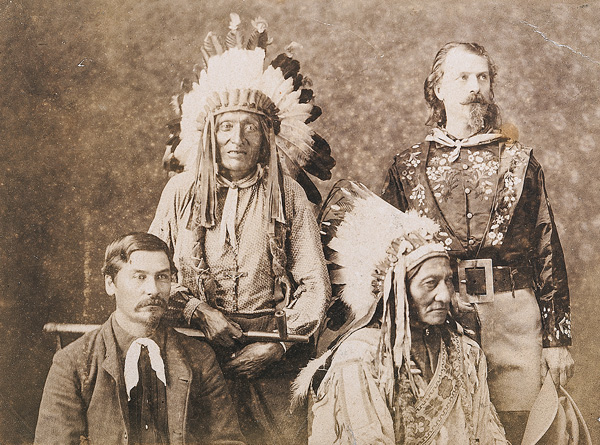 | |||
| Sitting Bull (bottom right), photographed in Montreal in 1885. Source: Daniel Englisberg, Los Angeles. | |||
| September 1886 | Peace between Hunkpapa and Crow 1886Sitting Bull and 100 Indians from the Standing Rock Reservation and the Cheyenne River Reservation spent a week visiting the Crows at Crow Agency in southern Montana. On this occasion, the two tribes made peace! During the week, the guests learned that the government was working to divide all Crow Indian land into individual parcels (see 'General Allotment Act'). Soon this issue would also affect the Indians on the reservations in North and South Dakota. | Hunkpapa (Lakota) Crow | Sitting Bull |
| 1886 | Gall took part in the celebrations for the 10th anniversary of Little Big Horn and was the first Native American to tell his version of the Battle of Little Big Horn. Until then, the only survivors of the Battle of Little Big Horn had never been interviewed! Sitting Bull had been refused participation by the Indian Commissioner of the Standing Rock Reservation, James McLaughlin. | Hunkpapa (Lakota) Hunkpapa (Lakota) | Gall Sitting Bull |
| 13 October 1888 | The government invited 54 chiefs to Washington to renegotiate the Sioux Act. - Standing Rock Indian Reservation (14 chiefs) - Crow Creek, Cheyenne River and Lower Brule Reservation (15 chiefs) - Rosebud Indian Reservation (14 chiefs) - Pine Ridge Indian Reservation (11 chiefs, including 2 Cheyenne chiefs) Sitting Bull proposed to sell the 9 million acres for $1.25. The U.S. government offered a price of $1 per acre for the first three years, then $0.75 per acre for the next two years and $0.50 for the following years. | Hunkpapa (Lakota) Brule (Lakota) Hunkpapa (Lakota) Blackfoot (Lakota) Hunkpapa (Lakota) Oglala (Lakota) Miniconjou (Lakota) | Sitting Bull He Dog Gall John Grass Mad Bear Little Wound Big Foot |
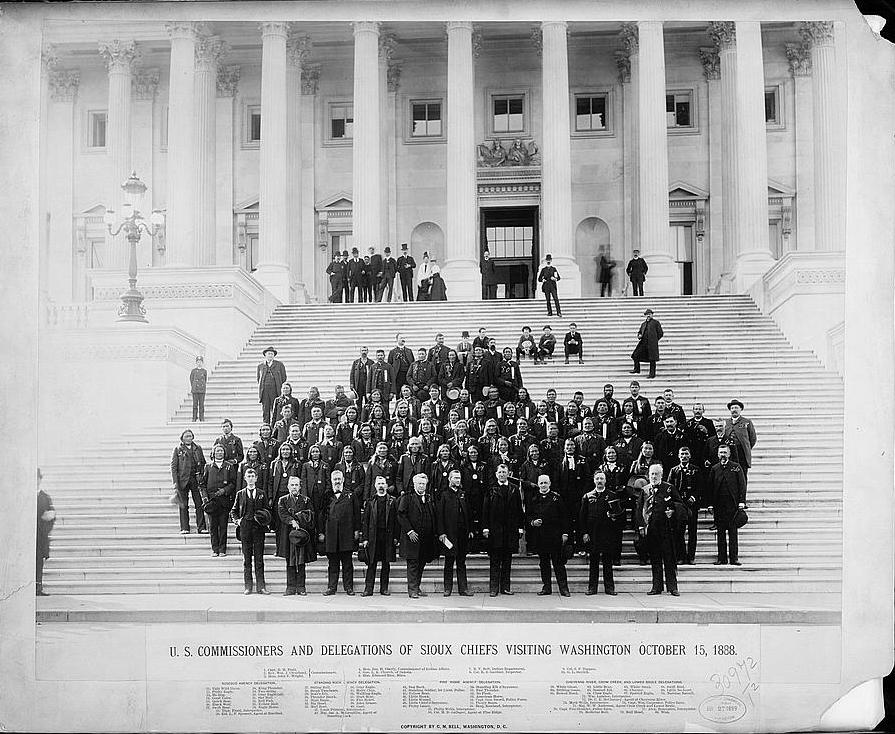 | |||
| Sioux Commission 1888 in Washington DC. Source: Courtesy of the Library of Congress, Washington DC. | |||
| May 1889 - August 1889 | For the third time in eight years (1882 Dawes Commission, 1888 Pratt Commission), a US government commission attempted to persuade the Lakota to give up a large part of their land. Although the 'Sioux Act' had already been passed by Congress, attempts were made afterwards to obtain the necessary votes from the Indians. The most important commissioner was General George Crook, which is why the commission was also called the 'Crook Commission'. This time, however, the commission took a different approach. On the Standing Rock reservation, for example, Indian agent James McLaughlin held individual talks with the negotiators, including John Grass of the Blackfoot Lakota. Concessions and promises were made to the Indians, which John Grass made palatable to the other negotiators such as Gall, Mad Bear and Bid Head. Over time, the negative attitude changed to a positive one. This method was used to win the necessary votes. This method also won the necessary votes in all other reservations! However, most of the concessions and promises made by the whites were not kept. | Hunkpapa (Lakota) Hunkpapa (Lakota) Hunkpapa (Lakota) Hunkpapa (Lakota) Blackfoot (Lakota) | Sitting Bull Gall Mad Bear Big Head John Grass |
| November 1889 | Lakota from the Cheyenne River Reservation (Kicking Bear) and the Rosebud Reservation (Short Bull) visited the prophet Wovoka in Mason Valley, Nevada, to learn more about the Ghost Dance. They brought the Ghost Dance to the Lakota reservations in South Dakota, but not to the Standing Rock reservation. The Hunkpapa did not participate in the journey. The Ghost Dance movement was a non-violent movement from the beginning. It was all about dancing, praying and believing. The great spirit would do the rest. In early June, the Indian Office in Washington got wind of the Ghost Dance movement and demanded reports from the Indian agents. James McLaughlin finally saw an opportunity to get rid of Sitting Bull. He recommended removing Sitting Bull from the Standing Rock reservation, then peace would return. McLaughlin suspected Sitting Bull of actively promoting the Ghost Dance and spreading it among the Indians (which was not true). | Hunkpapa (Lakota) Eastern Shoshone (Shoshone) Miniconjou (Lakota) Brule (Lakota) | Sitting Bull Kicking Bear Short Bull |
| 10 February 1990 | Thanks to the work of the 'Crook Commission' in the summer of 1889, US President Benjamin Harrison was able to announce that the necessary votes for the 'Sioux Act' of the Indians (with more than 3/4 of the necessary votes of all male reservation inhabitants) had come together and the 'Great Sioux Reservation' could be abolished. | Hunkpapa (Lakota) Hunkpapa (Lakota) Hunkpapa (Lakota) Hunkpapa (Lakota) Blackfoot (Lakota) | Sitting Bull Gall Mad Bear Big Head John Grass |
| Autumn 1890 | The Lakota on the six reservations in South Dakota danced throughout the fall and into the mild winter. The Indian agent in charge of the Standing Rock reservation, James McLaughlin, became increasingly nervous and paid a visit to Sitting Bull accompanied by Bull Head (district police chief). All the threats and persuasions could not persuade Sitting Bull to stop the Ghost Dance. Sitting Bull did not believe in the predictions of the Ghost Dance, but he supported the Lakota dances. Dances had been part of Lakota culture for centuries. McLaughlin came to the conclusion that Sitting Bull was the initiator and promoter of the Ghost Dance. | Hunkpapa (Lakota) Hunkpapa (Lakota) | Sitting Bull Bull Head |
| Begin of December 1890 | In early December 1890, nearly 3,000 Ghost Dancers from the Rosebud Reservation, the Pine Ridge Reservation and the Cheyenne River Reservation had gathered at the Stronghold Tables on the Rosebud Reservation and continued to dance. Missing were the Hunkpapa from the Standing Rock Reservation and Miniconjou under Hump and Big Foot. Kicking Bear led the group. Soon the US Army under Major General John Brooke had surrounded the Stronghold Tables in the Badlands. The Indians refused to surrender. Sitting Bull publicly declared that he did not believe in the new religion, but asked his followers to dance the Ghost Dance. As a result, some of his followers left his camp. | Oglala (Lakota) Brule (Lakota) Brule (Lakota) Hunkpapa (Lakota) | Kicking Bear Short Bull Two Strike Sitting Bull |
| Begin of December 1890 | Marc C. Collins, a missionary who visited Sitting Bull, confirmed that Sitting Bull did not believe in the Ghost Dance, but did not reject the dance itself (the Indians were used to dancing). Sitting Bull also expressed his suspicion to Collins that he would soon be arrested and imprisoned. Catherine Weldon, who worked for Sitting Bull, shared Collins' view. Weldon learned from Sitting Bull that he had been told by a bird during a morning walk that he would be killed by his own people. | Hunkpapa (Lakota) | Sitting Bull |
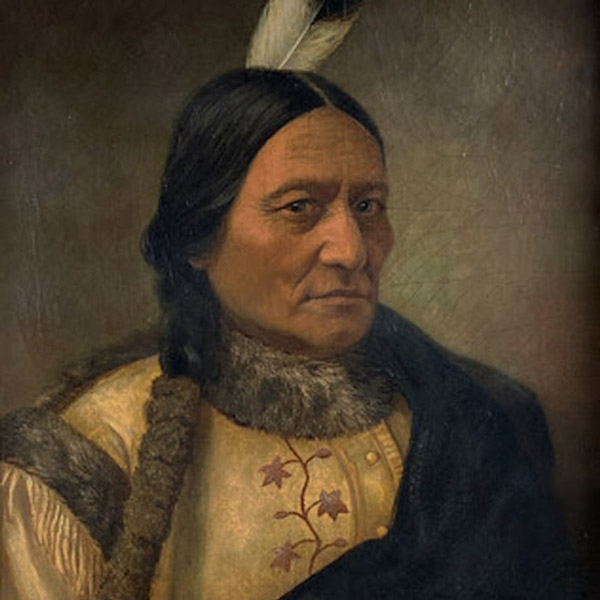 | |||
| Sitting Bull, painted from a photograph by the photographers Palmquist . | |||
| 15 December 1890 | Sitting Bull was shot by the Indian police when he was arrested that morning on the Standing Rock reservation. The Indian police were led by Lieutenant Bull Head, the district commander of the Indian police. Bull Head was an opponent of Sitting Bull. Sitting Bull was 59 years old. 3 days later, Sitting Bull was buried at Fort Yates. During the arrest, a loyal follower of Sitting Bull (Catch The Bear) fired a shot at Bull Head. As he fell, Bull Head shot Sitting Bull in the chest. Red Tomahawk, an Indian policeman, had shot Sitting Bull in the head from behind. Sitting Bull was killed instantly. The ensuing fierce firefight between Sitting Bull's 400 or so followers cost the lives of 8 Indians and 4 Indian policemen. Among the dead was Crow Foot, one of Sitting Bull's sons. | Hunkpapa (Lakota) Hunkpapa (Lakota) Hunkpapa (Lakota) Hunkpapa (Lakota) Hunkpapa (Lakota) | Sitting Bull Bull Head Crow Foot Catch The Bear Red Tomahawk |
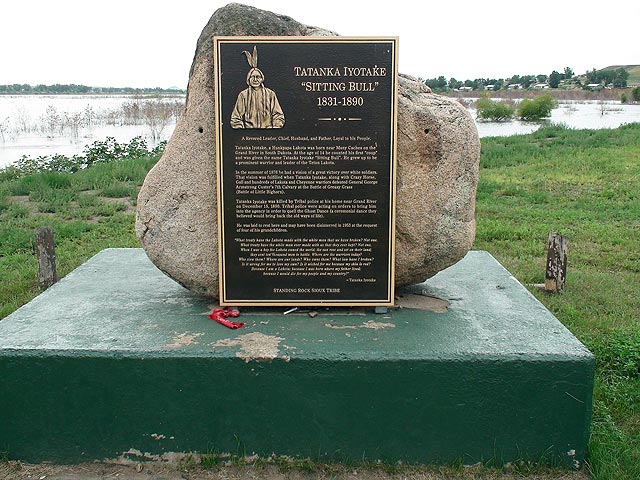 | |||
| Memorial plaque at the grave of Sitting Bull in the Standing Rock Reservation. Source: Thomet Daniel 2010. | |||