


|
| Book cover | Autor | Title | Description |
| Bild | Autor | Leer | Beschreibung |
| Date | Event | Tribe | Chief |
| 1636 | Shortly before the Mystic Massacre in May 1637, the Pequot lived in two fortified forts. One fortified fort was located about a mile northwest of the present-day town of Mystic, Connecticut. This fort was destroyed in May 1637 during the Mystic Massacre. The second fortified fort under Sachem Sassacus was located near the village of Groton, on the site of the later Fort Griswold.   | Pequot | Sassacus |
23 April 1637  | Battle of Mystic-River 1637 - A large number of Pequot and Wangunk warriors attacked the inhabitants of the village of Wethersfield in Connecticut. Six men and three women were killed and two children were taken prisoner. The Pequot raid on the village of Wethersfield was the trigger for the Mystic River massacre at the end of May this year. | Pequot Wangunk (River Indians) | Sassacus Sowheag (Sequim) |
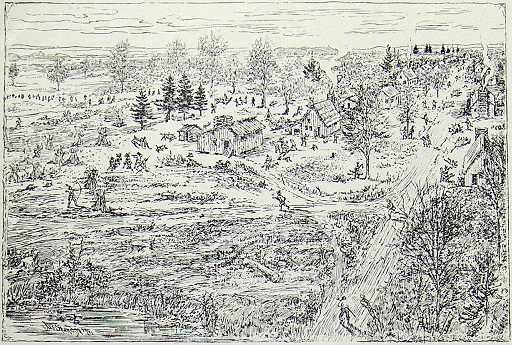 | |||
| Attack on Weatherfield in 1637. source: http://www.ferrisfamily.us/the-wethersfield-massacre/ | |||
| 25 April 1637 | Battle of Mystic-River 1637 - After the attack on Wethersfield, the Pequot and Wangunk warriors came to Fort Saybrook in a large number of canoes. The crew of Fort Saybrook fired a 6-pounder cannon in the direction of the canoes. The bullet landed in the center of the canoes after a flight of just over a mile. Impressed by the range of the cannon, the warriors rowed on in their canoes without attacking Fort Saybrook. From the fort, the crew could see the two captured Swain daughters in the Indians' canoes. | Pequot Wangunk (River Indians) | Sassacus Sowheag (Sequim) |
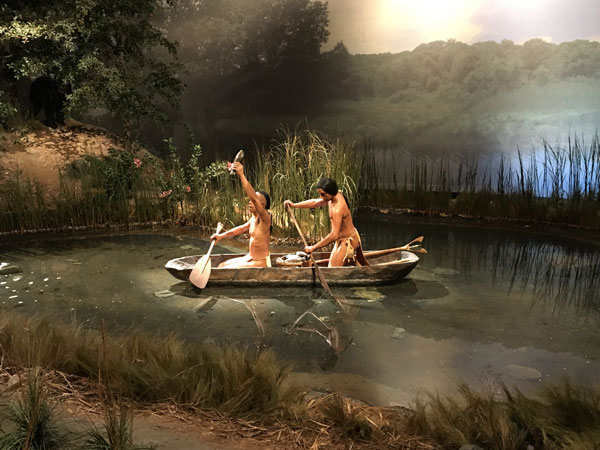 | |||
| Pequot dugout canoe. Source: Thomet Daniel 2018 (Mashantucket Pequot Museum, Connecticut). | |||
| 11 May 1637 | Battle of Mystic-River 1637 - After a Pequot attack on the town of Wethersfield, the towns of Hartford, Wethersfield and Windsor declared war on the Pequots. The command of the troops was given to Captain John Mason from Windsor. Mason was ordered to attack the two fortified Pequot forts in the area of the present-day towns of Mystic and Groton. | - | - |
| 12 May 1637 | Battle of Mystic-River 1637 - 90 soldiers under John Mason, 30 from Windsor, 42 from Hartford and 18 from Wethersfield, and 70 Indians under Sachem Uncas left Hartford on a ship for Fort Saybrook. Uncas marched to Fort Saybrook on foot. | Mohegan | Uncas |
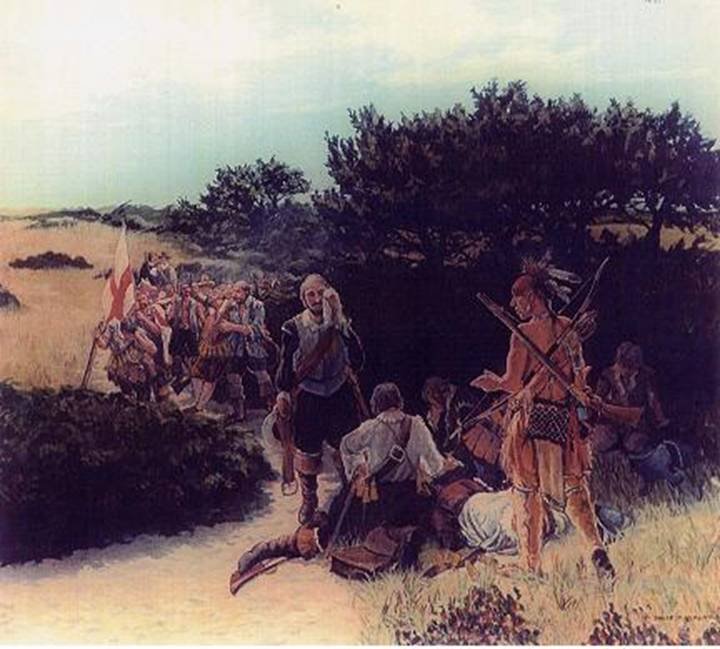 | |||
| Englishmen and Indians on the way to the fortified village of the Pequot Indians Source: http://ancientlights.org/mf_ch2.html. | |||
| Middle of May 1637 | Battle of Mystic-River 1637 - A Dutch ship anchored just above the mouth of the Thames. There the Dutch captured seven Pequot from the nearby village under Chief Sassacus and exchanged them for two English girls who had been captured during the attack on Wethersfield, both daughters of a certain Abraham Swain. The Dutch immediately brought the two girls back to Fort Saybrook. There the Dutch encountered the small army of John Mason. | Pequot | Sassacus |
| Middle of May 1637 | Pequot Indians under Sachem Sassacus were living in a village in the area now known as Grotton when Dutchmen arrived by ship on the Thames and forced their release when they raided the English girls (Swain daughters) at Wethersford. | Pequot | Sassacus |
| 15 May 1637 | John Mason came to Fort Saybrook with his small army. | Mohegan | Uncas |
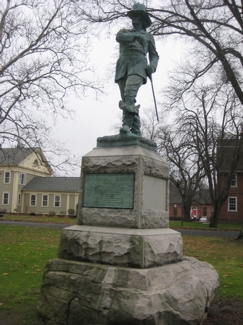 | |||
| John Mason. Source: http://www.ctmuseumquest.com/?page_id=7025. | |||
| 19 May 1637 | Mason left Fort Saybrook with his small army and sailed east toward the village of Canonicus on Massachusetts Bay. | Mohegan Narragansett | Uncas Canonicus |
| 20 May 1637 | Mason's ships reached Narragansett Bay in the evening. The next morning, the soldiers marched to the Narragansett village under Canonicus and Miantonomo and Eastern Niantic and Ninigret. | Mohegan Narragansett | Uncas Canonicus |
| 22 May 1637 - 24 May 1637 | Mason negotiated with the Narragansett under Canonicus and Miantonomo and the Eastern Niantic and Ninigret. The Narragansett supported the English and Mohegan in their attack on the Pequot. The village of Sachem Canonicus and Miantonomi was located on what is now Narragansett Bay, near present-day Wickford. On the morning of May 24, the small army left the Narragansett village and marched through the woods toward the two fortified Pequot villages. The three boats sailed to the mouth of the Thames River, where they were to take the soldiers back to Fort Saybrook after the attack. | Mohegan Eastern Niantic (Niantic) Narragansett Narragansett | Uncas Ninigret Miantonomi Canonicus |
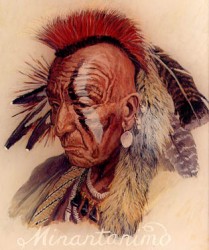 | |||
| Miantonomo, Narragansett Sachem. Source: https://rifootprints.com/2010/11/09/keepers-of-the-bay-the-narragansett-tribe-of-rhode-island/ | |||
| 24 May 1637 | On the evening of May 24, 1637, Mason's soldiers, the Mohegan, Narragansett and Eastern Niantic reached the fortified village of Eastern Niantic. The fortified Eastern Niantic fort under Sachem Ninigret was located on the site of today's Ninigret National Wildlife Refuge, about 2 miles southwest of Charlestown, Rhode Island. | Pequot Eastern Niantic (Niantic) Mohegan Eastern Niantic (Niantic) Pequot Pequot | Miantonomi Ninigret Uncas Wequash Momoho Sassacus |
| 25 May 1637 | On the morning of May 25, Mason left Ninigret's fort for the fortified Pequot fort. Mason's command now consisted of 77 soldiers, 60 Mohegan under Uncas and 60 Niantic under Ninigret. 200 Narragansett also joined Mason's army. | Pequot Eastern Niantic (Niantic) Mohegan Eastern Niantic (Niantic) Pequot Pequot | Miantonomi Ninigret Uncas Wequash Momoho Sassacus |
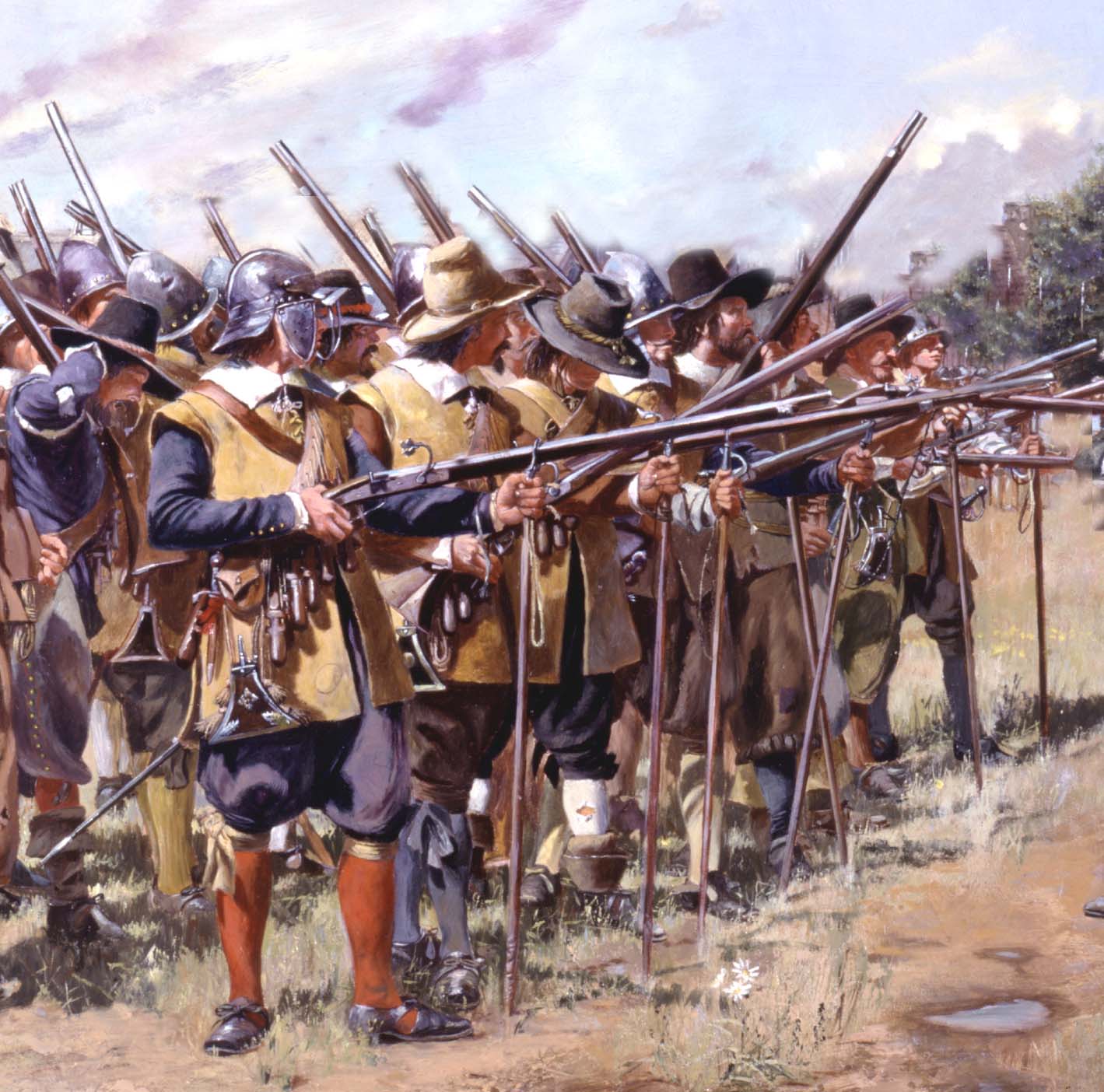 | |||
| English soldiers from the Massachusetts Bay Colony. Source: http://pequotwar.org/about/timeline/. | |||
| 25 May 1637 | On the evening of May 25, Mason's troops crossed the Mystic River and encamped at Porter's Rocks, about a mile southwest of Old Mystic. The allied Narragansett, Mohegan and Eastern Niantic were camped about 200 yards west of the English. Around 100 to 150 warriors from the neighboring Pequot village under Chief Miantonomi arrived at the fortified Pequot village. | Pequot Eastern Niantic (Niantic) Mohegan Eastern Niantic (Niantic) Pequot Pequot | Miantonomi Ninigret Uncas Wequash Momoho Sassacus |
| 26 May 1637 | The small army left Porter's Rock at about 01:00 (1:00 a.m.) and began the march toward the Pequot village under the leadership of Wequash (a Pequot Indian). The soldiers and Indians approached the Pequot village from the north along what is now Cow Hill Road. About a mile north of the village, the English and their allies stopped for the last time. The final preparations for the attack were made here. | Pequot Eastern Niantic (Niantic) Eastern Niantic (Niantic) Mohegan Eastern Niantic (Niantic) Pequot Pequot | Miantonomi Ninigret Wequash Uncas Wequash Momoho Sassacus |
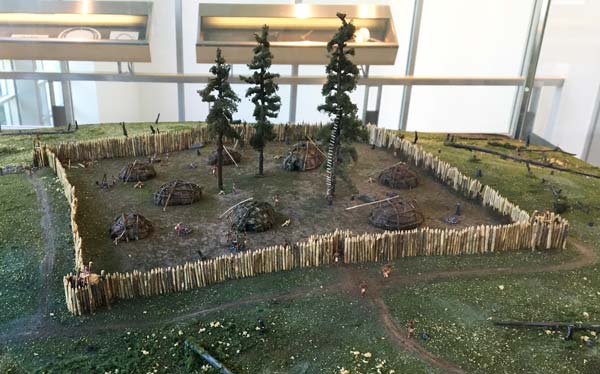 | |||
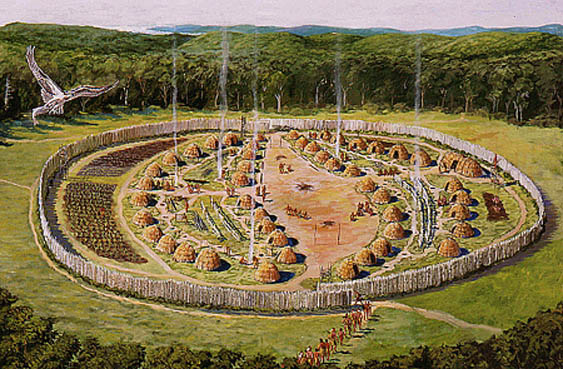
| Pequot fort village - Mashantucket Pequot Museum. Source: Thomet Daniel, 2018. | |||
| 26 May 1637 | Mason began the attack with 17 soldiers through the entrance gate in the northeast of the village. The village had a diameter of about 75 meters and consisted of about 70 huts. He only encountered resistance when he entered the Pequot huts. But now the soldiers and Indians were being shot at with Pequot arrows. More and more Pequot warriors attacked the English. Mason realized that he could not conquer the village with his rifles and swords alone and changed his tactics. Mason himself set fire to the first hut and his soldiers followed his example. John Underhill only reached the village when the Pequot village was already in flames. The fire drove the Pequot to the southwestern entrance. Underhill now entered the village through the southwest entrance and set fire to the village to the south. Mason and Underhill then left the burning village. The Pequot were now forced to leave the burning fort. Many of them fell victim to the swords of the English. After just over an hour, around 400 Pequot were dead. About half of the Pequot died in the burning village. 7 Pequot were captured, only a few Pequot managed to escape. The English losses amounted to two dead and between 20 and 24 wounded. The allied Indians had around 40 wounded.  | Pequot Eastern Niantic (Niantic) Mohegan Eastern Niantic (Niantic) Pequot Pequot | Miantonomi Ninigret Uncas Wequash Momoho Sassacus |
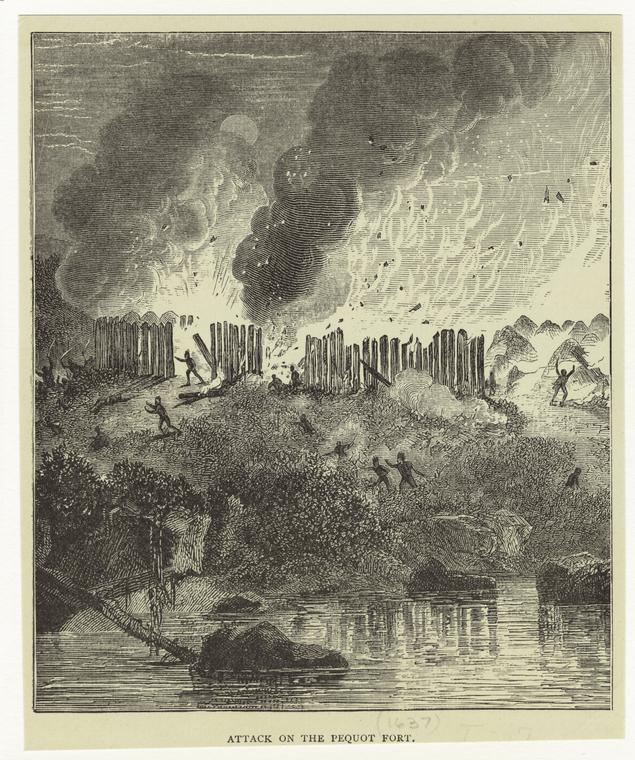 | |||
| Massacre of Mystic Fort in 1637. source: https://dp.la/primary-source-sets/cross-cultural-colonial-conflicts/sources/620 | |||
| 26 May 1637 | Mason had a temporary camp set up south of the burning village. Soon the Pequot from the surrounding villages attacked the English and their allies. About 50 Narragansett left the camp to return to their villages, but were attacked by Pequot north of the burning village. Underhill came to the aid of the Narragansett with about 30 soldiers and was able to drive the Pequot back after about an hour. The soldiers now moved via Fishtown Brooke (West Mystic) to the rendezvous point with the three own ships, with Mason at the head and Underhill at the rear of the column. The English were repeatedly attacked by the Pequot. The attacks ended about 2 miles from the mouth of the Thames. The attacking Pequots had probably lost more warriors at this point than in the massacre at Mystic Fort and therefore gave up the attack. Later, surviving Pequot testified that around 100 warriors had been killed in the attacks. The English then reached the waiting ships at the mouth of the Thames River. Underhill and the wounded were taken by ship to Fort Saybrook. | Pequot Eastern Niantic (Niantic) Mohegan Eastern Niantic (Niantic) Pequot Pequot | Miantonomi Ninigret Uncas Wequash Momoho Sassacus |
 | |||
| Massacre of Mystic Fort in 1637. source: https://dp.la/primary-source-sets/cross-cultural-colonial-conflicts/sources/620 | |||
| 27 May 1637 | The day after the massacre at Mystic River, the Pequot held a meeting and decided to flee their tribal territory. Before fleeing, the Pequot burned all the belongings they could not take with them. A group of several hundred Pequot led by Sassacus and Mononotto moved west to the area of present-day Fairfield. There the Pequot found refuge in a village of the Sasqua Indians. . Another group of 30 to 40 warriors, including many women and children, marched west, but changed their minds, returned and hid in Cedar Swamp near the present-day village of Ledyard. | Pequot Pequot | Sassacus Mononotto |
| 28 May 1637 | On May 27, Mason, Patrick and all the allied Indians marched about 20 miles westward through Western Niantic territory with 60 men and reached the east bank of the Connecticut River in the evening. On the way, Mason and Patrick came upon a Western Niantic village. The inhabitants abandoned the village and fled to a nearby swamp. The English drove the Western Niantics out of the swamp, but they fled in all directions, so the English gave up the chase. Mason reached Fort Saybrook on the morning of May 28. This marked the end of the campaign against the Pequot. | Pequot Eastern Niantic (Niantic) Western Niantic (Niantic) Mohegan Eastern Niantic (Niantic) Pequot | Miantonomi Ninigret Uncas Wequash Sassacus |
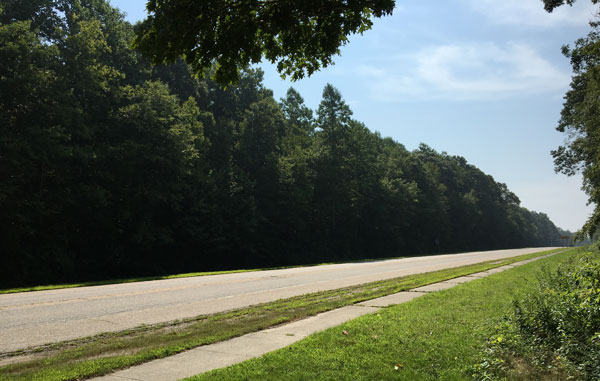 | |||
| Here, on Pequot Hill along today's Pequot Avenue, stood the fortified village of the Pequot Indians in 1637. Source: Thomet Daniel 2018. | |||
| End of June 1637 | Capture of Pequots at Cedar Swamp 1637 - After the massacre on the Mystic River at the end of May, the Hartford General Court decided not to give the Indians time to recover and, if necessary, to attack the colonists. Captain Samuel Stoughton therefore sailed with soldiers from the colonies to the mouth of the Thames River and marched west from there, but found no Pequot Indians. When he returned to his ships, Narragansett Indians told him that Pequot Indians were in a swamp northeast of the ships (Cedar Marsh, about a mile west of today's Foxwood Casino). It was the Pequot Indians who had fled west after the massacre, but then changed their minds and returned to their homeland. Stoughton and his soldiers reached the Cedar Swamps after a march of about 12 miles. The Pequot had too few warriors to resist the soldiers and surrendered. About 20 to 30 warriors were murdered in cold blood, the 80 or so women and children were divided up: 30 were given to the Narragansett Indians, 3 to the Massachusetts Indians and the remaining women and children were taken to Narragansett Bay as slaves. When Stoughton was back with the ships at the mouth of the Thames River, Mason arrived with 40 soldiers from Connecticut. This provided the English with a comfortable force for the further pursuit of the Pequot Indians. | Pequot Narragansett Massachusett | - |
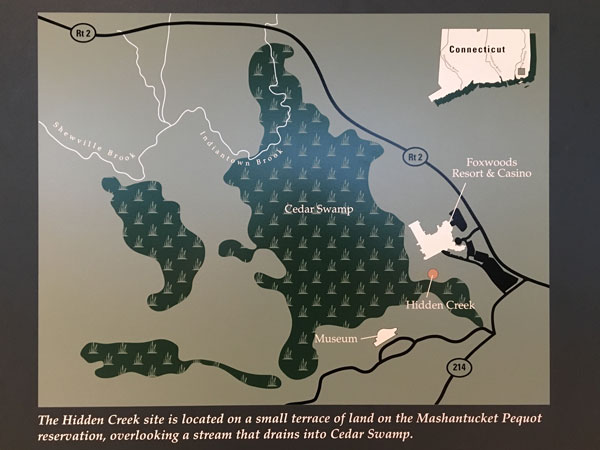 | |||
| Cedar Swamp, west of Foxwoods Resort . | |||