


|
| Book cover | Autor | Title | Description |
| Bild | Autor | Leer | Beschreibung |
| Date | Event | Tribe | Chief |
10 April 1603  | Martin Pring Expedition 1603 - No sooner had Gosnold returned to England with the news of his discovery than Martin Pring sailed on behalf of Sir Walter Raleigh with two ships and 43 men from the port of Pembrokeshire (Wales, England) to the east coast of the United States to explore the trade potential there. Pring was to bring a cargo of sassafras roots to England for financing.  | - | - |
| Beginn Juni 1603 | Martin Pring Expedition 1603 - After about two months at sea, Martin Pring and his two ships reached what is now Penobscot Bay in Maine. | - | - |
| Beginn Juni 1603 | Martin Pring Expedition 1603 - Martin Pring landed at Monhegan (a small island in the south of what is now the state of Maine) or in the area of Pemaquid Neck (Maine). Long before the arrival of the Europeans, Pemaquid Indians (Abenaki) lived in what is now Bristol County in what is now the state of Maine. Samoset, who was 13 years old at the time, probably lived in a village on Pemaquid Neck. Samoset was the Indian who was later to greet the newly arrived Pilgrim Fathers near the present-day town of Plymouth with the famous words 'Hello Englishmen'. | Pemaquid (Abenaki) | Samoset |
| Middle of June 1603 | Martin Pring Expedition 1603 - Pring reached the mouth of the Piscataqua River in present-day New Hampshire. He sailed his ships about 10-12 miles downstream. | - | - |
| Middle of June 1603 | Martin Pring Expedition 1603 - Downstream of the Piscataqua River, Pring did not see any Abenaki Indians, but he saw signs of them everywhere, such as abandoned hearths, etc. Pring may have been in the area southeast of Dover in what is now New Hamspshire. Pring did not find any sassafras roots in this area. | Abenaki | - |
| Middle of June 1603 | Martin Pring Expedition 1603 - Downstream of the Piscataqua River, Pring did not see any Abenaki Indians, but he saw signs of them everywhere, such as abandoned hearths and so on. Pring may have been in the area southeast of Dover in what is now New Hamspshire. Pring did not find any sassafras roots in this area. | Abenaki | - |
| Middle of June 1603 | Martin Pring Expedition 1603 - Pring sailed to Great Bay in what is now the state of New Hampshire. There he searched for sassafras roots. When he found no sassafras roots, he sailed back to the mouth of the Piscataqua River. | - | - |
| Middle of June 1603 | Martin Pring Expedition 1603 - Pring sailed on to the island of Martha's Vineyard south of Cape Cod. He probably anchored his ships in the harbor of Edgartown. Pring's men found large quantities of saffron here. Depending on the source, Pring is also said to have landed in Truro near Cape Cod or in Plymouth Harbor. In 1620, the Pilgrim Fathers came across the remains of a settlement at the mouth of the Pamet River near Cape Cod, which had probably been built by Pring's men. Indians, probably Wampanoag, visited the island and ate peas and beans with Pring's men. | Wampanoag | - |
| End of June 1603 | Martin Pring Expedition 1603 - Pring's men built a small fortification. | - | - |
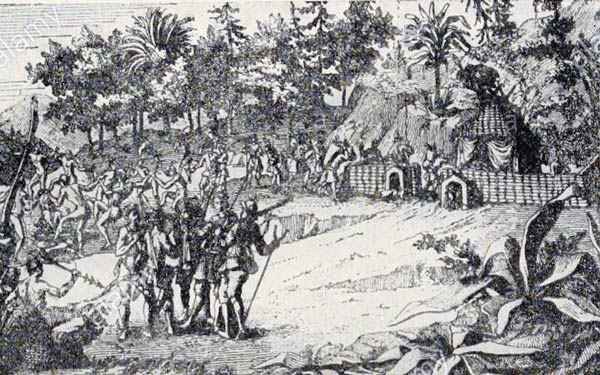 | |||
| An illustration of Pring Fortress in 1603: Wikipedia. | |||
| 8 August 1603 | Martin Pring Expedition 1603 - The 'Speedwell' returned to England. The 'Discoverer' had already started its journey home at the end of July with a cargo of saffara roots. Before the 'Speedwell' sailed, Pring's men were attacked by Indians. However, the dogs they had brought with them sounded the alarm and alerted Pring's men in time. | Wampanoag | - |
| 2 October 1603 | Martin Pring Expedition 1603 - The 'Speedwell' has returned to the port of Pembrokeshire (Wales, England). | - | - |
| 17 November 1620 | Pilgrims 1620-1676 - In the Corn Hill area, the Pilgrims found evidence that they were not the first Europeans to enter the area. In the area of the mouth of the Pamet River (probably at today's 'Pamet Harbor') they discovered the remains of an old fort. Was it the remains of the fort that Martin Pring had built on Cape Cod in 1603? (It is not clear where Martin Pring had landed in 1603: either on Martha's Vineyard, or on Cape Cod, or at Plymouth).  | - | - |