


|
| Book cover | Autor | Title | Description |
| Bild | Autor | Leer | Beschreibung |
| Date | Event | Tribe | Chief |
9000 BC  | Indians were already mining flint here 11,000 years ago. The flint was broken and had very sharp edges. The flint was used to make tools and weapons. The flint mined here is known as 'Knife River Flint' and was traded by the Indians. The Hidatsa and Mandan lived in this area in the 19th century and mined flint.   | Mandan Hidatsa | - |
| 1450 AD | The mandans numbered around 12,000 people. | Mandan | - |
| 1450 AD | Around 1450, a large settlement of Mandan Indians was established on the Missouri River in North Dakota, which is now known as Huff Indian Village. Perhaps 1,000 people lived in around 100 adobe houses. The settlement was surrounded by a wooden palisade and a moat with a total length of around 600 meters.  | Mandan | - |
 | |||
| Historic site of the Indian village of Huff. Source: Thomet Daniel 2010. | |||
| About 1500 | The Mandan lived in seven to ten villages at the mouth of the Heart River in the Missouri in North Dakota. The number of Mandan at this time is estimated at 10,000 or more. Mandan Indians lived in the settlement of Double Ditch until 1795. | Mandan | - |
 | |||
| Information board in Double Ditch State Park in North Dakota. Source: Thomet Daniel 2010 | |||
| 1575 | From three surrounding villages, the Mandan built a fortified village called 'On-a-Slant, about a mile south of the mouth of the Heart River into the Missouri River, south of the present-day town of Mandan. The village was not abandoned by its inhabitants until after the great smallpox epidemic of 1781. The village consisted of about 85 adobe houses. | Mandan | - |
| 1734 | In his annual report to the 'Governor General of Canada', Pierre Gaultier de Varennes (Sieur de La Verendrye) mentions an encounter with Cree and Assiniboine Indians. It was on this occasion that Gaultier first heard of the Mandan Indians. The Assiniboine and Cree traded corn with the Mandan in the spring. The Assiniboine and Cree said that the Mandan's hair was either brown or white, that some Mandan wore large beards and had white skin. | Cree Assiniboine Mandan | - |
| 3 December 1738 | Pierre Varennes Expeditionen 1731-1743 - Pierre Gaultier de Varennes (Sieur de La Verendrye) left Fort St. Charles on November 30 with a large group of Assiniboine and four days later reached the Mandan Indian village of On-A-Slant at the mouth of the White River in the Missouri. The village consisted of 130 adobe houses. Gaultier noticed that he saw people with dark and light skin (!) in the village. He saw Mandan with blond and brown eyes (!) and hair of all colors except red (i.e. blond, brown, black) The Mandan grew corn, sunflowers and pumpkins. Verendrye's brother Francis explored the surrounding area and noticed six other Mandan villages, some of which were much larger than the village where Pierre Verendrye lived. Gaultier left the village in mid-December. Verendrye left two men behind in the Mandan village to learn the Mandan language, among other things. | Mandan Assiniboine | - |
| 1738 | The Mandan lived in several villages with at least 1000 mud houses in the vicinity of the Heart River. | Mandan | - |
| 10 February 1739 | Pierre Varennes Expeditionen 1731-1743 - Pierre Gaultier de Varennes (Sieur de La Verendrye) returned to Fort La Reine. | Mandan Hidatsa Arikara | - |
| Summer 1739 | The tribes on the upper Missouri probably came into contact with horses for the first time (Mandan, Hidatsa, Arikara). Pierre Gaultier de La Verendrye left two men in the Mandan village on his trading trip south from Fort Reine to the Mandan Indians in 1738. Back in Fort Reine, they reported that in the summer of 1739, the Mandan were visited by Indians from the west who came with many horses to exchange embroidered bison skins for corn and beans. It can be assumed that this was the first time the Mandan came into contact with horses. | Mandan Hidatsa Arikara | - |
| Autumn 1739 | Pierre Varennes Expeditionen 1731-1743 - The two men, who had spent the winter of 1738-1739 in the Mandan village, came to Fort La Reine. The men reported that in the summer of 1739, the Mandan received a visit from a tribe that came with horses. Horses were new to the Mandan. The tribe seemed to live far to the west on a lake whose water was apparently influenced by the tides. White people also seemed to live there. Verendrye saw the possibility of finding a way to the Pacific and planned another journey to the Mandan Indians. | Mandan Hidatsa Arikara | - |
| Spring 1742 | Pierre Varennes Expeditionen 1731-1743 - Pierre Gaultier de Varennes (Sieur de La Verendrye) leaves Fort La Reine with his brother Fran?ois and sets off for the Mandan a second time. Verendrye hoped to meet the tribe in the Mandan village, who had arrived with horses in the summer of 1739. These Indians were to show him the way to this lake, which was apparently subject to the tides. From there, he wanted to find a way to the Pacific. | Mandan Hidatsa Arikara | - |
| May 1742 | Pierre Varennes Expeditionen 1731-1743 - Pierre and Fran?ois Gaultier de Varennes (Sieur de La Verendrye) arrived in the Mandan village. In May, June, July and almost the whole of August, the French waited in vain for the arrival of the tribe, which arrived with horses at the Mandan in 1739. | Mandan Hidatsa | - |
| 1750 | The Mandan lived on the upper Missouri in North Dakota in 9 large villages. Around 1800, there were only two large villages left due to cholera and smallpox epidemics. The Mandan built round boats made of buffalo hide, which they used to cross rivers. However, these boats were unsuitable for longer journeys. | Mandan | - |
 | |||
| Round boat made of bison hide, photographed near Fort Union, North Dakota. Source: Thomet Daniel 2010. | |||
| 1780-1781 | A smallpox epidemic spread from Mexico to the north from 1775. The trade in horses spread the disease among the tribes of the American prairie. By 1780, smallpox had spread to the Hidatsa Indians on the Missouri River in North Dakota. The smallpox epidemic killed about 4/5 of the Indians on the Missouri. The formerly large Mandan, Hidatsa and Arikara (Ree) tribes were particularly affected. Tribes that attacked the Hidatsa at that time became infected with smallpox and brought it to their own villages! Around 1700, the Hidatsa numbered around 20,000 people, after the epidemic there were still around 2,500. | Arikara Mandan Assiniboine Hidatsa | - |
| About 785 AD | The Sioux attacked the Mandan village of Rooptahee (Ruhptare or Nuptadi) and burned it down. | Mandan Sioux | - |
| 1787 | The Mandan built the village of Mitutanka with 40 adobe houses southeast of Stanton in North Dakota. The village is also known as 'Big White Village'. The village was abandoned in 1821. | Mandan | - |
| 1787 | The Mandan built the village of Rooptahee (also called Ruhptare) with 50 adobe houses east of Stanton in North Dakota. The Hidatsa called the village Awaicpuax (village on the hill). | Mandan | - |
| 1787 | The Cheyenne traded horses with the Mandan, Hidatsa and Arikara who lived along the Missouri. Like the Lakota living there, the Cheyenne also traded coveted European goods in exchange for horses. This trade worked well until the three tribes on the Missouri were ravaged and decimated by imported diseases after 1800. After that, the Cheyenne mainly traded directly with the white traders in the north and undertook raids into the southern prairies to procure horses. | Cheyenne Mandan Hidatsa Arikara Lakota | - |
| About 800 AD | At the trading post on the Mouse River in northern North Dakota, numerous Ojibwe, Assiniboine, Cree and Mandan warriors gather to fight the 'A-gutch-e-ninne-wug' (Hidatsa). The name 'A-gutch-e-ninne-wug' comes from the Ojibwe Indians and means 'settled people'. However, this campaign was not successful. | Ojibwe Assiniboine Cree Mandan Hidatsa | - |
| 1801 - 1802 | Two epidemics of smallpox in 1781/1782 and 1801/1802 killed about half of the northern Prairie Indians! It is recorded that the Ottawa and Ojibwe were infected with the disease while harvesting wild (water) rice. It began with coughing and hoarseness, often accompanied by bleeding from the nose and mouth. Many people died within a short time. There were also many suicides during this time. Suicides such as shooting, hanging, drowning and poisoning were not uncommon among the Indians. The Omaha Indians were so weakened by the plague that they accidentally came across their allies, the Ponka, while hunting and attacked them! The Ponka had already finished the hunt and the meat was already loaded onto the horses. The Ponka immediately fled to avoid being infected by the blatters. The 18 large villages of the Arikara were reduced to three small villages after the Poken epidemic. | Ojibwe Cree Ottawa Arikara Mandan Hidatsa Omaha Ponca Kickapoo | - |
| 19 October 1804Nicht erkannter Quellenhinweis | Lewis and Clark 1804-1806 - Lewis . | Mandan | - |
 | |||
| Fort Mandan. Source: Wikipedia | |||
| 24 December 1804 | Lewis and Clark 1804-1806 - The construction of Fort Mandan was completed. Lewis and Clark spent the winter of 1804/1805 at Fort Mandan. The fort was built in November 1804 from poplar wood. After 5 months, the expedition left the fort. | Mandan | - |
| 14 August 1806 - 16 August 1806 | Lewis and Clark 1804-1806 - During 3 Lewis and Clark negotiated with the Mandan, Hidatsa and Arikara. Clark again offered an invitation to meet with the President in Washington. But none of the chiefs were willing to travel to Washington with Lewis and Clark. The chiefs feared the Brule-Lakota, who lived further south on the Missouri River. The negotiations took place in Lewis and Clark's camp above the Mandan village of Mitutanka. Sheheke was the only chief to move to St. Louis with Lewis and Clark. | Hidatsa Mandan Mandan Mandan Hidatsa Mandan | Le Borgne Black Cat Sheheke Caltarcota Black Moccasin Little Raven |
| Summer 1806 | While Lewis and Clark were in the Hidatsa and Mandan villages, the Hidatsa sent several war parties against the Lemhi-Shoshone and Grand River Arikara. | Mandan Hidatsa Lemhi (Shoshone) Arikara | - |
| 23 September 1806 | Lewis and Clark 1804-1806 - William Clark accompanied Chief Sheheke to the 'General Store' at Fort Belle Fontaine. Here the Mandan chief was able to equip himself in the white man's world with the latest shirts made of calico as well as colorful handkerchiefs and objects made of colored glass beads. | Mandan | Sheheke |
| 1806 | The Dakota attacked a fortified Mandan village. The Mandan were supported by the Cree, Ojibwe and Assiniboine. As soon as the Dakota saw the Ojibwe, they fled in all directions. | Dakota Mandan Cree Assiniboine Ojibwe | - |
1806 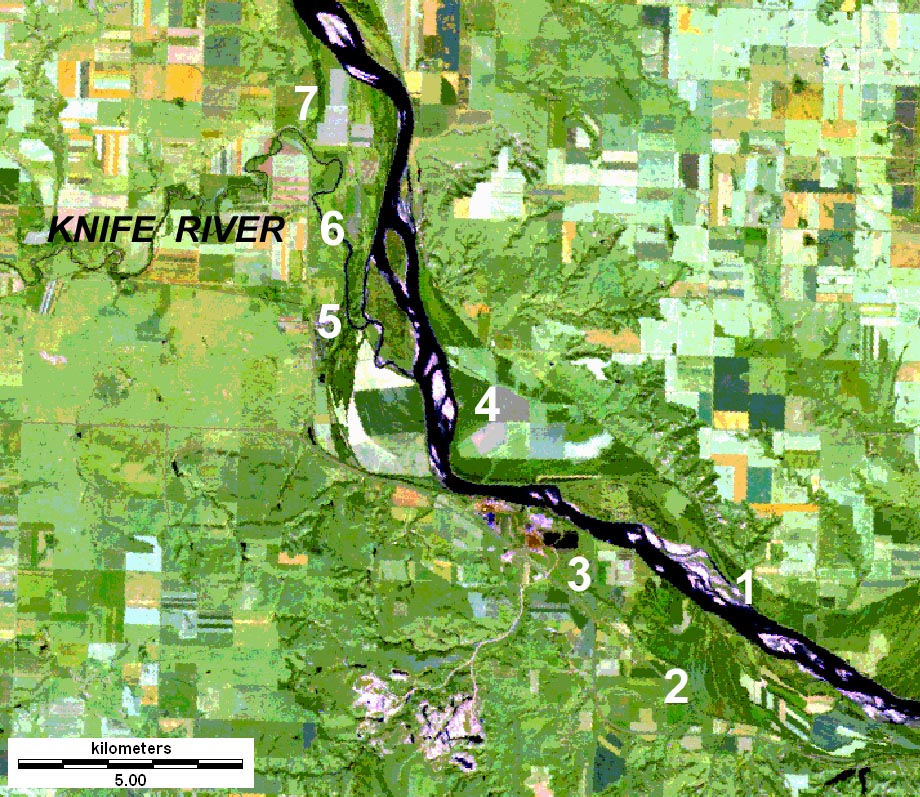 | The Mandan lived in two villages at that time: In Rooptahee (also called Ruhptare) with 50 mud houses and in Matootonha. | Mandan | - |
| 1806 | The Mandan moved their village of Rooptahee (also known as Ruhptare) with 50 mud houses to the south side of the Knife River. The village of Deapolis was later located there. This village also became known as the 'Deapolis site' or Mitutanke. The village was abandoned in 1837. | Mandan | - |
| 1821 | The Mandan left their village 'Mitutanka' on the Missouri River and built the village 'Mih-Tutta-Hangkush' (also called 'Mihtuttahangkush') 2 miles southeast of it. | Mandan | - |
| 12 October 1823 | Ashley's Hundred 1823 - In 1823, the Mandan lived in two villages, Mih-tutta-hang-kush and Ruptare. These villages were also called the 'upper villages'. The three villages of the Hidatsa were located in the surrounding area. | Mandan | - |
| End of November 1823 | Ashley's Hundred 1823 - The Mandan accompanied Glass to Fort Tilton. That same night, Glass left Fort Tilton and marched to Fort Henry, where the Yellowstone River flows into the Missouri River. | Mandan | - |
| 30 July 1825 | Yellowstone Expedition 1825 - Treaty with the Mandan 1825General Henry Atkinson signed a peace treaty in a Mandan village. I assume that it was the village of 'Mih-Tutta-Hangkusch' on the Missouri River. In 1825 the Mandan still lived in 2 villages: Mih-Tutta-Hangkush and Ruhptare (town of Deapolis). | Mandan | - |
| 1831 | The American Fur Company built Fort Clark on the Missouri River in the south of today's Mercer County. The Mandan village of 'Mih-Tutta-Hang-kusch' was located in the immediate vicinity. Fort Clark was built by James Kipp and measured 120 feet by 160 feet. | Mandan | - |
| Summer 1832 | The famous painter George Catlin traveled on the steamboat 'Yellowstone' on the Missouri River to Fort Union. Along the way, he painted landscapes and portraits of Native American tribes. These included the Pawnee, Omaha, Ponca, Mandan, Cheyenne, Crow, Assiniboine and the Blackfeet. Among others, Catlin painted the Mandan chief Ha-natah-nu-mauh and Four Bears (Mah-to-toh-pa), probably in the village of Mihtuttahangkush. Like Pierre Gaultier in 1736 and Lewis . | Mandan Mandan | Ha-natah-nu-mauh Four Bears |
| 18 June 1833 | Maximilian zu Wied Expedition 1832-1834 - The German Prince Maximilian zu Wied and the Swiss painter Karl Bodmer arrived at Fort Clark on the Missouri River in North Dakota on the steamboat 'Assiniboine'. Mandan and Hidatsa villages were located in the immediate vicinity of Fort Clark. The Crows with 70 tents under Chief Rotten Belly camped nearby as guests. Maximilian zu Wied and Bodmer visited the villages of the Mandan, Hidatsa and Crows. | Mandan Hidatsa River Crow (Crow) | Rotten Belly |
 | |||
| Fort Clark, North Dakota. Source: http://franceshunter.wordpress.com/2009/11/10/lewis-clark-road-trip-fort-clark-north-dakota/ | |||
| 8 November 1833 | Maximilian zu Wied Expedition 1832-1834 - Together with Toussaint Charbonnau, Bodmer and Prince Maximilian zu Wied arrived at Fort Clark in North Dakota. The new house built especially for the expedition in Fort Clark had not yet been completed. Bodmer and Maximilian zu Wied therefore lived in James Kipp's house until their own house was completed. | Mandan | Mato-Tope |
| 8 November 1833 | Maximilian zu Wied Expedition 1832-1834 - Bodmer often visited the nearby village of the Mandan Indians 'Mih-Tutta-Hangkusch'. There he always met with the chiefs Mato-Tope (The 4 Bears) and Dipauch (The Broken Arm). Most of the inhabitants had already left the village and were in a nearby winter camp. The village consisted of 60 mud houses. | Mandan Mandan | Mato-Tope Dipauch |
 | |||
| Map of the Mandan village 'Mih-Tutta-Hangkusch'. Source: http://www.gutenberg.org/files/37897/37897-h/37897-h.htm. | |||
| 13 November 1833 | Maximilian zu Wied Expedition 1832-1834 - In the Mandan village of 'Mih-Tutta-Hangkusch' on the upper Missouri, the Indians observed many shooting stars at night. According to Mandan belief, the shooting stars heralded the death of many people. Karl Bodmer documented this event in his diary. In 1837, the Mandan were almost completely wiped out by chickenpox. Only around 150 Mandan survived this epidemic. The surviving Mandan joined the Hidatsa. | Mandan Mandan | Mato-Tope Dipauch |
| End of February 1834 | Maximilian zu Wied Expedition 1832-1834 - At the end of February, when the sun was shining more strongly again, the Mandan returned to their summer villages. The stay in the winter camps lasted around 3.5 months. Temperatures in Fort Clark reached minus 60 degrees in the winter of 1833/1834! In winter there was often thin coffee with cornbread or cornbread with bean soup. | Mandan Hidatsa | - |
 | |||
| Village of Hidatsa 1833 Source: http://www.awesomestories.com. | |||
| 18 April 1834 | Maximilian zu Wied Expedition 1832-1834 - Karl Bodmer and Prince Maximilian zu Wied leave Fort Clark by ship and make their way back to St. Louis. | Mandan Hidatsa | Mato-Tope |
| 19 June 1837 | The American Fur Company's steamboat 'St. Peters' on the Missouri River brings smallpox to the Mandan, Hidatsa and Arikara. The steamer was unloaded, reloaded and left Fort Clark within 24 hours. The Mandan lived in 2 villages in the vicinity of Fort Clark with about 1,600 people. One of the two villages was called Mih-Tutta-Hangkush. Only about a hundred Mandan survived the epidemic. In 1845, the surviving Mandan joined the Hidatsa and founded the village 'Like a Fishook'. The Mandan chief Four Bears (Mato-Tope) died on July 30, 1837. According to George Catlin, Four Bears did not die of smallpox, but starved to death. His entire family had died of smallpox. About half of the Arikara and a third of the Pawnee died. | Mandan Hidatsa Pawnee Arikara | Four Bears |
 | |||
| Four bears (Mato-Tope), chief of the Mandan. Painted by Karl Bodmer in 1833. source: http://en.wikipedia.org/wiki/Mandan. | |||
| June 1837 | Francis A. Chardon noted in his diary that during the smallpox epidemic in the summer of 1837, the number of Mandan was reduced from 1800 to 23 men, 40 women and 60 to 70 children! Among the victims was Chief Four Bears. | Mandan | Four Bears |
| 1837 | The Mandan left their village Rooptahee (also called Ruhptare) on the south side of the Knife River. | Mandan | - |
| 1837 | The Mandan were hit by a leaf epidemic. The last 1600 or so Mandan were almost completely wiped out. The last 150 survivors joined the Hidatsa. | Mandan Hidatsa | - |
| 1837 | In 1837 and 1838, a smallpox epidemic raged in the prairies of the Midwestern United States. The epidemic originated from the steamboat 'S.S. St. Louis', which traveled from St. Louis on the Missouri River to Fort Mackenzie in northern Montana. The Mandan, Hidatsa, Arikara, Assiniboine, Crow, Pawnee and Blackfoot were infected. About 2/3 of the Blackfoot died of smallpox. Half of the Arikara and Assiniboine died. About 1/3 of the Crow died, about 1/4 of the Pawnee and over 90% of the Mandan. | Mandan Hidatsa Arikara Assiniboine Crow Blackfoot Pawnee | - |
| 1840 | After the smallpox epidemic of 1838 - 1838, around 300 of the original 12,000 Mandans were still alive in 1450. | Mandan | - |
| 1845 | After the smallpox epidemics of 1836 and 1837, the population of the Mandan and Hidatsa in particular was decimated. The Mandan and Hidatsa were now too weak to defend themselves against the attacks of the Dakota and Yantonai. The two tribes therefore joined forces and founded the joint village of Like-a-Fishhook. | Mandan Hidatsa Yanktonai (Western Dakota) Dakota | - |
| 1845 | The trading post Fort James was built by James Kipp and later renamed Fort Berthold. It is located in South Dakota at the mouth of the Little Missouri River into the Missouri River on the east side of the Missouri River. | Mandan Hidatsa Arikara | - |
| 1848 - 1849 | Treaty of Fort Laramie 1851The discovery of gold in California in 1848 led to a wave of immigration through the land of the Plains Indians. The end of the border conflict between the USA and England over the state of Oregon in 1846 was another reason for the long treks along the Platte River to Oregon and California. The government rightly feared bloody clashes with the Plains Indians and invited them to a peace conference. This took place in Fort Laramie in 1851. The government hoped that the treaty would lead to fewer raids on the wagon trains. | Lakota Crow Assiniboine Shoshone Cheyenne Arapaho Oglala (Lakota) Brule (Lakota) Arikara Hidatsa Mandan | Red Cloud |
| 1850 | The enemies of the Hunkpapa were the Crows in the west (along the Powder River) and the Assiniboine in the north (between the Missouri in the north and the confluence of the Yellowstone and Missouri rivers in the west). On their way west from the Minnesota River, the Lakota successively defeated the Kiowa, Omaha, Ponca, Otos, Pawnee, Arikara, Mandan, Hidatsa, Assiniboine and Crows. The Hunkpapa regarded the Powder River as their western border. By 1870, the Crows had been pushed back further west, so that the western border of the Hunkpapa extended as far as the Bighorn River. | Hunkpapa (Lakota) Kiowa Omaha Ponca Otoe Pawnee Arikara Mandan Hidatsa Assiniboine Crow | - |
| 17 September 1851 | Treaty of Fort Laramie 1851After the dispute with England over the boundary of the state of Oregon was settled in 1846 and gold was discovered in California in 1848, long wagon trains began to travel along the Platte River to Oregon and California. The government hoped that the treaty would reduce raids on the wagon trains. The treaty stipulated that the Great Plains belonged to the Indians as long as 'the rivers flow and the eagles fly'. In return, it was agreed that the Oregon Trail could be used by the white immigrants. In return, the Indians were to receive annual payments of 50,000 US dollars for the next 50 years. The treaty also permitted the construction of forts and roads on Indian territory. The Senate ratified the treaty in 1853 with one amendment: the payments were to last only 10 years. All tribes except the Crow agreed. The Treaty of Fort Laramie of 1851 is also known as the Horse Creek Treaty. Since more than 10,000 Indians showed up for the treaty negotiations with at least as many horses, the negotiations were moved to the mouth of Horse Creek, about 30 miles east of Fort Laramie. Many tribes never received the agreed upon annual payments. Over the next 10 years, a series of forts were built along the Platte River. Then came the wagon trains, the stagecoaches, then the pony express riders, and finally the telegraph poles. As a result, first the game and then the bison were gradually driven out of the area. In 1858, gold was discovered at Pike Peak and immigration increased, and it was agreed in the treaty that the Great Plains would belong to the Indians as long as 'the rivers flow and the eagles fly'. In return, it was agreed that the Oregon Trail could be used by the white immigrants. In return, the Indians were to receive annual payments of 50,000 US dollars for the next 50 years. The treaty also permitted the construction of forts and roads on Indian territory. The Senate ratified the treaty in 1853 with one amendment: the payments were only to be made for 10 years. All tribes except the Crows agreed. Many tribes never received the agreed upon annual payments. Many forts were built along the Platte River over the next 10 years. Then came the wagon trains, the stagecoaches, then the pony express riders and finally the telegraph poles. This drove the deer and bison out of the region. In 1858, gold was discovered on Pike Peak, south of Denver, Colorado, and immigration continued to increase. Under the treaty, the tribes undertook to no longer wage war against each other. The treaty also set fixed boundaries for the tribes. It can be assumed that the Indians hardly knew what they were actually signing. It was inconceivable that the Hunkpapa, for example, would suddenly stop waging wars against the Crow and Assiniboine. These traditions had become too engrained in the lives of the Indians over the last few centuries. As a result of the treaty, the tribal territory of the Crow Indians of 144,000 km. The contract provided for several payments. However, the US government only made one payment and thus breached the contract. The Assiniboine were given a reservation between the Musselshell River and the Yellowstone River. | Oglala (Lakota) Crow Assiniboine Shoshone Brule (Lakota) Arapaho Gros Ventre Southern Cheyenne (Cheyenne) Brule (Lakota) Arikara Hidatsa Mandan Assiniboine Assiniboine | Big Robber Little Owl White Antelope Conquering Bear Iron Bear Four Bears White Wolf First Fly Crazy Bear |
| Winter 1862 | Little Crow tried to win the Gros Ventres, Mandan and Arikara in the Fort Berthold area for the war against the whites. He approached the village of the Mandan, Gros Ventres and Arikara with 200 warriors. As is customary with the Indians when they want to make peace, the warriors approached the village shouting, dancing and firing their rifles. The Mandan, Gros Ventres and Arikara immediately began shooting at the Little Crow warriors. They were furious because their warriors had recently been killed by other Sioux tribes. The Mdewakanton had to flee for their lives and lost many warriors. Little Crow moved with 100 warriors and their families to the Turtle Mountains and spent the winter there. In April 1863, he moved to the area of Fort Garry in Manitoba, Canada. In mid-June, he moved south to Minnesota with 16 warriors and his son to raid farms. | Mdewakanton-Santee (Dakota) Gros Ventre Mandan Arikara | Little Crow V |
| 1862 | The Arikara were struck by the fourth smallpox epidemic in their village on Beaver Creek in North Dakota. Due to the many epidemics, the Arikara had become too weak to defend themselves against the constant attacks by the Lakota. The Arikara therefore left their village on Beaver Creek and moved to the village of Like-A-Fishhook to join the Mandan and Hidatsa. | Arikara Mandan Hidatsa | - |
| 27 July 1866 | Treaty of Fort Berthold 1866More and more settlers poured into the land of the Arikara, Mandan and Hidatsa. The US government concluded a treaty with the three tribes that granted the whites the right of passage east of the Missouri. In return, the three tribes received 10,000 dollars a year for 20 years. This contract was concluded at Fort Berthold. | Mandan Hidatsa Arikara | - |
| 1870 | The Fort Bertold Reservation for the Mandan, Hidatsa and Arikara was established by decree of the US President. | Mandan Hidatsa Arikara | - |
| May 1874 | Black Hills Expedition 1874 - Treaty between Mandan and Arikara 1874A delegation from the Arikara, Mandan and Gros Ventre arrived in Washington for negotiations. The Arikara, Mandan and Hidatsa were seeking protection from the constant attacks by the Lakota. It was agreed that the Arikara, Mandan and Hidatsa would provide scouts for the army. In return, soldiers from the US Army were to protect the three tribes from Lakota attacks As early as July 1874, Arikara Indians were to serve as scouts for Custer on his Black Hills expedition. | Arikara Arikara Mandan Mandan Mandan Gros Ventre | Son-of-the-star Bull Head Bad Gun Bald Eagle Shows-fear-in-the-face |
| 13 July 1880 | Executive Order of 1880By decree of US President Rutherford B. Hayes, the Mandan, Hidatsa and Arikara were deprived of a large part of their land. The tribes lost much of the land south and west of Fort Buford. As compensation, the tribes received land north of the Missouri River to the Canadian border. The government needed the land to build the Northern Pacific Railroad. | Mandan Hidatsa Arikara | - |
| 1888 | The Mandan, Hidatsa and Arikara village, Like-a-fishhook, was virtually abandoned as Indians were encouraged to settle in other areas of the reservation. Only a few old people remained in the village. | Mandan Hidatsa Arikara | - |
| 1953 | The Garrison Dam (583 MW) in North Dakota was put into operation. As a result, many important areas of the Mandan, Hidatsa and Arikara were flooded. The dam has completely destroyed the traditional life of the Mandan, Hidatsa and Arikara. | Mandan Hidatsa Arikara | - |
| 16 July 1993 | The new casino \`4 Bears\` of the \`Three Affiliated Tribes\` (Mandan, Hidatsa and Arikara) was opened west of New Town. | Mandan Hidatsa Arikara | - |