


|
| Book cover | Autor | Title | Description |
| Bild | Autor | Leer | Beschreibung |
| Date | Event | Tribe | Chief |
1 October 1542  | Juan Cabrillo Expedition 1542-1543 - Just west of today's Presidio Park in San Diego, Cabrillo came across the Kosaaay village of the Kumeyaay Indians. Cabrillo named the village San Miquel. The Indians were initially hostile to the Spaniards and wounded three Spaniards, but after the Spaniards made gifts to the Indians, a peaceful meeting with the Spaniards took place. The Indians communicated in sign language that bearded men with crossbows had been roaming the interior of the country before (!) and had killed many Indians. This was the reason for the hostility of the Indians towards the Spaniards. The Kumeyaay are a Yuman-speaking people and descend from the Hohokam.   | Kumeyaay Hohokam | - |
| 1 October 1542 | Juan Cabrillo Expedition 1542-1543 - Just west of today's Presidio Park in San Diego, Cabrillo came across the Kosaaay village of the Kumeyaay Indians. Cabrillo named the village San Miquel. The Indians were initially hostile to the Spaniards and wounded three Spaniards, but after the Spaniards presented the Indians with gifts, a peaceful encounter with the Spaniards ensued. The Indians used sign language to tell them that bearded men with crossbows had roamed the interior before (!) and killed many Indians. This was the reason for the hostility of the Indians towards the Spaniards. The Kumeyaay are a Yuman-speaking people and descend from the Hohokam. | Kumeyaay Hohokam | - |
| 26 March 1543 | Juan Cabrillo Expedition 1542-1543 - On March 26, the three ships met again at the Cedros Islands west of Lower California. On the way, the Spaniards took six Indians on board with the intention of letting them learn Spanish and using them as translators on later missions. | Kumeyaay | - |
| 1 July 1769 | Portola Expedition 1769-1770 - When the Portola expedition arrived in the vicinity of present-day San Diego, around 30 to 40 families of Kumeyaay Indians lived in the village of Kosaaay, near today's Old Town of San Diego. | Kumeyaay | - |
| 16 July 1769 | Spanish Missions 1769-1823 - The first Franciscan mission in California (then New Spain), the Mission Basilica San Diego de Alcala, was founded under the leadership of Father Junipero Serra in what is now the city of San Diego in south-western California. The Kumeyaay Indians lived in this area. The Franciscans believed that the conversion of the Indians to the Christian faith was in the best interests of the Indians. And that the Franciscans would bring salvation to the Indians with the word of God. The Franciscans did everything they could to ensure that their message was heard and accepted. The Franciscans needed a large workforce for the construction, maintenance and operation of the missions. Indians were used as laborers. To make life in the missions attractive to the Indians, the Franciscans gave away glass beads, clothing, blankets and food. Once converted to Christianity, the Indians had to adhere to many rules and a regular daily routine, were used as laborers in the missions and were only allowed to leave with the permission of the Franciscans. The men made adobe bricks, built the missions and worked in the fields. The women cooked, sewed and washed the clothes. The Indians spent a large part of the day teaching the Christian faith and attending church services. Men and women lived in separate buildings, regardless of whether they were married or not. Corporal punishment was the order of the day. Due to their proximity to the Franciscans and Spaniards, the Indians were also exposed to the diseases introduced by the Europeans, against which they had no defenses.  | Kumeyaay | - |
| Spanish Missions 1769-1823 - The first Franciscan mission in California (then New Spain), the Mission Basilica San Diego de Alcala, was founded under the leadership of Father Junipero Serra in what is now the city of San Diego in south-western California. The Kumeyaay Indians lived in this area. The Franciscans believed that the conversion of the Indians to the Christian faith was in the best interests of the Indians. And that the Franciscans would bring salvation to the Indians with the word of God. The Franciscans did everything they could to ensure that their message was heard and accepted. The Franciscans needed a large workforce for the construction, maintenance and operation of the missions. Indians were used as laborers. To make life in the missions appealing to the Indians, the Franciscans gave away glass beads, clothing, blankets and food. Once converted to Christianity, the Indians had to adhere to many rules and a regular daily routine, were used as laborers in the missions and were only allowed to leave with the permission of the Franciscans. The men made adobe bricks, built the missions and worked in the fields. The women cooked, sewed and washed the clothes. The Indians spent a large part of the day learning the Christian faith and celebrating church services. Men and women lived in separate buildings, regardless of whether they were married or not. Corporal punishment was the order of the day. Due to their proximity to the Franciscans and Spaniards, the Indians were also exposed to the diseases introduced by the Europeans, against which they had no defenses. | Kumeyaay | - | |
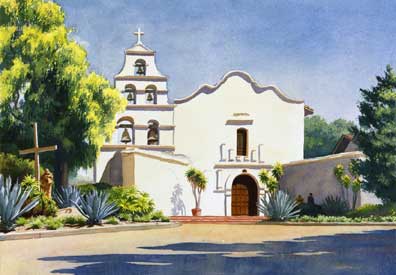 | |||
| Mission basilica of San Diego de Alcala. Source: Wikipedia | |||
| Middle of August 1769 | The recently completed mission in San Diego was attacked by Kumeyaay Indians. | Kumeyaay | - |
| 1769 | When the Spaniards established the first mission (Mission Basilica San Diego de Alcala) in California, the Viejas band of Kumeyvaay Indians lived in the area of today's El Capitan Reservoir, about 26 miles northeast of San Diego. At that time, the San Diego River flowed through the canyon. The El Capitan Reservoir was not created until 1935 with the completion of the El Capitan Dam. | Kumeyaay | - |
| 1769 | When the Spaniards established the first mission (Mission Basilica San Diego de Alcala) in California, the northern Ipai (Kumevaa) Indians lived in the area between the town of Escondido and Lake Henshaw. | Kumeyaay | - |
| 1769 | When the Spaniards established the first mission (Mission Basilica San Diego de Alcala) in California in 1769, the southern Tapai (Kumevaa) Indians lived in the area of the Laguna Mountains and Tecate (California) and Ensenada (Mexico). | Kumeyaay | - |
| August 1774 | Spanish Missions 1769-1823 - The mission Basilica San Diego de Alcala was moved to its current location, approx. 10 km east of the old site. There was no reliable water supply at the old location. In addition, the old location was too close to a Spanish fort (presidio). The presence of the military near the mission prevented the Indians from being converted to Christianity. The village of Nipaquay (Nipawai) of the Kumeyaay Indians was located near the new mission. | Kumeyaay Kumeyaay | - |
| 4 November 1775 | Spanish Missions 1769-1823 - Whippings and mistreatment of the Kumeyaay Indians at Mission San Diego led to an uprising. Father Luis Jayme was killed by the angry Indians. 600 - 800 Indians took part in the uprising. The mission was looted and burned down. This uprising was the first of a dozen similar Indian uprisings in 'Alta California'. | Kumeyaay | - |
| About 1800 | Fathers from Mission San Diego observed small children playing with stone arrowheads that contained gold. The Fathers found out that the arrowheads (probably) came from the village of Katalavina and the gold from the mountains of El Cajon. The Fathers negotiated with the chief of the village that he would deliver sacks of gold-bearing stones to the mission. In return, the soldiers from Mission San Diego protected the village from attacks by other tribes. The fathers used the gold to make ornaments and figures for the church at Mission San Diego and sent most of the gold to Mexico City. | Kumeyaay | - |
| 1875 | A decree by Ulysses S. Grant led to the establishment of the Capitan Grande Reservation for the Kumeyaay Indians. The tribal territory also included the now flooded area of El Capitan Reservoir, which was the only habitable area on the reservation. | Kumeyaay | - |
| 1932 | The reserve set up for the Kumeyaay Indians covers 5,181 acres (20.97 km²). | Kumeyaay | - |