


|
| Book cover | Autor | Title | Description |
| Bild | Autor | Leer | Beschreibung |
| Date | Event | Tribe | Chief |
| 4 July 1861 | Two volunteer regiments were assembled at Fort Snelling near St. Paul, the capital of the state of Minnesota, which had been founded three years earlier. One of the two regiments was soon sent to protect Washington. Almost 22,000 volunteers gathered in Minnesota alone on the side of the Union troops for the Civil War against the troops of the southern states. Among them was Lt. Lymam S. Kidder, who served in the 5th Minnesota Regiment.    | - | - |
| 26 July 1863 | Sibleys and Sullys Expedition 1863-1864 - Once again, General Sibley defeated the Dakota and Lakota at the Battle of Dead Buffalo Lake. The Dakota and Lakota tried to attack one flank of Sibley's army and drive the horses away, but failed after fierce resistance from the soldiers. The Indians then retreated and the battle was over. Among the cavalrymen who drove off the attacking Indians was a young soldier named Lyman S. Kidder. | Wahpekute-Santee (Eastern Dakota) Mdewakanton-Santee (Dakota) Sisseton-Santee (Eastern Dakota) Yankton (Western Dakota) Yanktonai (Western Dakota) Hunkpapa (Lakota) Hunkpapa (Lakota) | Inkpaduta Gall Sitting Bull |
3 September 1863  | Sibleys and Sullys Expedition 1863-1864 - The Lakota and Santee-Dakota knew that General Sibley was on his way back to Minnesota and that General Sully was stationed at Fort Pierre (in the center of South Dakota). General Sully had been delayed on his march from south to north due to the extreme drought and was unable to join General Sibley's troops in time. Sully marched to the Bismark area within a week and learned that Sibley was already on his way back. Sully then marched to the Whitestone Hills in about 3 days. Here General Sully attacked the Lakota and Santee-Dakota on the border between North Dakota and South Dakota. A front line unit discovered the Indian camp. The soldiers began to form a line of battle. 2 hours later, Sully arrived with his army and ordered an attack on the center of the Indian camp. Nightfall ended the battle at Whitestone Hill. Sully had lost 20 soldiers and 38 wounded. Between 100 and 200 Indians were killed and 156 taken prisoner. In addition, all tents and winter supplies were destroyed. The Sioux had to flee west across the Missouri again. A 19-year-old interpreter named Samuel J. Brown from the Fort Thompson Reservation wrote in a letter to his father that the Indians did not seem to have had any hostile intentions. Sully's soldiers are said to have killed almost only defenceless women and children, but hardly any warriors. The captured warriors are said to have been peaceful Yankton Indians who were later released. At the end of the expedition, the troops combed the surrounding area for two days and destroyed everything the Indians had left behind. Then the main body of troops marched back to Fort Ridgely with 156 prisoners. Some companies marched to Fort Abercrombie, including Lyman S. Kidder. General Sully was already thinking about a new offensive for 1864! And the Sioux and Lakota still thought they were unbeatable and acted like it. Unbeatable because the Lakota had defeated and driven out practically all the tribes on their way from the Great Lakes to the prairies of the Midwest. However, these tribes were all equipped with bows and arrows, spears, knives and tomahawks. The Long Knives, on the other hand, had long-range rifles and mobile artillery. And the Long Knives were strong in numbers. | Wahpekute-Santee (Eastern Dakota) Mdewakanton-Santee (Dakota) Sisseton-Santee (Eastern Dakota) Yankton (Western Dakota) Yanktonai (Western Dakota) Hunkpapa (Lakota) Hunkpapa (Lakota) | Inkpaduta Gall Sitting Bull |
| 2 October 1863 | Treaty of Old Crossing 1863The Ojibwe groups around Red Lake and the Pembina made a treaty at 'Old Crossing' at Red Lake in northern Minnesota in which they relinquished the rest of their lands in Minnesota, with the exception of the land around Upper and Lower Red Lake, Lake of the Woods, two large tracts of forest and the Red Lake Indian Reservation. These areas were finally ceded in 1889. Metis Indians were also present at the negotiations and received 464 units of 160 acres. The Red Lake Ojibwe lived between Red Lake and Lake of the Woods and Rainy River and around Red Lake in Minnesota after the land cession. The Pembina Lake Ojibwe lived north and northwest of Devils Lake in Minnesota under their chiefs Little Shell and Red Bear after the land cession. The Pembina Ojibwe lived mainly from buffalo hunting. The negotiations for the USA were led by Alexander Ramsey, currently Senator for Minnesota and former Governor of Minnesota. Lyman S. Kidder took part in the negotiations as a soldier. | Red Lake Ojibwe (Ojibwe) Pembina Ojibwe (Ojibwe) Pembina Ojibwe (Ojibwe) Metis | Little Shell Red Bear |
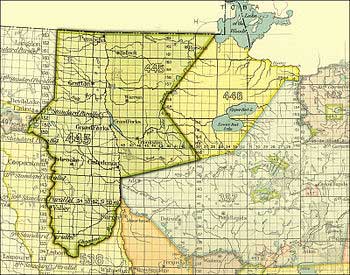 | |||
| Land ceded by the Ojibwe in the Treaty of Old Crossing. Source: http://en.wikipedia.org/wiki/Treaty_of_Old_Crossing. | |||
| 29 June 1867 | General Hancocks Campaign 1867 - Lt. Lyam S. Kidder left Fort Sedgwick (near Julesburg, Colorado) at 11:00 a.m. with 10 soldiers and an Indian scout with a message from General Sherman for Lt. Col. Custer. Each man in Kidder's division was armed with a 7-shot Spencer Model 1865 carbine in .50/56 caliber and a 6-shot Remington Model 1858 revolver in .44 caliber. | - | - |
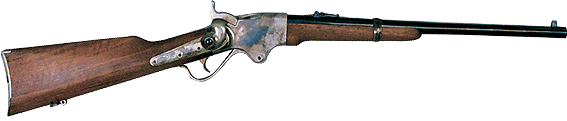 | |||
| Spencer carbine 1865 7 shots. Source: http://www.icollector.com/Spencer-Model-1865-Repeating-Saddle-Ring-Carbine_i9753114 | |||
| 1 July 1867 | General Hancocks Campaign 1867 - Lt. Liam Kidder reached Custer's campsite near Benkelman, where he interpreted the wagon tracks of the supply train south toward Fort Wallace as traces of Custer's command and followed them. Custer himself left this campsite on June 29. | - | - |
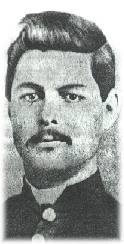 | |||
| Lyam S. Kidder. Source: http://www.lasr.net/travel. | |||
| 2 July 1867 | General Hancocks Campaign 1867 - Probably around noon, the Oglala under Chief Pawnee-Killer and about 12 Cheyenne warriors under Chief 'Tobacco' met Kidder and killed all the soldiers and the Indian scout Red Bead. Kidder and his 10 men were killed by the Oglala and Cheyenne because, according to statements by Indians, Kidder had probably unknowingly ridden directly towards the camp of the Pawnee killers and the Dog Soldiers (Cheyenne) at Beaver Creek in northeast Kansas. The Indians lost two people in this attack, including Yellow Horse, who had been elected chief shortly beforehand. . According to a statement made to George Bent in 1906 by two Indians who were present at the battle, the Cheyenne rode their horses in a circle around the soldiers, while the Oglala approached on foot. Most of the Oglala and Cheyenne were still armed with bows and arrows. Hundreds of Indian arrows were found in the ravine where Kidder was defending himself. Kidder died at the age of only 25. His soldiers were almost all around 20 years old. 5 of them were Americans, the others came from Ireland (3) and Germany (2), . | Oglala (Lakota) Oglala (Lakota) Northern Cheyenne (Cheyenne) Northern Cheyenne (Cheyenne) Northern Cheyenne (Cheyenne) Northern Cheyenne (Cheyenne) | Pawnee Killer Bear Rising Mischief Big Head Tobacco Howling Wolf Yellow Horse |
 | |||
| Chief Pawnee murderer of the Oglala. Source: Thomet Daniel 2010. | |||
| 2 July 1867 | General Hancocks Campaign 1867 - Probably around noon, the Oglala under Chief Pawnee-Killer and about 12 Cheyenne warriors under Chief 'Tobacco' met Kidder and killed all the soldiers and the Indian scout Red Bead. Kidder and his 10 men were killed by the Oglala and Cheyenne because, according to the Indians, Kidder had probably unknowingly ridden directly towards the camp of the Pawnee killers and the Dog Soldiers (Cheyenne) at Beaver Creek in northeast Kansas. The Indians lost two people in this attack, including Yellow Horse, who had been elected chief shortly beforehand. . According to a statement made to George Bent in 1906 by two Indians who were present at the battle, the Cheyenne rode their horses in a circle around the soldiers, while the Oglala approached on foot. Most of the Oglala and Cheyenne were still armed with bows and arrows. Hundreds of Indian arrows were found in the ravine where Kidder was defending himself. Kidder died at the age of only 25. His soldiers were almost all around 20 years old. 5 of them were Americans, the others came from Ireland (3) and Germany (2), . | Oglala (Lakota) Oglala (Lakota) Northern Cheyenne (Cheyenne) Northern Cheyenne (Cheyenne) Northern Cheyenne (Cheyenne) Northern Cheyenne (Cheyenne) | Pawnee Killer Bear Rising Mischief Big Head Tobacco Howling Wolf Yellow Horse |
| 6 July 1867 | General Hancocks Campaign 1867 - Custer reached Riverside Station and learned that Lieutenant Kidder had been on his way with new orders since June 29. However, Kidder had not yet reached Custer. Custer feared the worst and set off in search of Kidder. That same day, Custer made his way back to Fort Wallace. | - | - |
| 12 July 1867 | General Hancocks Campaign 1867 - Custer discovered the remains of Kidder's division at Beaver Creek. The bodies of the soldiers were pierced with arrows. | Oglala (Lakota) | Pawnee Killer |
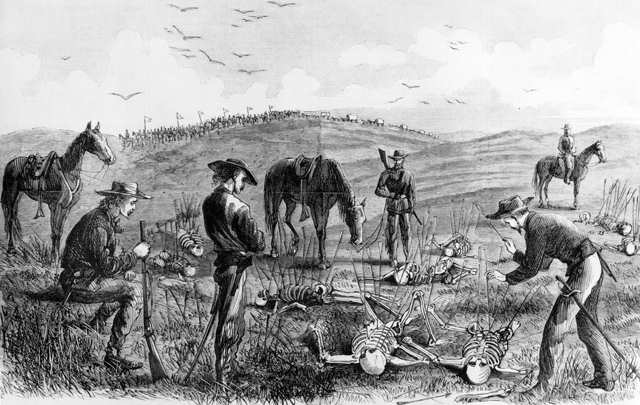 | |||
| Custer discovered the remains of Kidder's command. Source: http://kansasoakland.blogspot.com. | |||