


|
| Book cover | Autor | Title | Description |
| Bild | Autor | Leer | Beschreibung |
| Date | Event | Tribe | Chief |
1829  | The fur trading company 'American Fur Company' began building Fort Union at the confluence of the Missouri and Yellowstone Rivers on the border between Montana and North Dakota. Construction was completed around 1833. Steamboats could navigate the Missouri River as far as Fort Union, from there only maneuverable keelboats could reach Fort Cass (at the confluence of the Yellowstone River and the Big Horn River). The fort was built on Assiniboine land. The palisades were approx. 4.5 m high and made of poplar trunks. Around 800 bison had to be shot each year to feed the fort's garrison. In addition to the Assiniboine, Cree, Crow, Ojibwe, Blackfeet, Hidatsa and other tribes also visited the fort to trade their furs for metal objects such as kettles, needles, knives, arrowheads, blankets, cloth, glass beads, guns, lead and powder.    | Assiniboine Cree Crow Ojibwe Blackfoot (Lakota) Hidatsa | - |
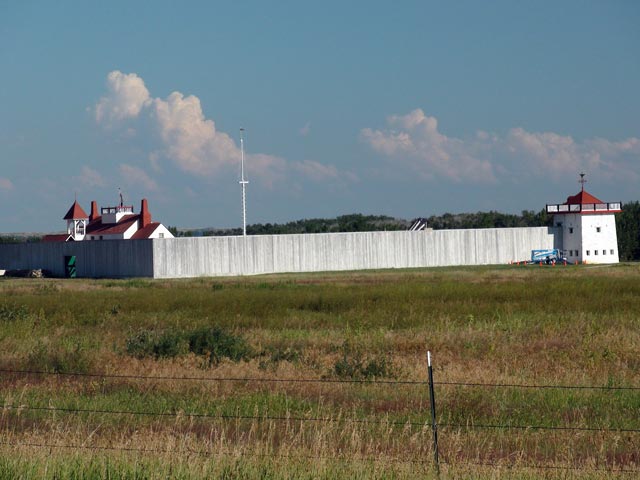 | |||
| The reconstructed Fort Union. Source: Thomet Daniel 2010. | |||
| Summer 1832 | The famous painter George Catlin traveled on the steamboat 'Yellowstone' on the Missouri River to Fort Union. Along the way, he painted landscapes and portraits of Native American tribes. These included the Pawnee, Omaha, Ponca, Mandan, Cheyenne, Crow, Assiniboine and the Blackfeet. Among others, Catlin painted the Mandan chief Ha-natah-nu-mauh and Four Bears (Mah-to-toh-pa), probably in the village of Mihtuttahangkush. Like Pierre Gaultier in 1736 and Lewis . | Mandan Mandan | Ha-natah-nu-mauh Four Bears |
| 18 June 1833 | Maximilian zu Wied Expedition 1832-1834 - The steamship 'Assiniboine' with Karl Bodmer and Prince Maximilian zu Wied reaches Fort Union. At that time, steamboats could only travel as far as Fort Union. From Fort Union, passengers had to transfer to a keelboat due to the low water level of the Missouri. | - | - |
| 18 June 1833 | Hugh Glass 1822-1833 - Three trappers, Hugh Glass, Ed Rose and Charley Menard, left Fort Cass with a message for Fort Union. Glass worked as a hunter for Fort Union. | Arikara | - |
| 20 June 1833 | Hugh Glass, Ed Rose and Charley Menard crossed the frozen Yellowstone River below Fort Union. They were attacked and killed by Arikara Indians. | Arikara | - |
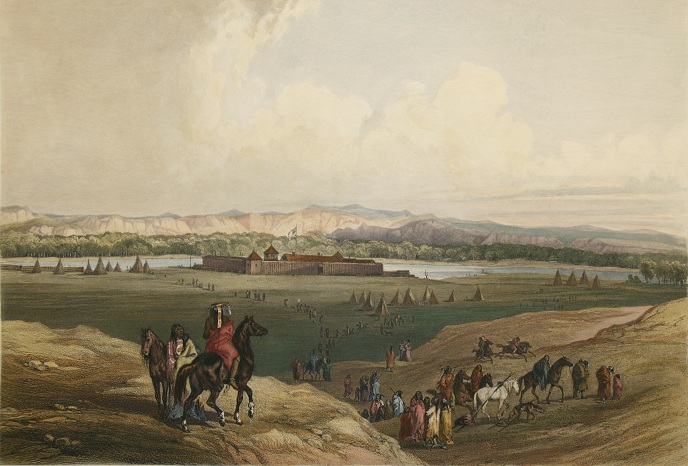 | |||
| Fort Union 1833 (photo by Karl Bodmer). Source: https://www.nps.gov/fous/learn/historyculture/index.htm | |||
| 24 June 1833 | Maximilian zu Wied Expedition 1832-1834 - Maximilian zu Wied and Karl Bodmer left Fort Union on the keelboat 'Flora' for Fort McKenzie. | - | - |
| 2 July 1833 | Maximilian zu Wied Expedition 1832-1834 - Karl Bodmer painted a picture of Fort Union. | - | - |
| 26 July 1833 | Maximilian zu Wied Expedition 1832-1834 - The steamer 'Assiniboine' returned to St. Louis from Fort Union loaded with furs and dried bison tongues. | - | - |
| 27 July 1833 | Maximilian zu Wied Expedition 1832-1834 - Cree and Assiniboine showed up at Fort Union to trade. | Assiniboine Cree | - |
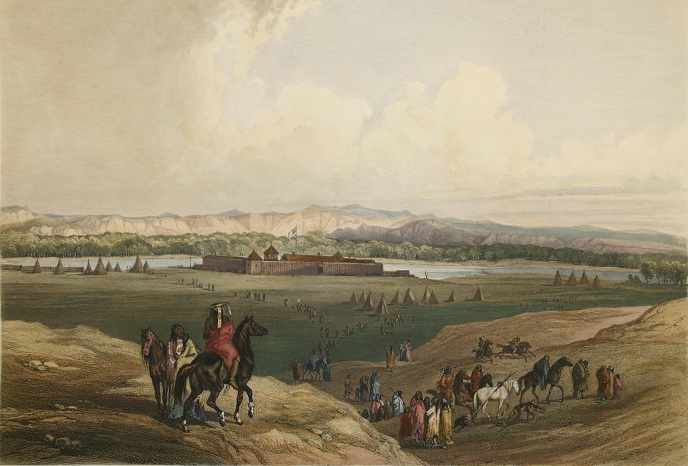 | |||
| Fort Union 1833 Source: http://www.nps.gov/fous/historyculture/index.htm | |||
| August 1833 | Maximilian zu Wied Expedition 1832-1834 - On the return journey from Fort Union to St. Louis, a fire broke out on the steamship 'Assiniboine'. The ship was destroyed by the fire. The entire natural history collection of Prince Maximilian zu Wied was also destroyed by the flames. I do not know the exact date of the fire. | - | - |
| 29 September 1833 | Maximilian zu Wied Expedition 1832-1834 - Bodmer returned to Fort Union. There was only one Indian tent left in front of the fort. They had already moved into their winter camps. | - | - |
| 11 October 1833 | Maximilian zu Wied Expedition 1832-1834 - Bodmer went bison hunting south of Fort Union with 12 mounted hunters. The small hunting party killed a small herd of bison. | - | - |
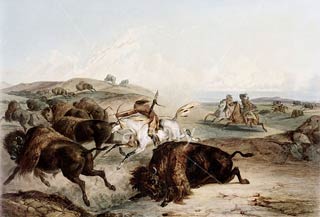 | |||
| Bison hunting, painted by Karl Bodmer. Source: http://www.alamy.com. | |||
| 16 October 1833 | Maximilian zu Wied Expedition 1832-1834 - The first snow of the year fell at Fort Union. Cree and Assiniboine came to the fort to conclude final trade deals. On this occasion, Bodmer painted a portrait of the Cree medicine man Mahsette-Kuiuab. | Cree Assiniboine | - |
| 30 October 1833 | Maximilian zu Wied Expedition 1832-1834 - With a helmsman and four Canadian crew members, Karl Bodmer and Prince Maximilian zu Wied left Fort Union for Fort Clark in North Dakota. The expedition spent the winter there. | - | - |
| 1833 | The Assiniboine have around 28,000 members. The name 'stone stoves' was given to them by the Ojibwe because the Assiniboine prepared their food in a cumbersome way: Food such as meat, maize, vegetables and water was placed in a hole in the ground lined with smooth leather. Stones were made red-hot in a fire next to it and placed in the hole in the ground until the food was cooked. At this time, the Assiniboine lived in the area of Fort Union in Montana, the main post of the fur trading company. | Assiniboine | - |
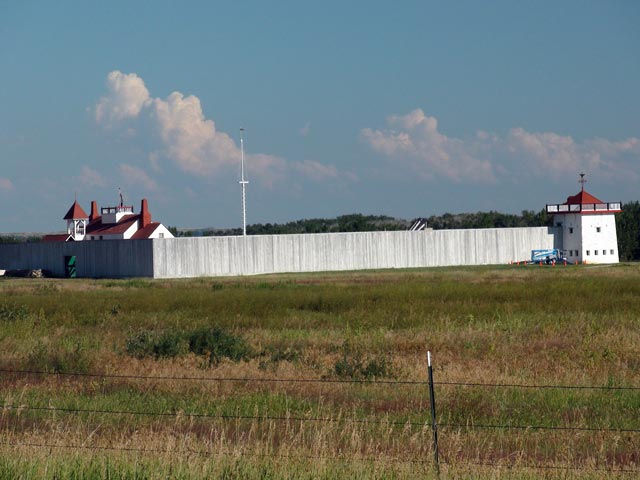 | |||
| Fort Union trading post. Source: Thomet Daniel 2010. | |||
| 20 June 1837 | The steamer 'S.S. St. Peter' of the American Fur Company arrived at Fort Union. Since arriving at Fort Clark, it was clear that smallpox was on board. The Indians were not allowed to enter Fort Union. Nevertheless, smallpox spread among the Indians. About half of the Assiniboine died. About a third of the Crow died. A longboat was sent from Fort Union to Fort McKenzie. | Assiniboine Crow | - |
| Summer 1837 | Edwin Thompson Denig worked as a bookkeeper in Fort Union on the border between North Dakota and Montana. He married the daughter of the Assiniboine chief `Iron Arrow Point` and the sister of the Assiniboine chief `First to Fly`. An American Fur Trade Company steamer brought the smallpox to Fort Union. Denig survived the smallpox almost unscathed. | Assiniboine Assiniboine | First to Fly Iron Arrow Point |
1842 | Fort Mortimer was built by the Union Fur Company about 2 miles east of Fort Buford. However, Fort Mortimer was never able to compete with Fort Buford and was sold to the owners of Fort Union, the American Fur Company. | - | - |
| Etwa 1845 | The Oglala and Brule traded mainly at Fort William / Fort Laramie (Wyoming), the Hunkpapa and Blackfeet mainly at Fort Union (Montana). | Oglala (Lakota) Hunkpapa (Lakota) Blackfoot (Lakota) | - |
| Summer 1851 | Father de Smet spent more than two weeks with Edwin Thompson Denig at Fort Union. De Smet organized the Indian leaders' trip to Fort Laramie to take part in the peace negotiations. | Assiniboine Crow | - |
| Autumn 1851 | The Swiss painter Rudolph Friedrich Kurz spent the period from September 1851 to April 1852 with Edwin Thompson Denig in Fort Union. | Assiniboine Crow | - |
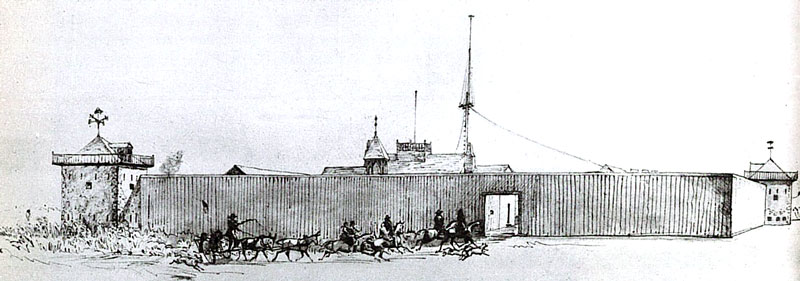 | |||
| Fort Union, 1852, painted by the Swiss painter Rudolph Friedrich Kurz. Source: http://www.zeno.org/Kunstwerke/B/Kurz, Rudolph Friedrich: Fort Union at the mouth of the Yellowstone. | |||
| 1855 | Groups of River Crows under the chiefs Two Face and Bear's Head with 200 tents lived in the Wind River Mountains in western Wyoming and traded their hides at Fort Sarpy or Fort Union. A large proportion of the hides were traded by the Crows for horses. The Crows received the horses either from the Flathead Indians in the St. Mary's Valley (in the Bitterroot Valley in western Montana) or from the Nez Perce and Shoshone Indians in the headwaters of the Yellowstone River in northwestern Wyoming. | Crow Flathead (Salish) Crow | Two Face Bear's Head |
| 22 August 1860 | 250 Hunkpapa and Blackfeet warriors attempted to enter Fort Union at dusk through the briefly opened gate. After the fort's garrison opened fire and killed a warrior, the warriors retreated. | Hunkpapa (Lakota) | - |
| |||
| Fort Union trading post. Source: Thomet Daniel 2010. | |||
| 10 August 1864 | Sibleys and Sullys Expedition 1863-1864 - General Sully's troops left the Badlands. They reached the Yellowstone River, where steamboats with provisions were waiting for the troops, and the Indians gave up the attacks and retreated to their camps. The tents of the Indian camp stretched over a length of 3 miles. But Sully followed the Indians' tracks to their camp. The completely surprised Indians had to leave the camp head over heels. The Indians now had to worry about getting food. The Indians had suffered heavy losses of meat, tents and equipment since General Sully had entered Indian territory, and Sully and his soldiers moved on to Fort Union and later to Fort Rice. On October 8, Sully reached Fort Ridgely. During the expedition, Sully's soldiers traveled approximately 1,625 miles. | Hunkpapa (Lakota) Hunkpapa (Lakota) Northern Cheyenne (Cheyenne) | Sitting Bull Gall |
| 18 August 1864 | Sibleys and Sullys Expedition 1863-1864 - General Sully had Fort Union (about 100 miles southeast of Fort Berthold) and Fort Berthold (in the area where the Little Missouri flows into the Missouri - North Dakota) reinforced. | - | - |
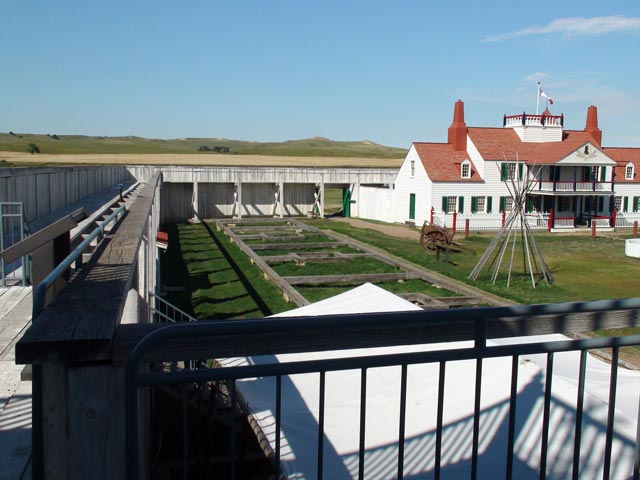 | |||
| Fort Union trading post. Source: Thomet Daniel 2010. | |||
| June 1865 | Sibleys and Sullys Expedition 1863-1864 - As a result of Sully's campaign in North Dakota in the summer of 1864, some tribes surrendered and settled in the area of Fort Union. These included a group of Hunkpapa under Bear's Rib and the Yanktonai. The Yanktonai were to sign a treaty on October 20, 1865 and October 28, 1865 at Fort Sully in South Dakota in which they were to cede land and end hostilities with the whites. | Yanktonai (Western Dakota) Yanktonai (Western Dakota) Yanktonai (Western Dakota) Yanktonai (Western Dakota) Yanktonai (Western Dakota) Hunkpapa (Lakota) | Two Bears Black Catfish Little Soldier Medicine Bear Two Heart Bear's Rib |