


|
| Book cover | Autor | Title | Description |
| Bild | Autor | Leer | Beschreibung |
| Date | Event | Tribe | Chief |
July 1832  | David Mitchell of the American Fur Company found Fort Piegan destroyed. He built Fort McKenzie about 6 miles upriver. .   | Blackfoot | - |
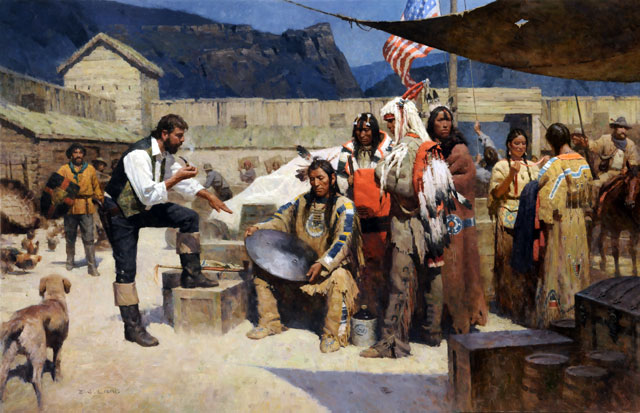 | |||
| Fort McKenzie 1835 Source: http://thewesternartdealer.blogspot.ch | |||
| 9 August 1833 | Maximilian zu Wied Expedition 1832-1834 - 800 Piegan-Blackfoot Indians received Karl Bodmer and Prince Maximilian zu Wied in Fort McKenzie, 6 miles above the mouth of the Marias River. The journey from Fort Union to Fort McKenzie took 34 days. Fort McKenzie was not a cozy place. The floors of the log cabins were made of tamped earth, and the inhabitants fought a constant battle against mice and vermin. Fortunately, among the cargo of the 'Flora' were windows and building materials for a new fort. The population lived exclusively on meat. An Indian hunter received 20 bullets and the necessary gunpowder for a bison cow. The horses were fed on grass for as long as possible. In winter, the horses fed on the bark of the poplars. In winter, the horses were taken to an island in the Missouri River where they had to spend the winter. The tipis of the Blackfeet consisted of 15 tent poles about seven meters long. The seams of the thinly scraped bison skins were sewn together and held together with thin sticks from the entrance to the top of the tent. | Piegan (Blackfoot) | - |
| 10 August 1833 | Maximilian zu Wied Expedition 1832-1834 - The travelers with Bodmer and zu Wied were invited by the chief of the Piegan 'Iron Shirt' (Mehkskehme-Sukahs). Bodmer was amazed, he had never seen such a large tent before. The diameter was about 15 steps (approx. 12 meters). The chief entertained his guests with pemmican (dried meat mixed with berries). The chief gave the guests an English officer's uniform (!), a dagger, a colorful handkerchief and a few beaver pelts. | Piegan (Blackfoot) | Iron Short |
| 11 August 1833 | Maximilian zu Wied Expedition 1832-1834 - Trade was conducted at Fort McKenzie. The Piegan gave Major David Mitchell, the commander of the fort, some horses and a considerable number of beaver pelts. Beaver pelts in particular were traded. On this day Bodmer painted a picture of Chief 'Iron Shirt'. Major Mitchell gave Chief Ninoch-Kiaiu a new red and green uniform coat, a felt hat and a double-barreled shotgun because he had never swapped furs with the competition. | Piegan (Blackfoot) Piegan (Blackfoot) Piegan (Blackfoot) | Iron Short Ninoch-Kiaiu Tatsicki-Stomick |
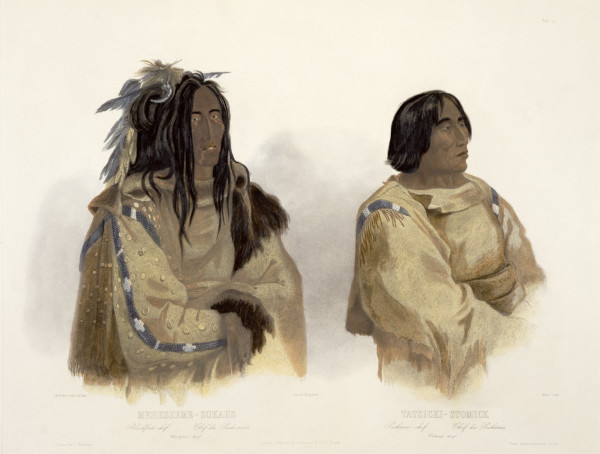 | |||
| Iron Shirt (Mehkskeme-Sukahs) and Tatsicki-Stomick, Chiefs of the Piegan 1833 Source: https://www.meisterdrucke.ch/kunstdrucke/Karl-Bodmer/155121/Mehkskeme-Sukahs,-Blackfoot-Häuptling-und-Tatsicki-Stomick,-Piekann-Häuptling,-Tafel-45-aus-Band-2-von-'Travels-in-Inner-North-America',-engraved-by-Allais,-1844.html. | |||
| 12 August 1833 | Maximilian zu Wied Expedition 1832-1834 - Bodmer painted the Piegan chief Kutonapi, who camped with his family in his hunting tent not far from the Missouri River. The guests were offered a bowl of fresh water from the Missouri and a meal of boiled beaver tail and root tubers. | Piegan (Blackfoot) | Kutonapi |
| 13 August 1833 | Maximilian zu Wied Expedition 1832-1834 - In Fort McKenzie, a Blackfeet Indian shot and killed a white trader named Martin. The Indian claimed that his pistol had accidentally discharged. Mitchell kept his nerve and threw the Indian out of the fort. Many Indian families left the camp and from then on there was a tense atmosphere around Fort McKenzie. | Piegan (Blackfoot) | - |
| 16 August 1833 | Maximilian zu Wied Expedition 1832-1834 - Bodmer and Prince Maximilian zu Wied were invited by Mitchell to visit the site of the new fort. During the ride, a Piegan Indian was shot when he found his horse in the camp of the Blood (Blackfeet) or Kainah (Blackfeet). | Piegan (Blackfoot) Blood (Blackfoot) Kainah (Blackfoot) | - |
| 28 August 1833 | Maximilian zu Wied Expedition 1832-1834 - In the morning, 600 Assiniboine and Cree warriors attacked the Blackfoot camp at the gates of Fort McKenzie. The Blackfoot had had too much to drink in the evening and were sleeping off their intoxication in the morning when the Assiniboine and Cree attacked. Many Blackfoot tents were destroyed and many Blackfoot Indians were killed. Prince Maximilian zu Wied felt threatened by the Indians and decided to break off his journey here and return to Fort Union.  | Blackfoot Assiniboine Cree | - |
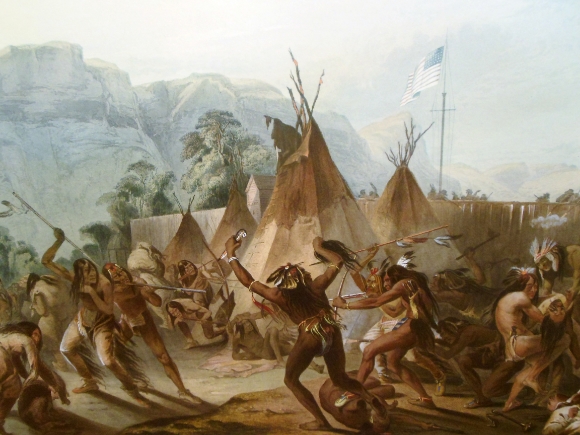 | |||
| Assiniboine and Cree attack on the Blackfoot camp in 1832. source: http://nativeamericannetroots.net/diary/1542. | |||
| Begin of September 1833 | Maximilian zu Wied Expedition 1832-1834 - In Fort McKenzie, Bodmer painted the Blackfoot chief Low Horn. | Blackfoot | Low Horn |
 | |||
| Chief of the Blackfoot Low Horn. Source: Book 'Indians were my friends', author Hans Läng. | |||
| 14 September 1833 | Maximilian zu Wied Expedition 1832-1834 - At 13:00 the keelboat 'Flora' left Fort McKenzie and returned to Fort Union. | - | - |
| 1833 | After Fort Piegan, the American Four Company established the second trading post on the Marias River, Fort McKenzie. This fort was operated until 1843 and was also visited by Karl Bodmer and Prince Maximilian von Wied-Neuwied in 1833. | Blackfoot | - |
| Winter 1834 | At Fort McKenzie on the Marias River in northwest Montana, the pelts of 9,000 bison, 2,800 muskrats, 1,500 prairie dogs, 200 red foxes, 180 wolves, 40 otters and 19 bears were traded. In 1840, for example, the Blackfoot received a rifle for 10 bison hides. | Blackfoot | - |
 | |||
| Bison in Custer State Park in South Dakota. Source: Thomet Daniel 2010 | |||
| End of June | A longboat arrived in Fort McKenzie with trade goods from Fort Union. The boat also brought smallpox and infected the Blackfoot Indians. About 2/3 of the Blackfoot Indians died of smallpox. | Blackfoot | - |
| 1837 | A keelboat arrived at Fort McKenzie. The goods were contaminated with smallpox. As a result, smallpox spread among the Blackfoot and claimed 6,000 lives, 2/3 of the Blackfoot population at the time. As a result, the Blackfoot were no longer able to suppress their former enemies such as the Northern Shoshone. Smallpox was introduced either by travelers across the Missouri or by white settlers who increasingly settled in Blackfoot territory. | Blackfoot Northern Shoshone | - |
| Winter 1838 | Despite the smallpox epidemic in northwestern Montana, the fur trade quickly flourished again. The pelts of 10,000 bison were traded via Fort McKenzie. | Blackfoot | - |
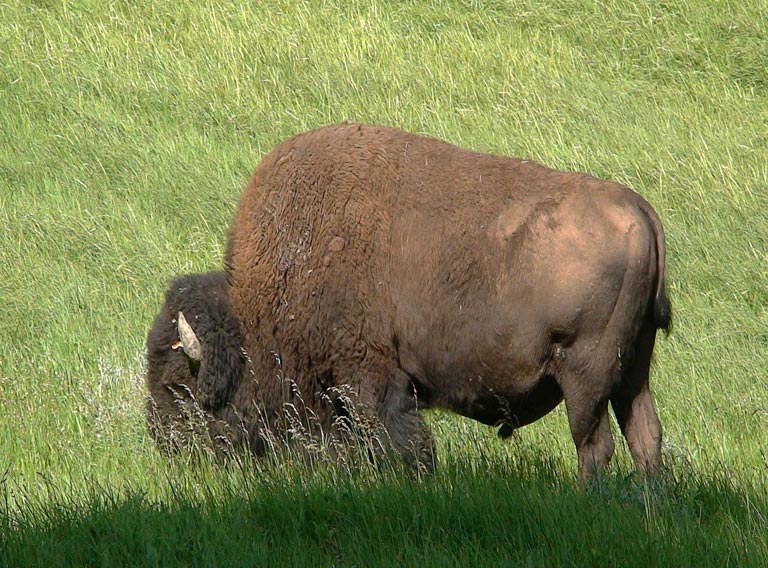 | |||
| Bison in Custer State Park in South Dakota. Source: Thomet Daniel 2010 | |||
| Winter 1840 | The hides of 21,000 bison were traded in Fort McKenzie. | Blackfoot | - |
| 1840 | The Blackfoot receive a rifle for 10 bison hides at the Fort McKenzie trading post (in northwestern Montana). | Blackfoot | - |