


|
| Book cover | Autor | Title | Description |
| Bild | Autor | Leer | Beschreibung |
| Date | Event | Tribe | Chief |
| 1610 | The Ojibwe (Chippewa) pushed the Sioux out of the Upper Lakes region to the south and west. Through trade with the French, the Chippewa came into possession of rifles early on and were able to hold their own against all enemies throughout the Great Lakes region thanks to their firepower. For their part, the Sioux pushed back the Cheyenne and Arapaho from Minnesota to the Missouri. Originally, the Sioux consisted of 7 autonomous groups, but they were in contact with each other: - Santee-Dakota (Eastern Dakota: Mdewakanton, Sisseton, Wahpekute and Wahpetonwan). They lived along the Minnesota River. - Yankton-Dakota and Yanktonai-Dakota (Western Dakota). These had left the Great Lakes woodlands for the prairies east of the Missouri and lived between the Santee and the Lakota - Even further west lived the Teton (or Lakota, 7 tribes). The French called the Lakota and Dakota Sioux, in reference to the word 'enemy' of the Chippewa.   | Ojibwe Cheyenne Arapaho Yankton (Western Dakota) Yanktonai (Western Dakota) Wahpeton-Santee (Eastern Dakota) Mdewakanton-Santee (Dakota) Sisseton-Santee (Eastern Dakota) Wahpekute-Santee (Eastern Dakota) Oglala (Lakota) Hunkpapa (Lakota) Brule (Lakota) Sans Arc (Lakota) Two Kettle (Lakota) Blackfoot (Lakota) Miniconjou (Lakota) Santee (Eastern Dakota) Sioux | - |
1650  | The Cheyenne probably lived between Lac Qui Parle and Lake Traverse in southwestern Minnesota. The Cheyenne lived on wild rice and hunting. Bison were hunted about 70 to 80 miles west of the Cheyenne settlements on the prairie. | Cheyenne | - |
| About 650 AD | The Suhtai or Sutaio (the later Cheyenne) lived in the area north of Lake Superior. From there they later moved southwest and met the Tsitsista, then living in southwestern Minnesota, around 1665 in the Coteau des Prairies (plateau in the flat prairie of eastern South Dakota, which extends into southwestern Minnesota and northwestern Iowa). They merged at the end of the 19th century to form the Cheyenne of today. | Cheyenne Suhtai (Cheyenne) | - |
| About 660 AD | The Suhtai came to the Coteau des Prairies in what is now southeastern North Dakota. The Suhtai came from north of Lake Superior, but left this area and moved southwest in search of a new home. | Cheyenne Suhtai (Cheyenne) | - |
| About 665 AD | The Cheyenne (also known as Tsitsetta) moved to the prairie, a glacial highland in what is now southeastern North Dakota, east of the Missouri River. Here the Cheyenne, like their neighboring tribes (Mandan, Hidatsa, Arikara and others), lived in earth houses. In the Coteau des Prairies, the Cheyenne met the Suhtai or Sutaio, who had moved into the Coteau des Prairies from the area north of Lake Superior. Both groups formed an alliance and at the beginning of the 19th century, they became a tribe. | Cheyenne Tsitsistas (Cheyenne) | - |
| About 1673 | Marquette-Joliet Expedition 1673 - First mention of the Cheyenne - On their journey from the Great Lakes to the Gulf of Mexico, Father Jacques Marquette (a Jesuit) and Louis Joliet (a fur trader) produced maps as well as travelogues. On one of these maps, the Cheyenne are mentioned for the first time by Europeans who lived in southwestern Wisconsin on the Wisconsin River. The name 'Cheyenne' is derived from the Sioux word 'sha hi ye na', which means 'those who speak an unintelligible language'. The Cheyenne were an immigrant group of Algonquin Indians and spoke a different dialect from the Sioux Indians of the region. | Cheyenne | - |
| 1700 | Marquette-Joliet Expedition 1673 - In the meantime, the Cheyenne had migrated to the Sheyenne River in eastern North Dakota and lived there in adobe houses, like the Mandan, Hidatsa and Arikara in the west. The Cheyenne grew corn, pumpkins and tobacco and hunted. From then on, the Cheyenne began a gradual process of transformation from agriculturalists (earth houses, corn, squash, tobacco) to nomadic tribes (tipi tents, buffalo hunting). This process was accompanied by a further westward migration to the prairies and was completed around 1770.  | Cheyenne | - |
| 1750-1780 | At this time, the Cheyenne, probably from the Great Lakes region, came to the northern prairies in search of horses and bison. The Cheyenne practiced horticulture in the Great Lakes region, planting corn and pumpkins, among other crops. With the migration to the great prairies, the Cheyenne lost their corn and became very good horsemen, living mainly from hunting bison. | Cheyenne | - |
| About 785 AD | The Tsistista and Suhtai (the later Cheyenne) crossed the Missouri River together and invaded the western prairies. For several years, the Cheyenne lived along what is now the Sheyenne River. | Tsistsistas (Cheyenne) Suhtai (Cheyenne) | - |
| About 790 AD | It is not known exactly when the Cheyenne left the Sheyenne River area in eastern North Dakota. Nor why. The most plausible is the statement made by an Ojibwe chief to David Thompson, who undertook several reconnaissance trips along the Canadian-American border around 1790 and drew maps, that the Ojibwe from the Rainy Lake area (in northern Minnesota) attacked and burned down the Cheyenne village with around 150 warriors. It is not clear from the records exactly when and where, but it must have been around 1790. Archaeologists have carried out excavations at the so-called 'Biesterfeldt Site' on the Sheyenne River in North Dakota, which confirm the above statements. | Cheyenne Ojibwe | - |
| About 790 AD | The Cheyenne traded horses with the Mandan, Hidatsa and Arikara who lived along the Missouri. Like the Lakota living there, the Cheyenne also traded coveted European goods in exchange for horses. This trade worked well until the three tribes on the Missouri were ravaged and decimated by imported diseases after 1800. After that, the Cheyenne mainly traded directly with the white traders in the north and undertook raids into the southern prairies to procure horses. | Cheyenne Mandan Hidatsa Arikara Lakota | - |
| 1795 | The French trader Jean Baptiste Trudeau lived for a short time with the Arikara above the Grande River on the border between North and South Dakota. He noticed that every spring Sioux from the St. Peter area (Minnesota) came to the Arikara to trade their horses for guns, clothing, metal kettles and other items. In addition, every August about 1,500 Sioux, Cheyenne and Arapaho came to the Arikara village, bringing bison blankets, fat and hides, which they in turn traded for goods that the Arikara received from the Sioux. At this time, the Cheyenne were already prairie Indians who lived in tipis and hunted buffalo. Around 1700, the Cheyenne were still living in adobe houses on the Sheyenne River in eastern North Dakota. | Arikara Cheyenne Arapaho Sioux | - |
| 1801 | Lewis and Clark 1804-1806 - The Cheyenne raided a Crow village with 30 tents. Lewis . | Crow Cheyenne Arikara | - |
| 1 October 1804 Nicht erkannter Quellenhinweis | Lewis and Clark 1804-1806 - Lewis . | Cheyenne Arikara | - |
| 21 August 1806 | Lewis and Clark 1804-1806 - In the afternoon, Lewis and Clark reached the villages of the Arikara Indians on the Grand River. The camp was opposite the village of Waho-erha. The Arikara were guests of the Cheyenne Indians, who traded corn and horses with the Arikara. | Arikara Cheyenne | Grey Eyes |
| About 1810 | Dull Knife was born on Rosebud Creek around 1810. | Northern Cheyenne (Cheyenne) | Dull Knife |
| 1819 | 32 Cheyenne were attacked by a large group of Crow Indians. The Cheyenne had to retreat to a hill. The Cheyenne fought all night and the next day until they ran out of ammunition and arrows. The Cheyenne used their knives to attack the Crow and were killed. | Cheyenne Crow | - |
| 1820 | In revenge for the killing of 32 warriors the previous year, the Cheyenne, with the support of the Lakota, attacked an almost empty Crow village in the Tongue River area. The warriors of both tribes left their villages to attack the enemy camp. For unknown reasons, the Crow did not find the empty Cheyenne camp. The Cheyenne, however, found the empty Crow camp, killed the warriors present and captured many women and children. | Cheyenne Lakota Crow | - |
| 4 July 1825 | Yellowstone Expedition 1825 - Treaty of Fort Lookout 1825General Henry Atkinson signed a treaty of peace and friendship with the Cheyenne. The signing probably took place somewhere in the area where the Cheyenne River flows into the Missouri River in central South Dakota. The treaty was intended to secure the emerging fur trade between whites and Indians. The Indians undertook not to exchange their weapons, gunpowder and ammunition with any other tribe, to remain within the borders of the USA, to recognize the sovereignty of the USA and to place themselves under its protection. This treaty defined the borders of the Indian territory. | Cheyenne | High Backed Wolf |
| 1 July 1825 | The first Rocky Mountain Rendezvous took place on July 1, 1825 at Henry's Fork of the Green River in Wyoming. 91 trappers and fur traders attended. Some Cheyenne and Crow were also present. Among the participants were William Ashley, Jedediah Smith and Jim Bridger. | Cheyenne Crow | - |
| 1834 | Some of the Cheyenne preferred Fort William (founded in 1834, later Fort Laramie) in Wyoming for trading, while others preferred Bent's Fort (founded in 1833) in south-eastern Colorado. These different preferences led directly to the division of the Cheyenne into Northern Cheyenne and Southern Cheyenne. The increasing use of the Oregon Trail from 1840 and the associated abandonment of this former Cheyenne tribal territory along the Platte River certainly also contributed to the division. The last traditional 'camp circle' with all Cheyenne groups is said to have taken place in 1838. | Cheyenne | - |
| June 1826 | The second Rocky Mountain Rendezvous took place in Cache Valley, Utah. | Cheyenne Crow | - |
| 1828 | First, the Comanche under Bull Hump drive the horses of the Cheyenne from their village on Bijou Creek (in the area of today's Fort Morgan, Colorado). Then the Cheyenne under Little Wolf search for and find the Comanche village on the Huerfano River (Colorado) and drive away a large number of the Comanche horses, also recapturing the horses stolen from them. Only a few Comanches pursued the Cheyenne, but were unable to retrieve the horses. | Northern Cheyenne (Cheyenne) Comanche Arapaho | Little Wolf Bull Hump |
| 1830 | The Cheyenne and Arapaho met the Comanche and Kiowa for the first time on the Arkansas River. After 10 years, it became apparent that the Comanche and Kiowa were unable to stop the Cheyenne and Arapaho. In 1840, the 4 tribes were to conclude a peace treaty with the help of William Bent. Like the French, this time it was an American who brought peace to the feuding Indian tribes. | Comanche Kiowa Cheyenne Arapaho | - |
| 1830 | Cheyenne and Pawnee fight each other. Their sacred 'Medicine Arrows' were stolen from the Cheyenne. | Cheyenne Pawnee | - |
| 1832 | The Crows under Chief Rotten Belly lured the Cheyenne into a trap and attacked them. The Cheyenne retreated. As they retreated, the Crows attacked again and again, killing many Cheyenne. The Cheyenne chief, Striped Elk, was killed by a shot from long range. The Cheyenne lost many warriors in this battle. According to the Crow Indians, there were more than 100. | River Crow (Crow) Cheyenne | Rotten Belly Striped Elk |
| 1833 | The Cheyenne discovered the Kiowa, who moved north to the Crows. The Kiowa wanted to trade deer teeth and ermine skins with the Crows. However, the Cheyenne rode to the wrong place and realized too late that the Kiowas were already far away. . | Cheyenne Kiowa | - |
| 1833 | A small group of Crows with 30 tents were camped in the headwaters of the Sheyenne River in North Dakota. The Cheyenne had only recently moved back into the area and noticed the Crow camp. The Cheyenne counted about 300 tents at this time. During the night, the Cheyenne attacked the Crow camp, killing all but a few who managed to escape. Around 600 Crow warriors and the chiefs Rotten Belly, Long Hair, Little White Bear, Yellow Belly and Two Face set off for North Dakota to avenge the loss they had suffered. The Crows pursued the Cheyenne to the Arkansas River and raided their camp. Between 100 and 200 Cheyenne warriors were killed, 270 women and children taken prisoner and about 1,000 horses captured. The Crows lost 5 warriors and had 15 wounded. The attack on the Cheyenne took place on the Arkansas River, either in Colorado or Kansas. On the way back to Montana, the Crows encountered an immigrant train and contracted smallpox! Half of the Crows died on the way back to Montana. The Crows split up into small groups to get as far away from the smallpox as possible. The next summer, the Crows met again at the mouth of the Big Horn River into the Yellowstone River. Of the 800 tents from the previous year, only 360 remained. . | River Crow (Crow) Crow Crow Crow Crow Cheyenne | Rotten Belly Long Hair Yellow Belly Two Face Little White Bear |
| 1833 | Ouray, the later chief of the Uncompaghre Ute Indians, was born in the Taos area to the Jicarilla Apache tribe. He was later abducted by Ute Indians and grew up as a Genizaro, probably in Taos or Abiquiu. He learned Spanish, English, Apache and Ute languages. In the 1940s, Ouray distinguished himself as the leader of the Ute in the fight against the Cheyenne and Arapaho. In 1864 he became chief of the Ute Uncompaghre. | Uncompahgre (Ute) Cheyenne Arapaho Jicarilla (Apache) | Ouray |
| 1833 | William and Charles Bent founded Bent's Old Fort on the Arkansas River in eastern Colorado. The two brothers mainly wanted to trade with the Arapaho and Cheyenne. . From 1848, the Santa Fe Trail was flooded with people due to the peace with Mexico. The Cheyenne moved to the prairie and trade at the fort collapsed. The fort was abandoned and destroyed in 1849. | Cheyenne Arapaho | - |
| 1837 | 38 warriors of the Bowstring warrior community of the Cheyenne were on a vendetta against the Kiowa and were discovered by the warriors of a large Kiowa, Comanche and Kiowa Apache village. The village was located on Walnut Creek, a tributary of the North Fork Red River in far east Texas. The Cheyenne were pursued eastward along the North Fork Red River. Several Cheyenne were killed during the pursuit. On the North Fork Red River in present-day Oklahoma, in the far west of Beckham County, the Cheyenne defended themselves in a ravine. All the Cheyenne were killed there. | Cheyenne Kiowa Comanche Kiowa-Apache (Apache) | - |
| Summer 1838 | In revenge for the killing of 38 Bowstring Cheyenne warriors in 1837, the Cheyenne and Arapaho raided a large Kiowa, Comanche and Kiowa-Apache camp on Wolf Creek. On the way to the large camp, the Cheyenne and Arapaho killed 31 Kiowa men and women. The women were searching for roots, the men were hunting buffalo. The Cheyenne and Arapaho attacked the large camp, but were unable to capture it. | Cheyenne Arapaho Kiowa Comanche Kiowa-Apache (Apache) | Porcupine Bear |
| 1838 | (San Juan Mountains / Southern Colorado). The Cheyenne and Arapaho searched for the Kiowa and Comanche camp and found it at Wolf Creek. About 58 Kiowa and Comanche were killed, the Cheyenne and Arapaho lost about 14 warriors. The tribes did not make peace with each other until 1840. | Cheyenne Arapaho Kiowa Comanche | - |
| 1838 | Arapaho and Cheyenne fight a major battle at the confluence of the Beaver River and Wolf Creek in Oklahoma. | Arapaho Cheyenne Comanche Kiowa | - |
| 1838 | The Cheyenne and the Delaware met. The Delaware were hunters who were on their way back loaded with furs. The Delaware and the Cheyenne never fought each other, but the Delaware shot at the Cheyenne. All the Delaware were killed in the battle. | Cheyenne Delaware | - |
| 1840 | Cheyenne, Arapaho, Comanchen, Kiowa 1840At Fort Bent, the Kiowa Apache, Kiowa and Comanche made peace with the Cheyenne and Arapaho. This peace has never been broken. In the conflicts before the peace, the Cheyenne / Arapaho were mostly outnumbered, as the Apache / Kiowa / Comanche already had horses and rifles, which they had taken from the Texans. The Cheyenne and Arapaho were mostly still on foot, and that in the vast prairie! Chief Satank of the Kiowa played a central role in the negotiations, as did William Bent. The Cheyenne and Arapaho received thousands of horses from the Comanche and thus developed into a true equestrian nation. | Cheyenne Kiowa-Apache (Apache) Comanche Kiowa Arapaho | - |
| May 1841 | The first wagon train of about 80 white settlers left the Westport/Independence area on the Kansas River under the leadership of Thomas Fitzpatrick, a very experienced mountain man. He led the 'Bidwell-Bartelson' wagon train. The first fort the wagon train saw was Fort Laramie on the North Platte River in southeastern Wyoming. Fort Laramie at this time was inhabited by trappers, traders, French and Indians, many of whom were women married to white trappers. From Fort Laramie, the Oregon Trail continued along the North Platte River, then along the Sweetwater River to the Green River in western Wyoming. At Soda Springs in southern Idaho, the settlers split up: some moved to California, others followed the Oregon Trail further north. When the first wagon trains moved west from St. Louis, the Pawnee had many of their villages along these routes: Some of their villages were located near St. Louis in what is now the state of Missouri and on the Platte River in Nebraska. The decline of the Pawnee began with this white immigration. The Pawnee had no allies among the Indians and were constantly attacked by them: by the Dakota in the north and east, by the Cheyenne and Kiowa in the north and west, and by the Comanche and Wichita in the south. | Pawnee Dakota Cheyenne Kiowa Wichita Comanche | - |
 | |||
| Migration routes to the west. Source: http://quarriesandbeyond.org/states/ca/ca-research_resources-hist.html | |||
| Middle of August 1841 | 35 trappers repelled the attack of a large number of Lakota, Cheyenne and Arapaho at the mouth of Battle Creek in the Little Snake River. Henry Fraeb was among the trappers. | Lakota Cheyenne Arapaho | - |
| 21 August 1841 - 27 August 1841 | Again 23 trappers were attacked east of the mouth of Battle Creek in the Little Snake River by a large number of Lakota, Cheyenne and Arapaho. Henry Fraeb died at the beginning of the raid. Jim Baker took over the leadership of the trappers. Three trappers died in the battle. The Indians only withdrew on August 27. | Lakota Cheyenne Arapaho | - |
| 28 June 1842 | John Charles Fremont Expeditions 1842-1846 - At sunset on June 28, Fremont and his men encountered three Cheyenne Indians, two men and a 13-year-old boy. The Cheyenne wanted to steal horses from the Pawnees, but found no Pawnees. The Cheyenne were only armed with bows and arrows and long spears. If the Cheyenne had come across Pawnees on the prairie, they would have had no chance against the Pawnees, some of whom were armed with rifles. | Cheyenne Pawnee | - |
| 8 July 1842 | John Charles Fremont Expeditions 1842-1846 - The second group of the Fremont Expedition under Charles Preuss (with Kit Carson as guide) encountered a large group of traders and trappers led by Jim Bridger. Bridger warned Preuss of hostile Lakota, Gros Ventre and Cheyenne who were in the Red Buttes area (west of the present-day town of Casper). | Lakota Cheyenne Gros Ventre | - |
| 5 July 1844 | John Charles Fremont Expeditions 1842-1846 - Fremont continued his expedition and camped in the evening about 20 miles below Bent's Old Fort. On the way he came across a large Lakota and Cheyenne village. | Lakota Cheyenne | - |
| 1846 | The Cheyenne under Chief Tobacco discovered a wagon train on the Santa Fe Trail in Kansas. Old Tobacco wanted to warn the wagon train about Comanches who were nearby. As the wagon train approached, the chief was mortally wounded and died five days later. Old Tobacco's murder was probably due to a misunderstanding in the sign language. | Cheyenne | Old Tobacco |
| 1848 - 1849 | Treaty of Fort Laramie 1851The discovery of gold in California in 1848 led to a wave of immigration through the land of the Plains Indians. The end of the border conflict between the USA and England over the state of Oregon in 1846 was another reason for the long treks along the Platte River to Oregon and California. The government rightly feared bloody clashes with the Plains Indians and invited them to a peace conference. This took place in Fort Laramie in 1851. The government hoped that the treaty would lead to fewer raids on the wagon trains. | Lakota Crow Assiniboine Shoshone Cheyenne Arapaho Oglala (Lakota) Brule (Lakota) Arikara Hidatsa Mandan | Red Cloud |
| 1849 - 1854 | During these 5 years, a cholera epidemic raged among the Plains Indians. | Crow Comanche Cheyenne Arapaho Pawnee Lakota Kiowa | - |
| 1849 | Bent's Old Fort on the Arkansas River in eastern Colorado was destroyed under unexplained circumstances. | Cheyenne Arapaho | - |
| 1849 | Treaty of Fort Laramie 1851In that year alone, around 22,500 settlers with around 60,000 cattle traveled along the California Trail to California. Along the way, the settlers used up the sparse supplies of firewood on the prairie and built fireplaces. The cattle ate almost all the grass in the area. The Northern Shoshone also noticed this when they returned from their annual buffalo hunt from Montana and Wyoming. The settlers followed the Oregon Trail from the Missouri River via Fort Laramie along the Platte River to Soda Springs in southern Idaho. This route led right through the territory of the Pawnee, Oglala and Brule, Cheyenne and Arapaho, as well as the Northern and Eastern Shoshone. This prompted the US government to negotiate, which led to the Treaty of Fort Laramie in 1851. From Soda Springs (about 60 miles southeast of Fort Hall), settlers could follow three different routes. One route was the California Trail to the west. The Oregon Trail led north towards Oregon. And the Mormon Trail led mainly the Mormons to Salt Lake City in Utah. | Northern Shoshone Eastern Shoshone Pawnee Oglala (Lakota) Oglala (Lakota) Brule (Lakota) Cheyenne Arapaho | Red Cloud Smoke |
 | |||
| Oregon Trail. Source: http://www.univie.ac.at/Anglistik/easyrider/data/parkoret.htm. | |||
| 17 September 1851 | Treaty of Fort Laramie 1851After the dispute with England over the boundary of the state of Oregon was settled in 1846 and gold was discovered in California in 1848, long wagon trains began to travel along the Platte River to Oregon and California. The government hoped that the treaty would reduce raids on the wagon trains. The treaty stipulated that the Great Plains belonged to the Indians as long as 'the rivers flow and the eagles fly'. In return, it was agreed that the Oregon Trail could be used by the white immigrants. In return, the Indians were to receive annual payments of 50,000 US dollars for the next 50 years. The treaty also permitted the construction of forts and roads on Indian territory. The Senate ratified the treaty in 1853 with one amendment: the payments were to last only 10 years. All tribes except the Crow agreed. The Treaty of Fort Laramie of 1851 is also known as the Horse Creek Treaty. Since more than 10,000 Indians showed up for the treaty negotiations with at least as many horses, the negotiations were moved to the mouth of Horse Creek, about 30 miles east of Fort Laramie. Many tribes never received the agreed upon annual payments. Over the next 10 years, a series of forts were built along the Platte River. Then came the wagon trains, the stagecoaches, then the pony express riders, and finally the telegraph poles. As a result, first the game and then the bison were gradually driven out of the area. In 1858, gold was discovered at Pike Peak and immigration increased, and it was agreed in the treaty that the Great Plains would belong to the Indians as long as 'the rivers flow and the eagles fly'. In return, it was agreed that the Oregon Trail could be used by the white immigrants. In return, the Indians were to receive annual payments of 50,000 US dollars for the next 50 years. The treaty also permitted the construction of forts and roads on Indian territory. The Senate ratified the treaty in 1853 with one amendment: the payments were only to be made for 10 years. All tribes except the Crows agreed. Many tribes never received the agreed upon annual payments. Many forts were built along the Platte River over the next 10 years. Then came the wagon trains, the stagecoaches, then the pony express riders and finally the telegraph poles. This drove the deer and bison out of the region. In 1858, gold was discovered on Pike Peak, south of Denver, Colorado, and immigration continued to increase. Under the treaty, the tribes undertook to no longer wage war against each other. The treaty also set fixed boundaries for the tribes. It can be assumed that the Indians hardly knew what they were actually signing. It was inconceivable that the Hunkpapa, for example, would suddenly stop waging wars against the Crow and Assiniboine. These traditions had become too engrained in the lives of the Indians over the last few centuries. As a result of the treaty, the tribal territory of the Crow Indians of 144,000 km. The contract provided for several payments. However, the US government only made one payment and thus breached the contract. The Assiniboine were given a reservation between the Musselshell River and the Yellowstone River. | Oglala (Lakota) Crow Assiniboine Shoshone Brule (Lakota) Arapaho Gros Ventre Southern Cheyenne (Cheyenne) Brule (Lakota) Arikara Hidatsa Mandan Assiniboine Assiniboine | Big Robber Little Owl White Antelope Conquering Bear Iron Bear Four Bears White Wolf First Fly Crazy Bear |
| Summer 1852 | Cheyenne, Plains Apache, Lakota, Arapaho and Kiowa attacked the Pawnee near present-day Smith Center, Kansas. The Cheyenne participated with more than 230 warriors. The war party stayed in Pawnee territory for about two weeks. The Pawnee were hunting buffalo along Beaver Creek. The charismatic Alights-on-the-Cloud was killed in the battle. | Cheyenne Pawnee Kiowa Arapaho Lakota Kiowa-Apache (Apache) | Alights-on-the-Cloud |
| 15 June 1853 | A Miniconjou Indian shot a soldier near the ferry across the Platte River at Fort Laramie. Lieutenant Richard B. Garnett, commander of Fort Laramie, sent 23 soldiers to the Miniconjou-Lakota village to arrest the shooter. There were about 600 Lakota and Cheyenne tents in the area. While the soldiers were in the Miniconjou-Lakota village, the discussion became increasingly heated. The soldiers opened fire and killed 3 Indians. Another 3 Indians were wounded and the soldiers took 2 Indians prisoner. The intervention of the chiefs prevented a bloodbath. | Miniconjou (Lakota) Oglala (Lakota) Cheyenne | - |
| Summer 1853 | William and Charles Bent abandoned Bent's Old Fort in 1849 and built a new fort, Bent's New Fort, 65 km downstream. The fort was about 60 m long and 45 m wide. In 1859, the Bent brothers leased the fort to the American army for 65 dollars a month. In 1860, Fort Lyon was built just a mile away by Major John Sedgwick. | Cheyenne Arapaho | - |
| 1853 | Cheyenne and Kiowa attacked the Pawnee again. Shortly before, the Pawnee had camped together with the Potawatomie. The Pawnee called on the Potawatomie for help and put the Cheyenne to flight with 20 men. The Potawatomie fired from horseback, 10 men at a time, while the others reloaded. The excellent rifles were supported by long poles to increase accuracy. The Potawatomie acquired these skills in the battles during the Pontiac Uprising and from the English. | Cheyenne Kiowa Pawnee Potawatomi | - |
| 1854 | About 100 Sauk and Fox warriors encountered a force of about 1,000 Comanche, Cheyenne, Osage and Kiowa warriors about 100 miles west of Fort Riley in eastern Kansas. Unlike the Prairie Indians, the Sauk and Fox had rifles. Most of the warriors were still armed with bows and arrows. For this reason, the Sauk and Fox were victorious in this battle and were able to kill at least 26 enemy warriors, with 'only' 6 of their own losses. | Sac and Fox Comanche Kiowa Osage Cheyenne | - |
| 1 July 1855 | Harney Expedition 1855-1856 - The troops at Fort Kearny received a visit from the Cheyenne Indians. The Cheyenne waged war against the Pawnee. | Cheyenne Pawnee | - |
| 1855 | The Cheyenne and Arapaho joined the Oglala. Together, the three tribes attacked the Omaha on the Loup River in central Nebraska. | Oglala (Lakota) Cheyenne Arapaho | - |
| Summer 1858 | William, Oliver and Levi Russel, John Beck and a group of Cherokee Indians found gold in significant quantities for the first time in Colorado at the mouth of Little Dry Creek in the South Platte River in the Englewood area of present-day Denver, Colorado. By the time the state of Colorado was founded on February 28, 1861, some 100,000 prospectors, gamblers, etc. had come to the area due to rapid population growth. These immigrants mainly came to the area via the immigration routes along the Platte River. However, this area had been granted to the Indians by the Treaty of Fort Laramie in 1851. The growing number of immigrants through the Indian Territory later led to conflicts between the Indians of the southern prairies and the US Army. In 1859, the first small town of Denver City was established in the gold prospectors' territory. From here, gold prospectors ventured into the mountains around Denver City. In the Treaty of Fort Wise of 1861, the US government attempted to buy the land from the Cheyenne and Arapaho, which was Indian land on the one hand, but also belonged to the newly founded state of Colorado on the other. | Cheyenne Arapaho | - |
| 18 February 1861 | Treaty of Fort Wise 1861The Cheyenne and Arapaho (from the upper Kansas region) ceded the land promised to them in the 1851 Treaty of Fort Laramie to the USA (!). The new reservation was about 1/13 the size of their original reservation, which had been promised to them in the 1851 treaty (in eastern Colorado, between the Sand Creek River and the Arkansas River). Fort Lyon was located in the reservation area. The Arapaho demanded that the fort be moved to the northern border of the reservation. However, the War Department never responded to this demand. Only 6 of the 44 Cheyenne chiefs signed the treaty. The Dog Soldiers of the Southern Cheyenne and other groups never signed the treaty and continued to live outside the reservation, east of Colorado and west of Kansas. As usual, the US government regarded the non-signatory Indians as enemies and treated them accordingly. These disagreements would lead to the Colorado War in 1864. | Southern Cheyenne (Cheyenne) Southern Cheyenne (Cheyenne) Southern Cheyenne (Cheyenne) Northern Cheyenne (Cheyenne) Southern Cheyenne (Cheyenne) Northern Cheyenne (Cheyenne) Southern Arapaho (Arapaho) Arapaho Arapaho Arapaho | Black Kettle White Antelope Lean Bear Little Wolf Tall Bear Left Hand Little Raven Storm Shave-Head Big Mouth |
| 7 June 1862 | Beginning the first week of June 1862, the newly constructed Platte Bridge Station was garrisoned by Company D of the 6th Ohio Volunteer Cavalry. The fort's mission was to protect the personnel and goods of the Overland Mail Company and the Pacific Telegraph from Indian raids (Arapaho, Oglala (Lakota), Northern Cheyenne and Southern Cheyenne). | Arapaho Southern Cheyenne (Cheyenne) Northern Cheyenne (Cheyenne) Arapaho Oglala (Lakota) | - |
| Winter 1862 | Throughout the winter of 1862/1863, the war whistle was passed around between the Lakota and the Cheyenne. The Lakota were preparing for war against the whites. George Bent also recalled that the war whistle was in circulation among the Northern Cheyenne at this time. In fact, the first major battles between the Plains Indians and the US Army in North Dakota would take place in the summer of 1863 (Battle of Big Mound, Dead Buffalo Lake, Stony Lake, Whitestone Hills). The white traders in the Oglala village were instructed in the spring of 1863 not to visit the Oglala again until the Oglala sent for them. | Oglala (Lakota) Hunkpapa (Lakota) Cheyenne Wahpekute-Santee (Eastern Dakota) Brule (Lakota) | Red Cloud |
| 1863 | The second governor of Colorado, John Evans, let his citizens know that all Indians in Colorado were to be killed and destroyed wherever they were found. No distinction was to be made between friendly and hostile Indians. Governor Evans thus paved the way for the massacre at Sand Creek in 1864, in which Colonel Chivington murdered peaceful Cheyenne and Arapaho at Sand Creek with precisely this attitude. | Southern Cheyenne (Cheyenne) Arapaho | - |
| Spring 1864 | The Civil War was still raging in the USA. From 1861 onwards, more and more bluecoats invaded the hunting grounds of the Indians in search of the graycoats (southerners), even reaching the remote hunting grounds on the Smoky Hill River in the spring. | Southern Cheyenne (Cheyenne) Arapaho | - |
| Spring 1864 | Black Kettle and White Antelope of the Southern Cheyenne speak to Agent Colley at Fort Larned, Kansas, and warn him that parts of the Cheyenne, especially the Dog Soldier and the Arapaho, will wage war again in the summer along the Platte and Arkansas Rivers. This warning was passed on to Governor Evans, who did not believe in the peaceful intentions of the two chiefs. | Southern Cheyenne (Cheyenne) Southern Cheyenne (Cheyenne) | Black Kettle White Antelope |
| 12 April 1864 | Lieutenant Dunn's soldiers discovered 25 Cheyenne Dog Soldiers north of Denver on Bijou Creek (near Fremont's Orchard). The Indians had a herd of mules with them. The Indians claimed that they had found the mules and wanted to return them in exchange for payment. The soldiers claimed that the Indians had admitted to stealing the mules and then formed up to fight. In the ensuing battle, 2 soldiers were killed and 2 wounded, the Indians lost about 3 of their men (Big Wolf and his family). The Battle of Summit Springs took place on the same site in 1869. | Southern Cheyenne (Cheyenne) | Little Chief |
| 16 May 1864 | The Southern Cheyenne were camped on Ash Creek in Nebraska under the command of Lean Bear. Soldiers of the Colorado militia under Lt. George Eayre approached the camp with 4 companies of cavalry and 2 mountain howitzers. Lean Bear and other Cheyenne approached the troops to talk to them. About 30 meters from the soldiers, they opened fire without warning, killing Lean Bear and two other Cheyenne. The angry Cheyenne were stopped from fighting by Black Kettle, but pursued the soldiers to Fort Larned. Black Kettle now became chief of this Cheyenne group. The artillerymen were under the command of Colonel Chivington. He gave Lieutenant Eayre the order to 'kill Cheyenne wherever and whenever he meets them'. There are several accounts of this battle, all of which differ from one another. | Southern Cheyenne (Cheyenne) Southern Cheyenne (Cheyenne) | Lean Bear Black Kettle |
| Begin of May 1864 | Major Jacob Downing attacked a Cheyenne camp on Cedar Creek in northern Colorado. Two children guarding a herd of ponies were killed in the attack. All the other Cheyenne managed to escape. Downing captured the Cheyenne pony herd and destroyed the village. | Southern Cheyenne (Cheyenne) | - |
| June 1864 | The Cheyenne (Dog Soldier) and the Brule (who lived with the Cheyenne at the time) repeatedly attacked farmers and ranchers near Denver along the Platte River, drove away their cattle, burned down farms and killed many whites. The farmers in the area all fled to Denver. However, there were no US troops stationed in Denver itself. Best known is the Hungate Massacre of April 11, in which the Hungates were killed. Presumably the house was besieged, then set on fire, the Hungates had to leave the house and were killed. The killed Hungates were brought to Denver and caused a panic among the residents. Chivington again demanded the formation of a new regiment. It is still not clear who carried out the massacre. | Southern Cheyenne (Cheyenne) Brule (Lakota) | - |
| June 1864 | John Bozeman and Jim Bridger independently organized wagon trains from Casper (Wyoming) to the gold fields of Virginia City (Montana). John Bozeman's route led through the Powder River area east of the Bighorn Mountains. At present-day Sheridan in northern Wyoming, the route entered Montana, where the Powder River and the Big Horn River had to be crossed. The route continued along the Yellowstone River to Virginia City. The route led right through the hunting grounds of the Lakota, Cheyenne and Arapaho. According to the Treaty of Fort Laramie of 1851, this area belonged to the Indians. Jim Bridger knew the Indians very well and therefore chose a route west of the Bighorn Mountains to Virginia City. This route was a few weeks faster and did not pass through the most important hunting grounds of the Plains Indians on the Powder River. However, this route was much more challenging than John Bozeman's. This is why John Bozeman's route prevailed. The route became known as the Bozeman Trail. The Bozeman Trail had a length of 680 miles. The use of the Bozeman Trail from 1865 by white settlers, gold seekers and adventurers led to the army being given the task of protecting the white wagon trains from the Indians. The invasion of Colonel Carrington with eight companies of the 18th Infantry in May 1866 into the Prairie Indians' most important remaining hunting grounds led directly to the 'Red Cloud War'. | Oglala (Lakota) Northern Cheyenne (Cheyenne) Lakota | Red Cloud |
 | |||
| Bozeman Trail. Source: http://www.plentycoups.org/ | |||
| 28 June 1864 | The governor of Colorado, Evans, sent letters to the peaceful Indians asking them to move close to the fort to avoid being attacked by the army. This was to prevent peaceful Indians from being accidentally killed. The White Father in Washington was very angry that the Indians had started a war (...). The dispatch riders had several weeks to get the message to the scattered Indians. The Cheyenne and Arapaho were to go to Fort Lyon, the Kiowa and Comanche to Fort Larned. At both locations, the Indians were to receive rations from the US Army. During this time, the wagon trains on the immigration route between Fort Laramie and Julesburg as well as Fort Larned and Fort Lyon were attacked by Indians. Many of these raids were carried out by Sioux (especially Brule) who came south from the north out of indignation at General Sully's punitive expedition. | Southern Cheyenne (Cheyenne) Arapaho Kiowa Comanche | - |
| Begin of July 1864 | In the Platte River area and along the Arkansas River, there were repeated raids by the Indians, especially the Kiowa, Comanche, Arapaho and Lakota (Brule and Oglala). The Cheyenne moved to the Republican River during this time and also took part in the raids from there. These raids quickly made themselves felt by the immigrants, the freight wagons and the mail riders. The mail and freight traffic along the Platte River had a station about every 12 miles, with farms and ranches between the stations. All the freight for Colorado, Oregon, California, Utah and the new mines in Montana was transported along the same route. | Southern Cheyenne (Cheyenne) Kiowa Comanche Apache Oglala (Lakota) Arapaho Brule (Lakota) | - |
| 6 August 1864 | 4 bison hunters were killed by Dog Soldiers on the Saline River above Salina, Kansas. Wagon trains were ambushed on the Little Blue River. 4 soldiers were killed near Salina. | Northern Cheyenne (Cheyenne) | - |
| 7. - 9 August 1864 | Sibleys and Sullys Expedition 1863-1864 - General Sully moved along the Heart River towards the Yellowstone River. The Yellowstone area was one of the Lakota's best hunting grounds at the time. On August 5, he reached the eastern border of the Badlands in western North Dakota with about 3,000 soldiers. Sully wanted to cross the Badlands quickly and reach the Yellowstone River in Montana, where supplies were waiting for him. The Lakota were also camped in the Badlands and once again sought a confrontation with the soldiers. The Lakota, reinforced by Cheyenne, Sans Arc, Miniconjou and Brule, attacked Sully's soldiers on their way through the confusing badlands between the present-day towns of Medora and Sentinel Butte (North Dakota) and achieved initial successes through surprise attacks. The Battle of Two Hills on the Little Missouri River. For 3 days, the Lakota warriors repeatedly attacked the long column of soldiers at their rear. Again and again the Lakota warriors tried to drive off the large herd of cattle. The soldiers' artillery and long-range rifles kept the Indians at a distance and considerably reduced the effect of the Indians' bows and arrows and older rifles. 9 soldiers were killed and 100 wounded. On August 10, Sully left the Badlands and reached the Yellowstone River. | Hunkpapa (Lakota) Hunkpapa (Lakota) Northern Cheyenne (Cheyenne) Wahpekute-Santee (Eastern Dakota) Miniconjou (Lakota) Sans Arc (Lakota) Brule (Lakota) Yanktonai (Western Dakota) | Four Horns Sitting Bull Inkpaduta |
 | |||
| Badlands. Source: Thomet Daniel 2010. | |||
| 6 August 1864 | 4 bison hunters were killed by Dog Soldiers on the Saline River above Salina, Kansas. Wagon trains were ambushed on the Little Blue River. 4 soldiers were killed near Salina. | Northern Cheyenne (Cheyenne) | - |
| 8 August 1864 | The Cheyenne ambushed a wagon train at Plum Creek on the Platte River (between Omaha and Julesburg, Nebraska), about 400 miles north of Fort Lyon, killing 14 men and burning 11 wagons. The wagon train was on its way to the gold fields at Pike's Peak in Colorado. 2 days later, the Cheyenne raided farms and wagon trains in the Little Blue Valley. These raids caused panic in Nebraska. All settlers fled to the east. At this time there is a large encampment of Kiowas, Comanches, Cheyenne, Apache, Arapaho and Brule (led by Spotted Tail and Pawnee Killer). From here the Indians launched their attacks west of Kearny (Cheyenne), South Platte and Denver (Arapaho) General Mitchel rode along the Platte River with a large number of soldiers, but did not find the enemy Indians. | Southern Cheyenne (Cheyenne) Kiowa Comanche Apache Brule (Lakota) Oglala (Lakota) | Spotted Tail Pawnee Killer |
 | |||
| Chief Pawnee murderer of the Oglala. Source: Thomet Daniel 2010. | |||
| 10 August 1864 | Sibleys and Sullys Expedition 1863-1864 - General Sully's troops left the Badlands. They reached the Yellowstone River, where steamboats with provisions were waiting for the troops, and the Indians gave up the attacks and retreated to their camps. The tents of the Indian camp stretched over a length of 3 miles. But Sully followed the Indians' tracks to their camp. The completely surprised Indians had to leave the camp head over heels. The Indians now had to worry about getting food. The Indians had suffered heavy losses of meat, tents and equipment since General Sully had entered Indian territory, and Sully and his soldiers moved on to Fort Union and later to Fort Rice. On October 8, Sully reached Fort Ridgely. During the expedition, Sully's soldiers traveled approximately 1,625 miles. | Hunkpapa (Lakota) Hunkpapa (Lakota) Northern Cheyenne (Cheyenne) | Sitting Bull Gall |
| 29 August 1864 | William Bent wrote a letter to Chief Black Kettle of the Cheyenne (!) urging him to make peace. The Cheyenne, who were still camped on the Solomon River in Kansas, held a meeting and decided to make peace. Black Kettle sent riders to the other tribes with a message to that effect. | Southern Cheyenne (Cheyenne) | Black Kettle |
| 26 September 1864 | Chief Black Kettle, White Antelope, Bull Bear, Neva and the Arapaho chiefs ride with Major Wynkoop to Denver to talk to Governor Evans and Colonel Chivington. Neither promised peace, however. Both were of the opinion that the Indians would have to be punished severely before peace could be achieved. Chivington and Wynkoop did not see eye to eye. Wynkoop was ready for peace and a good friend of Black Kettle, while Chivington was thinking of war and raising a regiment with a limited service of 100 days. Back at Fort Lyon, Major Wynkoop promised the Indians peace and protection from the US Army. The peaceful Indians were to settle in the vicinity of Fort Lyon. While about 650 Arapaho moved into the vicinity of Fort Lyon, the Cheyenne under Black Kettle camped on Sand Creek, 65 kilometers northeast of Fort Lyon. While the Indians were still approaching Fort Lyon, Major Wynkoop was relieved of his post and replaced by Major Anthony, an officer of Chivington's Colorado Volunteers. The reason: Major Wynkoop's friendly treatment of the Indians was strongly condemned by the US Army headquarters. | Southern Cheyenne (Cheyenne) Southern Cheyenne (Cheyenne) Southern Cheyenne (Cheyenne) Cheyenne | Black Kettle White Antelope Bull Bear Neva |
| 17 October 1864 | Like Colonel Chivington, Major Scott Anthony, the new commander of Fort Loyon, was of the opinion that the rebellious Indians had to be properly punished before peace could be considered. He also assured the Cheyenne and Arapaho of the peaceful intentions of the US Army. However, the Arapaho near Fort Lyon suddenly stopped receiving rations from the US Army. The Arapaho then split up: the majority under Chief Little Raven moved down the Arkansas to Camp Wynkoop, about ten tents under Chief Left Hand moved to the Cheyenne at Sand Creek. | Southern Cheyenne (Cheyenne) Southern Arapaho (Arapaho) Southern Arapaho (Arapaho) | Black Kettle Little Raven Left Hand |
| 29 November 1864 | Colonel John M. Chivington of the Colorado militia with 600-700 heavily armed soldiers of the 3rd Colorado Cavalry and a Howitzer cannon attacked the Southern Cheyenne village of Black Kettle on Sand Creek by surprise and killed 200 Indians. Two thirds of the victims were women and children. This massacre triggered an Indian war in Colorado that spread to Nebraska and Wyoming. During the massacre, White Antelope (Cheyenne) and Left Hand (Arapaho) were shot. Left Hand stood there, sang his death song and was ready to die: 'Nothing lives long, only the earth and the mountains'. Black Kettle survived the massacre and moved to the Arapaho, Kiowa and Comanche south of the Arkansas River. Major Wynkoop gave Black Kettle an American flag in 1861, which Black Kettle flew over his tent. The flag was to show everyone that Black Kettle lived in peace with the USA. Sand Creek was about 40 miles from Fort Lyon. Earlier, the Cheyenne had even surrendered their rifles to testify to their peace with the USA. The survivors managed to escape to the nearest Cheyenne village on the Smoky Hill River, among them Black Kettle. Black Kettle's wife survived with 9 bullet wounds. The Cheyenne sent riders to the Brule at Solomon Fork and to the Northern Arapaho. Both tribes agreed to support the Cheyenne in their fight against the whites. The citizens of Denver saluted their bravest citizen thus: 'All citizens greet with overflowing joy our brave soldiers who have covered themselves with immortal glory in the fight against the red-skinned plague. | Southern Cheyenne (Cheyenne) Southern Cheyenne (Cheyenne) Southern Arapaho (Arapaho) | Black Kettle White Antelope Left Hand |
 | |||
| This area, in eastern Colorado, is where the Sand Creek Massacre took place. Source: http://en.wikipedia.org/wiki/Sand_Creek_Massacre_National_Historic_Site. | |||
| End of December 1864 | The Brule, Northern Cheyenne and Arapaho unite to fight the whites and camp at Cherry Creek. | Southern Cheyenne (Cheyenne) Brule (Lakota) Arapaho | - |
| 6 January 1865 | The Brule, Northern Cheyenne and Arapaho attacked Julesburg with about 1,000 warriors. Julesburg was a small town at the time, consisting of a post office, a telegraph station, stables and stalls for the horses, a general store and a well-stocked warehouse. 5 Cheyenne and 2 Brule under the leadership of Chief Big Crow lured the 7th Iowa Cavalry under the command of Captain Nick O'Briens from Fort Ranking (Fort Sedgwick), about a mile away, into a nearby canyon where the main force was waiting. About half a mile ahead of the main force, some young warriors charged forward and the element of surprise was gone. Of the 60 or so soldiers, 14 did not return to the fort alive. A few weeks later, George Bent counted 18 graves outside the palisades of Fort Sedgwick. The warriors then plundered the camp and transported the goods away on ponies brought by women. The soldiers fired at the Indians with Howitzer cannons, but without success. Because of the heavy load on the ponies, the main camp at Cherry Creek was not reached until three days later. The Indians moved on to a camp between the Republican River and the South Platte River. From here they planned to launch attacks towards the South Platte River and then move north to the Powder River to join up with the Northern Cheyenne and the Oglala. When Black Kettle learned of this decision, he separated from the group with 80 tents and moved south of the Arkansas River on January 26 to camp and wait for peace to be restored. | Southern Cheyenne (Cheyenne) Brule (Lakota) Arapaho | - |
 | |||
| Typical tipi of the prairie Indians. | |||
| 28. Januar 1865 - 2 February 1865 | Southern Cheyenne, Brule, and Arapaho simultaneously attacked about 75 miles of the immigrant route around Julesburg on the South Platte River, burning stations and farms, raiding wagon trains, and destroying the telegraph line. The Indian camp stretched for 3 to 4 miles along the Platte River. The area along the South Platte River was the most densely populated on the prairie at the time, but there were only two companies of soldiers in the area. On February 1, Julesburg was again attacked, looted and burned. On February 2, the Indians moved north. | Southern Cheyenne (Cheyenne) Brule (Lakota) Arapaho | - |
| 2 February 1865 | On February 2, Julesburg was attacked again, plundered and burned to the ground. The Indians then moved further north. | Southern Cheyenne (Cheyenne) Brule (Lakota) Arapaho | - |
| 4 February 1865 | The Southern Cheyenne, Brule and Arapaho drove cattle away from Mud Springs, but did not attack the village. Mud Springs was a small village with a telegraph station and a few soldiers. From the telegraph station, the inhabitants sent a telegram to Fort Mitchell (about 55 miles west of Mud Springs). The very next day, 46 soldiers of the 11th Ohio Volunteer Cavalry under Lt. William Ellsworth arrived from Fort Mitchel and engaged the Indians in a skirmish. The next day, the Indians retreated to their camp. The camp was located about 10 miles east of Mud Springs. | Cheyenne Brule (Lakota) Arapaho | - |
| 4 February 1865 | In February 1865, Cheyenne, Brule-Lakota and Arapaho camped together about 10 miles west of Mud Springs. The Indians drove cattle from this village on February 4, 1865, and were subsequently attacked by soldiers from Fort Mitchell (see Battle of Mud Springs 1864). | Cheyenne | - |
| 8 February 1865 | Lt. Col. William Collins and about 200 soldiers were attacked by Indians coming from Mud Springs on the North Platte River. He forms a wagon fort with his wagons and sends 2 riders in different directions during the fighting to get help. The Indians break camp and continue north, reaching the Niobrara River on February 10. Runners\` (dispatch riders) report that the Northern Cheyenne and Oglala were camped on the Powder River and the Northern Cheyenne on the Tongue River. | Southern Cheyenne (Cheyenne) Brule (Lakota) Arapaho | - |
| April 1865 | Cheyenne warriors killed four young Crow Indians in northeastern Wyoming who had previously discovered the Cheyenne camp and stolen some horses. The Cheyenne then moved to the Little Powder River. Bison were sighted there. | Crow Southern Cheyenne (Cheyenne) Northern Cheyenne (Cheyenne) | - |
| May 1865 | The Northern and Southern Cheyenne crossed the Tongue River and moved their camp to the foot of the Big Horn Mountains. Since the horses were strong enough again after the winter, it was decided to attack the immigration routes along the North Platte River and the South Platte River again. From their camp at the foot of the Big Horn Mountains, the Cheyenne returned to Powder River, from where the attacks were launched to the south. The immigration road near Platte Bridge was chosen as the main target. | Oglala (Lakota) Southern Cheyenne (Cheyenne) Northern Cheyenne (Cheyenne) Arapaho | Young Man Afraid of his Horses |
| Middle of Sommer 1865 | East of Platte Bridge, the Cheyenne, Oglala and Arapaho gathered in a large camp with an estimated 3,000 warriors and around 200 Cheyenne women. The Indians decided to attack the small Fort Caspar at Platte Bridge in central Wyoming from here. The soldiers were lured out of the fort again, but this time the Indians were only pursued as far as Platte Bridge, but no further. This meant that the main Indian force waiting in ambush was not deployed. From Platte Bridge, the soldiers shot at the Indians with the Howitzer cannon. | Oglala (Lakota) Southern Cheyenne (Cheyenne) Northern Cheyenne (Cheyenne) Arapaho | Young Man Afraid of his Horses Roman Nose |
| 2 July 1865 | Several hundred Indians attacked Company I about 12 miles east of Platte Bridge. | Oglala (Lakota) Southern Cheyenne (Cheyenne) Northern Cheyenne (Cheyenne) Arapaho | Young Man Afraid of his Horses |
| 25 July 1865 | Some of the Cheyenne, Arapaho and Oglala tried to drive the horses into the vicinity of Platte Bridge, but failed. A short time later, the combined forces of the Indians pushed back the soldiers who had come from the fort to reinforce them. During this maneuver, High Backed Wolf was killed. | Arapaho Cheyenne Northern Cheyenne (Cheyenne) Oglala (Lakota) | High Backed Wolf Roman Nose Young Man Afraid of his Horses |
| 26 July 1865 | At 9 o'clock in the morning, a wagon train approached the fort over the hills from Sweat Water, accompanied by 25 soldiers of the 11th Kansas under the command of Seargant Custard. 25 soldiers of the 11th Ohio from the fort under the command of Lt. Caspar Collins rode towards the wagon train. Just over Platte Bridge, the detachment was attacked by hundreds of Indians. In the ensuing retreat back to the bridge, Lieutenant Collins himself and more than half of his men lost their lives. Sergeant Custard and the wagon train were destroyed by the Indians. Only two of his men were able to escape to the river and survived. Around 40 US soldiers lost their lives that day. The Indians then retreated. The 11th Kansas was relieved by the 6th Michigan, sent back to Fort Leavenworth and decommissioned. Fort Caspar in central Wyoming was named after Lieutenant Caspar Collings. After the battle, the Lakota, Cheyenne and Arapaho retreated to the Powder River country in north-eastern Wyoming. The Indians camped in the area where the Crazy Woman Fork flows into the Powder River. Further north along the Powder River and the Little Missouri River were the Hunkpapa, who had retreated there after the battles with General Alfred Sully. Black Bear decided to move to the Tongue River with his Arapaho and spend the winter there. | Northern Arapaho (Arapaho) Southern Cheyenne (Cheyenne) Northern Cheyenne (Cheyenne) Arapaho Oglala (Lakota) | Black Coal Roman Nose Black Bear Young Man Afraid of his Horses |
| 30 July 1865 | Powder River Expedition 1865 - The Powder River Expedition was the largest military operation of the US Army in the West up to that time. The aim of the expedition was to fight the hostile Indians along the Bozeman Trail and the Platte River. Conner went into the field with more soldiers than Sully and Sibley in 1863 and 1864. His army was composed as follows: - Conner himself led about 600 soldiers of the 2nd California Regiment as well as the Pawnee Company under Captain Franck North - Lieutenant Colonel Samuel Walker with 600 soldiers of the 16th Kansas Cavalry and the 11th Kansas Cavalry. Kansas Cavalry and the 11th Ohio Cavalry from Fort Laramie in southeastern Wyoming on August 5 - Colonel Nelson Cole commanded 1,400 soldiers of the 2nd Missouri Artillery and the 12th Missouri Cavalry from Ohama, Nebraska on July 1. Conner divided the troops into these three units, which were to meet at Rosebud Creek in Montana on September 1. Very bad weather made things difficult for the troops. Conner himself attacked the Arapaho at the Tongue River, while the other two columns were hard pressed by the Oglala under Red Cloud and the Cheyenne under Dull Knife. There were also 84 Winnebago and Omaha scouts. | Arapaho Omaha Winnebago Pawnee Oglala (Lakota) Northern Cheyenne (Cheyenne) | Black Bear Red Cloud Dull Knife |
| 14 August 1865 | Attack of Sawyers colums 1865 - Powder River Expedition 1865 - The Lakota and Cheyenne camped along the Powder River learned that Sawyer's troops were approaching them. 500 Lakota and Cheyenne rode towards Sawyer along the Powder River. The Indians met the soldiers about 25 kilometers from their village. | Oglala (Lakota) Northern Cheyenne (Cheyenne) | Red Cloud Dull Knife |
| 14 August 1865 Nicht erkannter Quellenhinweis | Attack of Sawyers colum 1865 - Powder River Expedition 1865 - From Sioux City (Nebraska), two companies consisting of discharged Confederate Army soldiers and 73 gold miners marched along the Niobrara River under the command of Colonel Sawyer. The troop was traveling with 80 wagons and 300 head of cattle. Sawyer's mission was to find a way to the gold mines in western Montana. At the Powder River near Pumpkin Butte (Bone Pile Creek), the troop was attacked by the Oglala under Red Cloud and the Northern Cheyenne under Dull Knife. The soldiers were besieged for 4 days, with few casualties on either side. During negotiations, Red Cloud and Dull Knife learned that Sawyer was meeting with General Patrick E. Conner at the newly established Camp Conner. Conner at the newly established Camp Conner (Fort Reno). The Oglala and Cheyenne learned that new forts were to be built in their territory. After the battle, Sawyer marched to Camp Conner with his troops. | Oglala (Lakota) Northern Cheyenne (Cheyenne) | Red Cloud Dull Knife |
| 16 August 1865 Nicht erkannter Quellenhinweis | Powder River Expedition 1865 - In the Camp Conner area, Frank North's Pawnee scouts killed a small group of wandering Cheyenne. Among them was Charly Bent's mother. | Oglala (Lakota) Pawnee Northern Cheyenne (Cheyenne) | Red Cloud Dull Knife |
| 17 August 1865 | Powder River Expedition 1865 - 48 Pawnee scouts from Fort Conner under Captain Frank North ambushed Cheyenne warriors returning from the Battle of Platte Bridge to their families along the Powder River, killing all 24 Cheyenne warriors and one woman. The Cheyenne marched very slowly and were discovered by the Pawnee because they were carrying a wounded warrior on the travois. Charly Bent's mother was among the Cheyenne. | Pawnee Northern Cheyenne (Cheyenne) | - |
| 5 September 1865 | Powder River Expedition 1865 - Walker and Cole were attacked by 1000 Cheyenne and Lakota in the area north of the present-day town of Powderville in Montana. Artillery kept the Indians at a distance. Chief Roman Nose of the Cheyenne rode back and forth in front of the ranks of soldiers several times without being hit. The Northern Cheyenne medicine man, Ice, had made a war hood to protect Roman Nose from enemy bullets. The Hunkpapa, Sans Arc and Blackfeet then gave up the fight and returned to their camps. They alerted the Oglala camped further south under Red Cloud and the Northern Cheyenne under Little Wolf. | Hunkpapa (Lakota) Oglala (Lakota) Northern Cheyenne (Cheyenne) Sans Arc (Lakota) Blackfoot (Lakota) Northern Cheyenne (Cheyenne) | Sitting Bull Red Cloud Little Wolf Roman Nose |
 | |||
| Roman Nose at Fort Laramie in 1868, shortly before his death. Source: http://www.search.com/reference/Roman_Nose. | |||
| 8 September 1865 | Powder River Expedition 1865 - Cole and Walker were attacked by around 2000 Oglala and Cheyenne. However, the soldiers managed to repel the Indians. On the night of September 9, the soldiers were surprised by a heavy snowstorm that lasted the whole next day. Around 400 horses died. The soldiers had to feed on the horse carcasses. | Oglala (Lakota) Northern Cheyenne (Cheyenne) | Red Cloud Roman Nose |
| 19 September 1865 | Powder River Expedition 1865 - The Pawnee of the Pawnee Battalion under General Conner found Cole and Walker with about 800 soldiers. The soldiers were in a miserable condition. A short time later, the soldiers reached Camp Conner on the upper Powder River (near the source of the Powder River - Wyoming). The Cheyenne moved on to the Black Hills to hunt buffalo. Many horses were driven away by the Indians. The remaining 600 horses were no longer fit for action. Neither Cole nor Walker had any experience with the prairie Indians. Both commanders were always afraid that their horses would be driven away by the Indians. For this reason, neither commander allowed the horses to graze on the open prairie. During several strong and cold storms, many horses starved to death. Most of the cattle herd was also lost. It can be assumed that the two columns would have been destroyed without the artillery. | Lakota Oglala (Lakota) Northern Cheyenne (Cheyenne) | Red Cloud |
| 24 September 1865 | Powder River Expedition 1865 - General Conner and his troops reached Camp Conner. There, Conner was ordered to proceed to Fort Laramie, where he was relieved of his command and sent to Salt Lake City. From the statements of the Cheyenne and a long report by Colonel Cole to General Grant, it is clear that General Conner was held largely responsible for the disaster. He had sent two columns under two colonels into the field and failed to regulate the overall command of the troops. Already in the Black Hills, the two commanders were fighting over supreme command. Conner also promised to meet with Cole and Walker in the Black Hills on September 1, but this never happened. Instead, Conner set up Camp Conner and attacked the Arapaho camp. Colonel Cole was tried in St. Louis and got off with a reprimand. Captain Frank North returned to the Pawnee Reservation in Kansas with his Pawnee scouts. | Oglala (Lakota) Northern Cheyenne (Cheyenne) | Red Cloud |
 | |||
| General Patrick Conner between 1860 and 1865. source: http://www.old-picture.com/civil-war/General-Patrick-Connor-E.htm | |||
| 14 October 1865 | Treaty of Little Arkansas River 1865Little Raven of the Southern Arapaho and Black Kettle of the Southern Cheyenne signed the Little Arkansas River Peace Treaty and lost all their territory in Colorado. The new reservation was located in eastern Kansas. The reservations promised in the treaty were never established and their area was further reduced by around 90% in the Medicine Lodge Treaty. Only 4 Cheyenne chiefs signed the treaty. Over time, more chiefs signed the treaty, but on the condition that the Cheyenne were allowed to remain on their land as long as there were bison. The Dog Soldiers and the Suhtai never signed this treaty. | Southern Cheyenne (Cheyenne) Southern Arapaho (Arapaho) Southern Cheyenne (Cheyenne) | Black Kettle Little Raven Tall Bull |
| 20 November 1865 | 60 Cheyenne and Arapaho Indians attacked Bluffton and Downers Station on the Smoky Hill River. Colonel William Tamblyn of Fort Fletcher reported that three members of the B.O.D. (Butterfield Overland Dispatch) were killed at Downers Station. | Arapaho Cheyenne | - |
| 20 November 1865 | The end of the American Civil War unleashed new strength and energy among Americans. Thousands moved west to the new territories that promised a new home and an attractive future. Immigration took place mainly along the Platte River through Cheyenne and Arapaho territory. Along the newly opened Bozeman Trail, prospectors and ranchers found their way north and then west to the gold fields of southwestern Montana, right through the territory of the Oglala, Miniconjou, Sans Arc, Two Kettle and Hunkpapa. These two migration routes caused the U.S. Army battles in the southern prairies along the Platte River to the then end of the Union Pacific Railroad line (1867 and 1868) and along the Bozeman Trail (Red Cloud War from 1866 to 1868). At the same time, the governments continued to build on the Central Pacific (in the east, from California to the east) and on the aforementioned Union Pacific (from the Mississippi to the west). Further south, construction continued on the Kansas Pacific Railway along the Smoky Hill River to Denver. | Oglala (Lakota) Cheyenne Arapaho | - |
| Summer 1866 | Many of the Southern Cheyenne who had moved north to Red Cloud in 1865 returned south in the summer to hunt in their old hunting grounds on the Smoky Hill River. Among them were chiefs like Tall Bull, White Horse, Bull Bear and Roman Nose. Roman Nose did not care about the Treaty of Little Arkansas River of 1865, in which the Cheyenne had ceded exactly this area and were only allowed to hunt south of the Arkansas. Only 6 of the 44 Cheyenne chiefs had signed this treaty, including Black Kettle. The southern Cheyenne, who were now returning from the north, did not. | Southern Cheyenne (Cheyenne) Southern Cheyenne (Cheyenne) Southern Cheyenne (Cheyenne) Northern Cheyenne (Cheyenne) | White Horse Bull Bear Tall Bull Roman Nose |
| 16 July 1866 | The peaceful Cheyenne visit the new Fort Phil Kearny. At this time, the Cheyenne were camped with about 180 tents on the Tongue River, roughly away from the hostile Lakota and Cheyenne under Red Cloud. Black Horse even offered Colonel Carrington the support of the Cheyenne in the fight of the US Army against the hostile Lakota and Cheyenne. | Northern Cheyenne (Cheyenne) Northern Cheyenne (Cheyenne) Northern Cheyenne (Cheyenne) | Black Horse Two Moons Dull Knife |
| 20 July 1866 | The Dillon and Kirkendall wagon trains were attacked by Lakota and Cheyenne on the Bozeman Trail. In both cases, the Indians approached the wagons with seemingly peaceful intentions, spoke with the wagon leaders, exchanged gifts, and shortly thereafter opened fire on their hosts. | Oglala (Lakota) Northern Cheyenne (Cheyenne) | Red Cloud |
| 20 July 1866 | A wagon train of 39 soldiers and civilians under Lt. George Templeton, traveling from Fort Reno to Fort Phil Kearny, was ambushed at Crazy Womans Fork, a tributary of the Powder River. Templeton and Lt. Daniels rode ahead as scouts and were attacked by about 50 Lakota, killing Daniels. Templeton was driven back to the wagon train by the Lakota. About 200 Lakota and Cheyenne attacked the wagon train beginning at noon and besieged it late into the night. When another wagon train arrived from Fort Reno under the command of Captain Burrowes, the Lakota retreated. 1 officer and 1 soldier were killed, 6 soldiers wounded. | Oglala (Lakota) Northern Cheyenne (Cheyenne) | Red Cloud |
 | |||
| Crazy Woman's Fork in eastern Wyoming. The wagon train was attacked at the left edge of the picture, the defensive position was in the area of the right edge of the picture. | |||
| 28 September 1866 | Enraged by the scalping of their comrade the day before, some of the soldiers attacked the Cheyenne Indians under Two Moons, who were camped near the fort and had asked Colonel Carrington for permission to hunt along the Tongue River the day before. Carrington reacted very quickly and sent Captain Ten Eyck to protect the Cheyenne from the angry soldiers. The incident had no further consequences. | Northern Cheyenne (Cheyenne) | Two Moons |
| 12 October 1866 | Cheyenne burned down the Chalk Bluffs Station of the Butterfield Overland Dispatch (BOD, Smoky Hill Trail). | Cheyenne | - |
| 16 October 1866 | General Hancocks Campaign 1867 - Lt. Col. George Armstrong Custer arrived at Fort Riley in eastern Kansas. The actual commander of the 7th U.S. Cavalry was rarely seen with the troops. Custer, on the other hand, was with the troops every day and took over the formation and training of the 7th U.S. Cavalry. The 7th U.S. Cavalry was tasked with protecting Kansas Pacific Railroad workers from Cheyenne, Lakota and Arapaho attacks. | Lakota Cheyenne Arapaho | - |
| 18 October 1866 | Colonel Carpenter marched with two companies of the 10th U.S. Cavalry along the north side of Beaver Creek. The soldiers were discovered by the Cheyenne (Dog Soldiers) about 60 miles west of Fort Hays. A Cheyenne named Bullet Proof had developed a medicine to disable the soldiers' rifles. He rode towards the soldiers with 7 warriors. They were to circle the soldiers four times, then they could kill them safely. First, the Cheyenne attacked the soldiers' wagon fort together. Then Bullet Proof demonstrated his medicine to the 7 warriors. The result was that several of the young warriors were quickly killed. When the Cheyenne said this from a hilltop, they mounted their horses and rode away. That was the end of the battle, which lasted about 6 hours. | Southern Cheyenne (Cheyenne) | - |
| Middle of December 1866 | Red Cloud had gathered an estimated 4,000 warriors along the Tongue River at this time to fight the soldiers along the Bozeman Trail. Crow Indians reported that the tents stretched for more than 40 miles along the Tongue River. | Northern Cheyenne (Cheyenne) Northern Cheyenne (Cheyenne) Oglala (Lakota) Oglala (Lakota) Northern Arapaho (Arapaho) Northern Arapaho (Arapaho) Miniconjou (Lakota) Hunkpapa (Lakota) | Roman Nose Dull Knife Red Cloud Crazy Horse Little Chief Sorrel Horse Black Shield Rain-in-the-face |
| 21 December 1866 | Captain William Judd Fetterman and 5 companies were ambushed by about 2000 Lakota, Cheyenne and Arapaho and were killed along with his entire command of 81 soldiers. 10 decoys (2 Cheyenne, 8 Lakota) under the command of Crazy Horse lured the soldiers into the valley of Peno Creek, about 2 miles from Fort Phil Kearny. No soldier escaped with his life. The Lakota decoys were American Horse, Young Men Afraid Of His Horses, He Dog, Little Hawk (Crazy Horse's younger brother) and Big Nose and Bird Ash of the Cheyenne). . 10:00 a.m.: Lt. Wands, under orders from Col. Carrington, leads a logging train of 10 soldiers from Company E under Seargent Legrow to 'Piney Island' southwest of the fort. 10:50 a.m.: The sentries on Sullivant Hill signal with flags that the logging train is being attacked by a large number of Indians. 11:15 a.m.: On Colonel Carrington's orders, Captain Fetterman leaves the fort with Company A and parts of Company C of the 18th Infantry (infantry soldiers with old Springfield Muzzle Loaders). The order was to free the logging train and return to the fort. Under no circumstances were the Indians to be pursued further than Lodge Trail Ridge. 11.30 a.m.: Lieutenant George Grummond followed Fetterman with 25 cavalrymen and two civilians, James Wheatley and Issac Fisher. A little later, the doctor followed the soldiers. Grummont caught up with the infantry southwest of Sullivant Hill, where the Big Piney had to be crossed. From then on, the two units rode on together. Shortly before 12:00 noon: Fetterman rode toward Lodge Tail Ridge. The infantry was in the center, Lt. Grummond with the cavalry on the flanks and in front of the infantry. Fetterman saw Indians riding back and forth on the steep slopes, swinging blankets to scare the soldiers' horses. The infantry fired, the Indians fled out of range, but kept coming back. When Fetterman was at the top, he saw the small group of Indians that Carrington had fired at with the howitzer earlier. They joined the decoys. The decoys later included such famous chiefs as Crazy Horse, Dull Knife, Black Shield, Big Nose and White Bull. | Northern Cheyenne (Cheyenne) Oglala (Lakota) Cheyenne Northern Arapaho (Arapaho) Miniconjou (Lakota) Miniconjou (Lakota) Oglala (Lakota) Oglala (Lakota) Oglala (Lakota) | Big Nose Red Cloud Medicine Man Little Chief Black Shield Hump Crazy Horse Young Man Afraid of his Horses He Dog |
 | |||
| Monument at the Fetterman Battlefield in northeastern Wyoming. Source: Daniel Thomet 2009. | |||
| 21 December 1866 | 12:00 p.m.: Fetterman was still standing on Lodge Trail Ridge as ordered by Carrington. The infantry fired on order at the Indians on the Bozeman Road. Now the Indians who had earlier ambushed the wagon train appeared in Fetterman's rear at the base of Lodge Trail Ridge and rode toward Fetterman. Fetterman could have decided to ride down to the Bozeman Trail, kill as many Indians as possible and then return to the fort. But things turned out differently. 11:35 a.m.: The guards on Sullivant Hill signal with their flags that the wagon train is no longer under attack. 11:40: Carrington had the howitzers fire on about 50 Indians at the point where Big Piney Creek crosses the Bozeman Road. The Indians then rode up the slopes of Lodge Trail Ridge. Shortly after noon: Fetterman ordered the infantry and cavalry to ride down to the Bozeman Trail. From here, however, Fetterman turned west against Colonel Carrington's orders, following the Bozeman Road and riding into the valley of Peno Creek. Massacre Hill lay to his right. 12:10 The decoys crossed Peno Creek at the end of Massacre Hill, followed by Grummond's cavalry. The infantry followed at a run. After the decoys crossed Peno Creek, they split into two groups, rode away from each other and then back to Peno Creek. This was the signal to attack. West of Massacre Hill, the mounted Cheyenne rode toward the soldiers. The Oglala advanced on foot. Fetterman's commands must have been barely audible over the clamor of the Indians. Grummond stopped his cavalry and Fetterman was able to catch up a little. Nevertheless, infantry and cavalry were separated during the first attack. After about 15 minutes, the infantrymen could barely hold their position and ammunition was running low. Some men left the position and tried to make their way to the cavalry. Shortly afterwards, the position of the two civilians and the six infantrymen collapsed. They fought to the end with rifle butts, bayonets and knives until the last man was dead. The rest of the cavalry now tried to reach the hill and probably wanted to flee over the hill towards the fort. To their horror, however, they saw that many Indians were coming up from the other side of Massacre Hill! Once on the hill, the soldiers lined up like infantry behind small, flat boulders for defense. 12:40 At this point, Carrington sent more reinforcements from the fort. The Indian scouts saw this and reported it to their chiefs. Fetterman's infantry took cover between a flat rock formation, the cavalry was about 100 meters away. The cavalry was by this time without Lt. Grummond, who had probably been killed right at the start of the fight. With the cavalry, still down on the Bozeman Road, civilians Wheatley and Fisher were fighting the attacking Indians with 5 or 6 soldiers. The Indians launched a final attack on the inexperienced cavalrymen. At 12:50 the battle was over. One of the last soldiers to die was the trumpeter Metzger, who had fought to the end with his battered trumpet and died with 12 wounds to his body. Most of the soldiers died from arrows, as the Indians were hardly armed with rifles at this time. 12:45: Captain Ten Eck crossed Big Piney Creek with his 75 soldiers and reached a hill on the right side of Bozeman Road. From here he rode towards Peno Creek. 12:50: Captain Ten Eyck and his soldiers reach a hill east of Massacre Hill and can see down into the valley. The Indians try to lure Ten Eyck down, but he waits and sends a dispatcher to Carrington. 13:05: The dispatch rider Soldier Sample reaches the fort. Captain Ten Eyck calls for reinforcements again. Carrington wrote him a message and referred to the 40 soldiers who had been sent on the march shortly before with the ambulance and 3,000 rounds of ammunition. Soldier Sample rode back to Ten Eyck and arrived about the time the Indians began to leave the valley. Shortly afterwards, Ten Eyck's men saw the dead soldiers lying in the snow for the first time. Carrington himself remained in the fort, as about 3/4 of his soldiers were already in the field. He feared an attack by the Indians on the empty fort. By the evening of December 21, around 49 dead soldiers had been brought into the fort on wagons, the remaining 32 soldiers, mainly cavalrymen, not until the next day. The lumberjack platoon on Pine Island had heard nothing of the battle at Fettermann; they were too far away to hear the noise of battle. After this victory, Red Cloud was at the height of his power, even if he himself was not present. But he was the organizer and brought the tribes together at the Tongue River. Apart from the Battle of Little Big Horn in 1876, the Battle of Fetterman was the only battle fought by the US Army against the Indians from which no soldier returned alive. The losses suffered by the Indians must have been considerable. Estimates vary widely, but one can assume around 60 or more dead and around 300 wounded, of whom an estimated 100 died later. White Elk, a Cheyenne, kept repeating that this battle claimed more lives than the Battle of Little Big Horn. The night after the battle, Colonel Carrington sent a volunteer dispatch rider to Fort Laramie to inform his superiors of the disaster and again request reinforcements, rifles and rations. Portugee Phillips rode 236 miles through snowstorms. He rode only at night. In the late morning of December 24, he reached the telegraph station 'Horseshoe Station', where a telegram was sent to Fort Laramie. The telegram never arrived! Portugee Phillips then rode another 40 miles to Fort Laramie. It arrived at the fort between 11 p.m. and midnight. Carrington's message was immediately forwarded to Omaha, the headquarters of his superior, General George Crook. From then on, news of the defeat spread very quickly and soon ended up in the newspapers. | Northern Cheyenne (Cheyenne) Oglala (Lakota) Cheyenne Northern Arapaho (Arapaho) Miniconjou (Lakota) Miniconjou (Lakota) Oglala (Lakota) Oglala (Lakota) Oglala (Lakota) | Big Nose Red Cloud Medicine Man Little Chief Black Shield Hump Crazy Horse Young Man Afraid of his Horses He Dog |
| 1866 | The whole year was relatively quiet in Kansas. Only the Kiowas committed a few raids in Texas and a Cheyenne murdered a Mexican while drunk. | Kiowa Cheyenne | - |
| 1866 | Treaty of Medicine Lodge 1867In 1867 and 1868, the government set up a peace commission. The commission wanted to conclude treaties with the Plains Indians in order to promote the settlement of the West. In addition, the Indians were to be persuaded to stay away from the central immigration routes along the Platte River and the Santa Fe Trail as well as along the railroad lines. To this end, two reservations were to be established in northern Nebraska and southern Kansas. In the Treaty of Medicine Lodge of 1867, the reservation in southern Kansas was granted to the Indians of the southern prairie. The Peace Commission began with the Southern Plains tribes in 1867 and turned its attention to the Northern Plains tribes beginning in 1868. The U.S. government's biggest concern was Red Cloud raids along the Bozeman Trail! At some point in 1868, the US government was even willing to give up the 3 forts along the Bozeman Trail for a peace treaty. A first in the history of the US government's wars against the Indians. The biggest problem for the commission was to get close to the stubborn Sitting Bull. Father de Smet was therefore chosen to visit Sitting Bull's village in June 1868. | Lakota Cheyenne Yamparika (Comanche) Arapaho | Ten Bears |
| Spring 1867 | General Hancocks Campaign 1867 - In western Kansas, Lakota, Cheyenne and Arapaho attacked white settlers. Major General Hancock, the new commander of the Missouri Department, demanded a punitive expedition. This was authorized. | Southern Cheyenne (Cheyenne) Southern Cheyenne (Cheyenne) Southern Cheyenne (Cheyenne) Northern Cheyenne (Cheyenne) Oglala (Lakota) | Bull Bear Tall Bull White Horse Roman Nose Pawnee Killer |
| 12 April 1867 | General Hancocks Campaign 1867 - Cheyenne chiefs met with Major General Hancock at Fort Larned. Inexperienced in dealing with Indians, Hancock made it clear to the Cheyenne that he would destroy them if they continued to attack Kansas Pacific Railroad workers. Hancock also made false accusations against the Cheyenne and insisted on moving his force to a suspected Cheyenne camp 35 miles west on the Pawnee Fork. This in turn alarmed the chiefs, who feared a second Sand Creek. The massacre at Sand Creek was less than three years ago. In fact, the Cheyenne camp was still 10 miles farther away than Hancock had suspected. The Indian agent Major Wynkoop was of the opinion that the Indians were peaceable and would only be driven to war by the presence of these strong military troops. Hancock, a war hero but with no experience of Indians, naturally denied this. | Southern Cheyenne (Cheyenne) Southern Cheyenne (Cheyenne) Southern Cheyenne (Cheyenne) Southern Cheyenne (Cheyenne) Southern Cheyenne (Cheyenne) | Little Robe Black Kettle White Horse Bull Bear Tall Bull |
| 13 April 1867 | General Hancocks Campaign 1867 - The soldiers camped that evening at Pawnee Fork near the Cheyenne and Oglala village. Major General Hancock held a meeting that evening near the Cheyenne and Oglala camp with Pawnee Killer of the Oglala and White Horse of the Cheyenne Dog Soldiers. The chiefs promised to meet at the soldiers' camp the next morning. | Oglala (Lakota) Southern Cheyenne (Cheyenne) | Pawnee Killer White Horse |
| 14 April 1867 | General Hancocks Campaign 1867 - Chief Bull Bear appeared at the soldiers' camp in the morning and said that the other chiefs would come later because of a buffalo hunt. At 11 a.m., Hancock broke camp and rode on along the Pawnee River toward the Oglala and Cheyenne village. After a few miles, Hancock encountered about 300 warriors who had formed up in front of his troops. A conversation took place between Hancock, Custer, Colonel Wynkoop and the Indians. Present were the Cheyenne chiefs Roman Nose, Bull Bear, White Horse, Grey Beard and Medicine Wolf as well as the Oglala chiefs Pawnee Killer, Little Bear and 'The Bear that walks under the ground'. Wynkoop told the Indians that Hancock intended to camp only a few hundred yards from the Indians' camp. The alarmed chiefs immediately rode back to their camp. | Oglala (Lakota) Oglala (Lakota) Oglala (Lakota) Southern Cheyenne (Cheyenne) Southern Cheyenne (Cheyenne) Southern Cheyenne (Cheyenne) Southern Cheyenne (Cheyenne) Southern Cheyenne (Cheyenne) | Pawnee Killer Little Bear The bear that walks under the ground Henry Roman Nose Bull Bear Grey Beard Medicine Wolf White Horse |
| 14 April 1867 | General Hancocks Campaign 1867 - After a ride of about 10 miles, Hancock camped a few hundred yards from the Oglala and Cheyenne village in the late afternoon. | Oglala (Lakota) Oglala (Lakota) Oglala (Lakota) Southern Cheyenne (Cheyenne) Southern Cheyenne (Cheyenne) Southern Cheyenne (Cheyenne) Southern Cheyenne (Cheyenne) Southern Cheyenne (Cheyenne) | Pawnee Killer Little Bear The bear that walks under the ground Henry Roman Nose Bull Bear Grey Beard Medicine Wolf White Horse |
| 14 April 1867 | General Hancocks Campaign 1867 - Captain Barnitz with Company G of the 7th US Cavalry reached the empty camp of the Dog Soldiers (Cheyenne) and Oglala on the Pawnee River in the evening. The Indians had left the camp. | Oglala (Lakota) Oglala (Lakota) Oglala (Lakota) Southern Cheyenne (Cheyenne) Southern Cheyenne (Cheyenne) Southern Cheyenne (Cheyenne) Southern Cheyenne (Cheyenne) Southern Cheyenne (Cheyenne) | Pawnee Killer Little Bear The bear that walks under the ground Henry Roman Nose Bull Bear Grey Beard Medicine Wolf White Horse |
 | |||
| Lakota village Source: http://www.old-picture.com/old-west/Village-Indian-Lakota.htm | |||
| 15 April 1867 | General Hancocks Campaign 1867 - Custer was ordered by Hancock to pursue and stop the fleeing Indians as quickly as possible. At 5 o'clock in the morning, Custer left the empty camp of the Cheyenne and Oglala with 8 companies (4 squadrons) and the Delaware scouts. It was easy to follow the trail to Walnut Creek. Like the Indians, Custer also crossed Walnut Creek several times. The Indians were now within range of the soldiers. Late in the evening, after a march of 35 miles, Custer camped at Walnut Creek. | Oglala (Lakota) Oglala (Lakota) Oglala (Lakota) Southern Cheyenne (Cheyenne) Southern Cheyenne (Cheyenne) Southern Cheyenne (Cheyenne) Southern Cheyenne (Cheyenne) Southern Cheyenne (Cheyenne) | Pawnee Killer Little Bear The bear that walks under the ground Henry Roman Nose Bull Bear Grey Beard Medicine Wolf White Horse |
| 15 April 1867 | General Hancocks Campaign 1867 - The Cheyenne and Oglala moving north destroyed the Lookout Station on the Smoky Hill River. 18 horses and 4 mules were captured. The 3 employees were killed. | Oglala (Lakota) Oglala (Lakota) Oglala (Lakota) Southern Cheyenne (Cheyenne) Southern Cheyenne (Cheyenne) Southern Cheyenne (Cheyenne) Southern Cheyenne (Cheyenne) Southern Cheyenne (Cheyenne) | Pawnee Killer Little Bear The bear that walks under the ground Henry Roman Nose Bull Bear Grey Beard Medicine Wolf White Horse |
| 15 April 1867 | General Hancocks Campaign 1867 - In the vicinity of Fort Lyon, Company C of the 7th US Cavalry under the command of Lt. Matthew Berry encountered Cheyenne Indians. 1 soldier was wounded. | Cheyenne | - |
| 16 April 1867 | General Hancocks Campaign 1867 - Custer left the camp on Walnut Creek before 4 a.m. and rode quickly north. After about 9 miles, it became clear that they were too far from the water for the horses. It was decided to ride back to Walnut Creek. | Oglala (Lakota) Oglala (Lakota) Oglala (Lakota) Southern Cheyenne (Cheyenne) Southern Cheyenne (Cheyenne) Southern Cheyenne (Cheyenne) Southern Cheyenne (Cheyenne) Southern Cheyenne (Cheyenne) | Pawnee Killer Little Bear The bear that walks under the ground Henry Roman Nose Bull Bear Grey Beard Medicine Wolf White Horse |
| 16 April 1867 | General Hancocks Campaign 1867 - Cheyenne and Oglala drove horses out of the Stormy Hollow station of the Butterfield Overland Dispatch. The Indians unsuccessfully shot at the buildings with incendiary arrows. | Oglala (Lakota) Oglala (Lakota) Oglala (Lakota) Southern Cheyenne (Cheyenne) Southern Cheyenne (Cheyenne) Southern Cheyenne (Cheyenne) Southern Cheyenne (Cheyenne) Southern Cheyenne (Cheyenne) | Pawnee Killer Little Bear The bear that walks under the ground Henry Roman Nose Bull Bear Grey Beard Medicine Wolf White Horse |
| 16 April 1867 | General Hancocks Campaign 1867 - On the way back to Walnut Creek, bison were spotted. A wild hunt for the buffalo began immediately. During the buffalo hunt, Custer had a mishap: in his eagerness to hunt, he shot his own horse. That evening at 8:00 p.m., the 7th U.S. Cavalry continued on its way toward the Smoky Hill River. | Oglala (Lakota) Oglala (Lakota) Oglala (Lakota) Southern Cheyenne (Cheyenne) Southern Cheyenne (Cheyenne) Southern Cheyenne (Cheyenne) Southern Cheyenne (Cheyenne) Southern Cheyenne (Cheyenne) | Pawnee Killer Little Bear The bear that walks under the ground Henry Roman Nose Bull Bear Grey Beard Medicine Wolf White Horse |
| 16 April 1867 | General Hancocks Campaign 1867 - At 3:30 that morning, the 7th U.S. Cavalry reached the Smoky Hills River, about 13 miles west of Downers Station. Downers Station (Fort Downer) was a station on the Butterfield Overland Dispatch, a stagecoach line between the Missouri River and Denver, Colorado. The stagecoaches transported goods and letters. | Oglala (Lakota) Oglala (Lakota) Oglala (Lakota) Southern Cheyenne (Cheyenne) Southern Cheyenne (Cheyenne) Southern Cheyenne (Cheyenne) Southern Cheyenne (Cheyenne) Southern Cheyenne (Cheyenne) | Pawnee Killer Little Bear The bear that walks under the ground Henry Roman Nose Bull Bear Grey Beard Medicine Wolf White Horse |
| 16 April 1867 | General Hancocks Campaign 1867 - In the late afternoon, Custer camped near Downers Station. Custer sent a messenger to Hancock. That evening, a corporal, five soldiers and a scout from Delaware left the 7th U.S. Cavalry and rode 70 miles south. | Oglala (Lakota) Oglala (Lakota) Oglala (Lakota) Southern Cheyenne (Cheyenne) Southern Cheyenne (Cheyenne) Southern Cheyenne (Cheyenne) Southern Cheyenne (Cheyenne) Southern Cheyenne (Cheyenne) | Pawnee Killer Little Bear The bear that walks under the ground Henry Roman Nose Bull Bear Grey Beard Medicine Wolf White Horse |
| 18 April 1867 | General Hancocks Campaign 1867 - At 5 o'clock in the morning, the troops marched further east. 10 hours later, Custer reached the destroyed Lookout Station. | Oglala (Lakota) Oglala (Lakota) Oglala (Lakota) Southern Cheyenne (Cheyenne) Southern Cheyenne (Cheyenne) Southern Cheyenne (Cheyenne) Southern Cheyenne (Cheyenne) Southern Cheyenne (Cheyenne) | Pawnee Killer Little Bear The bear that walks under the ground Henry Roman Nose Bull Bear Grey Beard Medicine Wolf White Horse |
| 18 April 1867 | General Hancocks Campaign 1867 - Hancock had the abandoned Cheyenne and Oglala camp burned down after receiving reports from Custer of Cheyenne and Lakota attacks on the Smoky Hill River. Among other things, 436 saddles, 251 tents (111 Cheyenne tents and 140 Oglala tents) and 942 bison blankets were burned. From then on, the previously peaceful Indians attacked the immigrant route along the Platte River again. In 1867 and 1868, 210 American citizens and soldiers were killed in Kansas alone. On April 20, Hancock left the burned village for Fort Dodge. | Oglala (Lakota) Oglala (Lakota) Oglala (Lakota) Southern Cheyenne (Cheyenne) Southern Cheyenne (Cheyenne) Southern Cheyenne (Cheyenne) Southern Cheyenne (Cheyenne) Southern Cheyenne (Cheyenne) | Pawnee Killer Little Bear The bear that walks under the ground Henry Roman Nose Bull Bear Grey Beard Medicine Wolf White Horse |
| 19 April 1867 | General Hancocks Campaign 1867 - Major Wickliffe Copper of the 7th US Cavalry attacked six Cheyenne Indians at Cimarron Crossing, west of Fort Dodge, who had been seen with the soldiers' herd of horses. Edward W. Wynkoop later wrote that it was an unprovoked attack by the US Army. | Cheyenne | - |
| 19 April 1867 | General Hancocks Campaign 1867 - Custer reached Fort Hays in the afternoon. Fort Hays was about 20 miles from Lookout Station. There was not enough food for the soldiers and feed for the horses at Fort Hays. The fort only had food and fodder for 3,000 horses for one day. But Custer needed food for at least 20 days. Custer sent Wild Bill Hickok as a courier to Fort Harker to get food and fodder. | Oglala (Lakota) Oglala (Lakota) Oglala (Lakota) Southern Cheyenne (Cheyenne) Southern Cheyenne (Cheyenne) Southern Cheyenne (Cheyenne) Southern Cheyenne (Cheyenne) Southern Cheyenne (Cheyenne) | Pawnee Killer Little Bear The bear that walks under the ground Henry Roman Nose Bull Bear Grey Beard Medicine Wolf White Horse |
| 1 May 1867 | General Hancocks Campaign 1867 - Hancock held a meeting with Kiowa chiefs at Fort Larned. Hancock was visibly impressed by Satanta. Hancock gave Satanta his army jacket with the emblems of a major general. | Kiowa Kiowa Kiowa Cheyenne | Satanta Stumbling Bear Lone Wolf |
| 13 May 1867 | General Hancocks Campaign 1867 - News arrived at the camp at Big Creek that 3,000 Indians had been sighted at Lookout Station. In the afternoon, the entire 7th U.S. Cavalry, supported by a company of the 37th U.S. Infantry, left the camp at Big Creek and marched to Lookout Station. At 01:00 that night they reached Lookout Station without stopping. However, no Indians were seen. At daybreak they marched back to the camp at Big Creek without stopping. Here Captain Barnitz was arrested. Custer accused him of not having fed his horses at Lookout Station. Barnitz was imprisoned for 4 days. | Oglala (Lakota) Southern Cheyenne (Cheyenne) | - |
| 26 May 1867Nicht erkannter Quellenhinweis | Presumably Cheyenne Indians ambushed a wagon train on the Smoky Hill Route at Coyote Station. | Cheyenne | - |
| End of May 1867 | A man was killed and scalped by Indians in the area of Fort Wallace. | Cheyenne | - |
| 22 June 1867 | General Hancocks Campaign 1867 - Indians were once sighted in the vicinity of Fort Wallace. Seargant William H. Dummell rode out of the fort with 3 soldiers and a civilian to drive the Indians away. Dummell and the 3 soldiers were killed in the process. The civilian was able to escape on a fast horse. | Oglala (Lakota) Northern Cheyenne (Cheyenne) | Pawnee Killer Roman Nose |
| 24 June 1867 | General Hancocks Campaign 1867 - After the meeting, soldiers under the command of Captain Louis Hamilton and Lieutenant Colonel Tom Custer pursued the Indians. They split up and were ambushed four miles from the camp. Only the timely arrival of Custer and his soldiers from the camp prevented worse. | Oglala (Lakota) Cheyenne | Pawnee Killer |
 | |||
| Pawnee Killer attacks soldiers outside the camp. Source: http://www.minerd.com/custerphotos.htm. | |||
| 24 June 1867 | General Hancocks Campaign 1867 - That evening, Lt. Robbins and Lt. William W. Cook of the 7th U.S. Cavalry arrived at Fort Wallace with 20 wagons. The commander of Fort Wallace was Lieutenant Joseph Hale. Also present at the fort was Lieutenant Frederick Beecher. | Oglala (Lakota) Cheyenne | Pawnee Killer |
| 26 June 1867 | General Hancocks Campaign 1867 - The Indians tried to drive away the horses from the Pond Creek Stage Station near Fort Wallace. The Indians tried to set fire to the station with incendiary arrows. They attached primers, cotton and black powder to the arrowheads, but the primers did not explode. Captain Barnitz Alfred engaged the Indians in a skirmish. Seven soldiers were killed and six wounded. | Oglala (Lakota) Northern Cheyenne (Cheyenne) | Pawnee Killer Roman Nose |
| 26 June 1867 | General Hancocks Campaign 1867 - After the Indian attack on Pond Creek Stage Station, the Indians rode north. In the afternoon, 800 Indians attacked Robbins and Cooke's wagon train. The wagons rode in 2 columns with the horses in the middle. Robbins managed to keep the wagon train together. After a few hours, Lt. Col. Myers and Col. Robert West arrived in time with reinforcements from Custer's camp. The Indians gave up the attack. Robbins lost two soldiers and had three wounded. | Oglala (Lakota) Cheyenne | Pawnee Killer |
 | |||
| Cheyenne and Oglala attacked Lieutenant Robbins' wagon train. Source: http://www.minerd.com/custerphotos.htm. | |||
| June - September 1867 | General Hancocks Campaign 1867 - The Indian raids expanded and now took place between Fort Harker / Kansas and Denver / Colorado. The Arapaho (and with them the Apaches) were camped on the Cimarron River. The Dog Soldiers of the Cheyenne were at Beaver Creek. The Southern Cheyenne under Black Kettle in Texas on the Sweet Water River. Custer was detached to this area to burn down the Indian villages. Pawnee - Killer met with Custer and promised to behave quietly and peacefully. | Black Kettle | |
| June 1867 | General Hancocks Campaign 1867 - William Bent conducts preliminary negotiations with Colonel Leavenworth on the Little Arkansas River to end the Indian raids and negotiate peace. Comanche, Apache, Kiowa, Southern Cheyenne and Arapaho were also present. At this time, only the Southern Cheyenne attacked the immigrant trails along the Arkansas. After these preliminary negotiations, Black Kettle ceased the attacks. However, other tribes continued to raid the immigrant routes. | Southern Cheyenne (Cheyenne) Yamparika (Comanche) Comanche Kiowa-Apache (Apache) Kiowa | Black Kettle Ten Bears Long Hat Wolfs Sleeve Black Eagle |
| 2 July 1867 | General Hancocks Campaign 1867 - Probably around noon, the Oglala under Chief Pawnee-Killer and about 12 Cheyenne warriors under Chief 'Tobacco' met Kidder and killed all the soldiers and the Indian scout Red Bead. Kidder and his 10 men were killed by the Oglala and Cheyenne because, according to statements by Indians, Kidder had probably unknowingly ridden directly towards the camp of the Pawnee killers and the Dog Soldiers (Cheyenne) at Beaver Creek in northeast Kansas. The Indians lost two people in this attack, including Yellow Horse, who had been elected chief shortly beforehand. . According to a statement made to George Bent in 1906 by two Indians who were present at the battle, the Cheyenne rode their horses in a circle around the soldiers, while the Oglala approached on foot. Most of the Oglala and Cheyenne were still armed with bows and arrows. Hundreds of Indian arrows were found in the ravine where Kidder was defending himself. Kidder died at the age of only 25. His soldiers were almost all around 20 years old. 5 of them were Americans, the others came from Ireland (3) and Germany (2), . | Oglala (Lakota) Oglala (Lakota) Northern Cheyenne (Cheyenne) Northern Cheyenne (Cheyenne) Northern Cheyenne (Cheyenne) Northern Cheyenne (Cheyenne) | Pawnee Killer Bear Rising Mischief Big Head Tobacco Howling Wolf Yellow Horse |
| |||
| Chief Pawnee murderer of the Oglala. Source: Thomet Daniel 2010. | |||
| 2 July 1867 | General Hancocks Campaign 1867 - Probably around noon, the Oglala under Chief Pawnee-Killer and about 12 Cheyenne warriors under Chief 'Tobacco' met Kidder and killed all the soldiers and the Indian scout Red Bead. Kidder and his 10 men were killed by the Oglala and Cheyenne because, according to the Indians, Kidder had probably unknowingly ridden directly towards the camp of the Pawnee killers and the Dog Soldiers (Cheyenne) at Beaver Creek in northeast Kansas. The Indians lost two people in this attack, including Yellow Horse, who had been elected chief shortly beforehand. . According to a statement made to George Bent in 1906 by two Indians who were present at the battle, the Cheyenne rode their horses in a circle around the soldiers, while the Oglala approached on foot. Most of the Oglala and Cheyenne were still armed with bows and arrows. Hundreds of Indian arrows were found in the ravine where Kidder was defending himself. Kidder died at the age of only 25. His soldiers were almost all around 20 years old. 5 of them were Americans, the others came from Ireland (3) and Germany (2), . | Oglala (Lakota) Oglala (Lakota) Northern Cheyenne (Cheyenne) Northern Cheyenne (Cheyenne) Northern Cheyenne (Cheyenne) Northern Cheyenne (Cheyenne) | Pawnee Killer Bear Rising Mischief Big Head Tobacco Howling Wolf Yellow Horse |
| 22 July 1867 | 9 days before the Battle of Hayfield, new Breech-Loading Springfield rifles arrived at Fort C.F. Smith. The new rifles made a decisive contribution to the success of the soldiers in the coming attacks by the Lakota and Cheyenne. | Oglala (Lakota) Oglala (Lakota) Miniconjou (Lakota) Northern Cheyenne (Cheyenne) | Red Cloud Crazy Horse High Back-Bone Little Wolf |
| July 1867 | Throughout the month of July, Lakota and Cheyenne warriors attacked civilian hay workers and loggers a few miles northwest of Fort Phil Kearny and repeatedly attempted to drive off grazing cattle. The attacks were not very violent and were only carried out by a few warriors, as the Lakota held their sun dance ceremonies in July. These usually ended in the last week of July. The civilian workers were protected by soldiers from A Company of the 27th US Infantry. | Oglala (Lakota) Northern Cheyenne (Cheyenne) | Red Cloud High Back-Bone |
| End of July 1867 | After the end of the Sun Dance ceremonies, the Lakota and Cheyenne decided to attack the forts on the Bozeman Trail again. Fort C.F. Smith was to be attacked by Cheyenne warriors under High Back-Bone. Fort Phil Kearny was to be attacked by Crazy Horse. | Oglala (Lakota) Oglala (Lakota) Northern Cheyenne (Cheyenne) | Red Cloud Crazy Horse High Back-Bone |
| 31 July 1867 | Company A of the 27th U.S. Infantry, guarding the civilian hay workers and loggers of Fort Phil Kearny, was relieved by Company C of the 27th U.S. Infantry under Captain James Powell. Powell brought 51 soldiers and rations for 10 days. Each soldier had 150 rounds of ammunition. 13 soldiers and one officer guarded the timber transports from the loggers to the fort and back. Of this squad, 8 soldiers and the officer guarded the loggers themselves, while the remaining 4 soldiers guarded the 'side camp', a log cabin used for defense and storage. This left Captain Powell with 24 soldiers, which he positioned at the location of the 13 oval wagon boxes. . | Oglala (Lakota) Oglala (Lakota) Miniconjou (Lakota) Northern Cheyenne (Cheyenne) | Red Cloud Crazy Horse High Back-Bone Little Wolf |
| 1 August 1867 | Warriors of the Oglala under Crazy Horse, Miniconjou under High Back-Bone, Sans Arc and about 60 Cheyenne under Little Wolf camped in the area of Fort Phil Kearny and prepared for an attack. A total of about 1000 warriors were assembled. | Oglala (Lakota) Oglala (Lakota) Miniconjou (Lakota) Northern Cheyenne (Cheyenne) | Red Cloud Crazy Horse High Back-Bone Little Wolf |
| 1 August 1867 | About 2 miles southwest of Fort C.F. Smith, Lt. Col. Luther P. Bradley and Lt. Sigismund Sternberg of the 27th Infantry, with 21 soldiers and 7 civilians, fought against 500 to 800 Cheyenne and Arapaho warriors. Two officers and one private were killed and 4 soldiers were wounded. The Indians suffered heavy losses. The Indians did not know that only about a week before the battle, the old muzzle-loading rifles had been replaced by new, more modern Springfield Model 1866 rifles, which had a much higher rate of fire. | Miniconjou (Lakota) Northern Cheyenne (Cheyenne) Oglala (Lakota) Arapaho | American Horse Little Wolf Red Cloud |
 | |||
| This is where the Battle of Hayfield took place, about a mile northeast of the present-day town of Fort Smith in southern Montana. Source: Thomet Daniel 2009. | |||
2 August 1867  | On the morning of August 2, two white hunters near Fort Phil Kearny spotted Oglala, Miniconjou, Sans Arc and Cheyenne ready to attack. Shortly after the two hunters sounded the alarm at the wagon camp, the Indians attacked the loggers and the 'side camp'. 200 Indians attacked and drove off the civilians guarding the cattle herd at 9 a.m. 500 Indians attacked the wagon camp with the loaded lumber, drove off the men and set the wagon camp on fire. The first attack on the wagon train probably came from the southwest. Due to the surprisingly constant and strong fire for the Indians because of the new rifles, they soon had to retreat behind a hill about 600 meters away. There the warriors got rid of all superfluous equipment and clothing and prepared for the next attack. Before the second attack began, the Indians collected their dead and wounded. The second attack took place on the east-southwest line at an angle of about 180 degrees. The Indians managed to kill an officer and two soldiers by snipers behind a hill in the northwest. But again the soldiers fired a constant and deadly barrage into the ranks of the Indians, most of whom were attacking on horseback. Many soldiers fired so long and so intensely that the barrels of their rifles began to glow red. The third attack took place at around 12.00 noon on foot from the northwest. This time the Indians came closer to the wagon fort than ever before. However, since the attack was only coming from one direction, Powell gathered all his men on that side of the wagon train and again fired a constant, heavy and deadly fire in the direction of the attacking Indians. As a result, the third attack also failed and the Indians had to retreat safely. Reinforcements from Fort Phil Kearny arrived around 1 pm. Major Benjamin Smith began firing on the Indian positions with his mountain howitzers. The guns drove off about 500 Indians east of the wagon fort. Shortly after Major Smith's arrival, 4 lumberjacks and 14 soldiers came out of their dugouts outside the wagon fort and charged towards the wagon fort. The Indians now ceased their attack. The soldiers wasted no time and marched back towards Fort Phil Kearny, with soldiers scalping a few more Indians. Again the Indians collected their dead and wounded before leaving. The reason for the clear defeat in this battle, as in the Battle of Hayfield on August 1, was the new Springfield Model 66 rifles. With these new rifles, the cartridges were loaded from the rear. With up to 10 cartridges fired per minute, a much higher cadence could be achieved than with the old 'muzzle loaders'. With the old muzzle loaders, an average of two shots could be fired per minute. There were long pauses between shots. The US Army suffered 3 dead and 2 wounded in the wagon fort and 3 dead in the side camp. The losses of the Indians cannot be precisely quantified. However, the losses were high: 50 to 100 dead Indians and just as many wounded, many of whom died later. | Oglala (Lakota) Oglala (Lakota) Miniconjou (Lakota) Northern Cheyenne (Cheyenne) | Red Cloud Crazy Horse High Back-Bone Little Wolf |
 | |||
| Scene from Wagon Box Fight. Source: http://www.militaryphotos.net | |||
| Begin of August 1867 | Cheyennes at Pawnee Fork (30 miles northwest of Fort Harker, Kansas) under Spotted Wolf tipped a Union Pacific Railroad car off the tracks at Plum Creek. Several railroad workers were killed. The Cheyenne then plundered the freight train. The locomotive was derailed. After the goods had been unloaded in their own village, the Cheyenne returned to get the rest. In the process, they encountered the Pawnee scouts who were searching for the Cheyenne. The Pawnee scouts under the command of Captain James Murie in Omaha were telegraphed for assistance after the Cheyenne had looted the freight train. After the Pawnee had driven off the Cheyenne, they remained stationed at Plum Creek for several months. | Southern Cheyenne (Cheyenne) Pawnee | Spotted Wolf |
| 21 August 1867 | General Hancocks Campaign 1867 - Captain George A. Armes and Captain Horace L. Moore, with about 250 soldiers of the 10th US Cavalry and the 18th Kansas Volunteers, encountered about 300 Kiowa and Northern Cheyenne under Satanta and Roman Nose. 3 soldiers were killed and 36 wounded. | Northern Cheyenne (Cheyenne) Oglala (Lakota) Kiowa | Roman Nose Pawnee Killer Satanta |
| October 1867 | Captain Dandy, quartermaster of Fort Phil Kearny, met a group of Lakota, Arapaho and Cheyenne at Big Piney Creek. The US Army discussed with the Indians that the Bozeman Trail with the 3 forts should possibly be abandoned. In return, the Indians promised to cease all hostilities. | Oglala (Lakota) Cheyenne Arapaho | Red Cloud |
| 28 October 1867 | Treaty of Medicine Lodge 1867The Cheyenne and Arapaho did not arrive until noon on October 26. On October 28, the southern Cheyenne under Chief Black Kettle and the Arapaho signed the treaty. | Southern Cheyenne (Cheyenne) Southern Cheyenne (Cheyenne) Southern Cheyenne (Cheyenne) Southern Cheyenne (Cheyenne) Southern Cheyenne (Cheyenne) Southern Cheyenne (Cheyenne) Southern Cheyenne (Cheyenne) Southern Cheyenne (Cheyenne) Southern Cheyenne (Cheyenne) Southern Cheyenne (Cheyenne) Southern Cheyenne (Cheyenne) Southern Cheyenne (Cheyenne) Southern Arapaho (Arapaho) Arapaho Arapaho Arapaho | Black Kettle Buffalo Chief Bull Bear Little Bear Spotted Elk White Horse Tall Bull Heap of Birds Slim Face Buffalo Chief Black White Man Grey Head Little Raven Storm Big Mouth Yellow Bear |
| November 1867 | The Kaw Indians on the reservation near Council Grove . | Kaw Northern Cheyenne (Cheyenne) Southern Cheyenne (Cheyenne) | - |
| Winter 1867 | Shortly after the Treaty of Medicine Lodge, Cheyenne (Dog Soldiers, Suhtais), Comanche and Kiowa encamped on the upper Pawnee River and on the Arkansas River west of Fort Dodge. | Northern Cheyenne (Cheyenne) Southern Cheyenne (Cheyenne) | - |
| Begin of 1868 | Treaty of Medicine Lodge 1867Young warriors from the tribes that had signed the Treaty of Medicine Lodge kept moving north to fight the Pawnee. As a result of the white man's encroachment into Indian territory, the buffalo largely disappeared. Colonel Wynkoop testified that the Indians were even starving. The Indians had long wanted to settle on the reservations assigned to them and live off the rations provided by the US administration, because the buffalo had disappeared, the winters were long and hard and the water in many rivers tasted bitter and was hardly drinkable because of all the gypsum in southern Kansas and on the Cimarron River. But the reservations were not yet ready for occupancy. In mid-1868, Generals Sherman and Sheridan came to the joint conclusion that the Indians should be persecuted, fought and destroyed. Unfortunately, the two generals had no understanding of the Indians and their way of thinking. | Pawnee Cheyenne Arapaho | - |
| 29 April 1868 | Treaty of Fort Laramie (Lakota) 1868The Treaty of Fort Laramie 1868 was a treaty between the US government, represented by Lieutenant General William Tecumseh Sherman, General Harney, General Alfred Terry and General Sanborn with - Lakota (Hunkpapa, Brule, Oglala, Miniconjou , Blackfeet, Two Kettles, Sans Arc) - Yankton (Yanktonai) - Dakota (Santee) - Arapaho The Brule-Lakota with Spotted Tail, Red Leaf, Swift Bear and Standing Elk, signed on April 29. April. April. Oglala-Lakota with Man Afraid of his Horses, Sitting Bull and American Horse signed May 25. Miniconjou-Lakota with Spotted Elk (Big Foot) and Bull Bear signed on May 26. The Hunkpapa-Lakota along with Sans Arc, Blackfoot and Two Kettle under Gall, Bear's Rib and Running Antelope signed at Fort Rice on July 2. Red Cloud signed the treaty on November 6, 1868, after the three forts on the Bozeman Trail had been abandoned and burned by the Indians. Sitting Bull and Crazy Horse did not sign the treaty. The Black Hills were granted to the Indians forever. The Indians were given the area of the Great Sioux Reservation, approx. 240000 km². The treaty began to crumble as early as 1872, when the army sent engineers under the protection of American troops into the Great Sioux Reservation to explore a suitable route for the railroad. And when Custer advanced into the Black Hills in 1874 with around 1,000 soldiers to search for gold, the treaty, like many others, was already a waste of time. The treaty established the entire area of the present-day US state of South Dakota west of the Missouri River, including the Black Hills (from the northern border in Nebraska to the 46th parallel and from the Missouri River in the east to the 104th meridian in the west) as Indian land (Great Sioux Reservation) for unrestricted and undisturbed use and settlement by the Great Sioux Nation. Land cessions were only to be possible if at least three quarters of all adult male Sioux agreed. After 1876, the Sioux had to give up their land along the Powder River. The Great Sioux Reservation became smaller and smaller. Chief Washakie of the Shoshone was able to secure a reservation for his tribe on the Wind River in Wyoming. The Crow Indians have traveled more than 100,000 km. | Oglala (Lakota) Oglala (Lakota) Oglala (Lakota) Oglala (Lakota) Miniconjou (Lakota) Miniconjou (Lakota) Miniconjou (Lakota) Brule (Lakota) Brule (Lakota) Brule (Lakota) Brule (Lakota) Hunkpapa (Lakota) Hunkpapa (Lakota) Hunkpapa (Lakota) Blackfoot Two Kettle (Lakota) Sans Arc (Lakota) Yanktonai (Western Dakota) Yanktonai (Western Dakota) Santee (Eastern Dakota) Northern Arapaho (Arapaho) Crow Northern Cheyenne (Cheyenne) Eastern Shoshone | Red Cloud Man-afraid-of-his-horses American Horse Sitting Bull One Horn Spotted Elk Bull Bear Spotted Tail Red Leaf Swift Bear Standing Elk Running Antelope Gall Bear's Rib Fire Heart Long Mandan The one that has neither horn Two Bears Mad Bear Red Ensig Little Chief Dull Knife Washakie |
 | |||
| Signing of the Treaty of Fort Laramie in 1868, source: http://www.ask.com/wiki/Fort_Laramie_Treaty_(1868). | |||
| End of April 1868 | Treaty of Fort Laramie (Lakota) 1868It was not until the end of April that the Cheyenne and Arapaho received the first goods promised under the treaty, several wagons of beef, flour, bacon, coffee, sugar and salt, but not the promised weapons and ammunition. The Cheyenne were already talking about fraud. The first warlike actions by dissatisfied Indians were to take place in May. | Southern Cheyenne (Cheyenne) Southern Cheyenne (Cheyenne) Southern Cheyenne (Cheyenne) Arapaho | Black Kettle Little Robe Medicine Arrow Old Little Wolf |
| 10 May 1868 | Treaty of Fort Laramie (Northern Cheyenne, NortheAt Fort Laramie, 13 Northern Cheyenne and Northern Arapaho chiefs signed a treaty with the same officials as the 1868 Treaty of Fort Laramie. Unlike the treaty with the Lakota, the tribes could choose whether to join the Southern Cheyenne and Southern Arapaho on the reservations in Oklahoma or the Lakota. | Northern Cheyenne (Cheyenne) Northern Cheyenne (Cheyenne) Northern Arapaho (Arapaho) Northern Arapaho (Arapaho) Northern Arapaho (Arapaho) Northern Arapaho (Arapaho) Northern Arapaho (Arapaho) | Dull Knife Little Shield Medicine Man Sorrel Horse Sharp Nose Little Wolf Black Bear |
| 5 June 1868 | 200 Cheyenne and Arapaho warriors raided the Kaw Indian agency 2.5 miles east of Council Grouve on their reservation, about 25 miles southeast of Fort Riley in eastern Kansas, shortly after the Treaty of Medicine Lodge. The Kaw managed to repel the Cheyenne and Arapaho. On the way back, the Indians plundered 3 farms and killed 7 cattle. The Indians passed by Fort Harker and told the soldiers that the Indians were starving and that is why they were killing cattle. The Indians rode through the town of Council Grove and terrified the inhabitants. As a result, the Cheyenne and Arapaho were not supplied with the hunting weapons promised in the Treaty of Medicine Lodge. Frustrated, the Cheyenne, Arapaho and Oglala attacked the settlers on the Saline River and the Solomon River in August 1868. | Southern Cheyenne (Cheyenne) Arapaho Southern Cheyenne (Cheyenne) Kaw | Little Robe Tall Bull |
| 5 June 1868 | On their retreat, the Cheyenne passed through the village of Council Grove, set fire to two houses, plundered the homes of three settlers and killed livestock and many dogs. The Kanza Indians refused to pursue the Cheyenne together with the whites. | Southern Cheyenne (Cheyenne) Southern Cheyenne (Cheyenne) Kaw | Little Robe Tall Bull |
| June 1868 | In November 1867, the Cheyenne attacked the reservation of the Kansas Indians near Council Grove in Kansas. The Cheyenne rode through the middle of the Kansas Indian reservation. The battle lasted all day without major losses. | Kaw Northern Cheyenne (Cheyenne) Southern Cheyenne (Cheyenne) | Little Robe |
| June 1868 | Above Fort Larned, Cheyenne Indians lived along the Pawnee Fork. | Cheyenne | - |
| 20 July 1868 | Between 15,000 and 20,000 Indians gathered at Fort Larned to receive the annual supplies and payments promised under the treaty from Colonel Alfred Sully. Once again, the Indians did not receive the guns and ammunition promised in the treaty because the Kaw Indians (Kanza Indians) were attacked. See Cheyenne Attack on Kaw Agency 1868 To avoid unrest, General Alfred Sully, commander of the District of Arkansas, had 6 companies of the 7th U.S. Cavalry and 2 additional cavalry units stationed at Fort Larned. Rifles and ammunition were not issued until August 9. | Cheyenne Arapaho Southern Arapaho (Arapaho) Kiowa Kiowa-Apache (Apache) | Heap of Bears Little Raven Lone Wolf |
| 2 August 1868 | 200 warriors of the Dog Soldiers (Southern Cheyenne) left their villages on Walnut Creek in midwestern Kansas and attacked Pawnee villages on the Platte River in southern Nebraska. | Southern Cheyenne (Cheyenne) Pawnee | - |
| 9 August 1868 | It was not until August 9 that the Southern Cheyenne received their rifles, which had been promised to them in the Treaty of Medicine Lodge. That was too late. Starting on August 10, the Cheyenne attacked the settlers in the counties along the Saline River. | Southern Cheyenne (Cheyenne) | Little Robe |
| 9 August 1868 | Colonel Wynkoop is able to distribute the annual rations to the Cheyenne at Fort Larned for the first time in accordance with the Medicine Lodge Treaty. In addition, 160 pistols, 8 rifles, gunpowder, lead and 15,000 primers were distributed. | Southern Cheyenne (Cheyenne) | - |
| 10 August 1868 | Cheyenne Dog Soldiers reached their camp on the Saline River in north-central Kansas. From here, the Cheyenne wanted to attack the Pawnee, who repeatedly made themselves available as scouts for the US Army. When the Cheyenne searched for food near a farm, they were fired upon. In response, the Cheyenne kidnapped a white woman at Spillman Creek, 17 miles north of Ellsworth, but she was returned the next day. On the way to the Salmon River, the Cheyenne were again shot at by whites. The Cheyenne then attacked a farm, killed several settlers and kidnapped two children, who were later released. 3 days later, the Cheyenne returned and repeated their actions until they were driven out by soldiers. Within 3 days, the Cheyenne killed 15 settlers, raided several farms and drove off cattle. | Cheyenne | - |
| 12 August 1868 | Cheyenne Indians attacked settlers again, this time on the Solomon River. Again settlers were killed, houses destroyed and cattle driven away. Captain Frederick Benteen rode to the Solomon River with a company of soldiers and drove the Indians away. | Cheyenne | - |
| 15 August 1868 | Major General Philip Sheridan raised an additional company of about 50 very experienced and well-armed soldiers under the command of Lieutenant Colonel George A. Forsyth. | Oglala (Lakota) Southern Cheyenne (Cheyenne) Southern Cheyenne (Cheyenne) Northern Cheyenne (Cheyenne) Northern Arapaho (Arapaho) | Pawnee Killer White Horse Tall Bull Roman Nose |
| Middle of August 1868 | 6 Indians attacked Mr. White's farm on Granny Creek in the Concordia area. The Indians kidnapped the 18-year-old daughter Sarah C. White. The father was killed, the two sons were able to escape. | Cheyenne | - |
| 16 August 1868 | Lieutenant Frederick W. Beecher wanted to find out more about the events on the Saline River and the Solomon River and sent two scouts from Fort Hays in a northwesterly direction to the village of the Dog Soldiers (Cheyenne). Returning warriors from the Saline River and Solomon River killed one of the scouts, and a second was able to drag himself wounded to Sheridan City. By September 1868, Generals Sheridan and Sherman were convinced that the Indians had to be hunted down and destroyed, regardless of whether they were friendly or hostile to the whites. General Sheridan even rejected the establishment of reservations for peaceful Indians. | Arapaho Cheyenne Kiowa-Apache (Apache) | - |
| 7 September 1868 | Alfred Sully's Expedition 1868 - General Alfred Sully left Fort Dodge with 9 companies of the 7th US Cavalry under the command of Major Elliott and a company of the 3rd US Infantry, a total of 500 soldiers. Sully's mission was to attack the Cheyenne and Arapaho villages between Crooked Creek and the Cimarron River before the onset of winter. | Cheyenne Kiowa Comanche | - |
| 10 September 1868 | Alfred Sully's Expedition 1868 - Sully crossed the Cimarron River on the Kansas-Oklahoma border. South of the Cimarron, Sully met Major Elliot of the 7th US Cavalry. Elliot had found Indian tracks. Sully followed the tracks about 18 miles east along the Cimarron River. | Cheyenne Kiowa Comanche | - |
| 10 September 1868 | Alfred Sully's Expedition 1868 - Cheyenne and Arapaho repeatedly attacked General Sully at night near the confluence of the Cimarron River and Crooked Creek on the Kansas-Oklahoma border. The Cheyenne and Arapaho also repeatedly attacked the soldiers during the day. Sully's soldiers were very tired and exhausted and were no match for the lightning-fast attack and retreat tactics of the Cheyenne and Arapaho. Sully lost 3 soldiers and had 6 wounded. | Cheyenne Kiowa Comanche | - |
| 11 September 1868 | Alfred Sully's Expedition 1868 - In the morning, a group of Indians broke into the soldiers' camp and tried to drive the horses away. 2 soldiers were abducted from the camp. One of the two soldiers was killed after a wild chase by the soldiers. After marching 10 miles east along the Cimarron River, the soldiers came upon an abandoned Indian village. Near the abandoned village, Sully's soldiers were attacked by several hundred Indians. However, the Indians were repulsed after 3 to 4 hours. | Cheyenne Kiowa Comanche | - |
| 11 September 1868 | Alfred Sully's Expedition 1868 - Sully followed the Indians' tracks. During the march, the Indians repeatedly attacked the soldiers. Sully was probably camped on the Beaver River, above Wolf Creek. At night, the Indians fired into the soldiers' camp. | Cheyenne Kiowa Comanche | - |
| 12 September 1868 | Alfred Sully's Expedition 1868 - In the Wolf Creek area, Sully's troops were again attacked by a large group of Cheyenne (Dog Soldiers), Kiowa and Comanche. By evening, the camp was on the right bank of the North Fork Canadian River. | Cheyenne Kiowa Comanche | - |
| 13 September 1868 | Alfred Sully's Expedition 1868 - Sully marched along the North Fork Canadian River in a southeasterly direction. During the entire march, there were repeated attacks by Indians. At some point, Sully made his way back. In the evening, Sully camped on the North Fork Canadian River. | Cheyenne Kiowa Comanche | - |
| 14 September 1868 | Alfred Sully's Expedition 1868 - Sully marched north along the North Fork Canadian River and then east along Buffalo Creek. In the evening he camped at Buffalo Creek. | Cheyenne Kiowa Comanche | - |
| 15 September 1868 | Alfred Sully's Expedition 1868 - Sully crossed the Cimarron River and marched in a northwesterly direction. In the evening, Sully camped by a small stream. | Cheyenne Kiowa Comanche | - |
| 15 September 1868 | A company of the 10th U.S. Cavalry was attacked by about 100 Cheyennes at Big Sandy Creek in eastern Colorado. The soldiers had to retreat to Fort Wallace after losing many horses and mules. | Southern Cheyenne (Cheyenne) Arapaho | - |
| 16 September 1868 | Alfred Sully's Expedition 1868 - Sully camped 45 miles southeast of Fort Dodge on Bluff Creek. Sully ended his expedition here. The soldiers remained in this camp until September 23. | Cheyenne Kiowa Comanche | - |
| 16 September 1868 | Forsyth Beecher Expedition 1868 - Lt. Col. Forsyth was camped on the Arikaree Fork, a tributary of the Republican River. Nearby were the camps of the Oglala under Pawnee Killer, the Cheyenne (mainly Dog Soldiers) with the chiefs White Horse, Tall Bull and Roman Nose and the Northern Arapaho. Some of the warriors had already seen soldiers on the morning of September 16 and alerted the villages. By noon, all the warriors were assembled for an attack and rode off, but could not find the soldiers until evening and camped. At midnight, some young warriors rode off on their own, discovered the soldiers, drove some horses away and alerted the main camp. At dawn on September 17, the main force of Indians reached the soldiers' camp. | Oglala (Lakota) Southern Cheyenne (Cheyenne) Southern Cheyenne (Cheyenne) Southern Cheyenne (Cheyenne) Northern Cheyenne (Cheyenne) Northern Arapaho (Arapaho) | Pawnee Killer White Horse Tall Bull Bull Bear Roman Nose |
| 17 September 1868 | Alfred Sully's Expedition 1868 - Sully returned to Fort Dodge with 3 dead and 5 wounded soldiers. | Cheyenne Kiowa Comanche | - |
| 17 September 1868 | Forsyth Beecher Expedition 1868 - Lieutenant Colonel Forsyth was attacked at dawn at Arikaree Fork (near the present-day town of Wray in eastern Colorado) by around 600 Indians and had to defend himself on a sandbank in the middle of Arikaree Fork. In the days that followed, the Indians were pushed back further and further by the superior firepower of the US scouts and the soldiers with their modern Spencer repeating rifles. The Indians possessed only a few old muzzle-loaders. No Indians were killed in the first attack at 9 o'clock. One Indian, Bed Heart, managed to ride over the soldiers and back without being wounded. Lt. Col. Forsyth was hit twice in the first attack and seriously wounded. Lieutenant Frederick Beecher was also hit twice and died that evening. During the second attack, the positions of the soldiers and scouts were surrounded and attacked, killing three Indians. The next attacks were made on foot, killing 2 more Indians. Then Roman Nose arrived and silence fell, everyone waited to see what Roman Nose would do. Roman Nose stopped on a hill to confer. He said the medicine was no longer working because he had eaten bread that had been taken out of a pan with a metal fork. If he attacked now, he would surely be dead. And there was no time to renew the medicine because Forsyth's men had been discovered. Nevertheless, Roman Nose rode close to the soldiers around midday and was hit in the back by a bullet. One of his warriors was able to pull him out of the danger zone. Like Beecher, he also died in the early evening. On the second day, the Indians attacked all day. During the night, Colonel Forsyth sent two scouts to Fort Wallace to fetch reinforcements. On the third day, some Cheyenne returned to see if the soldiers were still there. Minor skirmishes ensued. The Indians suffered 9 casualties (6 Cheyenne, 1 Arapaho, 2 Oglala) and called the battle the 'Battle in which Roman Nose died'. The US Army lost 6 soldiers (including Lieutenant Beecher, Forsyth's deputy) and 15 were wounded. | Oglala (Lakota) Southern Cheyenne (Cheyenne) Southern Cheyenne (Cheyenne) Southern Cheyenne (Cheyenne) Northern Cheyenne (Cheyenne) Northern Arapaho (Arapaho) | Pawnee Killer White Horse Tall Bull Bull Bear Roman Nose |
| 20 September 1868 | Forsyth Beecher Expedition 1868 - After the battle at Beecher's Island, the Oglala and Arapaho moved further down the Republican River with their villages. Only the Cheyenne (Dog Soldiers) remained where they were. | Oglala (Lakota) Arapaho Northern Cheyenne (Cheyenne) | Pawnee Killer Roman Nose |
24 September 1868  | Sheridan's Winter Expedition 1868 - The summer expeditions of 1867 and 1868 against the Plains Indians were unsuccessful. The Plains Indians were always one step ahead of the US Army! George Armstrong Custer came to the conclusion that it was more promising to attack the Indians in winter. General Philip H. Sheridan therefore planned a winter attack on the Indian camps: . 6 companies of the 3rd U.S. Cavalry and 2 companies of infantry were to march east from Fort Bascom, New Mexico, under the command of Major Andrew W. Evans. 7 companies of the 5th U.S. Cavalry Regiment, 4 companies of the 10th U.S. Cavalry Regiment, and one company of the 7th U.S. Cavalry Regiment were to march southeast from Fort Lyon, Colorado, under the command of Major Eugene A. Carr. 11 companies of the 7th U.S. Cavalry, 5 companies of infantry, and 12 companies of the 19th Kansas Volunteers were to march south from Fort Dodge under the command of Lt. Col. George Armstrong Custer. In addition to Sherman himself, General Alfred A. Sully was designated as commander. | Cheyenne Arapaho Comanche Kiowa Kiowa-Apache (Apache) | - |
 | |||
| General Philip Sheridan. Source: http://militaryhistory.about.com/od/1800sarmybiographies/p/sheridan.htm | |||
| 27 September 1868 | Forsyth Beecher Expedition 1868 - The soldiers left the battlefield. The wounded were transported away in ambulances. On the way, the soldiers passed the graves of a Cheyenne chief and an Oglala medicine man. The Cheyenne chief was probably Roman Nose. | Northern Cheyenne (Cheyenne) | Roman Nose |
| Begin of October 1868 | Major William B. Royall was with his 5th U.S. Cavalry in northwest Kansas on the Republican River when his camp was attacked by Tall Bull and his Dog Soldiers. 2 soldiers were killed and 26 horses were driven away. | Southern Cheyenne (Cheyenne) | Tall Bull |
| 17 October 1868 | Major Eugene A. Carr left Fort Wallace on October 14 with an escort of two companies of the 10th U.S. Cavalry under the command of Captain Louis H. Carpenter. Carr was searching for missing men of the 5th U.S. Cavalry. On October 17, the troops were attacked in northwestern Kansas along Beaver Creek by 400 to 600 Dog Soldiers (Cheyenne). Carpenter immediately formed the wagons into a wagon fort. With the new Spencer carbines (7 shots), the Indians were kept at a distance. During the battle, 5 young Dog Soldier warriors attacked the soldiers. A warrior named 'Wolf Man' claimed to possess a sacred medicine that would make the warriors invulnerable to the soldiers' bullets. The attack ended fatally for two of the young warriors. The Cheyenne then called off the attack. | Cheyenne Northern Cheyenne (Cheyenne) | Wolf Man Bullet Proof |
| 25 October 1868 bis 31 October 1868 | Major Eugene A. Carr rode north from Beaver Creek with the 5th U.S. Cavalry in pursuit of the Indians who had attacked his troops on October 17. He discovered a village on the Solomon River and attacked it. The Indians attacked Carr until the village was able to flee. Carr believed that he had driven the Indians out of Kansas for good. He returned with his troops to Fort Wallace in western Kansas and then to Fort Lyon in south-eastern Colorado. | Cheyenne | - |
 | |||
| General Alfred E. Sully. Source: http://history.nd.gov/textbook/unit3_3_sullysreport_whitestone.html | |||
 | |||
| Camp Supply 1869 in northern Oklahoma Source: http://www.johnhorse.com/imgszz/campsupzz.jpg. | |||
| 23 November 1868 | Sheridan's Winter Expedition 1868 - General Custer left Camp Supply in Oklahoma that morning with the 7th Cavalry Regiment and about 900 soldiers on orders from General Sheridan. The horses of the 7th Cavalry were in very good condition, unlike the other horses of the companies present, which is why Custer was chosen for this assignment. Custer took a month's rations with him. | Osage Southern Cheyenne (Cheyenne) | Black Kettle |
| 27 November 1868 | Sheridan's Winter Expedition 1868 - Lt. Col. George Armstrong Custer attacks the camp of the Southern Cheyenne under Chief Black Kettle with about 50 tents on the Washita River, supported by Osage scouts. The camp was attacked from 4 sides. There were about 6,000 Indians in the Washita Valley at the time, all tribes that had recently signed the Treaty of Medicine Lodge. South of the Cheyenne were the Arapaho under Chief Little Raven and the Kiowa under Kicking Bird. Even further south, more Cheyenne, Arapaho, Comanche and Lipan Apache were camped. The Indians believed they were living in peace and frequently visited General Hazen at nearby Fort Cobb. During one of these visits, the Indians were warned that General Sheridan was riding with his troops towards the Washita River to attack the Indians. The snow was now several meters deep. Within 10 minutes, the entire village was under the control of the 7th US Cavalry. The whole village was destroyed and about 850 Cheyenne ponies were shot. . 241 saddles, 573 bison hides, 360 untanned hides, 35 pistols and 47 rifles, 125 kg of lead, 4,000 arrows and arrowheads, 75 spears, 150 kg of tobacco and other goods fell into the hands of the soldiers that day, as well as the entire winter supply of dried meat, flour and clothing. Custer distributed the best horses among his men and had the remaining 800 ponies of the Indians shot. According to surviving Cheyenne Indians, they lost 13 warriors (including Black Kettle himself), 16 women and 9 children. The 7th U.S. Cavalry suffered 4 casualties, including Captain Hamilton. There was no trace of Major Elliott, no one knew where he was or what had become of him. Custer searched in vain for Elliott and left the now burnt village without him. | Southern Cheyenne (Cheyenne) Southern Cheyenne (Cheyenne) Kiowa Southern Arapaho (Arapaho) Yamparika (Comanche) Osage | Black Kettle Little Rock Kicking Bird Little Raven White Wolf |
 | |||
| Massacre on the Washita River in 1868 Source: https://www.nps.gov/nr/travel/cultural_diversity/washita_battlefield.html | |||
| 27 November 1868 | Sheridan's Winter Expedition 1868 - During the attack, Major Elliott rode behind a group of Indians with about 20 soldiers. At Seargant Major Creek, Elliott encountered a large group of Indians from the surrounding villages. All the soldiers were killed. | Southern Cheyenne (Cheyenne) | Black Kettle |
| 27 November 1868 | Arapaho, Kiowa and another group of Cheyenne Indians were camped in the vicinity of the village of Black Kettle. | Southern Cheyenne (Cheyenne) | - |
| 1 December 1868 | Sheridan's Winter Expedition 1868 - Custer arrived at Camp Supply with the 7th U.S. Cavalry and the 53 captured women and children. Custer's troops were triumphantly received by General Philip H. Sheridan and the 19th Kansas Volunteer Cavalry. | Southern Cheyenne (Cheyenne) | - |
| 9 December 1868 | Sheridan's Winter Expedition 1868 - Custer, Sheridan and Crawford returned to the Washita River battlefield, searched for and found Major Elliott. While pursuing the fleeing Indians, Major Elliott probably encountered incoming Arapaho and Kiowa from the surrounding villages and was killed by this superior force. The bodies of the dead soldiers were horribly disfigured. Captain Frederick Benteen and Custer got into an argument because Custer had left the battlefield without caring about the fate of Major Elliott. In the US cavalry regiment, there was a veritable anti-Custer faction: some were for Custer, others against Custer. On December 12, Custer, Sheridan and Crawford left the Washita River battlefield for Fort Cobb. On the way, a courier arrived from Fort Cobb from General Hazen, who informed the troops that the Indians on the Washita River were friendly and had not engaged in any fighting against the white settlers and soldiers that year (...). | Southern Cheyenne (Cheyenne) | Black Kettle |
 | |||
| Major Joel Elliott. Source: http://custerlives.com/7thcav7.htm | |||
| 12 December 1868 | Sheridan's Winter Expedition 1868 - The command of Sheridan, Custer and Crawford left the battlefield at the Washita River and began the march back to Fort Cobb. | Southern Cheyenne (Cheyenne) | Black Kettle |
 | |||
| Fort Cobb in central Oklahoma. Source: http://digital.library.okstate.edu/encyclopedia/entries/F/FO029.html | |||
| 20 December 1868 | Sheridan's Winter Expedition 1868 - Custer sent the Kiowa-Apache chief Iron Shirt to the Cheyenne and Arapaho with a message of peace. When Iron Shirt returned, he told Custer that Little Robe of the Cheyenne and Yellow Bear of the Arapaho had promised to meet soon at Fort Cobb. | Kiowa-Apache (Apache) Southern Cheyenne (Cheyenne) Arapaho | Iron Shirt Little Robe Yellow Bear |
| 31 December 1868 | Sheridan's Winter Expedition 1868 - 21 Arapaho and Cheyenne chiefs appeared at Fort Cobb and requested permission to camp near Fort Cobb. Soon several groups of Cheyenne and Arapaho gathered around Fort Cobb. On January 2, 1869, a grand council was held with the Cheyenne, Arapaho, Kiowa, Kiowa-Apache and Comanche chiefs, as well as Custer and Sheridan. | Kiowa-Apache (Apache) Kiowa Penateka (Comanche) Southern Cheyenne (Cheyenne) Arapaho | Iron Shirt Black Eagle Silver Knife Little Robe Yellow Bear |
| Winter 1869 | In the winter of 1868/1869, the Northern Cheyenne and the Southern Cheyenne camped along the North Fork Republican River and the South Fork Republican River in northwestern Kansas, southwestern Nebraska and northeastern Colorado. The Cheyenne could no longer camp on the Smoky Hill River in winter. The Kansas Pacific Railroad now ran through their former winter territory. Nearby, probably somewhere on the Republican River, Oglala was camped under Whistler and Brules under Two Strike. | Northern Cheyenne (Cheyenne) Northern Cheyenne (Cheyenne) Northern Cheyenne (Cheyenne) Southern Cheyenne (Cheyenne) Southern Cheyenne (Cheyenne) Oglala (Lakota) Brule (Lakota) | Tall Bull White Horse Bull Bear Black Shin Gray Beard Whistler Two Strike |
| Spring 1869 | The US government decided to move the Comanche and Kiowa from Fort Cobb to Fort Sill, Texas. The Cheyenne under Little Robe and Yellow Bear and the Arapaho under Yellow Bear were to be relocated to the vicinity of Camp Supply. Yellow Bull wanted to keep the peace on his reservation, but found that Tall Bull (Dog Soldier) was more interested in war with the US army. After an argument, he drove Tall Bull off the reservation with his 165 tents. From then on, as after Sand Creek, the Cheyenne divided again: the tribal group under Little Robe went to the reservation at Camp Supply, while the tribal group under Tall Bull refused to go to the reservation and moved north to join the victorious Red Cloud and Northern Cheyenne. | Southern Cheyenne (Cheyenne) Southern Cheyenne (Cheyenne) Arapaho Comanche Kiowa | Yellow Bear Tall Bull Yellow Bear |
| Spring 1869 | The Northern and Southern Cheyenne left their winter quarters on the North Fork and South Fork Republican River and moved to Beaver Creek in Kansas. | Northern Cheyenne (Cheyenne) Northern Cheyenne (Cheyenne) Northern Cheyenne (Cheyenne) Southern Cheyenne (Cheyenne) Southern Cheyenne (Cheyenne) | Tall Bull White Horse Bull Bear Black Shin Gray Beard |
| 15 March 1869 | Custers Sweetwater Expedition 1869 - At noon on March 15, Custer found the Southern Cheyenne village of 260 tents on Sweetwater Creek under the Medicine Arrow and Little Robe chiefs. Custer rode into the Cheyenne village. Here Custer asked Medicine Arrow to move with the Cheyennes to the reservation at Camp Supply. Custer then left the village. Custer's troops were camped about 0.75 miles from the Cheyenne village on Sweetwater Creek. | Southern Cheyenne (Cheyenne) Southern Cheyenne (Cheyenne) Northern Cheyenne (Cheyenne) Osage Northern Cheyenne (Cheyenne) | Little Robe Medicine Arrow Big Head Dull Knife |
| 16 March 1869 | Custers Sweetwater Expedition 1869 - The next day, Custer captured three Cheyennes: Dull Knife, Big Head and Fat Bear. He wanted to exchange the 3 Cheyenne for white captives. There were 2 white women (Sarah C. White and Anna Brewster Morgan) and a white man in the Cheyenne camp. | Southern Cheyenne (Cheyenne) Southern Cheyenne (Cheyenne) Northern Cheyenne (Cheyenne) Osage Northern Cheyenne (Cheyenne) | Little Robe Medicine Arrow Big Head Dull Knife |
 | |||
| Big Head, Fat Beat and Dull Knife. Source: http://amertribes.proboards.com/thread/1154?page=3 | |||
| 20 March 1869 | Custers Sweetwater Expedition 1869 - The Cheyenne handed Custer the three prisoners over to the whites. Custer then refused to hand over his prisoners to the Cheyennes. That evening, Custer camped at Sweetwater Creek, about four miles from the Cheyenne camp. | Southern Cheyenne (Cheyenne) Southern Cheyenne (Cheyenne) Northern Cheyenne (Cheyenne) Osage Northern Cheyenne (Cheyenne) | Little Robe Medicine Arrow Big Head Dull Knife |
| 20 March 1869 | Custers Sweetwater Expedition 1869 - The Comanche and Kiowa around Fort Cobb were relocated to Fort Sill, the Cheyenne and Arapaho to Darlington, Oklahoma (Indian Territory). | Kiowa Southern Cheyenne (Cheyenne) | - |
| 10 April 1869 | Custers Sweetwater Expedition 1869 - Custer's troops reached Fort Hays. There, the 19th Kansas Volunteer Cavalry was disbanded. 4 men died of hunger and cold, one man died in an accident. Of the approximately 1100 soldiers, only 90 deserted. The 19th Kansas Volunteer Cavalry marched 2,200 miles through very difficult terrain and bad weather. Nevertheless, the troop accomplished all the tasks assigned to it with flying colors! The 3 captured Cheyenne chiefs (Dull Knife, Big Head, Fat Bear) were imprisoned at Fort Hays along with the 53 prisoners from the Battle of the Washita River. The commandant at Fort Hays was Colonel Nelson A. Miles. | Northern Cheyenne (Cheyenne) Northern Cheyenne (Cheyenne) Cheyenne | Dull Knife Big Head Fat Bear |
 | |||
| Fort Hays. Source: http://www.fhsu.edu/library/ksheritage/Fort-Hays/ | |||
| Begin of May 1869 | The Cheyenne met for a council on the Washita River in Oklahoma. The question was whether or not to move to the reservation. Little Robe of the Dog Soldiers was in favor of surrender. Tall Bull, White Horse and Bull Bear of the Dog Soldiers were against, as were Black Shin and Grey Bird of the Southern Cheyenne. | Southern Cheyenne (Cheyenne) Cheyenne Southern Cheyenne (Cheyenne) Cheyenne Cheyenne Southern Cheyenne (Cheyenne) | Tall Bull Little Robe Bull Bear Black Shin Grey Bird White Horse |
| 9 May 1869 | Custers Sweetwater Expedition 1869 - The three Cheyenne chiefs Dull Knife, Big Head and Fat Bear, whom Custer was holding prisoner in Fort Hays, were to be transferred to another prison. The chiefs thought they were going to be shot and began to fight back. Big Head was killed immediately and Dull Knife was stabbed with a bayonet. Fat Bear only survived because he was knocked out. | Northern Cheyenne (Cheyenne) Northern Cheyenne (Cheyenne) Cheyenne | Dull Knife Big Head Fat Bear |
| 10 May 1869 | General Sheridan noticed that Tall Bull had left the reservation and ordered Major Eugene Carr to search for and attack Tall Bull. Major Eugene Carr left Fort Wallace with seven companies of the 5th US Cavalry and marched north. He wanted to search the area between the Republican River and the Smoky Hill River for Cheyenne and Oglala. | Cheyenne | - |
| 13 May 1869 | Major Eugene Carr, with seven companies of the 5th US Cavalry, came upon Tall Bull's village along Beaver Creek in northwest Kansas. Tall Bull had just returned to his village from a meeting on the Washita River. Most of the tribe had managed to escape. In the rush, however, many tents and supplies had to be left behind. Carr burned down the entire village. Full of rage, Tall Bull turned to the Smoky River (Kansas) and carried out raids and robberies there, destroying a 3 km stretch of railroad and kidnapping 2 women. In the following days, Carr pursued the Cheyenne as far as the Spring Creek area in southern Nebraska. Then Carr gave up the pursuit and marched back to Fort McPherson. Tall Bull went to the Oglala village under the chiefs Little Wound and Pawnee Killer at the source of the Solomon River in northwestern Kansas. | Southern Cheyenne (Cheyenne) Oglala (Lakota) Oglala (Lakota) | Tall Bull Pawnee Killer Little Wound |
| 13 May 1869 | Major Eugene Carr, with seven companies of the 5th US Cavalry, came upon Tall Bull's village along Beaver Creek in northwest Kansas. Tall Bull had just returned to his village from a meeting on the Washita River. Most of the tribe had managed to escape. But in the rush, many tents and supplies had to be left behind. Carr burned down the entire village. Full of rage, Tall Bull turned to the Smoky River (Kansas) and carried out raids and robberies there, destroying a 3 km stretch of railroad and kidnapping 2 women. In the following days, Carr pursued the Cheyenne as far as the Spring Creek area in southern Nebraska. Then Carr gave up the pursuit and marched back to Fort McPherson. Tall Bull went to the village of the Oglala under the chiefs Little Wound and Pawnee Killer at the source of the Solomon River in northwestern Kansas. | Southern Cheyenne (Cheyenne) Oglala (Lakota) Oglala (Lakota) | Tall Bull Pawnee Killer Little Wound |
| 21 May 1869 | Beginning on May 21, Cheyenne and Oglala attacked white settlers along the Solomon River, Saline River and Republican River in retaliation for the burning of their village on Beaver Creek. The attacks lasted until June 12. These were the last attacks of the Cheyenne Dog Soldiers in northern Kansas. | Southern Cheyenne (Cheyenne) Oglala (Lakota) Oglala (Lakota) | Tall Bull Pawnee Killer Little Wound |
| 9 June 1869 | Major Eugene Carr left Fort McPherson with 8 companies of the 5th U.S. Cavalry and 3 companies of Pawnee Scouts under the command of Frank North. Under Carr's command were about 500 men. | Cheyenne | - |
| 12 June 1869 | Custers Sweetwater Expedition 1869 - Liberation of the 53 Cheyenne Indians captured by Custer at Fort Hays. | Cheyenne | - |
| June 1869 | Custers Sweetwater Expedition 1869 - In midsummer 1869, the Cheyenne of Little Robe and Medicine Arrow and the Arapaho of Little Raven and Yellow Bear accepted the reservation under the terms of the 1867 Treaty of Medicine Lodge and moved to Camp Supply in northern Oklahoma. | Southern Cheyenne (Cheyenne) Southern Cheyenne (Cheyenne) Southern Arapaho (Arapaho) Arapaho | Little Robe Medicine Arrow Little Raven Yellow Bear |
| 11 July 1869 | On July 5, Major Eugene Carr's command was camped on Cherry Creek, a tributary of the Republican River. At the same time, the Dog Soldiers were camped with some Oglala in the headwaters of the creek. On the night of July 5, the Cheyenne attempted to drive the horses away, but failed thanks to the vigilance of the Pawnee scouts. That same night, the Cheyenne and Oglala moved their camp to the area of present-day Summit Springs on White Butte Creek. On July 11, the Pawnee scouts under Major Frank North discovered tracks of hunters returning to their village. The troops of General E. Carr and the Pawnee under the command of Major Frank North attacked the camp from three directions. One of two white women taken prisoner was killed at the beginning of the attack. The Indians were completely surprised. 52 Indians were killed (most of them probably women, children and old people) and only 18 women and children were taken prisoner. 400 horses were captured. The next day the village was burned down. The soldiers found a lot of gold and silver in the village, which the Indians had taken from the white settlers. Chief Tall Bull and many well-known Dog Soldiers were also killed in this attack. From then on, there were no more battles between Cheyenne and whites (Adobe Walls) until 1874. This put an end to the fighting on the southern prairie. | Southern Cheyenne (Cheyenne) Oglala (Lakota) | Tall Bull |
| Winter 1869 | Some of the Cheyenne spent the winter on the banks of the South Fork Republican River in eastern Colorado. Oglala under Chief Whistler and Brule-Lakota under Two Strike camped nearby. Normally, the Cheyenne wintered along the Smoky Hill River in the center of Kansas. In the meantime, however, this area was crossed by the Kansas Pacific Railway and a stagecoach line. | Cheyenne Oglala (Lakota) Brule (Lakota) | Whistler Two Strike |
| Winter 1869 | Some of the Cheyenne spent the winter in the Antelope Hills region. The Antelope Hills are located north of the Black Kettle National Grassland in western Oklahoma, north of the Washita River. | Southern Cheyenne (Cheyenne) Southern Cheyenne (Cheyenne) Cheyenne Cheyenne Southern Cheyenne (Cheyenne) | Tall Bull White Horse Grey Bird Black Shin Bull Bear |
| Winter 1869 | Some of the Cheyenne spent the winter in the Antelope Hills area. The Antelope Hills are located north of the Black Kettle National Grassland in western Oklahoma, north of the Washita River. | Southern Cheyenne (Cheyenne) | Tall Bull |
| April 1870 | The Indian Agency for the Northern Cheyenne and Arapaho was moved from Camp Supply (Fort Supply) further south to the North Canadian River. 4 years later, Fort Reno was built southwest of the agency to better protect the agency. | Cheyenne Arapaho | - |
| Begin of June 1870 | At the beginning of June, during the Kiowa Medicine Lodge ceremony, the Kiowa and Comanche decided to expel the soldiers from their land. The majority of the Cheyenne Indians who were also present refused. Even before the Medicine Lodge ceremony, individual Comanche and Kiowa groups had been hostile to each other. | Comanche Southern Cheyenne (Cheyenne) Kiowa | Little Robe Little Heart |
| 25 September 1870 | Hunkpapa, Miniconjou, and Northern Cheyenne attacked loggers about 2 miles from Fort Buford and killed one logger. The Indians lost five warriors. It was the last time that Sitting Bull attacked Fort Buford. From then on, Sitting Bull was less active at the front and more occupied with defensive duties as chief of the Lakota. After all, he was almost 40 years old. Crazy Horse, who thought very much like Sitting Bull, now took over the offensive tasks. | Hunkpapa (Lakota) Miniconjou (Lakota) Northern Cheyenne (Cheyenne) | Sitting Bull |
| April 1872 | Northern Pacific Railway Expedition 1872 - In the winter of 1871/1872, Sitting Bull learned that the US government was planning to build a railroad along the Yellowstone River and that the two expeditions of 1871 were to be followed by two more. Sitting Bull sent Spotted Tail to Fort Sully as an envoy. The 30-year-old Spotted Eagle appeared with 150 tents of the Sans-Arc in front of the Cheyenne River Agency at Fort Sully in South Dakota. In conversation with the commander of the fort, Colonel David S. Stanley, Spotted Eagle wanted to know if the Northern Pacific Railroad would now be built. If so, he would fight the construction workers as long as he lived. When he left the agency, the Sans Arc (Lakota) refused to take rations from the U.S. government. Stanley made it clear to Spotted Tail that the Northern Pacific Railroad would be built. Colonel Stanley was to lead the second expedition along the Yellowstone River in July 1872. Sitting Bull sent riders to the Lakota, Northern Cheyenne and Arapaho to invite them to a meeting in August 1872. The meeting was to take place on the Powder River near the Montana-Wyoming border (possibly in the Moorhead area). | Sans Arc (Lakota) Hunkpapa (Lakota) Northern Cheyenne (Cheyenne) Arapaho | Spotted Eagle Sitting Bull |
| Begin of August 1872 | Northern Pacific Railway Expedition 1872 - Hunkpapa, Sans Arc, Miniconjou, Brule, Northern Cheyenne and Arapaho camped together in a large camp on the Powder River on the border between Montana and Wyoming. The camp contained about 2000 warriors. The chiefs discussed the two upcoming expeditions of the Northern Pacific Railway and how the tribes should respond. | Hunkpapa (Lakota) Oglala (Lakota) Miniconjou (Lakota) Sans Arc (Lakota) Brule (Lakota) Northern Cheyenne (Cheyenne) Arapaho | Sitting Bull Crazy Horse |
| 14 August 1872 | Baker's battle 1872 - Northern Pacific Railway Expedition 1872 - Major Eugene M. Baker's command was still camped on the Yellowstone River. Baker had no guards posted in the evening or at night, although there were many signs of the presence of Indians in the area. Lakota, Northern Cheyenne and Arapaho from the camp on the Powder River near the Wyoming border planned to attack the Crow Indians on the Yellowstone River. During the night, about 1000 warriors approached Stanley's camp on the other side of the Yellowstone River. But the chiefs decided against an attack. Nevertheless, impatient young warriors crossed the Yellowstone River on the night of August 14 and sneaked into the soldiers' camp. In an attempt to steal weapons, one of the warriors was shot at 3 o'clock in the morning. Thus began the battle. The warriors were quickly pushed back by the soldiers and the battle was soon over. Two Indians, one soldier and one civilian were killed. After the battle, Baker refused to move his camp. The Northern Pacific Railway engineers had to move further and further away from the soldiers' camp each day. Finally, they agreed to return to Fort Ellis. After the battle, most of the warriors left Sitting Bull to go buffalo hunting for the rest of the summer. This left Sitting Bull with only 200 warriors to fight Colonel Stanley's column approaching from the east. | Hunkpapa (Lakota) Oglala (Lakota) Miniconjou (Lakota) Sans Arc (Lakota) Brule (Lakota) Northern Cheyenne (Cheyenne) Arapaho | Sitting Bull Crazy Horse Spotted Eagle Black Moon |
| 14 August 1872 | Baker's battle 1872 - Northern Pacific Railway Expedition 1872 - Major Eugene M. Baker's command was still camped on the Yellowstone River. Baker had no sentries posted in the evening or at night, although there were many signs of the presence of Indians in the area. Lakota, Northern Cheyenne and Arapaho from the camp on the Powder River near the Wyoming border planned to attack the Crow Indians on the Yellowstone River. During the night, about 1000 warriors approached Stanley's camp on the other side of the Yellowstone River. But the chiefs decided against an attack. Nevertheless, impatient young warriors crossed the Yellowstone River on the night of August 14 and sneaked into the soldiers' camp. In an attempt to steal weapons, one of the warriors was shot at 3 o'clock in the morning. Thus began the battle. The warriors were quickly pushed back by the soldiers and the fight was soon over. Two Indians, one soldier and one civilian were killed. After the battle, most of the warriors left Sitting Bull to go buffalo hunting for the rest of the summer. This left Sitting Bull with only 200 warriors to fight Colonel Stanley's column approaching from the east. | Hunkpapa (Lakota) Oglala (Lakota) Miniconjou (Lakota) Sans Arc (Lakota) Brule (Lakota) Northern Cheyenne (Cheyenne) Arapaho | Sitting Bull Crazy Horse Spotted Eagle Black Moon |
| 14 August 1872 | Baker's battle 1872 - Northern Pacific Railway Expedition 1872 - Major Eugene M. Baker's command was still camped on the Yellowstone River. Baker had no guards posted in the evening or at night, although there were many signs of the presence of Indians in the area. Lakota, Northern Cheyenne and Arapaho from the camp on the Powder River near the Wyoming border planned to attack the Crow Indians on the Yellowstone River. During the night, about 1000 warriors approached Stanley's camp on the other side of the Yellowstone River. But the chiefs decided against an attack. Nevertheless, impatient young warriors crossed the Yellowstone River on the night of August 14 and entered the soldiers' camp. In an attempt to steal weapons, one of the warriors was shot at 3 o'clock in the morning. Thus began the battle. The warriors were quickly pushed back by the soldiers and the fight was soon over. Two Indians, one soldier and one civilian were killed. After the battle, most of the warriors left Sitting Bull to go buffalo hunting for the rest of the summer. This left Sitting Bull with only 200 warriors to fight Colonel Stanley's column approaching from the east. | Hunkpapa (Lakota) Oglala (Lakota) Miniconjou (Lakota) Sans Arc (Lakota) Brule (Lakota) Northern Cheyenne (Cheyenne) Arapaho | Sitting Bull Crazy Horse Spotted Eagle Black Moon |
 | |||
| General view of the Battle of Baker in 1872. source: https://thelbha.proboards.com/thread/2885/baker-fight-8-14-1872. | |||
| End of April 1873 | The Hunkpapa and Northern Cheyenne discovered a Crow and New Perce village at the mouth of Rosebud Creek. The Hunkpapa and Cheyenne attacked the village and rode right into it. Sitting Bull led the attack. 5 Hunkpapa were killed, including Middle Bull and Sitting Crow. Two more Hunkpapa later died of their injuries. 4 Nez Perce and perhaps 10 Crow Indians died in this attack. The following night, the Hunkpapa stole another 10 horses from the Crow and Nez Perce village. | Hunkpapa (Lakota) Hunkpapa (Lakota) Hunkpapa (Lakota) Hunkpapa (Lakota) Hunkpapa (Lakota) Hunkpapa (Lakota) Hunkpapa (Lakota) Hunkpapa (Lakota) Hunkpapa (Lakota) Hunkpapa (Lakota) Hunkpapa (Lakota) Northern Cheyenne (Cheyenne) Nez Perce Crow | Sitting Bull Sitting Crow Old Bull Middle Bull Iron Thunder Fish in the kettle Little Horse Scout Catch the bear Strikes him as he runs Rain-in-the-face |
| 10 August 1873 | Northern Pacific Railway Expedition 1873 - In the evening, the Hunkpapa and Miniconjou received reinforcements from Miniconjou, Oglala, Sans Arc and Cheyenne from the lower Bighorn River. This force was armed with Henry and Winchester repeating rifles, among other weapons. | Hunkpapa (Lakota) Hunkpapa (Lakota) Hunkpapa (Lakota) Miniconjou (Lakota) Oglala (Lakota) Sans Arc (Lakota) Brule (Lakota) Northern Cheyenne (Cheyenne) | Sitting Bull White Bull Gall Bull Without Hair |
| 11 August 1873 | Northern Pacific Railway Expedition 1873 - At 4 o'clock in the morning, the Indians began shooting at Custer's soldiers from across the Yellowstone River. The long range of about 450 meters made accurate shooting difficult. | Hunkpapa (Lakota) Hunkpapa (Lakota) Hunkpapa (Lakota) Miniconjou (Lakota) Oglala (Lakota) Sans Arc (Lakota) Brule (Lakota) Northern Cheyenne (Cheyenne) | Sitting Bull Gall White Bull Bull Without Hair |
| 11 August 1873 | Northern Pacific Railway Expedition 1873 - After the first shots, the Indians crossed the Yellowstone River about 1 to 1.5 miles from Custer's camp. During this phase of the battle, Custer's orderly, Private John H. Tuttle, was shot and killed by an Indian sharpshooter. Earlier, Tuttle had pulled several Indians off their ponies over the same distance. | Hunkpapa (Lakota) Hunkpapa (Lakota) Hunkpapa (Lakota) Miniconjou (Lakota) Oglala (Lakota) Sans Arc (Lakota) Brule (Lakota) Northern Cheyenne (Cheyenne) | Sitting Bull Gall White Bull Bull Without Hair |
| 11 August 1873 | Northern Pacific Railway Expedition 1873 - Custer sent Lieutenant Charles Braden with 20 soldiers to a nearby hill to get an overview of the situation and fight the attacking Indians. About 200 Indians crossed the Yellowstone River and approached the soldiers' camp. From a distance of about 30 meters, Braden's men opened fire on the approaching Indians. The fire forced the Indians to retreat and several Indians were killed. | Hunkpapa (Lakota) Hunkpapa (Lakota) Hunkpapa (Lakota) Miniconjou (Lakota) Oglala (Lakota) Sans Arc (Lakota) Brule (Lakota) Northern Cheyenne (Cheyenne) | Sitting Bull Gall White Bull Bull Without Hair |
| 11 August 1873 | Northern Pacific Railway Expedition 1873 - Custer sent Lieutenant Charles Braden with 20 soldiers to a nearby hill to survey the situation and fight off the attacking Indians. About 200 Indians crossed the Yellowstone River and approached the soldiers' camp. From a distance of about 30 meters, Braden's men opened fire on the approaching Indians. The fire forced the Indians to retreat and several Indians were killed. | Hunkpapa (Lakota) Hunkpapa (Lakota) Hunkpapa (Lakota) Miniconjou (Lakota) Oglala (Lakota) Sans Arc (Lakota) Brule (Lakota) Northern Cheyenne (Cheyenne) | Sitting Bull Gall White Bull Bull Without Hair |
| 11 August 1873 | Northern Pacific Railway Expedition 1873 - Six companies now formed a battle line and attacked the Lakota and Northern Cheyenne, who had crossed the Yellowstone River at the mouth of the Bighorn River at the start of the battle. The Indians were unable to withstand the soldiers' fire and had to flee. | Hunkpapa (Lakota) Hunkpapa (Lakota) Hunkpapa (Lakota) Miniconjou (Lakota) Oglala (Lakota) Sans Arc (Lakota) Brule (Lakota) Northern Cheyenne (Cheyenne) | Sitting Bull Gall White Bull Bull Without Hair |
| 11 August 1873 | Northern Pacific Railway Expedition 1873 - At the same time, Stanley arrived with three companies of infantry and artillery north of Custer's camp and began firing on the Indians on the other side of the Yellowstone River. The infantry was equipped with long-range Springfield breechloading rifles that were deadly at 1000 yards! The artillery fired three times at the Indians, then the battle at Pease Bottom was over. According to the book 'Custer and the 1873 Yellowstone Survey, by M. John Lubetkin, Army and Navy Journal page 311' the Indians had 4 killed, 12 wounded and 26 dead ponies in both engagements. Of the wounded, another 6 are estimated to have succumbed to their wounds, giving the Indians a total of 10 casualties in both engagements. | Hunkpapa (Lakota) Hunkpapa (Lakota) Hunkpapa (Lakota) Miniconjou (Lakota) Oglala (Lakota) Sans Arc (Lakota) Brule (Lakota) Northern Cheyenne (Cheyenne) | Sitting Bull Gall White Bull Bull Without Hair |
 | |||
| Drawn Roadman cannon. Source: Wikipedia. | |||
| 27 June 1874 | The Comanche medicine man, Isatai, promised the Comanche a golden age. A spell would protect the warriors from the white man's bullets. He called on the Comanche to fight fiercely against the whites. At this time, the Kwahadi were confronted with the fact that the white buffalo hunters were slaughtering countless bison and thus seriously threatening the existence of the Comanche. And this in an area that had been granted to the Indians and not the whites as a hunting ground in the Treaty of Medicine Lodge in 1867. White bison hunters from the vicinity of Fort Lodge repeatedly moved into the hunting grounds of the Indians south of the Arkansas River. Led by Isatai, several hundred Comanche, Kiowa and Southern Cheyenne crept up to the old trading post at Adobe Walls during the night. The Indians could not rely on the element of surprise, as the buffalo hunters had been working in a saloon all night. As a result, the Indians, who were lined up in rank and file, were not sighted until dawn. The 28 buffalo hunters, with their long-range and accurate Sharps buffalo rifles, managed to stop the onslaught of the Indians, who never got close enough to the buffalo hunters. The buffalo hunters defended themselves from 3 blockhouses. At around 2 p.m. on the first day, the Indians left demotivated and passed by again and again over the next two days, but did not attack again. Right at the beginning, the buffalo hunters lost 2 freight men who were still asleep in their vehicles. A third buffalo hunter also died at the beginning of the battle. The Indians lost 6 Cheyenne and 3 Comanche. On the third day, the 23-year-old scout Billy Dixon made the famous shot when he shot an Indian on a distant hill out of the saddle with his 0.50 caliber Sharps rifle from a distance of about 1400 meters. The wounded Quanah Parker then ordered his warriors to retreat. After this battle, the buffalo hunters abandoned their fort, which was located about a mile from the abandoned Bents Fort on Adobe Creek. | Quahadi (Comanche) Kiowa Southern Cheyenne (Cheyenne) Apache | Quanah Parker |
 | |||
| Sharp's Model 1874 rifle, source: Daniel Thomet 2021, Southwest Museum of the American Indian, Los Angeles. | |||
| July 1874 | A group of frustrated Cheyenne traveled to the Smoky Hill River in Kansas and killed five of the nine members of a Germaine family immigrant train. | Southern Cheyenne (Cheyenne) | Medicine Water |
| July 1874 | Fort Reno was built in northern Oklahoma by troops of the 6th U.S. Cavalry under Colonel Thomas H. Neil near the Darlington Indian Agency. The Darlington Indian Agency was responsible for the southern Cheyenne and Arapaho. | Southern Cheyenne (Cheyenne) Arapaho | - |
| 17. August 1874 - 2 October 1874 | Bighorn Expedition 1874 - 400 soldiers under the command of Anson Mills started an expedition with 5 scouts and 68 teamsters. The scouts were led by Buffalo Bill. The troops were in search of hostile Lakota and Cheyenne who were raiding settlers and miners in the South Pass area at the time. The expedition started at Rawlins Station on the Union Pacific Railroad and rode north. | Lakota Cheyenne | - |
| End of August 1874 | Bighorn Expedition 1874 - It was around this time that Anson Mills' Bighorn Expedition reached the Fraker Mountains in central Wyoming. From here, Mills had a good view of the valley of the Red Fork River of the Powder River. There, on November 25, 1876, the Northern Cheyenne village was attacked by Colonel Mackenzie. | Lakota Cheyenne | - |
| 27 September 1874 | The Comanches under their chief Quanah Parker were crushed in Palo Duro Canyon in North Texas by Colonel Mackenzie and his 7 companies of the 4th Cavalry, destroying all their tents, over 1000 horses and almost all their supplies. Mackenzie drove the Comanche horses to their deaths in nearby Tule Canyon. The survivors retreated to the Ilano Estacado, a barren desert area, but could not hold out there for long. In June 1875, the Comanche surrendered and moved to the reservations of Fort Sill (Oklahoma) and Fort Reno. | Quahadi (Comanche) Quahadi (Comanche) Cheyenne Quahadi (Comanche) Kiowa | Quanah Parker Red Warbonnet Iron Shirt Poor Buffalo Lone Wolf |
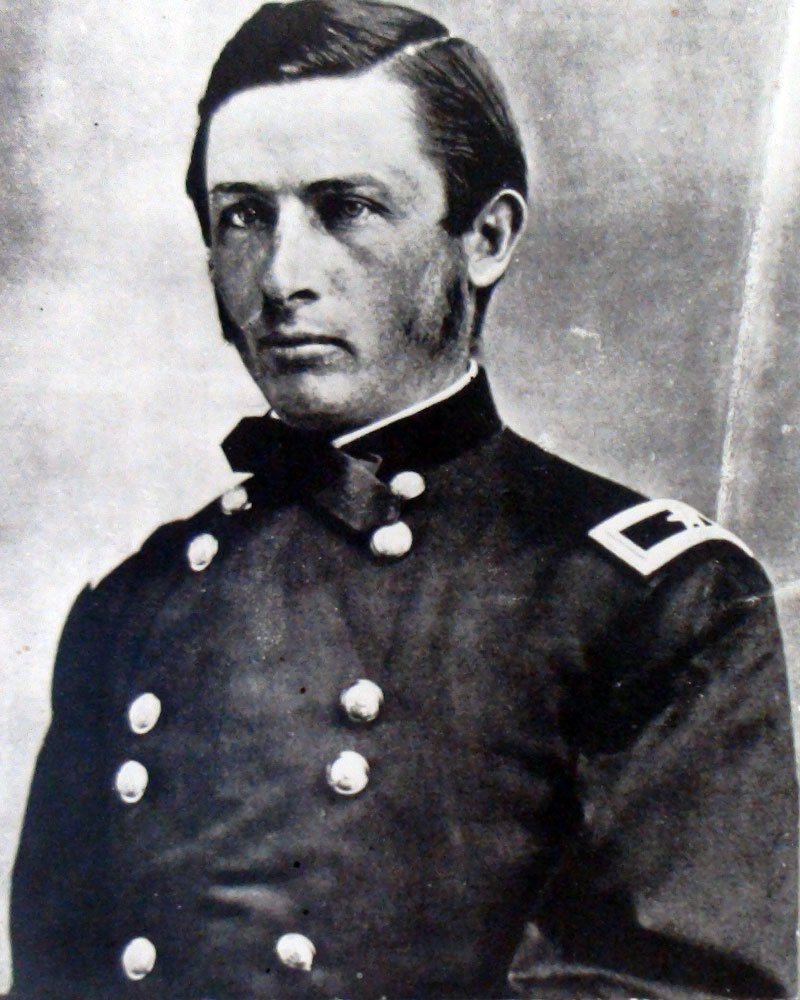 | |||
| Colonel Ranald S. Mackenzie. Source: Thomet Daniel 2010. | |||
| Begin of 1875 | At the beginning of the year, White Horse and his Dog Soldiers came to Darlington, Oklahoma (Indian Territory) and surrendered. Later, Stone Calf also surrendered. The Indians were held as prisoners of war and supplied with rations. In the spring of 1875, Colonel Neal had all the male Indians rounded up and 25 of them locked up in a guardhouse. Mexicans had reported that Indians had committed raids in Mexico. The 25 Indians were later brought to Florida via Fort Sill and remained there for 5 years. Some Indians died in Florida, the survivors were allowed to return to Indian Territory. Meanwhile, the younger men in the Indian Territory were forced to attend school in Carlisle (Pennsylvania) to learn English. Afterwards, they were also allowed to return to Indian Territory. | Southern Cheyenne (Cheyenne) Southern Cheyenne (Cheyenne) | White Horse Stone Calf |
| 6 April 1875 | Battle of Dark Water Creek 1875 - Southern Cheyenne Exodus 1875 - 167 Southern Cheyenne under Chief Little Bull camped on the Canadian River. The Southern Cheyenne had spent the winter away from the Darlington Reservation. Riders from White Horse's camp brought word that Indians were being captured on the Darlington Reservation and taken to Florida. Little Bull decided to break camp and join the Northern Cheyenne in the Black Hills. All the Southern Cheyenne were already living on reservations and could no longer continue their traditional life. The Northern Cheyenne were still living freely on the prairie. | Southern Cheyenne (Cheyenne) Southern Cheyenne (Cheyenne) | White Bear Little Bull |
| 8 April 1875 | Battle of Dark Water Creek 1875 - Southern Cheyenne Exodus 1875 - Near Fort Wallace on Punished Woman Creek, the fleeing Cheyenne stole several head of cattle. As a result, the troops of Fort Wallace knew that the fleeing Cheyenne were in the area. | Southern Cheyenne (Cheyenne) Southern Cheyenne (Cheyenne) | White Bear Little Bull |
| 10 April 1875 | Battle of Dark Water Creek 1875 - Southern Cheyenne Exodus 1875 - Lt. Austin Henely leaves Fort Wallace with Company A of the 6th U.S. Cavalry in pursuit of the fleeing Southern Cheyenne. | Southern Cheyenne (Cheyenne) Southern Cheyenne (Cheyenne) | White Bear Little Bull |
| Middle of April 1875 | Battle of Dark Water Creek 1875 - Southern Cheyenne Exodus 1875 - The Cheyenne attacked a hunting camp of 4 whites. The Whites escaped and joined the troops of the 6th U.S. Cavalry. This raid put the 6th U.S. Cavalry back on the trail of the fleeing Cheyenne. | Southern Cheyenne (Cheyenne) Southern Cheyenne (Cheyenne) | White Bear Little Bull |
| 23 April 1875 | Battle of Dark Water Creek 1875 - Southern Cheyenne Exodus 1875 - The village of Little Bull was attacked in the morning by 40 well-armed soldiers of the 6th US Cavalry. 19 warriors and 8 women and children died in the attack, including the Little Bull chief. Most of the villagers were able to flee. A group of Cheyenne were unable to flee the village in time and dug themselves into a nearby hill. This group resisted for about 3 hours and was finally overrun by the soldiers. None of the Cheyenne survived. 2 soldiers were killed. 140 Native American ponies were shot. It was the last battle of the Southern Cheyenne against the troops of the US Army. | Southern Cheyenne (Cheyenne) Southern Cheyenne (Cheyenne) | White Bear Little Bull |
| 23 April 1875 | Battle of Dark Water Creek 1875 - Southern Cheyenne Exodus 1875 - The village of Little Bull was attacked in the morning by 40 well-armed soldiers of the 6th US Cavalry. 19 warriors and 8 women and children died in the attack, including the Little Bull chief. Most of the villagers were able to flee. A group of Cheyenne could not flee the village in time and dug themselves into a nearby hill. This group resisted for about 3 hours and was finally overrun by the soldiers. None of the Cheyenne survived. 2 soldiers were killed. 140 Native American ponies were shot. It was the last battle of the Southern Cheyenne against the troops of the US Army. | Southern Cheyenne (Cheyenne) Southern Cheyenne (Cheyenne) | White Bear Little Bull |
| Summer 1875 | Sitting Bull arranged a sun dance meeting with the Northern Cheyenne to win them as allies in the fight against the rising tide of the whites. The Northern Cheyenne had always fought and hunted with the Oglala and Miniconjou, but not with the Hunkpapa who lived further north. | Hunkpapa (Lakota) Oglala (Lakota) Oglala (Lakota) Sans Arc (Lakota) Miniconjou (Lakota) Northern Cheyenne (Cheyenne) Northern Cheyenne (Cheyenne) | Sitting Bull Black Twin Crazy Horse Spotted Eagle Little Wolf White Bull |
 | |||
| Lakota sun dance. Source: http://lib.fit.edu/print.php?app=librarydisplays | |||
| Begin of March 1876 | Hunkpapa and Northern Cheyenne laid siege to Fort Pease near the present-day town of Bozeman from the fall of 1875 to the late winter of 1876, killing six of the two dozen or so civilians present and wounding eight men. Following a call for help, infantry and cavalry from Fort Ellis under the command of Major James S. Brisbin arrived at the fort in early March 1876. The fort was abandoned and the surviving civilians were taken to Fort Ellis by the troops. | Hunkpapa (Lakota) Northern Cheyenne (Cheyenne) | Sitting Bull |
| Begin of March 1876 | Reynolds Battle 1876 - Bighorn Expedition March 1876 - The Northern Cheyenne under their chiefs Old Bear, Box Elder and Black Eagle led a village of about 60 tents from the Tongue River to the Powder River, about 40 miles north of the mouth of the Little Powder River. Among them were about ten Oglala tents under He Dog and some Miniconjou-Lakota. There must have been a total of around 735 people in the camp, of whom around 210 were men of military age. The camp was visited several times by other Cheyenne chiefs who warned the Cheyenne chiefs present that soldiers would come to their village and attack them, such as Spotted Wolf, Medicine Wolf, Twin and Little Wolf. | Northern Cheyenne (Cheyenne) Northern Cheyenne (Cheyenne) Northern Cheyenne (Cheyenne) Miniconjou (Lakota) Oglala (Lakota) Northern Cheyenne (Cheyenne) Northern Cheyenne (Cheyenne) Northern Cheyenne (Cheyenne) Northern Cheyenne (Cheyenne) | Old Bear Box Elder Black Eagle He Dog Little Wolf Twin Medicine Wolf Spotted Wolf |
| 3 November 1875 | Bighorn Expedition March 1876 - Treaty of Fort Laramie 1868A meeting was held at the White House in Washington with President Ulysses Grant, Generals Philip Sheridan and George Crook, Secretary of Defense William Belknap and senior civilian representatives to find a solution to the Sioux problem. The following decisions were made: - The government will continue to officially prohibit the operation of gold mines in Montana, but will not take action on its own initiative. In other words: The government prohibits something, but knows that the prohibition is not being observed, but does nothing about it - Infantry and cavalry under Captain Robert Pollack - The Lakota who are still free are asked to leave their land and move to the Great Sioux Reservation like the southern Lakota. This measure was also recorded in writing in the Treaty of Fort Laramie in 1868, but not all of the Prairie Indians had adhered to this agreement. The war against the last free prairie Indians had nothing to do with the dispute over the Black Hills. The whites interpreted the constant raids by the Indians on the inhabitants of Montana and the attacks on peaceful Indians such as the Crow and Arikara as a violation of the Treaty of Fort Laramie in 1868. However, some chiefs of these last free prairie Indians had never signed this treaty and continued to move outside the reservations. In addition, reservation Indians were allowed to hunt outside the reservations as long as the game supply was large enough. | Hunkpapa (Lakota) Northern Cheyenne (Cheyenne) | Sitting Bull |
| 9 November 1875 | Reynolds Battle 1876 - Bighorn Expedition March 1876 - On March 1, the expedition under his command and that of Colonel Joseph Reynolds marched north from Fort Fetterman (Wyoming) in search of Indian villages. On March 17, 1876, Colonel Joseph Reynolds and six companies of cavalry raided a Northern Cheyenne and Oglala village on the Powder River north of the present-day village of Moorhead, Montana. Watkins, U.S. Indian Inspector, wrote an angry letter to Commissioner John Q. Smith. Watkins had previously traveled through North and South Dakota and eastern Montana. Watkins stated that this area was so rich in game that the Indians living there did not need food from the U.S. government and therefore had no reason to remain on the reservations. Watkins also recognized that the individual tribes were not led by a single chief. As a result, Red Cloud of the Oglala-Lakota signed the Fort Laramie Treaty in 1868, but other Oglala-Lakota chiefs such as Crazy Horse did not. Crazy Horse had no intention of going to the reservation and continued to live off the reservation.Watkins recommended that 1000 soldiers under the command of an experienced commander attack and subdue the Indians during the winter. In December 1875, Generals Sheridan, Crook and Terry agreed to Watkins' proposal. General George W. Crook now began planning a winter campaign against the Indians of the northern prairies. One result of this planning was the attack on a Northern Cheyenne village on the Powder River on March 17, 1876. | Northern Cheyenne (Cheyenne) Lakota | - |
| 6 December 1875 | Bighorn Expedition March 1876 - The Indian agents were instructed by the US government to send dispatch riders to the tribes and deliver the government's ultimatum: By January 31, 1876, all Indians on the reservations were to report and surrender. After this date, all Indians still living freely outside the reservations were to be regarded as hostile Indians and fought against. Under the given circumstances, it was impossible to meet this deadline. The winter of 1875/1876 went down in history as the coldest winter for a long time, with temperatures between -30 and -40 degrees below zero. The news reached the Cheyenne River Reservation (Miniconjou-Lakota) on December 20 and the Standing Rock Reservation (Hunkpapa-Lakota) on December 22. The Hunkpapa wintered at the mouth of the Powder River, the Northern Cheyenne, Sans Arc and Miniconjou at the Tongue River. | Hunkpapa (Lakota) Oglala (Lakota) Northern Cheyenne (Cheyenne) | Sitting Bull Gall Crazy Horse |
| Winter 1875 - 1876 | The Northern Cheyenne under their chief Dull Knife spent the winter with the Oglala at Red Cloud Agency No. 2. In the spring, the Cheyenne left the agency and moved along the Powder River. | Northern Cheyenne (Cheyenne) | Dull Knife |
| Winter 1875 - 1876 | Miniconjou's, Sans Arc's, Oglala's and Northern Cheyenne wintered west of the Powder River on the middle reaches of the Tongue River in Montana in the winter of 1875/1876. | Miniconjou (Lakota) Sans Arc (Lakota) Oglala (Lakota) Northern Cheyenne (Cheyenne) | - |
| Winter 1875 - 1876 | The Cheyenne camps were located south of the Yellowstone River along the Powder River and the Tongue River. According to the Treaty of Fort Laramie of 1868, the Cheyenne were allowed to hunt bison and harvest bison hides. A Cheyenne village was located on Otter Creek, which flows into the Tongue River near Ashland (Montana). | Northern Cheyenne (Cheyenne) | - |
| 1 February 1876 | Reynolds Battle 1876 - The ultimatum passed without the Indians settling on the reservation. Only a small number of the Indians found their way onto the reservation. General Sherman's army was now ordered to drive the Indians onto the reservations. General George Crook was stationed in Omaha at the time, General Alfred Terry in St. Paul, Minnesota). General Sherman's plan called for the entry of three units into Lakota territory:. - From Fort Abraham Lincoln in eastern North Dakota, General Alfred Terry was to ride towards the Yellowstone River with 2,000 soldiers. He was to be accompanied by Lieutenant Colonel George Armstrong Custer with his 7th Regiment. - Colonel Gibbon was to set off from Fort Ellis in Montana with 1,300 soldiers. He was to meet General Alfred Terry at the Yellowstone River. - From the south, General George Crook was to advance north from Fort Fetterman with about 1,000 soldiers. The army was supported by Crow and Shoshone scouts. However, the first concrete action was to come from General George W. Crook, who attacked a Northern Cheyenne village on the Powder River on March 17, 1876. | Hunkpapa (Lakota) Hunkpapa (Lakota) Oglala (Lakota) Northern Cheyenne (Cheyenne) | Sitting Bull Gall Crazy Horse |
| End of February 1876 | Reynolds Battle 1876 - Bighorn Expedition March 1876 - The Northern Cheyenne under their chiefs Old Bear, Box Elder and Black Eagle led a village of about 60 tents from the Tongue River to the Powder River, about 40 miles north of the mouth of the Little Powder River. Among them were about ten Oglala tents under He Dog and some Miniconjou-Lakota. There must have been a total of around 735 people in the camp, of whom around 210 were men of military age. The camp was visited several times by other Cheyenne chiefs who warned the Cheyenne chiefs present that soldiers were coming to their village and would attack them, including Spotted Wolf, Medicine Wolf, Twin and Little Wolf. Red Cloud sent Crawler of the Red Cloud Agency to the Northern Cheyenne village and Oglala. Crawler asked He Dog, the Oglala chief, to return to the Red Cloud Agency. | Northern Cheyenne (Cheyenne) Northern Cheyenne (Cheyenne) Northern Cheyenne (Cheyenne) Miniconjou (Lakota) Oglala (Lakota) Northern Cheyenne (Cheyenne) Northern Cheyenne (Cheyenne) Northern Cheyenne (Cheyenne) Northern Cheyenne (Cheyenne) Northern Cheyenne (Cheyenne) | Old Bear Box Elder Black Eagle He Dog Little Wolf Twin Medicine Wolf Last Bull Spotted Wolf |
| 17 March 1876 | Reynolds Battle 1876 - Bighorn Expedition March 1876 - At 9:00 a.m. on the morning of March 17, 1876, Companies K under Captain James Egan and I under Captain Noyes Henry attacked the Cheyenne and Oglala village from positions about a half mile from the mouth of Thompson Creek. Company K was to ride through the village to the northern edge of the village. Company I was to occupy the southern edge of the village and, with the scouts, keep the horses away from the Indians, round them up and guard them. | Northern Cheyenne (Cheyenne) Northern Cheyenne (Cheyenne) Oglala (Lakota) Northern Cheyenne (Cheyenne) Northern Cheyenne (Cheyenne) Northern Cheyenne (Cheyenne) Northern Cheyenne (Cheyenne) | Old Bear Box Elder He Dog Black Eagle Two Moons Wooden Leg Little Wolf |
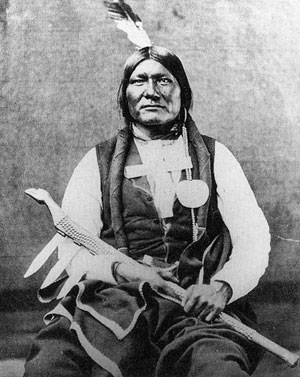 | |||
| He Dog, Oglala Chief 1877 Source: Wikipedia. | |||
| 17 March 1876 | Reynolds Battle 1876 - Bighorn Expedition March 1876 - Company K under Captain Egan, which was approaching from the southern edge of the village, met the soldiers of Company M under Captain Anson Mills, who were approaching from the west, just above the southern edge of the village at around 9.30 in the morning. Both companies continued their attack together towards the northern edge of the village, which was now almost completely deserted. | Northern Cheyenne (Cheyenne) Northern Cheyenne (Cheyenne) Oglala (Lakota) Northern Cheyenne (Cheyenne) Northern Cheyenne (Cheyenne) Northern Cheyenne (Cheyenne) Northern Cheyenne (Cheyenne) | Old Bear Box Elder He Dog Black Eagle Two Moons Wooden Leg Little Wolf |
| 17 March 1876 | Reynolds Battle 1876 - Bighorn Expedition March 1876 - Companies E under the command of 1st Lieutenant Rawolle William and F under the command of Captain Moore Alexander took up positions 'under the bluff' on the orders of Reynolds. As the terrain could not be sufficiently reconnoitred before the battle began, Moore did not find his way around the terrain as desired and took up a position too far from the village. Moore should probably have taken up a position on the northern edge of the village to prevent the Indians from fleeing along Flood Creek or to the northeast. Nevertheless, the soldiers fired on the village, which was about 1100 yards away. However, the Springfield Model 1873 carbine only had a maximum range of 600 yards. | Northern Cheyenne (Cheyenne) Northern Cheyenne (Cheyenne) Oglala (Lakota) Northern Cheyenne (Cheyenne) Northern Cheyenne (Cheyenne) Northern Cheyenne (Cheyenne) Northern Cheyenne (Cheyenne) | Old Bear Box Elder He Dog Black Eagle Two Moons Wooden Leg Little Wolf |
| 17 March 1876 | Reynolds Battle 1876 - Bighorn Expedition March 1876 - The attack by Egan and Mill caused almost all the Indians in the village to flee to the northern edge of the village. From there, the fleeing Indians were taken under fire by a small group of soldiers from Company E under Major Stanton (chief of scouts), 2nd Lieutenant Frederick Sibley and five soldiers. Stanton's men were originally in the positions of Moore's two companies and set out to reconnoiter a position closer to the village. The remaining soldiers of Companies E and F, under the command of Captain Moore Alexander, were still on a hill about a mile west of Powder River, not actively engaged in the battle. Stanton realized that one man could not stop the Indians and rode into the village to join Companies K and M. Moore's Companies E and F also rode into the village. Lt. Rawolle joined Company M under Captain Mills, while Company F under Moore stood to the south of Company E. | Northern Cheyenne (Cheyenne) Northern Cheyenne (Cheyenne) Oglala (Lakota) Northern Cheyenne (Cheyenne) Northern Cheyenne (Cheyenne) Northern Cheyenne (Cheyenne) Northern Cheyenne (Cheyenne) | Old Bear Box Elder He Dog Black Eagle Two Moons Wooden Leg Little Wolf |
| 17 March 1876 | Reynolds Battle 1876 - Bighorn Expedition March 1876 - By about 10 o'clock the village was in the hands of the soldiers, and a large number of the Indians' ponies had been rounded up on the southern edge of the village. Reynolds now ordered them to collect hides and meat from the tents and then burn them down. The village consisted of about 105 tents. However, when Reynolds realized that he probably did not have enough soldiers under his command to fend off an imminent attack by the Indians with part of his command and at the same time separate the meat and hides with the rest of his command and then burn down the village, he ordered the complete destruction of the village a short time later. Reynolds wanted to leave the village as quickly as possible and go to a safer place, i.e. march to Lodge Pole Creek to meet with General Crook. The soldiers also destroyed large quantities of ammunition belonging to the Indians, which they had probably obtained from the Red Cloud Agency. The soldiers were also surprised by the large number of chickens (!) and dogs they found in the village. | Northern Cheyenne (Cheyenne) Northern Cheyenne (Cheyenne) Oglala (Lakota) Northern Cheyenne (Cheyenne) Northern Cheyenne (Cheyenne) Northern Cheyenne (Cheyenne) Northern Cheyenne (Cheyenne) | Old Bear Box Elder He Dog Black Eagle Two Moons Wooden Leg Little Wolf |
| 17 March 1876 | Reynolds Battle 1876 - Bighorn Expedition March 1876 - Around 11 a.m., the Indians returned and began shooting at Reynolds' soldiers. The first casualty was Private Jeremiah Murphy of Company M. Shortly afterward, Private Peter Dowty of Company E was hit in the head in the northwest part of the village and was killed instantly. Companies M and E were positioned on the northern edge of the village and formed a line of battle to fend off the Indians. Since the sharpshooters of Rawolle's company had been ordered to help guard the horses, the Indians occupied this position and began firing into the village at the soldiers. Around noon, another man from Anson Mills' Company M was hit and wounded by an Indian bullet. Sgt. Charles Kaminski was hit in the left thigh just above the knee. Later, Private Michael McCannon of Company F was fatally shot in the head. | Northern Cheyenne (Cheyenne) Northern Cheyenne (Cheyenne) Oglala (Lakota) Northern Cheyenne (Cheyenne) Northern Cheyenne (Cheyenne) Northern Cheyenne (Cheyenne) Northern Cheyenne (Cheyenne) | Old Bear Box Elder He Dog Black Eagle Two Moons Wooden Leg Little Wolf |
| 17 March 1876 | Reynolds Battle 1876 - Bighorn Expedition March 1876 - At around 2 p.m., the soldiers under Reynolds left the Northern Cheyenne and Oglala village, which had been burned down in the meantime. From the surrounding hills, the Cheyenne and Oglala watched the retreating soldiers and later returned to the burned village. Four soldiers died from the Indians' bullets. The dead soldiers were buried under the ice cover of the frozen Powder River. Private Lorenzo Ayers was shot in the back of the head and killed by Bear Head. No one in Reynolds' command knew exactly what had happened to Ayers, where he was and whether he was still alive. Three other soldiers were wounded. With no concern for the whereabouts of Private Lorenzo Ayers, Reynolds' command began the march out of the destroyed village toward Lodge Pole Creek. | Northern Cheyenne (Cheyenne) Northern Cheyenne (Cheyenne) Oglala (Lakota) Northern Cheyenne (Cheyenne) Northern Cheyenne (Cheyenne) Northern Cheyenne (Cheyenne) Northern Cheyenne (Cheyenne) | Old Bear Box Elder He Dog Black Eagle Two Moons Wooden Leg Little Wolf |
| 17 March 1876 | Reynolds Battle 1876 - Bighorn Expedition March 1876 - Reynolds and Anson Mills' battalion (Companies M and K) reached the mouth of Lodge Pole Creek in the Powder River around sunset. Egan and Moore arrived around 9:00 pm. Rawolle arrived around 21:30. Crook was not there as arranged. The Indians' ponies were driven into the area south of the camp, but were not guarded there. This did not go unnoticed by the Northern Cheyenne and Oglala scouts. | Northern Cheyenne (Cheyenne) Northern Cheyenne (Cheyenne) Oglala (Lakota) Northern Cheyenne (Cheyenne) Northern Cheyenne (Cheyenne) Northern Cheyenne (Cheyenne) Northern Cheyenne (Cheyenne) | Old Bear Box Elder He Dog Black Eagle Two Moons Wooden Leg Little Wolf |
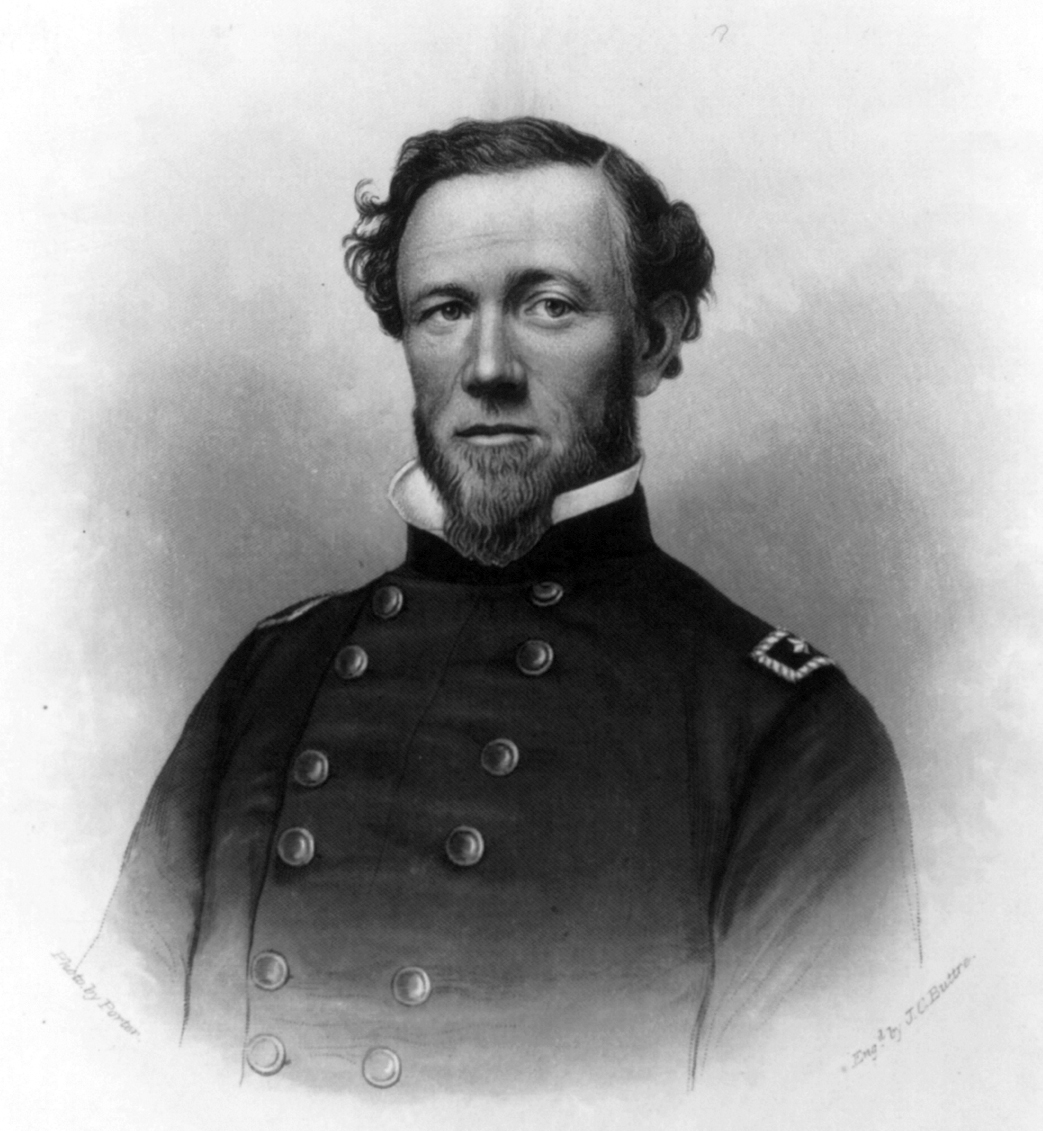 | |||
| Colonel John Joseph Reynolds. Source: Wikipedia | |||
| 17 March 1876 | Reynolds Battle 1876 - Bighorn Expedition March 1876 - He Dog, the Oglala chief, led the Oglala and Northern Cheyenne north towards Crazy Horse's village. At the same time, Oglala and Northern Cheyenne scouts followed the tracks of the soldiers riding south. | Northern Cheyenne (Cheyenne) Northern Cheyenne (Cheyenne) Oglala (Lakota) Northern Cheyenne (Cheyenne) Northern Cheyenne (Cheyenne) Northern Cheyenne (Cheyenne) Oglala (Lakota) Northern Cheyenne (Cheyenne) | Old Bear Box Elder He Dog Black Eagle Two Moons Wooden Leg Crazy Horse Little Wolf |
 | |||
| Chief He Dog of the Oglala. Source: Thomet Daniel 2010. | |||
| 18 March 1876 | Reynolds Battle 1876 - Bighorn Expedition March 1876 - Shortly after midnight, scouts from the Northern Cheyenne and Oglala drove away the unguarded ponies of the Indians. About 2/3 of the entire pony herd fell back into the possession of the Indians. The ponies were first driven south, then in a wide arc west past the soldiers' camp and finally further north. | Northern Cheyenne (Cheyenne) Northern Cheyenne (Cheyenne) Oglala (Lakota) Northern Cheyenne (Cheyenne) Northern Cheyenne (Cheyenne) Northern Cheyenne (Cheyenne) Northern Cheyenne (Cheyenne) | Old Bear Box Elder He Dog Black Eagle Two Moons Wooden Leg Little Wolf |
| 18 March 1876 | Reynolds Battle 1876 - Bighorn Expedition March 1876 - Reynolds troop doctor Dr. Curtis Munn had his hands full. Many soldiers had contracted frostbite on their toes, noses and fingers in the cold. It was not until shortly after 09:00 that the soldiers realized that the ponies were gone! At around 13:30, the commando under Reynolds left the camp at Lodge Pole Creek. There was too little grass for the horses and too little food and warm clothing for the soldiers. The blankets, hides and meat in the Northern Cheyenne and Oglala village were burned by the soldiers. | Northern Cheyenne (Cheyenne) Northern Cheyenne (Cheyenne) Oglala (Lakota) Northern Cheyenne (Cheyenne) Northern Cheyenne (Cheyenne) Northern Cheyenne (Cheyenne) Northern Cheyenne (Cheyenne) | Old Bear Box Elder He Dog Black Eagle Two Moons Wooden Leg Little Wolf |
| 19 March 1876 | Bighorn Expedition March 1876 - On the second night after the raid on their village, the Northern Cheyenne and Oglala scouts returned to the Indian camp. | Northern Cheyenne (Cheyenne) Northern Cheyenne (Cheyenne) Oglala (Lakota) Northern Cheyenne (Cheyenne) Northern Cheyenne (Cheyenne) Northern Cheyenne (Cheyenne) Northern Cheyenne (Cheyenne) | Old Bear Box Elder He Dog Black Eagle Two Moons Wooden Leg Little Wolf |
| 21 March 1876 | Bighorn Expedition March 1876 - The Northern Cheyenne and Oglala reached Crazy Horse's village. He Dog told Crazy Horse what had happened. Then the Oglala shared what little they had with the arriving Indians. It was decided in a council that they would defend themselves together against the US army. But they did not have enough food, weapons and ammunition. They decided to ride together to Sitting Bull's camp and join the Hunkpapa. Sitting Bull's camp was located on Spring Creek, a tributary of the Powder River, in the Chalk Buttes area. | Northern Cheyenne (Cheyenne) Northern Cheyenne (Cheyenne) Oglala (Lakota) Northern Cheyenne (Cheyenne) Northern Cheyenne (Cheyenne) Northern Cheyenne (Cheyenne) Oglala (Lakota) Northern Cheyenne (Cheyenne) | Old Bear Box Elder He Dog Black Eagle Two Moons Wooden Leg Crazy Horse Little Wolf |
| 27 March 1876 | Bighorn Expedition March 1876 - After a few days' march, the Northern Cheyenne and Oglala, led by Crazy Horse and He Dog, reached Sitting Bull's village. Once again, the guests were given the warmest of welcomes. The Hunkpapa shared everything they had with their guests. After about two days, they also left this camp and set off together for the Tongue River. These meetings were a turning point in the 'Great Sioux War' of 1876. From now on, all groups and tribes were united and began to fight together against the US army. Old Bear (Northern Cheyenne) and He Dog (Oglala) also joined the fight, although both chiefs had previously decided to go to the reservation. Until they were ambushed by Reynolds' troops in their village on the Powder River on March 17, 1876. | Northern Cheyenne (Cheyenne) Northern Cheyenne (Cheyenne) Oglala (Lakota) Northern Cheyenne (Cheyenne) Northern Cheyenne (Cheyenne) Northern Cheyenne (Cheyenne) Oglala (Lakota) Hunkpapa (Lakota) Northern Cheyenne (Cheyenne) | Old Bear Box Elder He Dog Black Eagle Two Moons Wooden Leg Crazy Horse Sitting Bull Little Wolf |
| Begin of April 1876 | Battle of Powder River 1876 - Sitting Bull's camp with 100 Hunkpapa and Miniconjou tents was located in Montana between the Powder River and the Little Missouri River. On April 1, after the attack by General George Crook on March 17, the Oglala and Miniconjou reached Sitting Bull's camp after a march of about 100 km. They had previously arrived at Crazy Horse's camp on the Little Powder River, but his camp consisted of only about 30 tents and Crazy Horse could not accommodate the many people. Alerted by the nearby soldiers, the Oglala under Crazy Horse broke down their tents and moved north with the refugees to find Sitting Bull's camp. Sitting Bull's camp grew to about 235 tents with perhaps 500 warriors. The refugees were warmly welcomed by Sitting Bull. Tents were set up in a circle in the middle of the camp. As soon as the refugees were discovered, Sitting Bull had kettles of meat set up. Women dragged kettle after kettle until the new guests could eat no more. Many brought gifts such as horses, tents, cooking utensils, etc. Many of the refugees never forgot the generosity of the Hunkpapa that day for the rest of their lives. In the subsequent war council, it was unanimously decided to stay together and fight. At that time, the Lakota and Northern Cheyenne, who considered themselves free Indians and never went to an agency or reservation, numbered about 3,400 people, including perhaps 1,000 warriors. These Indians lived in about 500 tents. The largest group was the Hunkpapa with about 154 tents. They were followed by the Cheyenne with 100 tents, 70 tents of the Oglala, 55 tents of the Sans Arc and 55 tents of the Miniconjou. There were also some Brule and Blackfeet tents. This group of free Indians was joined by the Dakota under Inkpaduta. Some Yanktonai also joined Sitting Bull. | Hunkpapa (Lakota) Oglala (Lakota) Miniconjou (Lakota) Northern Cheyenne (Cheyenne) Northern Cheyenne (Cheyenne) Wahpekute-Santee (Eastern Dakota) Blackfoot (Lakota) Brule (Lakota) Sans Arc (Lakota) Yanktonai (Western Dakota) Northern Cheyenne (Cheyenne) Northern Cheyenne (Cheyenne) | Sitting Bull Crazy Horse Two Moons Old Bear Inkpaduta Box Elder Black Eagle |
| Middle of April 1876 | The camp of the Indians under Sitting Bull and Crazy Horse grew to 360 tents. | Hunkpapa (Lakota) Oglala (Lakota) Miniconjou (Lakota) Northern Cheyenne (Cheyenne) Northern Cheyenne (Cheyenne) Wahpekute-Santee (Eastern Dakota) Blackfoot (Lakota) Brule (Lakota) Sans Arc (Lakota) Yanktonai (Western Dakota) Northern Cheyenne (Cheyenne) Northern Cheyenne (Cheyenne) | Sitting Bull Crazy Horse Two Moons Old Bear Inkpaduta Box Elder Black Eagle |
| Middle of May 1876 | The camp of the Indians under Sitting Bull and Crazy Horse had grown to 431 tents. In addition, there were Northern Cheyenne, Hunkpapa, Blackfeet and 15 tents of the Dakota and Yanktonai. | Hunkpapa (Lakota) Oglala (Lakota) Miniconjou (Lakota) Northern Cheyenne (Cheyenne) Northern Cheyenne (Cheyenne) Wahpekute-Santee (Eastern Dakota) Blackfoot (Lakota) Brule (Lakota) Sans Arc (Lakota) Yanktonai (Western Dakota) Northern Cheyenne (Cheyenne) Northern Cheyenne (Cheyenne) | Sitting Bull Crazy Horse Two Moons Old Bear Inkpaduta Box Elder Black Eagle |
| 4 June 1876 | The Indian camp under Sitting Bull and Crazy Horse had grown to 461 tents and comprised about 3,000 Indians, including about 800 warriors. The large Indian camp had crossed the Powder River and the Tongue River and marched to lower Rosebud Creek. The Indians simply followed the bison that were in the Yellowstone River area at the time. The Hunkpapa held a sun dance in the area of Deer Medicine Rock on Rosebud Creek (the site is about 2 miles north of Lame Deer on the left side of the road). During the Sun Dance, Sitting Bull had a vision: he saw many soldiers and horses invading an Indian village with their heads down. On the fourth day, the sun dance ended and the large camp moved on towards the Little Big Horn River. The long column of Indians was over half a mile wide and so long that the Hunkpapa, who formed the end of the column, only arrived when the Cheyenne ahead of them had already set up camp and eaten. This large camp could only stay in one place for 2 to 5 days, by which time all the grass in the area had been eaten by the horses and the firewood had been used up. At this point, the chiefs met and decided where to move the camp based on the movements of the bison. Up to this point, only a few Indians had arrived from the reservations. But they were due to arrive as soon as the grass was high enough. This year, the first green grasses were not visible until the last week of April and it was not until the end of May that conditions on the prairie would allow normal travel. | Hunkpapa (Lakota) Hunkpapa (Lakota) Oglala (Lakota) Oglala (Lakota) Miniconjou (Lakota) Miniconjou (Lakota) Miniconjou (Lakota) Northern Cheyenne (Cheyenne) Northern Cheyenne (Cheyenne) Northern Cheyenne (Cheyenne) Northern Cheyenne (Cheyenne) Hunkpapa (Lakota) Oglala (Lakota) Wahpekute-Santee (Eastern Dakota) Blackfoot (Lakota) Brule (Lakota) Sans Arc (Lakota) Yanktonai (Western Dakota) Northern Cheyenne (Cheyenne) Northern Cheyenne (Cheyenne) | Sitting Bull Black Moon Crazy Horse Big Road Lame Deer Fast Bull Hump Two Moons Lame White Man Dirty Moccasins Old Bear Sitting Bull Crazy Horse Inkpaduta Kill Eagle Spotted Eagle Box Elder Black Eagle |
 | |||
| The Deer Medicine Rocks can be seen on the right. The vision of Sitting Bull is engraved in the rocks. The vision of Crazy Horse's death is engraved in the rock formation on the left. Source: Thomet Daniel 2010. | |||
| 7 June 1876 | Crook's command was camped about three miles southeast of present-day Decker, Montana, at the confluence of Prairie Dog Creek and the Tongue River. The camp site itself was less than a mile from the Montana-Wyoming border in Wyoming. | Hunkpapa (Lakota) Hunkpapa (Lakota) Oglala (Lakota) Oglala (Lakota) Miniconjou (Lakota) Miniconjou (Lakota) Miniconjou (Lakota) Northern Cheyenne (Cheyenne) Northern Cheyenne (Cheyenne) Northern Cheyenne (Cheyenne) Northern Cheyenne (Cheyenne) Hunkpapa (Lakota) Oglala (Lakota) Wahpekute-Santee (Eastern Dakota) Blackfoot (Lakota) Brule (Lakota) Sans Arc (Lakota) Yanktonai (Western Dakota) Northern Cheyenne (Cheyenne) Northern Cheyenne (Cheyenne) | Sitting Bull Black Moon Crazy Horse Big Road Lame Deer Fast Bull Hump Two Moons Lame White Man Dirty Moccasins Old Bear Sitting Bull Crazy Horse Inkpaduta Kill Eagle Spotted Eagle Box Elder Black Eagle |
| 9 June 1876 | Crook's detachment was attacked at their campsite by Northern Cheyenne from the Rosebud camp, but the Indians were easily repulsed. Little Hawk attempted to drive the soldiers' horses away, but was quickly driven back by the soldiers' heavy rifle fire. Crook's soldiers reported as many as 900 Indians attacking the soldiers, while Little Hawk's force numbered less than a dozen warriors. | Hunkpapa (Lakota) Hunkpapa (Lakota) Oglala (Lakota) Oglala (Lakota) Miniconjou (Lakota) Miniconjou (Lakota) Miniconjou (Lakota) Northern Cheyenne (Cheyenne) Northern Cheyenne (Cheyenne) Northern Cheyenne (Cheyenne) Northern Cheyenne (Cheyenne) Hunkpapa (Lakota) Oglala (Lakota) Wahpekute-Santee (Eastern Dakota) Blackfoot (Lakota) Brule (Lakota) Sans Arc (Lakota) Yanktonai (Western Dakota) Northern Cheyenne (Cheyenne) Northern Cheyenne (Cheyenne) | Sitting Bull Black Moon Crazy Horse Big Road Lame Deer Fast Bull Hump Two Moons Lame White Man Dirty Moccasins Old Bear Sitting Bull Crazy Horse Inkpaduta Kill Eagle Spotted Eagle Box Elder Black Eagle |
| 12 June 1876 - 14 June 1876 | After the Sun Dance, the large Indian camp moved southward to the mouth of David Creek at Rosebud Creek, about 3 miles south of Busby, Montana. | Hunkpapa (Lakota) Hunkpapa (Lakota) Oglala (Lakota) Oglala (Lakota) Miniconjou (Lakota) Miniconjou (Lakota) Miniconjou (Lakota) Northern Cheyenne (Cheyenne) Northern Cheyenne (Cheyenne) Northern Cheyenne (Cheyenne) Northern Cheyenne (Cheyenne) Northern Cheyenne (Cheyenne) Wahpekute-Santee (Eastern Dakota) Blackfoot (Lakota) Brule (Lakota) Sans Arc (Lakota) Yanktonai (Western Dakota) Northern Cheyenne (Cheyenne) Northern Cheyenne (Cheyenne) | Sitting Bull Black Moon Crazy Horse Big Road Lame Deer Fast Bull Hump Two Moons Lame White Man Dirty Moccasins Old Bear Crazy Head Inkpaduta Kill Eagle Spotted Eagle Box Elder Black Eagle |
| 15 June 1876 | General George Crook's command was reinforced by 175 Crow warriors and 86 Shoshone warriors. The Crow and Shoshone served Crook as scouts. | Hunkpapa (Lakota) Hunkpapa (Lakota) Oglala (Lakota) Oglala (Lakota) Miniconjou (Lakota) Miniconjou (Lakota) Miniconjou (Lakota) Northern Cheyenne (Cheyenne) Northern Cheyenne (Cheyenne) Northern Cheyenne (Cheyenne) Northern Cheyenne (Cheyenne) Northern Cheyenne (Cheyenne) Hunkpapa (Lakota) Oglala (Lakota) Wahpekute-Santee (Eastern Dakota) Blackfoot (Lakota) Brule (Lakota) Sans Arc (Lakota) Shoshone Crow Crow Crow Yanktonai (Western Dakota) Northern Cheyenne (Cheyenne) Northern Cheyenne (Cheyenne) | Sitting Bull Black Moon Crazy Horse Big Road Lame Deer Fast Bull Hump Two Moons Lame White Man Dirty Moccasins Old Bear Crazy Head Sitting Bull Crazy Horse Inkpaduta Kill Eagle Spotted Eagle Washakie Old Crow Medicine Crow Good Heart Box Elder Black Eagle |
| 16 June 1876 | General George Crook's command left the camp at Goose Creek at 6 a.m. and set off in search of the Indian village. Beforehand, the infantry soldiers received one day of riding training and were provided with horses. Crook wanted to speed up the progress of his army. All the wagons were left behind in the camp. Each soldier had a blanket, 100 rounds of ammunition and rations for four days. 6 miles north of the camp, Crook's army crossed the Tongue River and rode north along the Tongue River until noon. Then the army turned west toward Rosebud Creek. In the evening at 7 p.m. Crook's army camped near the source of the Rosebud River. | Hunkpapa (Lakota) Hunkpapa (Lakota) Oglala (Lakota) Oglala (Lakota) Miniconjou (Lakota) Miniconjou (Lakota) Miniconjou (Lakota) Northern Cheyenne (Cheyenne) Northern Cheyenne (Cheyenne) Northern Cheyenne (Cheyenne) Northern Cheyenne (Cheyenne) Northern Cheyenne (Cheyenne) Hunkpapa (Lakota) Oglala (Lakota) Wahpekute-Santee (Eastern Dakota) Blackfoot (Lakota) Brule (Lakota) Sans Arc (Lakota) Shoshone Crow Crow Crow Yanktonai (Western Dakota) Northern Cheyenne (Cheyenne) Northern Cheyenne (Cheyenne) | Sitting Bull Black Moon Crazy Horse Big Road Lame Deer Fast Bull Hump Two Moons Lame White Man Dirty Moccasins Old Bear Crazy Head Sitting Bull Crazy Horse Inkpaduta Kill Eagle Spotted Eagle Washakie Old Crow Medicine Crow Good Heart Box Elder Black Eagle |
| 15 June 1876 | After June 14, the large Indian camp moved south along Davis Creek and then back northwest along Reno Creek to about where South Fork Reno Creek empties into Reno Creek. This was the center of the large camp. The camp extends from the center about 2 miles to the west and east. | Hunkpapa (Lakota) Hunkpapa (Lakota) Oglala (Lakota) Oglala (Lakota) Miniconjou (Lakota) Miniconjou (Lakota) Miniconjou (Lakota) Northern Cheyenne (Cheyenne) Northern Cheyenne (Cheyenne) Northern Cheyenne (Cheyenne) Northern Cheyenne (Cheyenne) Northern Cheyenne (Cheyenne) Wahpekute-Santee (Eastern Dakota) Blackfoot (Lakota) Brule (Lakota) Sans Arc (Lakota) Yanktonai (Western Dakota) Northern Cheyenne (Cheyenne) Northern Cheyenne (Cheyenne) | Sitting Bull Black Moon Crazy Horse Big Road Lame Deer Fast Bull Hump Two Moons Lame White Man Dirty Moccasins Old Bear Crazy Head Inkpaduta Kill Eagle Spotted Eagle Box Elder Black Eagle |
| 16 June 1876 | Little Hawk of the Northern Cheyenne rode at night with 4 warriors from the camp at Reno Creek over the Wolf Mountains to Rosebud Creek to steal horses. Arriving at Rosebud Creek, the 5 warriors killed a buffalo. While roasting the meat over a fire, they spotted the approaching soldiers and rode back to their camp at Reno Creek. The chiefs decided not to attack the soldiers. But during the night, around 500 Lakota and Cheyenne broke out of the camp at Reno Creek and rode towards the Rosebud River. Sitting Bull and Crazy Horse followed the young warriors on the morning of June 17. According to another version (see the book 'With Crook at the Rosenbud'), Crazy Hose ordered the older chiefs to stay in the village and look after the women, children and old people, while the majority of the warriors were to ride out to meet the soldiers and drive them away. Soon different groups rode out of the village on different routes and under different leaders to meet the soldiers. Gall and Crow King (Hunkpapa) were not yet in the big camp at this time. The Indians were armed with 1866 Winchester repeating rifles in 0.44 caliber, Spencer carbines, Henry repeating rifles, older Sharps rifles and older muzzleloaders. | Hunkpapa (Lakota) Hunkpapa (Lakota) Oglala (Lakota) Oglala (Lakota) Miniconjou (Lakota) Miniconjou (Lakota) Miniconjou (Lakota) Northern Cheyenne (Cheyenne) Northern Cheyenne (Cheyenne) Northern Cheyenne (Cheyenne) Northern Cheyenne (Cheyenne) Northern Cheyenne (Cheyenne) Wahpekute-Santee (Eastern Dakota) Blackfoot (Lakota) Brule (Lakota) Sans Arc (Lakota) Yanktonai (Western Dakota) Northern Cheyenne (Cheyenne) Northern Cheyenne (Cheyenne) | Sitting Bull Black Moon Crazy Horse Big Road Lame Deer Fast Bull Hump Two Moons Lame White Man Dirty Moccasins Old Bear Crazy Head Inkpaduta Kill Eagle Spotted Eagle Box Elder Black Eagle |
| 17 June 1876 | About 1,000 Lakota met about 1,000 soldiers in the morning, including 15 companies of cavalry (2nd and 3rd Cavalry Regiments) and 5 companies of infantry (4th and 9th Infantry Regiments), as well as 262 Crow and Shoshone scouts from General George Crook. In the afternoon, after 6 hours, the Indians gave up the fight, leaving 13 dead. Crazy Horse gave the total losses as 39 dead Indians and 63 wounded. Crook's losses amounted to 28 dead and 56 wounded. The scouts refused to advance any further into Sioux territory. Crook then retreated south to his camp on Goose Creek (in the area of present-day Sheridan, Wyoming) and from then on no longer took part in the summer campaign against the Sioux and Cheyenne. The Indians celebrated their success in the following days and gathered in their camp on the Little Big Horn River. Without the Crow and Shoshone scouts, Crook's soldiers would probably have been crushed at the first attempt; the scouts fought doggedly and selflessly for their chiefs. The camp on the Little Big Horn River received a massive influx of Indians from the reservations. The number of tents doubled in a short space of time. It is estimated that the camp grew by more than 4,000 Indians within 6 days. As always, the Hunkpapa were camped at the southern end, followed by the Oglala, the Miniconjou, the Sans Arc and the Two Kettle with some Arapaho. The Cheyenne were camped at the far north. | Hunkpapa (Lakota) Hunkpapa (Lakota) Oglala (Lakota) Oglala (Lakota) Miniconjou (Lakota) Miniconjou (Lakota) Miniconjou (Lakota) Northern Cheyenne (Cheyenne) Northern Cheyenne (Cheyenne) Northern Cheyenne (Cheyenne) Northern Cheyenne (Cheyenne) Wahpekute-Santee (Eastern Dakota) Blackfoot (Lakota) Brule (Lakota) Sans Arc (Lakota) Yanktonai (Western Dakota) Northern Cheyenne (Cheyenne) Northern Cheyenne (Cheyenne) Oglala (Lakota) Shoshone Crow Crow Crow | Sitting Bull Black Moon Crazy Horse Big Road Lame Deer Fast Bull Hump Two Moons Lame White Man Dirty Moccasins Old Bear Inkpaduta Kill Eagle Spotted Eagle Box Elder Black Eagle Good Weasel Washakie Old Crow Medicine Crow Good Heart |
 | |||
| The Rosebud Battlefield as seen from General George Crook's headquarters. The soldiers were camped on Rosebud Creek in the background. Source: Thomet Daniel 2010. | |||
| 18 June 1876 | Crook's troops started the march back to Fort Fetterman ('Camp on the Goose Creek') in the early morning. Soldiers and scouts had already buried their dead in the vicinity of the camp the evening before after the battle. The retreating soldiers could see the Lakota and Cheyenne watching the soldiers' departure from a distance. However, the Indians no longer attacked the retreating soldiers. Shortly after leaving the camp, Crow scouts found a dead Laktoa warrior with a gunshot wound to the chest. The Crow scouts decapitated and scalped the man, cutting off his ears, fingers, nose and toes. Further mutilations were prevented when Captain John A. Satorius (a Swiss!) and some men put an end to the goings-on. After a march of about 22 miles, Crook probably camped at the source of a tributary of the Tongue River on the Montana-Wyoming border. That evening, the Crow scouts left Crook's camp with the promise to return in 15 days. | Crow Shoshone Oglala (Lakota) Oglala (Lakota) Miniconjou (Lakota) Miniconjou (Lakota) Miniconjou (Lakota) Crow Crow Northern Cheyenne (Cheyenne) Northern Cheyenne (Cheyenne) Northern Cheyenne (Cheyenne) Northern Cheyenne (Cheyenne) Wahpekute-Santee (Eastern Dakota) Blackfoot (Lakota) Brule (Lakota) Sans Arc (Lakota) Yanktonai (Western Dakota) Northern Cheyenne (Cheyenne) Northern Cheyenne (Cheyenne) Oglala (Lakota) | Old Crow Washakie Crazy Horse Big Road Lame Deer Fast Bull Hump Medicine Crow Good Heart Two Moons Lame White Man Dirty Moccasins Old Bear Inkpaduta Kill Eagle Spotted Eagle Box Elder Black Eagle Good Weasel |
| 21 June 1876 | Terry, Gibbon and Custer met on the Yellowstone River at the mouth of the Rosebud River. On the steamboat 'Far West', the 3 commanders discussed their mission. General Alfred Terry was in overall command. He ordered the operation as follows: Custer was to ride south along the Rosebud River and then west to the Little Bighorn River. Terry himself was to ride with Gibbon along the Yellowstone River to the mouth of the Bighorn River and then along the Bighorn River to the Little Bighorn River. The Indians were thought to be at the Little Bighorn. Custer also received 6 Crow scouts from Gibbon. The Crow knew the Little Big Horn area very well. | Hunkpapa (Lakota) Hunkpapa (Lakota) Oglala (Lakota) Oglala (Lakota) Miniconjou (Lakota) Miniconjou (Lakota) Miniconjou (Lakota) Northern Cheyenne (Cheyenne) Northern Cheyenne (Cheyenne) Northern Cheyenne (Cheyenne) Northern Cheyenne (Cheyenne) Wahpekute-Santee (Eastern Dakota) Blackfoot (Lakota) Brule (Lakota) Sans Arc (Lakota) Yanktonai (Western Dakota) Northern Cheyenne (Cheyenne) Northern Cheyenne (Cheyenne) | Sitting Bull Black Moon Crazy Horse Big Road Lame Deer Fast Bull Hump Two Moons Lame White Man Dirty Moccasins Old Bear Inkpaduta Kill Eagle Spotted Eagle Box Elder Black Eagle |
 | |||
| The steamship 'Far West'. Source: http://westerntrips.blogspot.com/2011/04/steamboat-and-indian-war.html | |||
| 22 June 1876 | In the afternoon, Custer began the march south along the Rosebud River with his 7th Cavalry Regiment. After 12 miles, the first camp was set up. On June 24, Custer reached the Indian camp at Deer Medicine Rock, where the Hunkpapa had held a sun dance on June 4. Custer's Crow scouts became restless. They had probably never seen such a large camp of Indians. The Indians' tracks suddenly became wider and looked fresher. They were the tracks of the Indians who had come from the reservations to join the Indians on the Little Bighorn River. Custer's division followed the tracks. As expected, the tracks pointed west. Custer wanted to lead his command over the Wolf Mountains in a night march from June 24 to 25, take a rest and have his scouts search for the Indian village in the meantime. | Hunkpapa (Lakota) Hunkpapa (Lakota) Oglala (Lakota) Oglala (Lakota) Miniconjou (Lakota) Miniconjou (Lakota) Miniconjou (Lakota) Northern Cheyenne (Cheyenne) Northern Cheyenne (Cheyenne) Northern Cheyenne (Cheyenne) Northern Cheyenne (Cheyenne) Wahpekute-Santee (Eastern Dakota) Blackfoot (Lakota) Brule (Lakota) Sans Arc (Lakota) Yanktonai (Western Dakota) Northern Cheyenne (Cheyenne) | Sitting Bull Black Moon Crazy Horse Big Road Lame Deer Fast Bull Hump Two Moons Lame White Man Dirty Moccasins Old Bear Inkpaduta Kill Eagle Spotted Eagle Box Elder |
 | |||
| Deer Medicine Rocks. Source: Thomet Daniel 2010 | |||
| 23 June 1876 | Custer's 7th US Cavalry was camped in the valley of Rosebud Creek, north of present-day Lame Deer, north of Deer Medicine Rocks. | Hunkpapa (Lakota) Hunkpapa (Lakota) Oglala (Lakota) Oglala (Lakota) Miniconjou (Lakota) Miniconjou (Lakota) Miniconjou (Lakota) Northern Cheyenne (Cheyenne) Northern Cheyenne (Cheyenne) Northern Cheyenne (Cheyenne) Northern Cheyenne (Cheyenne) Wahpekute-Santee (Eastern Dakota) Blackfoot (Lakota) Brule (Lakota) Sans Arc (Lakota) Yanktonai (Western Dakota) Northern Cheyenne (Cheyenne) | Sitting Bull Black Moon Crazy Horse Big Road Lame Deer Fast Bull Hump Two Moons Lame White Man Dirty Moccasins Old Bear Inkpaduta Kill Eagle Spotted Eagle Box Elder |
 | |||
| Memorial plaque in the valley of Rosebud Creek, north of Lame Deer. Custer camped here on June 23, 1876 Source: Thomet Daniel 2010. | |||
| 24 June 1876 | Custer's division was located in the Wolf Mountains east of the Little Big Horn River. Arikara and Crow scouts discovered the Indian camp in the early evening and tried to show Custer from a hill where the camp was located. This point is known today as 'Crow's Nest'. The scouts saw plumes of smoke from the village and the pony herd, which consisted of about 20,000 animals. Custer himself saw nothing. But Custer saw several groups of Indians on the surrounding hills. This is probably why Custer was convinced that he had already been discovered. Custer therefore decided to attack the Indian camp immediately. At 9:25 in the evening, Custer informed his commanders of the scouts' reports. Die Crows White Man Runs Him, Curley, Hairy Moccasin und Goes Ahead dienten Custer als Späher. | Hunkpapa (Lakota) Hunkpapa (Lakota) Oglala (Lakota) Oglala (Lakota) Miniconjou (Lakota) Miniconjou (Lakota) Miniconjou (Lakota) Northern Cheyenne (Cheyenne) Northern Cheyenne (Cheyenne) Northern Cheyenne (Cheyenne) Northern Cheyenne (Cheyenne) Wahpekute-Santee (Eastern Dakota) Blackfoot (Lakota) Brule (Lakota) Sans Arc (Lakota) Yanktonai (Western Dakota) Northern Cheyenne (Cheyenne) Northern Cheyenne (Cheyenne) Arikara Crow | Sitting Bull Black Moon Crazy Horse Big Road Lame Deer Fast Bull Hump Two Moons Lame White Man Dirty Moccasins Old Bear Inkpaduta Kill Eagle Spotted Eagle Box Elder Black Eagle |
 | |||
| View from Little Big Horn towards Crows Nest. Source: Thomet Daniel 2010. | |||
| 25 June 1876 | 13:15 (A) Reno rode as ordered about 2.5 miles towards the village of the Hunkpapa and Blackfeet and drove the Indians in front of him, who put up more and more resistance. He also noticed that the village was very large and still standing. Custer reckoned that the Indians would flee from his regiment and sent a dispatch rider to him. About 70 meters in front of the tents, Indians suddenly appeared from all sides, according to Reno's report '... the whole earth seemed to be full of Indians...'. He halted his attack on horseback and retreated on foot into a nearby copse. This retreat into the grove, or rather the disintegration of the mounted attack line, lasted about 20 minutes. During this phase, it was mainly the Hunkpapa and the Oglala, whose tepees were located at the southern end of the village, who fought. | Hunkpapa (Lakota) Hunkpapa (Lakota) Oglala (Lakota) Oglala (Lakota) Miniconjou (Lakota) Miniconjou (Lakota) Miniconjou (Lakota) Northern Cheyenne (Cheyenne) Northern Cheyenne (Cheyenne) Northern Cheyenne (Cheyenne) Northern Cheyenne (Cheyenne) Wahpekute-Santee (Eastern Dakota) Blackfoot (Lakota) Brule (Lakota) Sans Arc (Lakota) Yanktonai (Western Dakota) Northern Cheyenne (Cheyenne) Arikara Northern Cheyenne (Cheyenne) | Sitting Bull Black Moon Crazy Horse Big Road Lame Deer Fast Bull Hump Two Moons Lame White Man Dirty Moccasins Old Bear Inkpaduta Kill Eagle Spotted Eagle Box Elder Bloody Knife Black Eagle |
| 25 June 1876 | (B) Major Reno withdrew to a nearby grove as described. He was only able to hold this position for about 30 minutes due to an estimated 5:1 superiority, then Major Reno ordered a retreat from the grove. During the fight in this grove, the Arikara scout Bloody Knife was shot dead while sitting on his horse. | Hunkpapa (Lakota) Hunkpapa (Lakota) Oglala (Lakota) Oglala (Lakota) Miniconjou (Lakota) Miniconjou (Lakota) Miniconjou (Lakota) Northern Cheyenne (Cheyenne) Northern Cheyenne (Cheyenne) Northern Cheyenne (Cheyenne) Northern Cheyenne (Cheyenne) Wahpekute-Santee (Eastern Dakota) Blackfoot (Lakota) Brule (Lakota) Sans Arc (Lakota) Yanktonai (Western Dakota) Northern Cheyenne (Cheyenne) Arikara Northern Cheyenne (Cheyenne) | Sitting Bull Black Moon Crazy Horse Big Road Lame Deer Fast Bull Hump Two Moons Lame White Man Dirty Moccasins Old Bear Inkpaduta Kill Eagle Spotted Eagle Box Elder Bloody Knife Black Eagle |
| 25 June 1876 | 15:30 During this retreat across the river to what is now Reno Hill on the opposite side, 29 soldiers and 3 officers were killed and about 7 soldiers were wounded. On his way, Reno also had to cross the lines of the Indians, who were already surrounding him in the woods. In addition, the hills were very steep after crossing the Little Big Horn River on his retreat, so that many Indians approached and fought the soldiers. Reno was lucky: Reno and his men had barely crossed the Little Big Horn River when the Indians stopped pursuing the soldiers and returned to the village to fend off Custer's two companies, who were now trying to attack the large village. In this battle, the Indians lost about 11 warriors. In addition, 6 women and 4 children were killed in the first attack on the village. | Hunkpapa (Lakota) Hunkpapa (Lakota) Oglala (Lakota) Oglala (Lakota) Miniconjou (Lakota) Miniconjou (Lakota) Miniconjou (Lakota) Northern Cheyenne (Cheyenne) Northern Cheyenne (Cheyenne) Northern Cheyenne (Cheyenne) Northern Cheyenne (Cheyenne) Wahpekute-Santee (Eastern Dakota) Blackfoot (Lakota) Brule (Lakota) Sans Arc (Lakota) Yanktonai (Western Dakota) Northern Cheyenne (Cheyenne) Northern Cheyenne (Cheyenne) | Sitting Bull Black Moon Crazy Horse Big Road Lame Deer Fast Bull Hump Two Moons Lame White Man Dirty Moccasins Old Bear Inkpaduta Kill Eagle Spotted Eagle Box Elder Black Eagle |
| 25 June 1876 | 16:10 Reno has reached Reno Hill and begins to dig in. | Hunkpapa (Lakota) Hunkpapa (Lakota) Oglala (Lakota) Oglala (Lakota) Miniconjou (Lakota) Miniconjou (Lakota) Miniconjou (Lakota) Northern Cheyenne (Cheyenne) Northern Cheyenne (Cheyenne) Northern Cheyenne (Cheyenne) Northern Cheyenne (Cheyenne) Wahpekute-Santee (Eastern Dakota) Blackfoot (Lakota) Brule (Lakota) Sans Arc (Lakota) Yanktonai (Western Dakota) Northern Cheyenne (Cheyenne) Northern Cheyenne (Cheyenne) | Sitting Bull Black Moon Crazy Horse Big Road Lame Deer Fast Bull Hump Two Moons Lame White Man Dirty Moccasins Old Bear Inkpaduta Kill Eagle Spotted Eagle Box Elder Black Eagle |
 | |||
| Reno Hill - Reno's troops had to retreat through these ravines across the Little Big Horn River to Reno Hill. Source: Thomet Daniel 2009. | |||
| 25 June 1876 | 15:30 (B) Reno's retreat was observed by Captain Benteen. He was about 3 miles from the village at the time. In the meantime, Benteen had received a message from Custer that he had discovered a large village and that Benteen should hurry. In his message, Custer asked Benteen to also bring the pack train under Lt. McDougal ('PS: bring packs...'). Benteen believed at this point that the people disappearing into the hills were Indians that Reno was driving ahead of him. | Hunkpapa (Lakota) Hunkpapa (Lakota) Oglala (Lakota) Oglala (Lakota) Miniconjou (Lakota) Miniconjou (Lakota) Miniconjou (Lakota) Northern Cheyenne (Cheyenne) Northern Cheyenne (Cheyenne) Northern Cheyenne (Cheyenne) Northern Cheyenne (Cheyenne) Wahpekute-Santee (Eastern Dakota) Blackfoot (Lakota) Brule (Lakota) Sans Arc (Lakota) Yanktonai (Western Dakota) Northern Cheyenne (Cheyenne) Northern Cheyenne (Cheyenne) | Sitting Bull Black Moon Crazy Horse Big Road Lame Deer Fast Bull Hump Two Moons Lame White Man Dirty Moccasins Old Bear Inkpaduta Kill Eagle Spotted Eagle Box Elder Black Eagle |
| 25 June 1876 | (C) Custer sent two of his five companies to Medicine Trail Ford on the Little Big Horn River to attack the camp. However, the two companies were attacked at the Little Big Horn River by numerous warriors and immediately repulsed. | Hunkpapa (Lakota) Hunkpapa (Lakota) Oglala (Lakota) Oglala (Lakota) Miniconjou (Lakota) Miniconjou (Lakota) Miniconjou (Lakota) Northern Cheyenne (Cheyenne) Northern Cheyenne (Cheyenne) Northern Cheyenne (Cheyenne) Northern Cheyenne (Cheyenne) Wahpekute-Santee (Eastern Dakota) Blackfoot (Lakota) Brule (Lakota) Sans Arc (Lakota) Yanktonai (Western Dakota) Northern Cheyenne (Cheyenne) Northern Cheyenne (Cheyenne) | Sitting Bull Black Moon Crazy Horse Big Road Lame Deer Fast Bull Hump Two Moons Lame White Man Dirty Moccasins Old Bear Inkpaduta Kill Eagle Spotted Eagle Box Elder Black Eagle |
| 25 June 1876 | Meanwhile, Custer rode along Custer Ridge to the north end of the village, from where he planned to attack the village. 4:00 PM (D) Somewhere in the middle of Custer Ridge, Custer sent Company L under Lt. Calhoun back to the south end of Custer Ridge. There Indians appeared under Gall, who opened heavy fire on the soldiers from two positions. These were Indians who had been on Reno Hill shortly before and who, when they heard that soldiers had also been seen east of the village, immediately moved in that direction. | Hunkpapa (Lakota) Hunkpapa (Lakota) Oglala (Lakota) Oglala (Lakota) Miniconjou (Lakota) Miniconjou (Lakota) Miniconjou (Lakota) Northern Cheyenne (Cheyenne) Northern Cheyenne (Cheyenne) Northern Cheyenne (Cheyenne) Northern Cheyenne (Cheyenne) Wahpekute-Santee (Eastern Dakota) Blackfoot (Lakota) Brule (Lakota) Sans Arc (Lakota) Yanktonai (Western Dakota) Northern Cheyenne (Cheyenne) Northern Cheyenne (Cheyenne) | Sitting Bull Black Moon Crazy Horse Big Road Lame Deer Fast Bull Hump Two Moons Lame White Man Dirty Moccasins Old Bear Inkpaduta Kill Eagle Spotted Eagle Box Elder Black Eagle |
| 25 June 1876 | 16:30 (D) Lieutenant Calhoun was shot at by Gall and his Lakota from the east ('Henryville') from a distance of 100 to 300 meters. More than 20 different types of Henry and Winchester repeating rifles were used here. A second position was located south of Calhoun at 'Greasy Grass Ridge', about 300 meters average distance to the soldiers. The firepower of the Indians must have been so strong due to the number of shell casings found in the positions that Calhoun's men were quickly decimated and subsequently overrun. The Indians then advanced on Captain Keogh and the South Skirmish Line. The soldiers were already involved in fierce battles at both points. Calhoun's men may also have run out of ammunition, only 50 rounds were carried on the man, and according to Gall's report the horses were driven off with the remaining ammunition. The few surviving soldiers on Calhoun Hill retreated to Captain Keogh. (D) The fighting at Calhoun Hill was very intense. It was here that the Indians suffered their greatest losses. In 1886, on the occasion of the 10th anniversary of the Battle of Little Big Horn, Gall spoke of 11 fallen Indians. | Hunkpapa (Lakota) Hunkpapa (Lakota) Oglala (Lakota) Oglala (Lakota) Miniconjou (Lakota) Miniconjou (Lakota) Miniconjou (Lakota) Northern Cheyenne (Cheyenne) Northern Cheyenne (Cheyenne) Northern Cheyenne (Cheyenne) Northern Cheyenne (Cheyenne) Wahpekute-Santee (Eastern Dakota) Blackfoot (Lakota) Brule (Lakota) Sans Arc (Lakota) Yanktonai (Western Dakota) Northern Cheyenne (Cheyenne) Northern Cheyenne (Cheyenne) | Sitting Bull Black Moon Crazy Horse Big Road Lame Deer Fast Bull Hump Two Moons Lame White Man Dirty Moccasins Old Bear Inkpaduta Kill Eagle Spotted Eagle Box Elder Black Eagle |
 | |||
| The Hunkpapa chief 'Gall'. Source: http://digilander.libero.it/gipp1/scouts/lupi/indians/indians.htm. | |||
| 25 June 1876 | 16:30 (B) Captain Benteen reaches Reno Hill. Because of the Indian attacks on Major Reno, Benteen decided to stay with Reno, contrary to Custer's orders to bring him ammunition '(... bring packs'). Benteen could not bring ammunition to Custer because it was with Company B under the command of Captain McDougall. McDougall had about 24,000 rounds of ammunition with him. Company B was several miles behind Benteen at the time and did not reach Reno Hill until an hour later. | Hunkpapa (Lakota) Hunkpapa (Lakota) Oglala (Lakota) Oglala (Lakota) Miniconjou (Lakota) Miniconjou (Lakota) Miniconjou (Lakota) Northern Cheyenne (Cheyenne) Northern Cheyenne (Cheyenne) Northern Cheyenne (Cheyenne) Northern Cheyenne (Cheyenne) Wahpekute-Santee (Eastern Dakota) Blackfoot (Lakota) Brule (Lakota) Sans Arc (Lakota) Yanktonai (Western Dakota) Northern Cheyenne (Cheyenne) Northern Cheyenne (Cheyenne) | Sitting Bull Black Moon Crazy Horse Big Road Lame Deer Fast Bull Hump Two Moons Lame White Man Dirty Moccasins Old Bear Inkpaduta Kill Eagle Spotted Eagle Box Elder Black Eagle |
| 25 June 1876 | 4:30 p.m. (E) Custer rode on over Custer Ridge with the remaining 4 companies and reached the upper end of the South Skirmish Line below Last Stand Hill. From here he sent Captain Miles Keogh with I Company toward Lt. Calhoun's position. Either Keogh was on his way to help Calhoun, or he was to cover Calhoun's retreat. | Hunkpapa (Lakota) Hunkpapa (Lakota) Oglala (Lakota) Oglala (Lakota) Miniconjou (Lakota) Miniconjou (Lakota) Miniconjou (Lakota) Northern Cheyenne (Cheyenne) Northern Cheyenne (Cheyenne) Northern Cheyenne (Cheyenne) Northern Cheyenne (Cheyenne) Wahpekute-Santee (Eastern Dakota) Blackfoot (Lakota) Brule (Lakota) Sans Arc (Lakota) Yanktonai (Western Dakota) Northern Cheyenne (Cheyenne) Northern Cheyenne (Cheyenne) | Sitting Bull Black Moon Crazy Horse Big Road Lame Deer Fast Bull Hump Two Moons Lame White Man Dirty Moccasins Old Bear Inkpaduta Kill Eagle Spotted Eagle Box Elder Black Eagle |
| 25 June 1876 | 16:45 Keogh's men were attacked by the advancing Indians after they overran Calhoun's position. Keogh was probably also fired upon from Henryville and from a position about 200 yards northeast of Last Stand Hill. Keogh's men held their position to the last man. There is no evidence that surviving soldiers from Keogh retreated to Last Stand Hill to join Custer. 17:00 (D) With Keogh's men dead, the Indians in this area charged toward Last Stand Hill. Custer and his remaining 2 companies were now attacked from all sides. | Hunkpapa (Lakota) Hunkpapa (Lakota) Oglala (Lakota) Oglala (Lakota) Miniconjou (Lakota) Miniconjou (Lakota) Miniconjou (Lakota) Northern Cheyenne (Cheyenne) Northern Cheyenne (Cheyenne) Northern Cheyenne (Cheyenne) Northern Cheyenne (Cheyenne) Wahpekute-Santee (Eastern Dakota) Blackfoot (Lakota) Brule (Lakota) Sans Arc (Lakota) Yanktonai (Western Dakota) Northern Cheyenne (Cheyenne) Northern Cheyenne (Cheyenne) | Sitting Bull Black Moon Crazy Horse Big Road Lame Deer Fast Bull Hump Two Moons Lame White Man Dirty Moccasins Old Bear Inkpaduta Kill Eagle Spotted Eagle Box Elder Black Eagle |
 | |||
| Captain Miles W. Keogh. | |||
| 25 June 1876 | 16:30 (G) Probably more and more Indians (Crazy Horse, Gall and Lame White Man) were now approaching from the village and from all sides. To counter this threat, Custer sent Companies E and F down Deep Ravine to the Little Big Horn River. He himself remained with the two remaining companies at the upper end of the South Skirmish Line, below Last Stand Hill. 4:45 PM (G) However, the soldiers of Companies E and F were stopped short of the river by fire from 3 positions east of Deep Ravine led by Lame White Man and offered little resistance here. Lame White Man attacked the soldiers and drove them back towards Last Stand Hill, with only a few soldiers, perhaps a quarter, reaching Last Stand Hill and joining Custer here. It was probably mainly the soldiers of Company F and the staff who were on Last Stand Hill. The Cheyenne were reinforced by Lakotas who, after overrunning Calhoun's position, advanced towards the South Skirmish Line. Lame White Man was killed in the attack and later accidentally scalped by Indians who mistook him for an Arikara scout. Shortly thereafter, Crazy Horse attacked the retreating soldiers from the west and from a position about 200 yards northeast of Last Stand Hill (where the National Cemetery and Visitor Center are located today) and attacked the soldiers on Last Stand Hill. From the position northeast of Last Stand Hill, Keogh's command was also fired upon. Lame White Man then advanced on Keogh's position and joined up with the Lakota who had previously overrun Calhoun's position. The number of Indians in this area must have been so great that the resistance of the soldiers was, as described, low (due to the few cartridge cases found for both the 1873 Springfield rifle and the Model 1873 Colt revolver). Recent archaeological investigations could indicate that the 'Last Stand' described did not exist in this form. It could also be that an attack by Crazy Horse caused the soldiers of the Last Stand to flee. Many of the soldiers could also have fought their last battle in the area of today's 'Custer Hill', about 300 meters from the 'Last Stand Hill'. | Hunkpapa (Lakota) Hunkpapa (Lakota) Oglala (Lakota) Oglala (Lakota) Miniconjou (Lakota) Miniconjou (Lakota) Miniconjou (Lakota) Northern Cheyenne (Cheyenne) Northern Cheyenne (Cheyenne) Northern Cheyenne (Cheyenne) Northern Cheyenne (Cheyenne) Wahpekute-Santee (Eastern Dakota) Blackfoot (Lakota) Brule (Lakota) Sans Arc (Lakota) Yanktonai (Western Dakota) Northern Cheyenne (Cheyenne) Northern Cheyenne (Cheyenne) | Sitting Bull Black Moon Crazy Horse Big Road Lame Deer Fast Bull Hump Two Moons Lame White Man Dirty Moccasins Old Bear Inkpaduta Kill Eagle Spotted Eagle Box Elder Black Eagle |
 | |||
| Custer's last stand', where Lieutenant Colonel George Armstrong Custer fell. Source: http://blog.newspictures.com/ | |||
| 25 June 1876 | 17:15 (B) Lt. McDougal arrived at Reno Hill with the Pack Train. Major Reno now commanded 7 companies with about 380 men. | Hunkpapa (Lakota) Hunkpapa (Lakota) Oglala (Lakota) Oglala (Lakota) Miniconjou (Lakota) Miniconjou (Lakota) Miniconjou (Lakota) Northern Cheyenne (Cheyenne) Northern Cheyenne (Cheyenne) Northern Cheyenne (Cheyenne) Northern Cheyenne (Cheyenne) Wahpekute-Santee (Eastern Dakota) Blackfoot (Lakota) Brule (Lakota) Sans Arc (Lakota) Yanktonai (Western Dakota) Northern Cheyenne (Cheyenne) Northern Cheyenne (Cheyenne) | Sitting Bull Black Moon Crazy Horse Big Road Lame Deer Fast Bull Hump Two Moons Lame White Man Dirty Moccasins Old Bear Inkpaduta Kill Eagle Spotted Eagle Box Elder Black Eagle |
 | |||
| Monument on the Reno hill. Source: Thomet Daniel 2009. | |||
| 25 June 1876 | 17:15 (H) From Reno's position, sounds of battle could be heard and clouds of smoke could be seen in the area where Custer had ridden (about 4 miles away). Captain Thomas Weir received orders from Benteen and Reno to ride ahead with one man from the staff to determine more accurately if Custer needed support and what the situation was. Lt. Edgerly with Company D followed him. 17:30 (H) Lt. Edgerly saw Indians riding up and down and firing into the ground. No doubt Edgerly saw the victorious Indians firing pistols and rifles into the bodies of the already dead soldiers. The two were spotted and Weir told Edgerly to join him. Benteen, Captain French and Lieutenant Godfrey joined them. After a short march, the Indians began firing at the soldiers. The dismounted soldiers returned fire for about 30 minutes. Then Reno ordered them to retreat. One soldier was killed during the retreat. 18:15 (B) The Indians pursued the soldiers to Reno's position and then opened fire for over an hour, until half an hour after daybreak. | Hunkpapa (Lakota) Hunkpapa (Lakota) Oglala (Lakota) Oglala (Lakota) Miniconjou (Lakota) Miniconjou (Lakota) Miniconjou (Lakota) Northern Cheyenne (Cheyenne) Northern Cheyenne (Cheyenne) Northern Cheyenne (Cheyenne) Northern Cheyenne (Cheyenne) Wahpekute-Santee (Eastern Dakota) Blackfoot (Lakota) Brule (Lakota) Sans Arc (Lakota) Yanktonai (Western Dakota) Northern Cheyenne (Cheyenne) Northern Cheyenne (Cheyenne) | Sitting Bull Black Moon Crazy Horse Big Road Lame Deer Fast Bull Hump Two Moons Lame White Man Dirty Moccasins Old Bear Inkpaduta Kill Eagle Spotted Eagle Box Elder Black Eagle |
| 25 June 1876 | 17:00 (F) The last remaining soldiers gathered at Last Stand Hill and were attacked by Indians from the south (Lame White Man / Cheyenne), by Crazy Horse from the west and by Gall's Lakota (coming via Calhoun Hill and Keogh's positions). The battle here probably lasted less than 20 minutes. Knives and tomahawks were used in the final phase of the battle at Last Stand Hill. Many soldiers did not seem to have had time to reload their empty revolvers before the Indians were upon them. | Hunkpapa (Lakota) Hunkpapa (Lakota) Oglala (Lakota) Oglala (Lakota) Miniconjou (Lakota) Miniconjou (Lakota) Miniconjou (Lakota) Northern Cheyenne (Cheyenne) Northern Cheyenne (Cheyenne) Northern Cheyenne (Cheyenne) Northern Cheyenne (Cheyenne) Wahpekute-Santee (Eastern Dakota) Blackfoot (Lakota) Brule (Lakota) Sans Arc (Lakota) Yanktonai (Western Dakota) Northern Cheyenne (Cheyenne) Northern Cheyenne (Cheyenne) | Sitting Bull Black Moon Crazy Horse Big Road Lame Deer Fast Bull Hump Two Moons Lame White Man Dirty Moccasins Old Bear Inkpaduta Kill Eagle Spotted Eagle Box Elder Black Eagle |
| 25 June 1876 | (B) The attacks subsided after 9 pm. The losses of Reno's command amounted to 18 dead and 46 wounded in these 3 hours. During the night, rifle positions were dug up, with the dead horses and crates of hard bread in front of the positions. A total of 53 soldiers lost their lives and 60 were wounded in the attack on the southern edge of the village and on Reno Hill. | Hunkpapa (Lakota) Hunkpapa (Lakota) Oglala (Lakota) Oglala (Lakota) Miniconjou (Lakota) Miniconjou (Lakota) Miniconjou (Lakota) Northern Cheyenne (Cheyenne) Northern Cheyenne (Cheyenne) Northern Cheyenne (Cheyenne) Northern Cheyenne (Cheyenne) Wahpekute-Santee (Eastern Dakota) Blackfoot (Lakota) Brule (Lakota) Sans Arc (Lakota) Yanktonai (Western Dakota) Northern Cheyenne (Cheyenne) Northern Cheyenne (Cheyenne) | Sitting Bull Black Moon Crazy Horse Big Road Lame Deer Fast Bull Hump Two Moons Lame White Man Dirty Moccasins Old Bear Inkpaduta Kill Eagle Spotted Eagle Box Elder Black Eagle |
| 25 June 1876 | None of the 210 soldiers under Custer's direct command survived the Battle of Little Big Horn. A total of 276 US Army soldiers lost their lives. The Indians probably suffered around 100 dead warriors, including 6 women and 4 children, and well over 100 wounded. Many of the wounded later succumbed to their injuries. The number of warriors involved in the battle was between 1500 and 1800. The exact number of Indian casualties is difficult to quantify, but research and interviews with Indian veterans between 1876 and 1938 suggest the above figures. It is striking that the Cheyenne suffered the highest losses in relation to the number of their warriors. (F) According to the Indians, the skirmish lasted between 30 and 45 minutes after Custer was first seen on Custer Ridge. The leaders of the Indians were Gall (Hunkpapa), Lame White Man (Southern Cheyenne) and Crazy Horse (Oglala). Sitting Bull did not take part in the battle, but was present and gave instructions. He mainly stayed in the camp and looked after the women, children and old people. | Hunkpapa (Lakota) Hunkpapa (Lakota) Oglala (Lakota) Oglala (Lakota) Miniconjou (Lakota) Miniconjou (Lakota) Miniconjou (Lakota) Northern Cheyenne (Cheyenne) Northern Cheyenne (Cheyenne) Northern Cheyenne (Cheyenne) Northern Cheyenne (Cheyenne) Wahpekute-Santee (Eastern Dakota) Blackfoot (Lakota) Brule (Lakota) Sans Arc (Lakota) Yanktonai (Western Dakota) Northern Cheyenne (Cheyenne) Northern Cheyenne (Cheyenne) | Sitting Bull Black Moon Crazy Horse Big Road Lame Deer Fast Bull Hump Two Moons Lame White Man Dirty Moccasins Old Bear Inkpaduta Kill Eagle Spotted Eagle Box Elder Black Eagle |
| 26 June 1876 | (B) After the battle with Custer, the Indians returned to Reno Hill at 02:30 at daybreak. Reno was able to hold the position with his approximately 360 men until the arrival of General Alfred Terry, losing 18 men and suffering 64 wounded. Unlike Custer, he had enough ammunition; the pack train had already arrived before him. The Indians were so numerous that they were able to completely surround Reno's hill and take it under constant fire. Under this pressure, Reno estimated the number of warriors at around 2500. Around 9:30 on the morning of June 26, the Indians' fire subsided and they prepared for a final attack in the area of Companies H and M. This time they came close enough to shoot arrows. This time the Indians came close enough to shoot arrows. One Indian even came close enough to hit one of the soldiers with a baton. Reno himself noted in his report the boldness and selflessness with which the Indians attacked. (B) From about 18:00 on June 25 until about 09:00 on June 26, the approximately 360 soldiers were without water. At around 10:00 Benteen formed an attack line and marched down the river to fill canisters with water. Some of the soldiers were hit. But by this time the Indians were already retreating towards the village, much to the astonishment of the soldiers. The soldiers did not know at the time that the Indians had already discovered the soldiers approaching from the north and had therefore decided to retreat. | Hunkpapa (Lakota) Hunkpapa (Lakota) Oglala (Lakota) Oglala (Lakota) Miniconjou (Lakota) Miniconjou (Lakota) Miniconjou (Lakota) Northern Cheyenne (Cheyenne) Northern Cheyenne (Cheyenne) Northern Cheyenne (Cheyenne) Northern Cheyenne (Cheyenne) Wahpekute-Santee (Eastern Dakota) Blackfoot (Lakota) Brule (Lakota) Sans Arc (Lakota) Yanktonai (Western Dakota) Northern Cheyenne (Cheyenne) Northern Cheyenne (Cheyenne) | Sitting Bull Black Moon Crazy Horse Big Road Lame Deer Fast Bull Hump Two Moons Lame White Man Dirty Moccasins Old Bear Inkpaduta Kill Eagle Spotted Eagle Box Elder Black Eagle |
| 26 June 1876 | On the evening of June 26, between 6 and 7 p.m., the Sioux and Cheyenne left their camp at Little Big Horn and moved southwest along the Little Bighorn towards the Bighorn Mountains. To camouflage their retreat, the Indians set fire to the prairie grass. Black Elk mentioned in his book 'I Call My People' that the Indians traveled through the night to Wood Louse Creek and stayed there for about a month. From there they moved to Rosebud Creek and on to the Tongue River. From here the Indians began to split up into smaller groups, each of which moved on separately. According to Major Reno's report, the column was as long as that of the Army of the Potomac in the American Civil War! Scouts had long since discovered that General Alfred Terry was advancing from the north in the direction of Little Big Horn. Terry was due to arrive at Reno Hill at 10:30 a.m. on June 27. | Hunkpapa (Lakota) Hunkpapa (Lakota) Oglala (Lakota) Oglala (Lakota) Miniconjou (Lakota) Miniconjou (Lakota) Miniconjou (Lakota) Northern Cheyenne (Cheyenne) Northern Cheyenne (Cheyenne) Northern Cheyenne (Cheyenne) Northern Cheyenne (Cheyenne) Wahpekute-Santee (Eastern Dakota) Blackfoot (Lakota) Brule (Lakota) Sans Arc (Lakota) Yanktonai (Western Dakota) Northern Cheyenne (Cheyenne) Northern Cheyenne (Cheyenne) | Sitting Bull Black Moon Crazy Horse Big Road Lame Deer Fast Bull Hump Two Moons Lame White Man Dirty Moccasins Old Bear Inkpaduta Kill Eagle Spotted Eagle Box Elder Black Eagle |
| 26 June 1876 Nicht erkannter Quellenhinweis | The 7th U.S. Cavalry was equipped with a Model 1873 Springfield carbine, a breech-loading rifle. Muzzle velocity 410 m/s. Copper cartridges were used at Little Bighorn, but occasionally jammed. After the Battle of Little Bighorn, they were replaced by brass cartridges. After each shot, the cartridge had to be reloaded individually by hand: Open the breech - insert the cartridge - close the breech. A maximum of 10 cartridges could be fired per minute. About 1/4 of the warriors still used single-shot rifles, including the older muzzle loaders. About 1/4 of the warriors (approx. 375 Indians) probably used more modern repeating rifles. The rest, i.e. about half of the Indians, were still armed with bows and arrows, spears and tomahawks. The Indians thus used about 750 rifles compared to about 210 repeating Winchester Model 1873 rifles of the 5 companies under Custer's direct command. The number and type of rifles used by the warriors documents their superiority over the soldiers in terms of firepower. The Winchester Springfield 1873 used by Custer's troops was a breech-loading rifle with a range of 2,500 meters and good accuracy. About 44 different types of cartridges were used by the Indians on the battlefield! Here a Winchester Model 1866, which fired Henry cartridges in .44 caliber. The magazine held 10-13 cartridges. This rifle was reloaded with a 'lever-action' bolt. | Hunkpapa (Lakota) Hunkpapa (Lakota) Oglala (Lakota) Oglala (Lakota) Miniconjou (Lakota) Miniconjou (Lakota) Miniconjou (Lakota) Northern Cheyenne (Cheyenne) Northern Cheyenne (Cheyenne) Northern Cheyenne (Cheyenne) Northern Cheyenne (Cheyenne) Wahpekute-Santee (Eastern Dakota) Blackfoot (Lakota) Brule (Lakota) Sans Arc (Lakota) Yanktonai (Western Dakota) Northern Cheyenne (Cheyenne) Northern Cheyenne (Cheyenne) | Sitting Bull Black Moon Crazy Horse Big Road Lame Deer Fast Bull Hump Two Moons Lame White Man Dirty Moccasins Old Bear Inkpaduta Kill Eagle Spotted Eagle Box Elder Black Eagle |
 | |||
| Winchester Model 1866 Source: http://bulletin.accurateshooter.com/ | |||
| 26 June 1876 | One of the biggest problems for the chiefs of such a large Indian village with hundreds of tents and thousands of people was obtaining food. The Indians were therefore forced to follow the grazing and migration routes of the bison. This motive drove the large village further and further east to the Rosebud River and from there on to the Tongue River. The large village could not stay in one place for more than a few days, by which time the large number of ponies (around 22,000 in number) had eaten away the surrounding grass. So at the beginning of August, it was decided at Tongue River that the Indians should split up again and move on in different directions. | Hunkpapa (Lakota) Hunkpapa (Lakota) Oglala (Lakota) Oglala (Lakota) Miniconjou (Lakota) Miniconjou (Lakota) Miniconjou (Lakota) Northern Cheyenne (Cheyenne) Northern Cheyenne (Cheyenne) Northern Cheyenne (Cheyenne) Northern Cheyenne (Cheyenne) Wahpekute-Santee (Eastern Dakota) Blackfoot (Lakota) Brule (Lakota) Sans Arc (Lakota) Yanktonai (Western Dakota) Northern Cheyenne (Cheyenne) Northern Cheyenne (Cheyenne) | Sitting Bull Black Moon Crazy Horse Big Road Lame Deer Fast Bull Hump Two Moons Lame White Man Dirty Moccasins Old Bear Inkpaduta Kill Eagle Spotted Eagle Box Elder Black Eagle |
 | |||
| Wild horses. Source: https://www.all-creatures.org/articles2/mdi-wild-horses-extinction.html | |||
| 27 June 1876 | Lt. James H. Bradley, commander of the scouts in General Alfred Terry's column, was the first to arrive on the battlefield at Little Big Horn on the morning of June 27. Bradley was two to three miles to the left of Terry's long column, scouting the terrain with his scouts. At this time, Major Reno and his command were still on Reno Hill. The first reports from the Crow scouts that Custer and his command had been routed were not believed by Reno's men. Around 10:30 a.m., General Alfred Terry rode into Reno Hill and Custer's death was now a certainty. In the area of today's 'Last Stand Hill', 206 dead soldiers were found. Custer's body was not found mutilated. Only a few of the dead soldiers were found mutilated, most were scalped and undressed. | Hunkpapa (Lakota) Hunkpapa (Lakota) Oglala (Lakota) Oglala (Lakota) Miniconjou (Lakota) Miniconjou (Lakota) Miniconjou (Lakota) Northern Cheyenne (Cheyenne) Northern Cheyenne (Cheyenne) Northern Cheyenne (Cheyenne) Northern Cheyenne (Cheyenne) Wahpekute-Santee (Eastern Dakota) Blackfoot (Lakota) Brule (Lakota) Sans Arc (Lakota) Yanktonai (Western Dakota) Northern Cheyenne (Cheyenne) Northern Cheyenne (Cheyenne) | Sitting Bull Black Moon Crazy Horse Big Road Lame Deer Fast Bull Hump Two Moons Lame White Man Dirty Moccasins Old Bear Inkpaduta Kill Eagle Spotted Eagle Box Elder Black Eagle |
| 27 June 1876 | In the morning, the victorious Indians reached the area of Lodge Grass. The Indians camped here for a day. | Hunkpapa (Lakota) Hunkpapa (Lakota) Oglala (Lakota) Oglala (Lakota) Miniconjou (Lakota) Miniconjou (Lakota) Miniconjou (Lakota) Northern Cheyenne (Cheyenne) Northern Cheyenne (Cheyenne) Northern Cheyenne (Cheyenne) Northern Cheyenne (Cheyenne) Wahpekute-Santee (Eastern Dakota) Blackfoot (Lakota) Brule (Lakota) Sans Arc (Lakota) Yanktonai (Western Dakota) Northern Cheyenne (Cheyenne) Northern Cheyenne (Cheyenne) | Sitting Bull Black Moon Crazy Horse Big Road Lame Deer Fast Bull Hump Two Moons Lame White Man Dirty Moccasins Old Bear Inkpaduta Kill Eagle Spotted Eagle Box Elder Black Eagle |
| 28 June 1876 | At noon, the Indians camped at Lodge Grass Creek at the foot of the Bighorn Mountains. | Hunkpapa (Lakota) Hunkpapa (Lakota) Oglala (Lakota) Oglala (Lakota) Miniconjou (Lakota) Miniconjou (Lakota) Miniconjou (Lakota) Northern Cheyenne (Cheyenne) Northern Cheyenne (Cheyenne) Northern Cheyenne (Cheyenne) Northern Cheyenne (Cheyenne) Wahpekute-Santee (Eastern Dakota) Blackfoot (Lakota) Brule (Lakota) Sans Arc (Lakota) Yanktonai (Western Dakota) Northern Cheyenne (Cheyenne) Northern Cheyenne (Cheyenne) | Sitting Bull Black Moon Crazy Horse Big Road Lame Deer Fast Bull Hump Two Moons Lame White Man Dirty Moccasins Old Bear Inkpaduta Kill Eagle Spotted Eagle Box Elder Black Eagle |
 | |||
| Village of the Lakota. Source: https://www.posterazzi.com/birds-eye-view-of-a-large-lakota-camp-of-teepees-horses-and-wagons-probably-on-or-near-pine-ridge-indian-reservation-poster-print-by-john-c-h-grabill-item-varbll0587237929/ | |||
| 5 July 1876 | The Lakota and Cheyenne camped north of today's Bighorn National Forest in northern Wyoming. | Hunkpapa (Lakota) Hunkpapa (Lakota) Oglala (Lakota) Oglala (Lakota) Miniconjou (Lakota) Miniconjou (Lakota) Miniconjou (Lakota) Northern Cheyenne (Cheyenne) Northern Cheyenne (Cheyenne) Northern Cheyenne (Cheyenne) Northern Cheyenne (Cheyenne) Wahpekute-Santee (Eastern Dakota) Blackfoot (Lakota) Brule (Lakota) Sans Arc (Lakota) Yanktonai (Western Dakota) Northern Cheyenne (Cheyenne) Northern Cheyenne (Cheyenne) | Sitting Bull Black Moon Crazy Horse Big Road Lame Deer Fast Bull Hump Two Moons Lame White Man Dirty Moccasins Old Bear Inkpaduta Kill Eagle Spotted Eagle Box Elder Black Eagle |
 | |||
| Bison in Custer State Park in South Dakota. Source: Thomet Daniel 2010 | |||
| 7 July 1876 | A reconnaissance party under Lieutenant Frederick W. Sibley was presumably attacked by Lakota and Northern Cheyenne Indians in the Nickel Creek area in today's Bighorn National Forest. During the battle, Chief White Antelope was killed by the Northern Cheyenne. After the battle, Sibley had to march back to General Crook's camp without horses with 26 soldiers and the scouts Frank Gruard and Big Bat Pourier. | Oglala (Lakota) Northern Cheyenne (Cheyenne) | Flying Hawk White Antelope |
| 14 July 1876 | The Lakota and Cheyenne moved their camp east to the Tongue River, still within what is now the Bighorn National Forest, Wyoming. | Hunkpapa (Lakota) Hunkpapa (Lakota) Oglala (Lakota) Oglala (Lakota) Miniconjou (Lakota) Miniconjou (Lakota) Miniconjou (Lakota) Northern Cheyenne (Cheyenne) Northern Cheyenne (Cheyenne) Northern Cheyenne (Cheyenne) Northern Cheyenne (Cheyenne) Wahpekute-Santee (Eastern Dakota) Blackfoot (Lakota) Brule (Lakota) Sans Arc (Lakota) Yanktonai (Western Dakota) Northern Cheyenne (Cheyenne) Northern Cheyenne (Cheyenne) | Sitting Bull Black Moon Crazy Horse Big Road Lame Deer Fast Bull Hump Two Moons Lame White Man Dirty Moccasins Old Bear Inkpaduta Kill Eagle Spotted Eagle Box Elder Black Eagle |
 | |||
| Tongue River, Montana. Source: https://www.flickr.com/photos/montanatom1950/52083521153 | |||
| Middle of July 1876 | The Lakota and Cheyenne were camped on the Powder River, near the large Indian encampment established after Reynolds' attack on the Northern Cheyenne camp on March 17, 1876 (possibly in the Moorehead, Montana area). The Indians camped here for four days. The chiefs decided that the large Indian camp should split up from here. Each tribe went its own way. Some went north, east, west or southeast to the Great Sioux Reservation to surrender. | Hunkpapa (Lakota) Hunkpapa (Lakota) Oglala (Lakota) Oglala (Lakota) Miniconjou (Lakota) Miniconjou (Lakota) Miniconjou (Lakota) Northern Cheyenne (Cheyenne) Northern Cheyenne (Cheyenne) Northern Cheyenne (Cheyenne) Northern Cheyenne (Cheyenne) Wahpekute-Santee (Eastern Dakota) Blackfoot (Lakota) Brule (Lakota) Sans Arc (Lakota) Yanktonai (Western Dakota) Northern Cheyenne (Cheyenne) Northern Cheyenne (Cheyenne) | Sitting Bull Black Moon Crazy Horse Big Road Lame Deer Fast Bull Hump Two Moons Lame White Man Dirty Moccasins Old Bear Inkpaduta Kill Eagle Spotted Eagle Box Elder Black Eagle |
| 17 July 1876 | Bighorn and Yellowstone Expedition 1876 - After the Battle of Little Big Horn, the 5th U.S. Cavalry was ordered to reinforce General George Crook's army at Goose Creek in Montana. After the Battle of Little Big Horn, about 800 Cheyenne warriors left the agencies of Spotted Tail and Red Cloud in Nebraska to join the victorious Lakota. Colonel Wesley Merritt and 7 companies of his 5th U.S. Cavalry were to prevent this. He planned an ambush by positioning his soldiers in an apparently unguarded wagon train. The Cheyenne rode straight into the trap. In the ensuing battle, Buffalo Bill killed a young Cheyenne chief named Yellow Hand (Hay-o-wie). 2 other Cheyenne warriors were killed. Lone Wolf was then chased into the Red Cloud Agency by the soldiers of the 5th U.S. Cavalry. The soldiers then rode to the Red Cloud Agency and helped disarm the Oglala at the Red Cloud Agency. Then the 5th U.S. Cavalry met General George Crook at Fort Fetterman. General Crook had orders to meet General Terry at Rosebud Creek and pursue the Indians at Little Big Horn on their eastward march (see 'Bighorn and Yellowstone Expedition 1876'). | Cheyenne Cheyenne | Yellow Hand (Hay-o-wie) Lone Wolf |
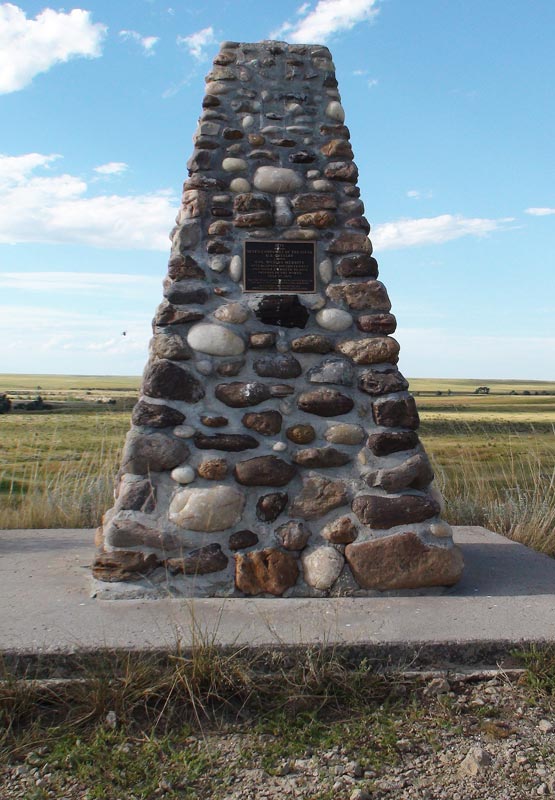 | |||
| Monument with memorial plaque on the Warbonnet Battlefield, west of Fort Robinson. Source: Thomet Daniel 2010. | |||
| 1 August 1876 | The large Indian camp was now located on the Powder River, about 20 miles south of the mouth of the Yellowstone River. After a few days it was decided to break up the camp. There was too little game and buffalo for so many Indians. Sitting Bull moved with most of the Hunkpapa into the Killdeer Mountains. Crazy Horse moved into the Black Hills with another large group. The Northern Cheyenne under Two Moons joined Crazy Horse, the rest returned to the reservations and agencies. | Hunkpapa (Lakota) Hunkpapa (Lakota) Oglala (Lakota) Oglala (Lakota) Miniconjou (Lakota) Miniconjou (Lakota) Miniconjou (Lakota) Northern Cheyenne (Cheyenne) Northern Cheyenne (Cheyenne) Northern Cheyenne (Cheyenne) Northern Cheyenne (Cheyenne) Wahpekute-Santee (Eastern Dakota) Blackfoot (Lakota) Brule (Lakota) Sans Arc (Lakota) Yanktonai (Western Dakota) Northern Cheyenne (Cheyenne) Northern Cheyenne (Cheyenne) | Sitting Bull Black Moon Crazy Horse Big Road Lame Deer Fast Bull Hump Two Moons Lame White Man Dirty Moccasins Old Bear Inkpaduta Kill Eagle Spotted Eagle Box Elder Black Eagle |
| August 1876 | Lakota and Cheyenne hunt bison along the Yellowstone River in eastern Montana. | Lakota Northern Cheyenne (Cheyenne) | - |
| Begin ofs September 1876 | The Oglala and Northern Cheyenne camped at the headwaters of the South Fork Grand River in northwestern South Dakota. The village consisted of around 300 tents. | Oglala (Lakota) Northern Cheyenne (Cheyenne) | Crazy Horse |
| 20 October 1876 | Colonel Samuel Davis Sturgis, Major Marcus Reno and General Alfred Terry left Fort Abraham Lincoln and marched to the Standing Rock Reservation and Cheyenne River Agency. Here the Indians were to be robbed of their horses and rifles. | Northern Cheyenne (Cheyenne) Hunkpapa (Lakota) | - |
| 14 November 1876 | Dull Knife Fight 1876 - Crooks Powder River Campaign Winter 1876 - After the Battle of Little Big Horn, the US army wanted to drive the last remaining free prairie Indians onto the reservations. General Crook was ordered to lead a winter expedition into the Powder River and Tongue River area. General Crook, Colonel Mackenzie and Colonel Dodge left Fort Fetterman at a temperature of about -15 degrees with about 2,000 soldiers, 400 Indian scouts (63 Oglala, 55 Arapaho, 105 Bannock, Eastern Shoshone, 48 Pawnee and 10 Northern Cheyenne) and 175 supply wagons. The soldiers had to fight their way through a lot of snow. | Oglala (Lakota) Bannock (Northern Paiute) Eastern Shoshone Pawnee Arapaho Northern Cheyenne (Cheyenne) | Three Bears |
 | |||
| Fort Fetterman in winter. Source: http://www.wyomingtalesandtrails.com/rosebud.html. | |||
| 15 November 1876 | Dull Knife Fight 1876 - Crooks Powder River Campaign Winter 1876 - The Powder River Expedition was camped on Sage Creek, 11 miles from Fort Fetterman. | Oglala (Lakota) Bannock (Northern Paiute) Eastern Shoshone Pawnee Arapaho Northern Cheyenne (Cheyenne) | Three Bears |
| 16 November 1876 | Dull Knife Fight 1876 - Crooks Powder River Campaign Winter 1876 - The Powder River Expedition was camped 29 miles from Fort Fetterman. | Oglala (Lakota) Bannock (Northern Paiute) Eastern Shoshone Pawnee Arapaho Northern Cheyenne (Cheyenne) | Three Bears |
| 17 November 1876 | Dull Knife Fight 1876 - Crooks Powder River Campaign Winter 1876 - The Powder River Expedition camped on the Dry Fork Powder River. | Oglala (Lakota) Bannock (Northern Paiute) Eastern Shoshone Pawnee Arapaho Northern Cheyenne (Cheyenne) | Three Bears |
| 18 November 1876 | Dull Knife Fight 1876 - Crooks Powder River Campaign Winter 1876 - The Powder River Expedition camped at the old Fort Reno on the Powder River. The former Fort Reno was now a U.S. Army supply depot. The supply depot was commanded by Captain Edwin Pollock of the 15th Regiment. During the night, 8 Oglala of the Red Cloud Agency and 6 Arapaho were sent out as scouts to search the area north and west towards the Bighorn Mountains for Indians. | Oglala (Lakota) Bannock (Northern Paiute) Eastern Shoshone Pawnee Arapaho Northern Cheyenne (Cheyenne) | Three Bears |
| 21 November 1876 | Dull Knife Fight 1876 - Crooks Powder River Campaign Winter 1876 - Scouts from the Oglala and Arapaho encountered a young Cheyenne at Clear Creek. Based on the young warrior's statements, Crook came to the conclusion that there must be Cheyenne Indians in the vicinity. | Oglala (Lakota) Bannock (Northern Paiute) Eastern Shoshone Pawnee Arapaho Northern Cheyenne (Cheyenne) | Three Bears |
| 22 November 1876 | Dull Knife Fight 1876 - Crooks Powder River Campaign Winter 1876 - On this day, the expedition hiked 28 miles (!) and camped at Crazy Woman's Fork. A young Cheyenne from the Red Cloud Agency came to Crook's camp and reported that there was a large Northern Cheyenne camp nearby. Crook ordered Colonel Mackenzie to get his soldiers ready to march and attack the Northern Cheyenne village. | Oglala (Lakota) Bannock (Northern Paiute) Eastern Shoshone Pawnee Arapaho Northern Cheyenne (Cheyenne) | Three Bears |
| 23 November 1876 | Dull Knife Fight 1876 - Crooks Powder River Campaign Winter 1876 - In the late afternoon, Colonel Mackenzie left the camp at Crazy Woman's Fork with about 1,100 men. Mackenzie took almost all the Indian scouts with him. 14 Pawnee and Shoshone scouts left Crook's Camp with orders to explore the area north to the Bighorn Mountains. | Oglala (Lakota) Bannock (Northern Paiute) Eastern Shoshone Pawnee Arapaho Northern Cheyenne (Cheyenne) | Three Bears |
| 23 November 1876 | Dull Knife Fight 1876 - Crooks Powder River Campaign Winter 1876 - Mackenzie marched 12 miles along Crazy Woman Creek to the mouth of Beaver Creek and camped there. | Oglala (Lakota) Bannock (Northern Paiute) Eastern Shoshone Pawnee Arapaho Northern Cheyenne (Cheyenne) | Three Bears |
| 24 November 1876 | Dull Knife Fight 1876 - Crooks Powder River Campaign Winter 1876 - In the morning 5 Indian scouts arrived at Mackenzie and reported that they had discovered a Northern Cheyenne village with about 200 tents. Mackenzie now planned to march through the night and attack the village on the morning of November 25. At 2 a.m. Mackenzie was still about 8 miles from the village at 'Sioux Pass' (before today's Dull Knife Pass). | Oglala (Lakota) Bannock (Northern Paiute) Eastern Shoshone Pawnee Arapaho Northern Cheyenne (Cheyenne) | Three Bears |
| 25 November 1876 | Dull Knife Fight 1876 - Crooks Powder River Campaign Winter 1876 - At dawn, Colonel Mackenzie attacked the Northern Cheyenne camp of Dull Knife and Little Wolf on the Red Fork River (in the area west of present-day Kaycee in central Wyoming. The Indians called the river Willow Creek at the time). Company after company rode toward the Northern Cheyenne village. The 48 Pawnee rode east of the Red Fork River, crossed the Red Fork River and rode right into the village. The Pawnee were to prevent the Cheyenne at the western end of the village from retreating to the nearby hills and firing into the village from there. The Shoshone climbed the hills west of the village and began firing into the village. | Oglala (Lakota) Bannock (Northern Paiute) Eastern Shoshone Pawnee Arapaho Northern Cheyenne (Cheyenne) Northern Cheyenne (Cheyenne) | Three Bears Dull Knife Little Wolf |
| 25 November 1876 | Dull Knife Fight 1876 - Crooks Powder River Campaign Winter 1876 - At dawn, Colonel Mackenzie attacked the Northern Cheyenne camp of Dull Knife and Little Wolf on the Red Fork River (in the area west of present-day Kaycee in central Wyoming. The Indians called the river Willow Creek at the time). Company after company rode toward the Northern Cheyenne village. The 48 Pawnee rode east of the Red Fork River, crossed the Red Fork River and rode into the middle of the village. The Pawnee were to prevent the Cheyenne at the western end of the village from retreating to the nearby hills and firing into the village from there. The Shoshone climbed the hills west of the village and began firing into the village. | Oglala (Lakota) Bannock (Northern Paiute) Eastern Shoshone Pawnee Arapaho Northern Cheyenne (Cheyenne) Northern Cheyenne (Cheyenne) | Three Bears Dull Knife Little Wolf |
 | |||
| The Northern Cheyenne were attacked in this valley. Source: Thomet Daniel 2009.1) Mackenzie attacked from here 2) Northern Cheyenne village 3) Deep Ravine 4) Cheyenne defensive position 5) Mackenzie's Hill. | |||
| 25 November 1876 | Dull Knife Fight 1876 - Crooks Powder River Campaign Winter 1876 - Approximately in the middle of the village, a deep ravine stretched to the north. Here, 30 to 40 Cheyenne hid and began shooting at the soldiers of Second Lieutenant McKinney's approaching company. McKinney was hit by at least six bullets and died. Company F of the 4th U.S. Cavalry and Company H of the 5th U.S. Cavalry rushed to the aid of McKinney's soldiers. Two more companies of the 3rd U.S. Cavalry and the 5th U.S. Cavalry were needed to drive the Cheyenne out of the cut. The surviving Cheyenne retreated to the raised defensive positions at the west end of the village. | Oglala (Lakota) Bannock (Northern Paiute) Eastern Shoshone Pawnee Arapaho Northern Cheyenne (Cheyenne) Northern Cheyenne (Cheyenne) | Three Bears Dull Knife Little Wolf |
| 25 November 1876 | Dull Knife Fight 1876 - Crooks Powder River Campaign Winter 1876 - Mackenzie set up his headquarters on a hill to the south of the village. From here, he had a very good overview of the village and could deploy his troops in a targeted manner. | Oglala (Lakota) Bannock (Northern Paiute) Eastern Shoshone Pawnee Arapaho Northern Cheyenne (Cheyenne) Northern Cheyenne (Cheyenne) | Three Bears Dull Knife Little Wolf |
| 25 November 1876 | Dull Knife Fight 1876 - Crooks Powder River Campaign Winter 1876 - After a few hours, the whole village was in the hands of the soldiers. The Cheyenne had retreated to the hill on the western edge of the village. From there, they were able to keep the soldiers at a distance. Soldiers and Cheyenne engaged in a firefight from a great distance. The soldiers could have stormed the hill, but only at great cost. The Pawnee began to burn down the 173 tents in the village. Later, the Pawnee were supported by Company K of the 3rd US Cavalry and Company F of the 4th US Cavalry. 700 ponies were captured. 40 Cheyenne were killed. Little Wolf was wounded 6 times. 6 soldiers were killed and 24 wounded. | Oglala (Lakota) Bannock (Northern Paiute) Eastern Shoshone Pawnee Arapaho Northern Cheyenne (Cheyenne) Northern Cheyenne (Cheyenne) | Three Bears Dull Knife Little Wolf |
 | |||
| Gun emplacement on the hill west of the village. Source: Daniel Thomet 2009. | |||
| 25 November 1876 | Dull Knife Fight 1876 - Crooks Powder River Campaign Winter 1876 - The surviving Cheyenne gathered in a canyon behind the rifle ranges at the western end of the village. They decided to ask for help in the village of Crazy Horse. That same night, the Cheyenne began their march to Crazy Horse. Most Cheyenne did not have time to take clothing or even their sacred war medicine with them. As a result, many Cheyenne were traveling almost naked. On the first night, 11 infants died in their mothers' arms in temperatures of around -30 degrees. | Oglala (Lakota) Bannock (Northern Paiute) Eastern Shoshone Pawnee Arapaho Northern Cheyenne (Cheyenne) Northern Cheyenne (Cheyenne) | Three Bears Dull Knife Little Wolf |
 | |||
| The Cheyenne fled through this canyon. Source: Daniel Thomet 2009. | |||
| 26 November 1876 | Dull Knife Fight 1876 - Crooks Powder River Campaign Winter 1876 - The 14 Pawnee and Shoshone scouts who left Crook's Camp on Nov. 23 encountered the Cheyenne marching in a blizzard. The scouts managed to drive away about half of the 200 Cheyenne horses. The scouts estimated that about 1,200 Cheyenne were on the run. Most of them were almost naked, without mochasins, blankets or ammunition. | Oglala (Lakota) Bannock (Northern Paiute) Eastern Shoshone Pawnee Arapaho Northern Cheyenne (Cheyenne) Northern Cheyenne (Cheyenne) | Three Bears Dull Knife Little Wolf |
| 26 November 1876 | Dull Knife Fight 1876 - Crooks Powder River Campaign Winter 1876 - Mackenzie began his return march to Crazy Woman's Fork in the afternoon. Late that afternoon, Mackenzie joined the 14 scouts who left Crook's Camp on Nov. 23. The scouts reported the clash with the Cheyenne and about 100 horses running away. Mackenzie camped in Willow Creek late in the evening. | Oglala (Lakota) Bannock (Northern Paiute) Eastern Shoshone Pawnee Arapaho Northern Cheyenne (Cheyenne) Northern Cheyenne (Cheyenne) | Three Bears Dull Knife Little Wolf |
| 26 November 1876 | Dull Knife Fight 1876 - Crooks Powder River Campaign Winter 1876 - Crook received news of the successful attack on the Cheyenne village from a scout. At noon, Crook and Dodge began an express march with the 9th US Infantry toward Mackenzie. That day, the troops traveled 35 miles through the snow. At 11:00 p.m., Crook and Frank Grouard reached the Willow Creek valley, not far from Mackenzie. Here they both waited for the rest of the troop. | Oglala (Lakota) Bannock (Northern Paiute) Eastern Shoshone Pawnee Arapaho Northern Cheyenne (Cheyenne) Northern Cheyenne (Cheyenne) | Three Bears Dull Knife Little Wolf |
| 27 November 1876 | Dull Knife Fight 1876 - Crooks Powder River Campaign Winter 1876 - In the morning, Mackenzie continued his march toward Crook and Dodge's camp at Crazy Woman's Fork. After 14 miles, Mackenzie camped at Willow Creek. | Oglala (Lakota) Bannock (Northern Paiute) Eastern Shoshone Pawnee Arapaho Northern Cheyenne (Cheyenne) Northern Cheyenne (Cheyenne) | Three Bears Dull Knife Little Wolf |
| 27 November 1876 | Dull Knife Fight 1876 - Crooks Powder River Campaign Winter 1876 - At 10:00 a.m., Crook received word that Mackenzie was on his way to camp at Crazy Woman's Fork. Crook and Dodge returned to the camp at Crazy Woman's Fork, as Mackenzie was obviously no longer in need of Dodge's help. | Oglala (Lakota) Bannock (Northern Paiute) Eastern Shoshone Pawnee Arapaho Northern Cheyenne (Cheyenne) Northern Cheyenne (Cheyenne) | Three Bears Dull Knife Little Wolf |
| 27 November 1876 | Dull Knife Fight 1876 - The Cheyenne camped in the headwaters of Clear Creek. | Northern Cheyenne (Cheyenne) Northern Cheyenne (Cheyenne) | Dull Knife Little Wolf |
| 28 November 1876 | Dull Knife Fight 1876 - Crooks Powder River Campaign Winter 1876 - At noon it began to snow again. After a 10-mile march, Mackenzie's troops camped. It was very cold. The soldiers could not make a fire as there was no more wood in the area. | Oglala (Lakota) Bannock (Northern Paiute) Eastern Shoshone Pawnee Arapaho Northern Cheyenne (Cheyenne) Northern Cheyenne (Cheyenne) | Three Bears Dull Knife Little Wolf |
| 29 November 1876 | Dull Knife Fight 1876 - Crooks Powder River Campaign Winter 1876 - After another 10 miles, Mackenzie finally reached Crook and Dodge's camp at Crazy Woman's Fork. | Oglala (Lakota) Bannock (Northern Paiute) Eastern Shoshone Pawnee Arapaho Northern Cheyenne (Cheyenne) Northern Cheyenne (Cheyenne) | Three Bears Dull Knife Little Wolf |
| 29 November 1876 | Dull Knife Fight 1876 - Crooks Powder River Campaign Winter 1876 - The Cheyenne traveled along Clear Creek to Lake deSmet and from there to the sources of Prairie Dog Creek. | Northern Cheyenne (Cheyenne) Northern Cheyenne (Cheyenne) | Dull Knife Little Wolf |
| 1 December 1876 | Dull Knife Fight 1876 - Crooks Powder River Campaign Winter 1876 - Somewhere on the western bank of the Tongue River, the marching Cheyenne were spotted by another small group of hunting Cheyenne. | Northern Cheyenne (Cheyenne) Northern Cheyenne (Cheyenne) | Dull Knife Little Wolf |
| 3 December 1876 | Dull Knife Fight 1876 - Crooks Powder River Campaign Winter 1876 - Above the present-day village of Ashland, the Cheyenne crossed the Tongue River and moved along the east bank of Otter Creek. | Northern Cheyenne (Cheyenne) Northern Cheyenne (Cheyenne) | Dull Knife Little Wolf |
| 6 December 1876 | The village of Crazy Horse and the Oglala, Sans Arc, Miniconjou and Northern Cheyenne under Ice and Two Moons was located on Beaver Creek, a tributary of the Tongue River, Montana. | Northern Cheyenne (Cheyenne) Northern Cheyenne (Cheyenne) Northern Cheyenne (Cheyenne) Sans Arc (Lakota) Miniconjou (Lakota) Northern Cheyenne (Cheyenne) Oglala (Lakota) | Dull Knife Ice Two Moons Little Wolf Crazy Horse |
| 6 December 1876 | Dull Knife Fight 1876 - Crooks Powder River Campaign Winter 1876 - 11 days after the raid on their village at Red Fork Powder, Little Wolf and Dull Knife reached Crazy Horse's camp at Beaver Creek with the Northern Cheyenne. In the days that followed, Cheyenne continued to arrive at the Oglala camp. The first Cheyenne to reach the village were still in favor of fighting the whites. Crazy Horse was still generous and distributed clothing, food and horses to the Cheyenne. The Cheyenne who arrived later were demoralized and spoke of surrender. Crazy Horse now began to rationalize his resources and was no longer so generous. Crazy Horse mainly distributed goods to the Cheyenne who were in favor of resisting the whites, i.e. to Ice and Two Moons and Black Moccasin, but not to Dull Knife, Little Wolf and Standing Elk. | Northern Cheyenne (Cheyenne) Northern Cheyenne (Cheyenne) Northern Cheyenne (Cheyenne) Northern Cheyenne (Cheyenne) | Dull Knife Black Moccasin Standing Elk Little Wolf |
| 20 December 1876 | Along the Hanging Woman Creek there were 4 villages of the Oglala (Crazy Horse), Northern Cheyenne (Dull Knife, Little Wolf), Miniconjou (Lame Deer) and Sans Arc with about 800 tents. | Oglala (Lakota) Northern Cheyenne (Cheyenne) Northern Cheyenne (Cheyenne) Miniconjou (Lakota) Northern Cheyenne (Cheyenne) Sans Arc (Lakota) | Crazy Horse Dull Knife Little Wolf Lame Deer Two Moons |
| 8 January 1877 | Battle of the Butte 1877 - Colonel Nelson A. Miles with 7 companies and 436 soldiers met Crazy Horse with about 500 warriors at Hanging Woman Creek on the Tongue River in southern Montana. Crazy Horse attacked Miles several times, but was repulsed by artillery and heavy rifle fire. A snowstorm ended the battle, which claimed only a few casualties on both sides. After the battle, Crazy Horse moved his camp into the mountains to the Prairie Dog Cree, where the Tongue River left the Bighorn Mountains. Sitting Bull found this camp on January 15. This battle with the US Army was to be Crazy Horse's last. In May 1877, Crazy Horse was forced to surrender at Fort Robinson in Nebraska. The chiefs in Crazy Horse's camp debated fiercely whether they should surrender or not. The Miniconjou and Sans Arc (except Spotted Eagle) were in favor, the Hunkpapa, Oglala and Cheyenne against. | Oglala (Lakota) Northern Cheyenne (Cheyenne) Northern Cheyenne (Cheyenne) Northern Cheyenne (Cheyenne) Miniconjou (Lakota) Sans Arc (Lakota) | Crazy Horse Dull Knife Little Wolf Two Moons |
 | |||
| Here, near the small town of Birney in southeastern Montana, Crazy Horse was attacked by Colonel Nelson A. Miles in the winter of 1877. Source: Thomet Daniel 2010. | |||
| 15 January 1877 | Sitting Bull reached Crazy Horse's camp on the Dog Creek prairie, where the Tongue River comes out of the Bighorn Mountains. Sitting Bull still had a retinue of 100 tents with him. This camp also contained the surviving Cheyenne who had fled after Colonel Mackenzie's attack. The Miniconjou and Sans Arc were ready to surrender, unlike the Oglala, Hunkpapa and Cheyenne. | Oglala (Lakota) Oglala (Lakota) Cheyenne Miniconjou (Lakota) Northern Cheyenne (Cheyenne) Northern Cheyenne (Cheyenne) Northern Cheyenne (Cheyenne) Sans Arc (Lakota) | Crazy Horse Little Big Man Black Shield Dull Knife Little Wolf Two Moons |
 | |||
| Chief Little Big Man of the Oglala. Source: Thomet Daniel 2010. | |||
| 1 February 1877 | Little Wolf and his men left Crazy Horse's camp at Prairie Dog Creek. | Northern Cheyenne (Cheyenne) | Little Wolf |
| Begin of February 1877 | The camps decided to split up again. The Miniconjou and the Sans Arc moved east towards Cheyenne Agency to surrender. The Hunkpapa and the Cheyenne moved to the Little Bighorn River to hunt buffalo. Soon Sitting Bull and his Hunkpapa's trail led back to the Big Dry Creek area south of Fort Peck, where they arrived about mid-March. But now with 15 tents. More and more Indian groups were now leaving the camps for an agency or reservation to surrender. 150 tents in Sitting Bull's camp had already decided to go to Canada. | Oglala (Lakota) Cheyenne Miniconjou (Lakota) Sans Arc (Lakota) | - |
 | |||
| Bison in Custer National Park. Source: Thomet Daniel 2010 | |||
| Middle of February 1877 | It was probably around this time that Little Wolf surrendered at Camp Robinson. | Northern Cheyenne (Cheyenne) | Little Wolf |
| 21 April 1877 | 80 tents and 550 Northern Cheyenne under Chief Dull Knife and Standing Elk surrender at Fort Robinson. | Northern Cheyenne (Cheyenne) Northern Cheyenne (Cheyenne) | Dull Knife Standing Elk |
| End of April 1877 | 50 Miniconjou under Hump and 250 Northern Cheyenne under Two Moons surrendered to Colonel Miles at his headquarters 'Cantonment on Tongue River' on the Tongue River. This group of Indians was assigned an area around Fort Keogh. | Northern Cheyenne (Cheyenne) Miniconjou (Lakota) | Two Moons Hump |
| 5 May 1877 | Dull Knife wanted to surrender to the Red Cloud Agency. However, the agency was abandoned. On October 23, Dull Knife surrendered at Fort Robinson. | Northern Cheyenne (Cheyenne) | Dull Knife |
| 28 May 1877 | Northern Cheyenne Exodus 1877 - The Cheyenne began their 70-day march with 972 people from Fort Robinson to Fort Reno (founded in 1875, to the Darlington Indian Agency (Oklahoma) in Indian Territory. At that time, the US government intended to gather all Indians who had surrendered into reservations in Oklahoma. The Cheyenne were commanded by Lt. Henry W. Lawton of the 4th Division. The Cheyenne were promised that they could return if they did not like Oklahoma. This was the only reason the Cheyenne agreed to go to Oklahoma. | Northern Cheyenne (Cheyenne) Northern Cheyenne (Cheyenne) Northern Cheyenne (Cheyenne) | Dull Knife Wild Hog Little Wolf |
| 5 August 1877 | Northern Cheyenne Exodus 1877 - 937 Cheyenne came to the Darlington Indian Agency (founded in 1875, to the Darlington Indian Agency (Oklahoma) in the Indian Territory. The Darlington Indian Agency was home to the Southern Cheyenne and the Southern Arapaho. At this time there was no more game or bison in Oklahoma. The Cheyenne chose a campsite about 8 miles north of the agency. On the evening of the arrival, the Southern Cheyenne organized a feast for the Northern Cheyenne. It was a very small feast with very little meat for everyone. The Northern Cheyenne quickly realized that the Indians on the reservation were very poor. In addition, the Indians were not allowed to own horses or guns. | Northern Cheyenne (Cheyenne) Northern Cheyenne (Cheyenne) Northern Cheyenne (Cheyenne) | Dull Knife Wild Hog Little Wolf |
| 18 September 1877 | Colonel Miles left the 'Cantonment on Tongue River' near the present-day town of Miles City with 11 companies, 520 soldiers and scouts from the Cheyenne and Hunkpapa. He first rode west along the Yellowstone River and then north. | Nez Perce Cheyenne Miniconjou (Lakota) | Hump |
| 30 September 1877 | Miles attacked the camp at around 10.30 am. The camp was quickly surrounded by the soldiers, who could only attack on foot due to the impassable terrain. The Nez Perce managed to keep the soldiers at a distance. The women, children and old people sought shelter as best they could in the gullies and small hollows. At the beginning of the battle, around 70 Nez Perce managed to break through the lines and flee towards Canada. Miles had the camp shelled with Hotchkiss cannons. Looking Glass was convinced that the Lakota from Canada would rush to their aid and rose from his post for a moment too violently. At that moment he was hit in the head by a sniper's bullet. Toohoolhoolzote was also killed in a rifle position. | Nez Perce Nez Perce Nez Perce Palouse Nez Perce Nez Perce Nez Perce Nez Perce Nez Perce Miniconjou (Lakota) Cheyenne | Joseph Ollokot Toohoolhoolzote Husishusis Kute Lean Elk Poker Joe Looking Glass Yellow Wolf White Bird Hump |
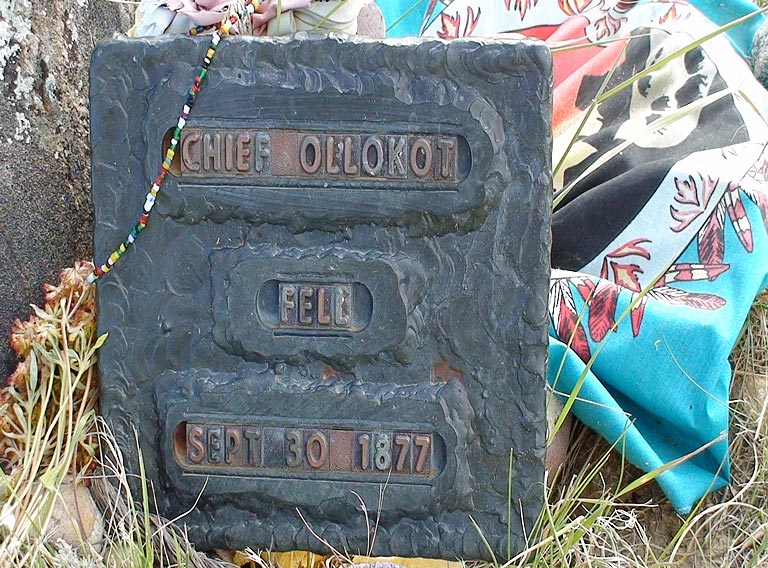 | |||
| Memorial stone for Chief Ollokot, who was killed by a sniper on September 30, 1877. Source: Thomet Daniel 2009. | |||
| 30 September 1877 | 3 Nez Perce warriors were far south-east of the Nez Perce camp. The Palouse chief Husishusis Kute mistook the 3 warriors for enemies and killed them. Lean Elk was also killed in the heat of battle by a Nez Perce warrior. Lean Elk led the Nez Perce to the Missouri after the battle at Big Hole. | Nez Perce Nez Perce Nez Perce Palouse Nez Perce Nez Perce Nez Perce Nez Perce Nez Perce Miniconjou (Lakota) Cheyenne | Joseph Ollokot Toohoolhoolzote Husishusis Kute Lean Elk Poker Joe Looking Glass Yellow Wolf White Bird Hump |
| 30 September 1877 | Chief Ollokot was shot in 1877 - Right at the beginning of the attack by Colonel Miles' soldiers, Chief Ollokot was shot dead. | Nez Perce Nez Perce Nez Perce Palouse Nez Perce Nez Perce Nez Perce Nez Perce Nez Perce Miniconjou (Lakota) Cheyenne | Joseph Ollokot Toohoolhoolzote Husishusis Kute Lean Elk Poker Joe Looking Glass Yellow Wolf White Bird Hump |
| 30 September 1877 | During Miles' first attack on the Nez Perce, Peo-Peo Tholekt was with the horses. There he encountered Hump, a Miniconjou-Lakota chief and Miles' scout, several times. Peo-Peo Tholekt wounded Hump in a gunfight. | Nez Perce Nez Perce Nez Perce Palouse Nez Perce Nez Perce Nez Perce Nez Perce Nez Perce Miniconjou (Lakota) Cheyenne | Joseph Ollokot Toohoolhoolzote Husishusis Kute Lean Elk Poker Joe Looking Glass Yellow Wolf White Bird Hump |
| 1 October 1877 | On the night of September 30 to October 1, the Nez Perce deployed their 20 or so rifle positions. It had started to snow. The Nez Perce had too few blankets and clothing for these wintry conditions. | Nez Perce Palouse Nez Perce Nez Perce Nez Perce Miniconjou (Lakota) Cheyenne | Joseph Husishusis Kute Looking Glass Yellow Wolf White Bird Hump |
| 1 October 1877 | The day began for the Nez Perce with a cold wind and fog. It had snowed during the night. The Nez Perce had hardly any clothing suitable for this weather. Naturally, it was not possible to make a fire during the night. Shortly after sunrise, the Cheyenne scouts met with 3 Nez Perce to discuss a surrender. The Cheyenne saw many dead in the Nez Perce camp. Joseph met with Miles behind the soldiers' lines. Joseph refused to surrender and was about to march back to his camp when Miles captured Joseph. The officer who had brought the news of Joseph's capture was also taken prisoner by the Nez Perce. That day, one soldier was killed and one wounded. | - | |
| 2 October 1877 | The exchange of Joseph for the officer was agreed and carried out without any problems. . | Nez Perce Palouse Nez Perce Nez Perce Nez Perce Miniconjou (Lakota) Cheyenne | Joseph Husishusis Kute Looking Glass Yellow Wolf White Bird Hump |
| 3 October 1877 | The US army fired into the Nez Perce camp with the Hotchkiss cannon. The captured officer had memorized the exact position of the women, children and old people. | Nez Perce Palouse Nez Perce Nez Perce Nez Perce Miniconjou (Lakota) Cheyenne | Joseph Husishusis Kute Looking Glass Yellow Wolf White Bird Hump |
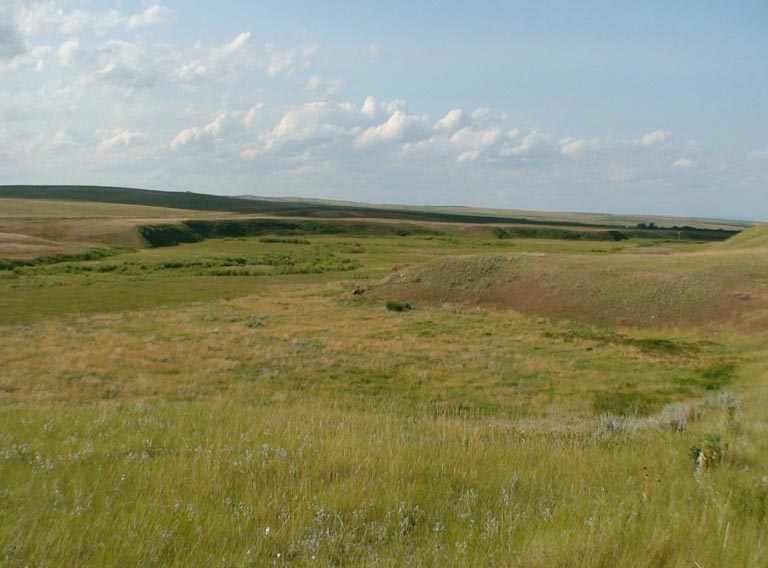 | |||
| Bear Paw Battlefield in summer. In this area, which offered the Indians little cover, they defended themselves for days against Colonel Miles' soldiers in the middle of winter. Source: Thomet Daniel 2009. | |||
| 4 October 1877 | The shelling with the Hotchkiss cannon continued. One of the shells landed directly in a rifle position and killed a child and an elderly woman, 4 Indians were seriously injured. In the evening, General Howard arrived with 21 soldiers. | Nez Perce Palouse Nez Perce Nez Perce Nez Perce Miniconjou (Lakota) Cheyenne | Joseph Husishusis Kute Looking Glass Yellow Wolf White Bird Hump |
| 5 October 1877 | In the early hours of the morning, Chief Looking Glass was shot dead. In the distance, Looking Glass saw a lone Indian on a horse. Looking Glass believed it was a Sioux Indian who had come to the aid of the Nez Perze. Looking Glass stood up briefly and was probably shot by a sniper. | Nez Perce Palouse Nez Perce Nez Perce Nez Perce Miniconjou (Lakota) Cheyenne | Joseph Husishusis Kute Looking Glass Yellow Wolf White Bird Hump |
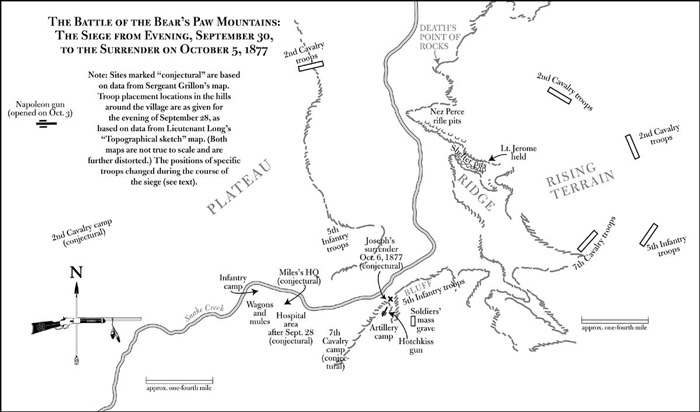 | |||
| Battle in the Bear Paw Mountains. Source: http://www.nps.gov/history/history/online_books/biho/greene/chap13.htm | |||
| 5 October 1877 | Der Beschuss mit der Hotchkiss-Kanone zeigte bei den Nez Perce Wirkung. Um 11 Uhr kapitulierte Joseph. Seine berühmte Kapitulationsrede lautete: 'Tell General Howard I know his heart. What he told me before I have in my heart. I am tired of fighting. Our leaders are killed. Looking Glass is dead. Tu-hul-hul-sote is dead. The old men are all dead. It is the young men who say yes or no. He who led the young men is dead. It is cold and we have no blankets. The little children are freezing to death. My people, some of them, have run away to the hills and have no blankets, no food; no one knows where they are - maybe freezing to death. I want to have time to look for my children and see how many of them I can find. Maybe I shall find them among the dead. Hear me, my chiefs. I am tired; my heart is sick and sad. From where the sun now stands I will no more fight forever. At around 9 p.m., White Bird and Looking Glass and about 50 people managed to escape across Snake Creek to Canada. A total of 448 Nez Perce surrendered. Miles lost 2 officers, 22 soldiers and 2 Indian scouts during the siege, 4 officers and 46 soldiers were wounded. The Nez Perce had less than 25 killed and about 50 wounded. | Nez Perce Palouse Nez Perce Nez Perce Nez Perce Miniconjou (Lakota) Cheyenne | Joseph Husishusis Kute Looking Glass Yellow Wolf White Bird Hump |
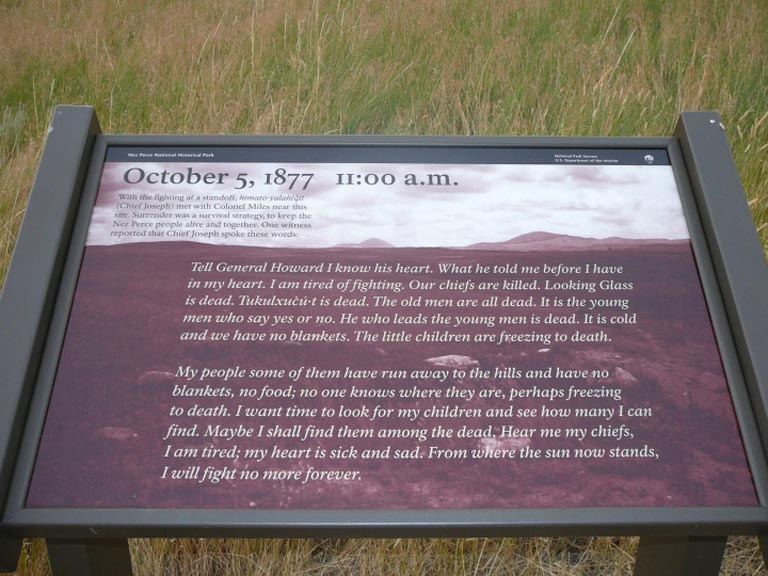 | |||
| Bear Paw Battlefield, one of the memorial plaques with Chief Joseph's surrender speech. Source: Thomet Daniel 2007. | |||
| 6 October 1877 | Probably on October 6, Looking Glass was killed by a Cheyenne scout north of the Bear Paw battlefield while fleeing to Canada. | Nez Perce Nez Perce Cheyenne | White Bird Looking Glass |
| 12 October 1877 | Chief White Bird arrived with over 100 Nez Perce and 45 tents at Sitting Bull in the Cyprus Hills in southern Saskatchewan. This group of Nez Perce also included Yellow Bull and Chief Joseph's daughter. The poor condition of the Nez Perce must have reinforced Sitting Bull's opinion that the US army was still acting ruthlessly against all Indians. What Sitting Bull did not know was that Northern Cheyenne and even some Lakota Indians were serving as scouts for Colonel Miles. The knowledge of these scouts was crucial to Miles finding the Nez Perce camp in the Bear Paw Mountains in time. | Nez Perce Hunkpapa (Lakota) Northern Cheyenne (Cheyenne) Lakota Hunkpapa (Lakota) | White Bird Sitting Bull Gall |
| October 1877 | Northern Cheyenne Exodus 1877 - After just two months, 70 Cheyenne on the Darlington reservation had died of measles and hunger. General Pope, the commander of the Missouri Department, wrote to Washington. He demanded an increase in food rations because of the arrival of the Northern Cheyenne. But nothing happened. | Northern Cheyenne (Cheyenne) Northern Cheyenne (Cheyenne) Northern Cheyenne (Cheyenne) | Dull Knife Wild Hog Little Wolf |
| Winter 1877 | Immediately after arriving in Oklahoma, fever and malaria run rampant among the Cheyenne. Only about 3/4 of the rations are supplied, the meat consists only of house and bones. Already in the first winter, 41 Cheyenne died. | Northern Cheyenne (Cheyenne) Northern Cheyenne (Cheyenne) | Dull Knife Little Wolf |
| 1 July 1878 | Treaty of Fort Laramie 1868Camp Sturgis was established by Companies C, F, I and K of the 1st US Infantry at Spring Creek, about 2 miles west of Bear Butte in what is now northeastern Wyoming. On July 18, 8 companies of the newly formed 7th US Cavalry were added. The camp had the task of protecting the gold mining camps and the connecting roads to them in the Black Hills from the Indians. According to the Treaty of Fort Laramie, it was supposed to be the other way around: US troops were to ensure that the Black Hills remained free of whites. The camp was named after the son of Colonel Samuel D. Sturgis, who died together with Lieutenant Colonel Custer in the Battle of Little Big Horn. On August 27, 1878, the camp was disbanded and the companies moved to the newly built Fort Meade on Bear Butte Creek, about two miles south of the camp. | Northern Cheyenne (Cheyenne) | - |
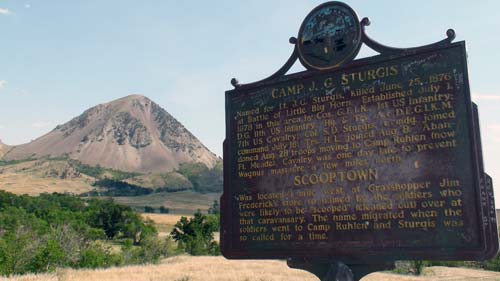 | |||
| Historical marker of the Sturgis camp. Source: Thomet Daniel 2012. | |||
| Summer 1878 | Northern Cheyenne Exodus 1877 - There is still no medical care for the Cheyenne and food rations have not improved in terms of quality or quantity. Many Cheyenne have contracted malaria and dysentery. Endless discussions between the Cheyenne and the Indian agent remain unsuccessful. | Northern Cheyenne (Cheyenne) Northern Cheyenne (Cheyenne) Northern Cheyenne (Cheyenne) | Dull Knife Wild Hog Little Wolf |
| 8 September 1878 | Northern Cheyenne Exodus 1877 - A doctor came to the Cheyenne reservation for the first time. After a tour of the village, the doctor said: \`This is a plague camp, a cemetery! But the doctor brought neither medicine nor food. The Cheyenne had decided to leave the reservation a long time ago. | Northern Cheyenne (Cheyenne) Northern Cheyenne (Cheyenne) Northern Cheyenne (Cheyenne) | Dull Knife Wild Hog Little Wolf |
| 9 September 1878 | Northern Cheyenne Exodus 1877 - Around 10 p.m., 353 Northern Cheyenne left their reservation in Oklahoma and moved to Nebraska. To deceive the soldiers, the Cheyenne left their tents standing and kept the fires burning. | Northern Cheyenne (Cheyenne) Northern Cheyenne (Cheyenne) Northern Cheyenne (Cheyenne) | Dull Knife Wild Hog Little Wolf |
| 11 September 1878 | Northern Cheyenne Exodus 1877 - At a place called 'Buffalo Springs', the Cheyenne hunters discovered bison. How long the Cheyenne had had to wait for a buffalo hunt! . | Northern Cheyenne (Cheyenne) Northern Cheyenne (Cheyenne) Northern Cheyenne (Cheyenne) | Dull Knife Wild Hog Little Wolf |
| 13 September 1878 | Battle of Red Hills 1878 - Northern Cheyenne Exodus 1877 - 2 companies of the 4th U.S. Cavalry from Fort Reno under the command of Captain Joseph Rendlebrock discovered the Cheyenne. After a short negotiation, the soldiers opened fire. The Cheyenne set fire to the prairie. After a short time, the Cheyenne and the soldiers took up their positions. These positions were held all night. During the night, warriors were out capturing wild horses in the area. The Cheyenne urgently needed horses to transport the wounded and make faster progress. | Northern Cheyenne (Cheyenne) Northern Cheyenne (Cheyenne) Northern Cheyenne (Cheyenne) | Dull Knife Wild Hog Little Wolf |
| 14 September 1878 | Battle of Red Hills 1878 - Northern Cheyenne Exodus 1877 - The Cheyenne blocked the soldiers' access to the water. Rendlebrock therefore decided to retreat to Camp Supply at nightfall. The Cheyenne pursued the fleeing soldiers for 2 hours. 3 soldiers died. 5 Cheyenne were wounded. | Northern Cheyenne (Cheyenne) Northern Cheyenne (Cheyenne) Northern Cheyenne (Cheyenne) | Dull Knife Wild Hog Little Wolf |
| 16 September 1878 | Northern Cheyenne Exodus 1877 - 2 days after the Battle of Turkey Springs, the first Cheyenne was killed. Some warriors discovered horses near a farm. The warriors wanted to pay for the horses with money. The Cheyenne had taken the money from the dead soldiers of Turkey Springs. But the farmer shot at the warriors and killed one of them. The warrior's name was Black Beaver. | Northern Cheyenne (Cheyenne) Northern Cheyenne (Cheyenne) Northern Cheyenne (Cheyenne) | Dull Knife Wild Hog Little Wolf |
| 16 September 1878 | Northern Cheyenne Exodus 1877 - On the night of September 17, the Cheyenne crossed the border from Oklahoma into Kansas. | Northern Cheyenne (Cheyenne) Northern Cheyenne (Cheyenne) Northern Cheyenne (Cheyenne) | Dull Knife Wild Hog Little Wolf |
| 17 September 1878 | Northern Cheyenne Exodus 1877 - Shortly after the Cheyenne crossed the border from Oklahoma into Kansas, they were attacked by soldiers of the 4th U.S. Cavalry and numerous cowboys under the command of Captain Hemphill. After initial losses, the soldiers and cowboys fled. | Northern Cheyenne (Cheyenne) Northern Cheyenne (Cheyenne) Northern Cheyenne (Cheyenne) | Dull Knife Wild Hog Little Wolf |
| 18 September 1878 | Northern Cheyenne Exodus 1877 - Cheyenne scouts found the bodies of two young Cheyenne warriors. The two young warriors had been assigned to observe the movements of the soldiers and cowboys at the conference. In revenge, young Cheyenne warriors killed a white man in the area of the village of Protection. | Northern Cheyenne (Cheyenne) Northern Cheyenne (Cheyenne) Northern Cheyenne (Cheyenne) | Dull Knife Wild Hog Little Wolf |
| 21 September 1878 | Northern Cheyenne Exodus 1877 - Captain Abram E. Wood commanded a company of 20 soldiers from the 4th US Cavalry. He set out from Fort Reno (Oklahoma) in search of the Cheyenne. At Little Sandy Creek, Wood attacked the Cheyenne and was ambushed in a small ravine. The Cheyenne escaped during the night. Wood then joined the 19th U.S. Infantry under Lt. Col. William Lewis. | Northern Cheyenne (Cheyenne) Northern Cheyenne (Cheyenne) | Dull Knife Little Wolf |
| 27 September 1878 | Northern Cheyenne Exodus 1877 - 238 soldiers of the 19th US Infantry and the 4th US Cavalry under the command of Lt. Col. William H. Lewis were hot on the Cheyenne's heels. The Cheyenne planned an ambush at the Punished Woman's Fork. The ambush failed. Lewis had the gorge blocked on one side and attacked from the other. Despite this, the Cheyenne managed to escape during the night. The Cheyenne lost 60 horses and most of their supplies. Lt. Col. Lewis was killed by a sniper and 6 other soldiers were wounded. | Northern Cheyenne (Cheyenne) Northern Cheyenne (Cheyenne) | Dull Knife Little Wolf |
| 4 October 1878 | Northern Cheyenne Exodus 1877 - The Cheyenne crossed the South Platte River below the present-day village of Oglala. | Northern Cheyenne (Cheyenne) Northern Cheyenne (Cheyenne) Northern Cheyenne (Cheyenne) Northern Cheyenne (Cheyenne) | Dull Knife Left Hand Little Wolf Wild Hog |
| 4 October 1878 | Northern Cheyenne Exodus 1877 - The Cheyenne marched along the South Platte River to White Tail Creek. By then, at least four Cheyenne had died of exhaustion. At White Tail Creek there was a fierce fight between Dull Knife and Little Wolf. The warriors joined either Dull Knife or Little Wolf. Dull Knife wanted to go to Spotted Tail Agency, Little Wolf wanted to go to the Yellowstone River. The next morning, Dull Knife moved on without Little Wolf. | Northern Cheyenne (Cheyenne) Northern Cheyenne (Cheyenne) Northern Cheyenne (Cheyenne) | Dull Knife Left Hand Little Wolf Wild Hog |
| 23 October 1878 Nicht erkannter Quellenhinweis | Northern Cheyenne Exodus 1877 - 2 companies of the 3rd U.S. Cavalry under Captain John Johnson suddenly encountered the Cheyenne under Dull Knife south of the present-day village of Chadron (Nebraska) on Chadron Creek in a snowstorm. The Cheyenne wanted to move to the Spotted Tail Agency. The Spotted Tail Agency was about 16 miles northeast of the present location. At the soldiers' camp, Johnson ordered the Cheyenne to surrender. A count revealed that the Cheyenne numbered 46 men, 61 women and 42 children, totaling 149 people. There were also 131 horses. The Cheyenne surrendered. The Cheyenne camp was located near the soldiers' camp. | Northern Cheyenne (Cheyenne) Northern Cheyenne (Cheyenne) Northern Cheyenne (Cheyenne) | Dull Knife Left Hand Wild Hog |
| 24 October 1878 Nicht erkannter Quellenhinweis | Northern Cheyenne Exodus 1877 - During the night, more soldiers arrived at Captain Johnson's camp. Major Caleb Carlton arrived at the camp on Chadron Creek with the soldiers. Carlton was the commander of Fort Robinson. He ordered Johnson to take the Cheyenne prisoners and bring them to Fort Robinson. Negotiations took place during the day. The Cheyenne realized that they would be taken to Fort Robinson. From there they would probably return to Oklahoma. During the night, the Cheyenne, like the soldiers, took up rifle positions. Everything pointed to a battle the next morning. | Northern Cheyenne (Cheyenne) Northern Cheyenne (Cheyenne) Northern Cheyenne (Cheyenne) | Dull Knife Left Hand Wild Hog |
| 25 October 1878 Nicht erkannter Quellenhinweis | Northern Cheyenne Exodus 1877 - The next morning, Carlton showed the Cheyenne the two cannons he had brought with him. If the Cheyenne did not surrender within an hour, the cannons would shoot at them. Eventually the Cheyenne surrendered. Shortly afterwards, the Cheyenne began their march with the soldiers to Fort Robinson. | Northern Cheyenne (Cheyenne) Northern Cheyenne (Cheyenne) Northern Cheyenne (Cheyenne) | Dull Knife Left Hand Wild Hog |
| 25 October 1878 | Northern Cheyenne Exodus 1877 - The Cheyenne with Dull Knife, Left Hand and Wild Hog reached Fort Robinson in the late afternoon. 150 Cheyenne Indians were housed in a barrack that had been built for 75 soldiers. Most of the rifles, pistols, bows and horses were taken from the Cheyenne. The Cheyenne were allowed to move freely inside and outside the fort. In the evening, the Cheyenne had to return to the fort for dinner. The older Cheyenne searched the area around the fort for the 'Red Willow'. The bark of this tree was an ingredient of 'Kinnikinnick', the Indian tobacco. | Northern Cheyenne (Cheyenne) Northern Cheyenne (Cheyenne) Northern Cheyenne (Cheyenne) | Dull Knife Left Hand Wild Hog |
| 4 December 1878 | Northern Cheyenne Exodus 1877 - Captain Henry W. Wessells takes over command of Fort Robinson from Major Caleb Carlton. | Northern Cheyenne (Cheyenne) | Dull Knife |
| December 1878 | Northern Cheyenne Exodus 1877 - Red Cloud came to Fort Robinson to talk to the Cheyenne. He complained about the poor condition of the Cheyenne. But Red Cloud was unable to help the Cheyenne. | Northern Cheyenne (Cheyenne) Oglala (Lakota) Northern Cheyenne (Cheyenne) Northern Cheyenne (Cheyenne) | Dull Knife Red Cloud Left Hand Wild Hog |
| Winter 1878 | Northern Cheyenne Exodus 1877 - Little Wolf spent the winter with the Cheyenne at Chokecherry Lake in Nebraska. | Northern Cheyenne (Cheyenne) | Little Wolf |
| 3 January 1879 | Northern Cheyenne Exodus 1877 - The Cheyenne were told to return to Oklahoma. But the Cheyenne refused. Now Wessels had the windows of the barracks boarded up with wooden shutters. | Northern Cheyenne (Cheyenne) Northern Cheyenne (Cheyenne) Northern Cheyenne (Cheyenne) | Dull Knife Left Hand Wild Hog |
| 5 January 1879 | Northern Cheyenne Exodus 1877 - However, the Cheyenne were immediately deprived of food and firewood. | Northern Cheyenne (Cheyenne) Northern Cheyenne (Cheyenne) Northern Cheyenne (Cheyenne) | Dull Knife Left Hand Wild Hog |
| 8 January 1879 | Northern Cheyenne Exodus 1877 - The Cheyenne still refused to return to the Darlington Reservation in Oklahoma. Again, Dull Knife said that the Cheyenne would rather die than move to Oklahoma. Wessels now also stopped the Cheyenne's water supply. The Cheyenne were now without food, water and firewood. | Northern Cheyenne (Cheyenne) Northern Cheyenne (Cheyenne) Northern Cheyenne (Cheyenne) | Dull Knife Left Hand Wild Hog |
| 9 January 1879 Nicht erkannter Quellenhinweis | Northern Cheyenne Exodus 1877 - On January 9, Dull Knife still refused to return to Oklahoma. That evening at 9:45 p.m., the Cheyenne broke out of their prisoner barracks, armed only with knives and 5 concealed rifles. Of the 130 Cheyenne, only 44 warriors were left. Among them were boys aged 11 and over! Under the floor of the barracks, the Cheyenne pulled out 5 hidden rifles and 9 pistols. To cover the escape of the women and children, 5 warriors formed a line of battle about 100 meters from the barracks. The 5 warriors were quickly cut down by the combat-ready Companies C and H. Most of the Northern Cheyenne rushed to the White River to drink. Many collapsed in the thin ice as they crossed the river. Weakened by 5 days without food, the Indians could not run fast and were quickly caught up by the soldiers. | Northern Cheyenne (Cheyenne) Northern Cheyenne (Cheyenne) Northern Cheyenne (Cheyenne) | Dull Knife Left Hand Wild Hog |
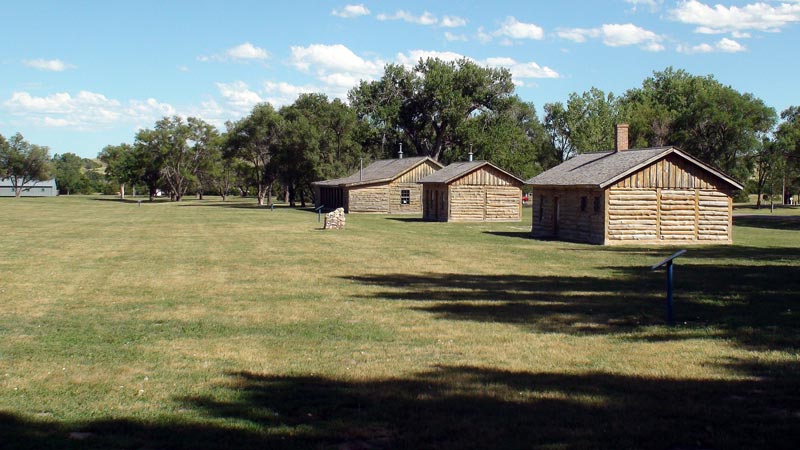 | |||
| The Northern Cheyenne broke out of the rear barracks and fled north towards the trees. Source: Thomet Daniel 2010. | |||
| 9 January 1879 | Northern Cheyenne Exodus 1877 - Dull Knife fled with Bull Hump, Great Eyes, Pawnee Woman and the children from the barracks to the White River. When one child was shot, Bull Hump stayed behind with another child to stop the soldiers. At White River, the soldiers discovered the group's tracks. Great Eyes stayed behind and held off the soldiers until he was shot. The soldiers did not follow the tracks of Dull Knife's group. Dull Knife led the group to a cave he knew from his youth. The group hid in the cave for 10 days. | Northern Cheyenne (Cheyenne) Northern Cheyenne (Cheyenne) Northern Cheyenne (Cheyenne) Northern Cheyenne (Cheyenne) | Dull Knife Red Bird Great Eyes Bull Hump |
| 10 January 1879 | Northern Cheyenne Exodus 1877 - 21 dead Cheyenne warriors and 9 dead women and children were laid out near the sawmill. 62 women and children were taken prisoner. Only 38 Cheyenne survived the escape. Dull Knife and five other Cheyenne hid in a field cave and marched toward the Pine Ridge Reservation. 34 Cheyenne marched northwest to Hat Creek. During the course of the day, a woman and 3 children were captured at White River. In a small ravine, 2 Dog Soldier Cheyenne were shot guarding a small cave. In the cave were a boy, a woman and 2 children. In the evening, the soldiers encountered 5 warriors. The soldiers shot at the warriors until 4 of them were dead. Northwest of Fort Robinson, 4 women were captured and taken to Fort Robinson. 12 miles above the White River, the soldiers found tracks of 2 Indians. One Indian managed to escape. A little girl was captured and taken to Fort Robinson. | Northern Cheyenne (Cheyenne) Northern Cheyenne (Cheyenne) Northern Cheyenne (Cheyenne) | Dull Knife Left Hand Wild Hog |
| 11 January 1879 | Northern Cheyenne Exodus 1877 - Wessels discovered the group of 32 Cheyenne northwest of Fort Robinson. The group was led by Little Finger Nail. During the day there were only occasional small skirmishes. The Cheyenne had hardly any ammunition left. The Cheyenne had not eaten for 5 days. At night, the Cheyenne marched as far as they could. | Northern Cheyenne (Cheyenne) Northern Cheyenne (Cheyenne) Northern Cheyenne (Cheyenne) | Little Finger Nail Bullet Proof Roman Nose |
| 12 Januar 1879 | Northern Cheyenne Exodus 1877 - Wessels set off again in search of the Cheyenne group under Little Finger Nail. During a battle with the Cheyenne rearguard, the warrior Bullet Proof fell. | Northern Cheyenne (Cheyenne) Northern Cheyenne (Cheyenne) Northern Cheyenne (Cheyenne) | Little Finger Nail Bullet Proof Roman Nose |
| 13 Januar 1879 | Northern Cheyenne Exodus 1877 - Wessels pursued the Cheyenne again, this time with more soldiers and a cannon. Wessels fired the cannon into the camp where the Cheyenne were staying on January 12. Guards were posted at night so that the Cheyenne could not escape at night. | Northern Cheyenne (Cheyenne) Northern Cheyenne (Cheyenne) | Little Finger Nail Roman Nose |
| 14 Januar 1879 | Northern Cheyenne Exodus 1877 - In the morning, Wessels examined the results of his gunfire. But Wessels did not find a single Cheyenne in the positions. All the Cheyenne had fled in time and moved on. In the afternoon, the soldiers rode back to Fort Robinson. On this day, two more Cheyenne who had survived the breakout from the barracks arrived with the group around Little Finger Nail. The temperature was about -33 degrees Celsius (-28 degrees Fahrenheit). | Northern Cheyenne (Cheyenne) Northern Cheyenne (Cheyenne) | Little Finger Nail Roman Nose |
| 15 January 1879 - 21 January 1879 | Northern Cheyenne Exodus 1877 - The Cheyenne reached Hat Creek Bluff (Antelope Creek). According to Iron Teeth 1926, the Cheyenne stayed here for 7 nights and almost 7 days. On January 17, the two Oglala scouts John Sangreau and Woman's Dress discovered the Cheyenne's position. | Northern Cheyenne (Cheyenne) Oglala (Lakota) Oglala (Lakota) Northern Cheyenne (Cheyenne) | Little Finger Nail John Shangreau Wowan's Dress Roman Nose |
| 19 January 1879 | Northern Cheyenne Exodus 1877 - Dull Knife's group with Bull Hump left the cave and marched toward the Pine Ridge Reservation. Red Bird did not go with them. His injury was too severe and he could no longer walk. He stayed in the cave. In the Fort Robinson area, Dull Knife discovered the house of Gus Craven, a white man who had married a Lakota woman. Dull Knife trusted him. Craven's wife cooked soup, fried bread and coffee with sugar. From there, the Dull Knife group was taken to the friendly interpreter William Rowland. From there, the group was taken unnoticed to the Pine Ridge Agency. | Northern Cheyenne (Cheyenne) Northern Cheyenne (Cheyenne) Northern Cheyenne (Cheyenne) Northern Cheyenne (Cheyenne) | Dull Knife Red Bird Great Eyes Bull Hump |
| 21 January 1879 | Northern Cheyenne Exodus 1877 - During the night, the Cheyenne moved their position from Hat Creek Bluffs to Warbonnet Creek. | Northern Cheyenne (Cheyenne) Oglala (Lakota) Oglala (Lakota) Northern Cheyenne (Cheyenne) | Little Finger Nail John Shangreau Wowan's Dress Roman Nose |
| 22 January 1879 | Battle of Last Hole 1879 - Northern Cheyenne Exodus 1877 - In the morning, the Oglala scout Shangreau discovered the Cheyenne tracks leading to the hideout at Warbonnet Creek. Soon all the soldiers marched into attack position. The 'strong-heart songs' could now be heard from the Cheyenne positions. Captain Wessells and 4 companies of soldiers then attacked the 32 surviving Northern Cheyenne under Little Finger Nail, who had set up a defensive position in a dry riverbed on Antelope Creek. All the warriors, 4 women and 2 children were killed. Only 6 women and children survived the attack injured. | Northern Cheyenne (Cheyenne) Oglala (Lakota) Oglala (Lakota) Northern Cheyenne (Cheyenne) | Little Finger Nail John Shangreau Wowan's Dress Roman Nose |
| 31 January 1879 | Northern Cheyenne Exodus 1877 - The 33 surviving women and 22 children were taken by train from Fort Robinson to the Pine Ridge Agency. | Northern Cheyenne (Cheyenne) | - |
| End of January 1879 | Northern Cheyenne Exodus 1877 - Dull Knife's group with Bull Hump arrived at Red Cloud on the Pine Ridge Reservation. The Northern Cheyenne were given a tent at Wounded Knee Creek. Just two days later, Dull Knife, Bull Hump, Pawnee Woman and three other men left the camp at Wounded Knee. | Northern Cheyenne (Cheyenne) Northern Cheyenne (Cheyenne) Northern Cheyenne (Cheyenne) | Dull Knife Great Eyes Bull Hump |
| 7 February 1879 | Northern Cheyenne Exodus 1877 - 7 men and 14 family members were put on wagons and taken by train to Fort Leavenworth. In Fort Leavenworth, the men were charged with murder. | Northern Cheyenne (Cheyenne) | - |
| February 1879 | Northern Cheyenne Exodus 1877 - Little Wolf left the winter camp at Chokecherry Lake with the Cheyenne and marched north. At the Niobrara River, Cheyenne from the Black Coyote group killed a cowboy. | Northern Cheyenne (Cheyenne) Northern Cheyenne (Cheyenne) | Little Wolf Black Coyote |
| Begin of March 1879 | Northern Cheyenne Exodus 1877 - The group from Little Wolf camped at Bear Butte. | Northern Cheyenne (Cheyenne) Northern Cheyenne (Cheyenne) | Little Wolf Black Coyote |
| Begin of March 1879 | Northern Cheyenne Exodus 1877 - Little Wolf climbed to the summit of Bear Butte alone and fasted and meditated for three days. | Northern Cheyenne (Cheyenne) Northern Cheyenne (Cheyenne) | Little Wolf Black Coyote |
| Middle of March 1879 | Northern Cheyenne Exodus 1877 - After a week-long march, Little Wolf's group reached the Little Missouri River area. One day, Black Coyote brought cattle with US government branding into the camp. A consultation was called under the leadership of Black Crane, the keeper of the peace. Black Coyote was ordered to return the cattle. Black Coyote refused and shot first Black Crane and then Old Crier. Black Coyote had to leave the group with the people who wanted to go with him. He was expelled. | Northern Cheyenne (Cheyenne) Northern Cheyenne (Cheyenne) Northern Cheyenne (Cheyenne) | Little Wolf Black Crane Black Coyote |
| 20 March 1879 | Northern Cheyenne Exodus 1877 - Little Wolf's scouts saw Lieutenant Clark's two scouts from Fort Keogh. After a conversation, Little Wolf sent the two scouts back to Fort Keogh with the words 'Tell them I am here'. Little Wolf then moved his camp to a more defensible location. | Northern Cheyenne (Cheyenne) | Little Wolf |
| 25 March 1879 | Northern Cheyenne Exodus 1877 - Soon, Lt. Clark's troops from Fort Keogh discovered Little Wolf's positions. After a night of reflection, Little Wolf surrendered with 114 Cheyennes, 33 of whom were men (including young men aged 11 and over). | Northern Cheyenne (Cheyenne) | Little Wolf |
| 1 April 1879 | Northern Cheyenne Exodus 1877 - Little Wolf reached Fort Keogh on the Yellowstone River with his Cheyennes and the soldiers. Lieutenant Clark took 51 rifles and 11 revolvers from the Cheyennes. | Northern Cheyenne (Cheyenne) | Little Wolf |
| April 1879 | Northern Cheyenne Exodus 1877 - Two soldiers were repairing a telegraph line on the Mizpah River. Black Coyote attacked the two soldiers. One of the two soldiers was killed, the other escaped injured and was found 5 days later on the Deadwood-Keogh road. The soldiers pursued the fleeing Indians for 5 days. After their capture, Black Coyote and Whetstone were taken to Fort Keogh. | Northern Cheyenne (Cheyenne) Northern Cheyenne (Cheyenne) | Black Coyote Whetstone |
| October 1879 | Northern Cheyenne Exodus 1877 - The charges against the 7 Northern Cheyenne men were dropped. The men and their families were taken to the Darlington Reservation in Oklahoma. A short time later, the Cheyenne returned to the Red Cloud Agency and then back to the Yellowstone River. | Northern Cheyenne (Cheyenne) | - |
| Winter 1879 | Northern Cheyenne Exodus 1877 - Little Wolf lived with his Northern Cheyenne in the area around Fort Keogh. Life was boring, as the Cheyenne could no longer hunt buffalo and other tribes were at war. Some Cheyenne enlisted as scouts for the US Army to track down Sitting Bull in northern Montana. Others spent their days competing and playing games. One day, Little Wolf bought a bottle of whiskey and drank it. Under the influence of the alcohol, Little Wolf then shot Thin Elk. Shortly afterwards, Little Wolf was no longer recognized as a Cheyenne chief by the US Army. . | Northern Cheyenne (Cheyenne) Hunkpapa (Lakota) | Little Wolf Sitting Bull |
| 1879 | 208 Northern Cheyenne were resettled in the Fort Keogh area. | Northern Cheyenne (Cheyenne) | - |
| 1883 | Dull Knife (Morning Star), chief of the Northern Cheyenne, died on the Tongue River Indian Reservation in Montana. The grave in the Lame Deer cemetery is empty today. Dull Knife was buried on a hill in the Rosebud Valley according to Cheyenne custom. | Northern Cheyenne (Cheyenne) | Dull Knife |
 | |||
| Grave of Dull Knife and Little Wolf in Lame Deer, Montana. | |||
| 16 November 1884 | The Tongue River Indian Reservation was established in southeastern Montana. The reservation had an area of 371,200 acres (1,502 km²). | Northern Cheyenne (Cheyenne) | - |
| Autumn 1886 | On the Wind River Reservation of the Northern Arapaho and Eastern Shoshone in Wyoming, the Ghost Dance was danced every night for weeks. Lakota, Cheyenne and tribes from the reservations in Oklahoma came to the Wind River Reservation, which was the center of the Ghost Dance movement at the time. | Eastern Shoshone Northern Arapaho (Arapaho) Lakota Cheyenne | - |
| 1886 | Little Wolf dies at the age of 92. | Northern Cheyenne (Cheyenne) | Little Wolf |
| |||
| Grave of Dull Knife and Little Wolf in Lame Deer, Montana. | |||
| 1886 | The Lakota assembled a second delegation for a trip to Wovoka. This time the delegation was to travel directly to the prophet Wovoka in Nevada to learn more about the Ghost Dance. Representatives of the Oglala, Brule and Miniconjou tribes took part in this journey. No representatives of the Hunkpapa were present. On the way to Nevada, some Cheyenne and Arapaho joined the group. | Oglala (Lakota) Brule (Lakota) Miniconjou (Lakota) Cheyenne Arapaho Northern Paiute (Paiute) | Good Thunder Short Bull Kicking Bear Wovoka |
| Autumn 1890 | The Last Stand with Cheyenne Indians: At the height of the Ghost Dance riots, Lt. Casey and his Cheyenne scouts were sent to the scene. After a discussion between Lt. Casey and a Sioux named Plenty of Horses, the lieutenant was shot in the back and killed. | Cheyenne | - |
| 13 September 1890 | A white man named Hugh Boyle was killed by the Northern Cheyenne in the area of present-day Lame Deer when he went to visit relatives. He probably surprised two Northern Cheyenne warriors as they were butchering a milk cow. The two warriors knew that they would probably be hanged. They attacked the soldiers when they tried to arrest them. | Northern Cheyenne (Cheyenne) | - |
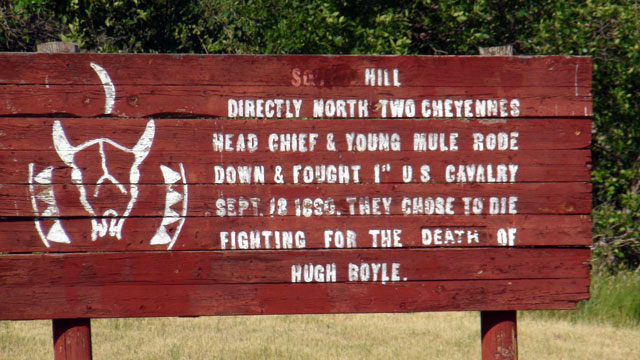 | |||
| Plaque commemorating the event of September 13, 1890 in Lame Deer. | |||
| June 1895 | Harper's New Monthly Magazine published an account of the Battle of Beecher's Island in 1868, written by George A. Forsyth, the commanding officer at the time: Years after the battle, Forsyth met a young Brule chief who had taken part in the battle. He learned from him that the Oglala, Cheyenne and Arapaho had suffered 75 dead warriors. The Brule chief mentioned that many more warriors had been wounded. And of these wounded warriors, many more had died from their wounds. | Oglala (Lakota) Cheyenne Arapaho | - |
| 19 March 1900 | The Tongue River Indian Reservation in southeastern Montana was renamed the Northern Cheyenne Indian Reservation and expanded. The reservation now encompassed 444,157 acres (1,797 km²). | Northern Cheyenne (Cheyenne) | - |
| 1904 | Little Wolf died on the Northern Cheyenne Indian Reservation in Montana. George Bird Grinnell, the author of the book 'Fighting Cheyenne', called him 'The greatest Indian I have ever known'. After Little Wolf shot Think Elk in the winter of 1904, he lived a secluded life alone with his wives. He only moved around on foot and no longer smoked a pipe. He visited his Arapaho relatives in the Wind River Reservation southwest of the Bighorn Mountains on foot over 200 miles. Like Dull Knife, Little Wolf was buried on a hill overlooking the valley of Rosebud Creek. | Northern Cheyenne (Cheyenne) | Little Wolf |
| 1904 | Little Wolf, chief of the Northern Cheyenne, died on the Northern Cheyenne Reservation in Montana. | Northern Cheyenne (Cheyenne) | Little Wolf |
| 1917 | Two Moons, Chief of the Cheyenne, died in his home at the age of 70. | Northern Cheyenne (Cheyenne) | Two Moons |